

The fastest way to convert clicks to streams is to cut the funnel to two taps, ad to link to play, and stop optimizing for Clicks. Optimize for Conversions instead, and route every ad through a tracked entry point that fires pixels or Conversions API events so you can reconcile Spotify Ads Manager data with Spotify for Artists. Campaigns built this way focus on conversion because raw click volume tells you almost nothing about who actually pressed play.
TL;DR:
- Focusing on conversion campaigns with tracked entry points and server-side events yields higher-quality streams than simple click-based ads.
- Using a single-destination link or a smart link above the fold reduces drop-off from landing page choices and improves conversion rates.
- Conversion metrics such as click-outs and page views do not match Spotify streams because tracking limitations mean they measure different actions across platforms.
- Optimizing creative hooks early in the video and retargeting highly engaged audiences significantly increases the likelihood of streaming playback.
- Proper tracking setup, fast-loading landing pages, and high-quality masterings are essential to accurately measure and improve conversion performance.
Table of Contents
- What Two-Tap Funnels Do to Convert Clicks to Streams
- Why Clicks, Conversions, and Streams Aren’t the Same Number
- Setting Up Campaigns That Turn Intent Into Plays
- Creative Choices That Produce Higher-Quality Clicks
- Diagnosing Where Your Funnel Leaks Listeners
- Practitioner Notes From 35+ Years in the Studio
- The Gap Between What Ad Platforms Promise and What Streaming Rewards
- Managed Setup: What Twisby Records Handles End to End
- Primary Sources and Tools to Consult
- Sources
- FAQ
What Two-Tap Funnels Do to Convert Clicks to Streams
Every extra tap between the ad and the play button costs you listeners. The goal is simple: someone taps the ad, lands somewhere, and taps play. That’s it. Two taps, no detours.
Most artists lose people at the second tap because their landing page makes fans choose from six platform icons before they can hear anything. That decision paralysis kills momentum. A single-destination smart link or a direct Spotify link removes the choice entirely and sends the listener straight where you want them.
A few fixes you can make before your next campaign launches:
- Replace any multi-link landing page with one smart link or a direct DSP link.
- Put the play button above the fold. No scrolling required.
- Never run link-in-bio hubs as your paid campaign destination. They’re built for browsing, not converting.
- Match the link type to your audience: use smart links when your audience streams across multiple services, and direct Spotify links when your ad targets Spotify listeners specifically.
Give yourself 24 to 48 hours to audit your current destination page, strip it down to one clear action, and confirm it loads fast on mobile before you spend another dollar on ads.
Why Clicks, Conversions, and Streams Aren’t the Same Number
A click means someone tapped your ad. A conversion means they completed an action your pixel tracked, usually a click-out to a music link. A stream means Spotify counted at least 30 seconds of playback inside its own 14-day conversion window. These three numbers live on different platforms, measured by different rules, and they will never match perfectly.
That gap exists because you cannot fire a Meta or TikTok pixel on Spotify’s app or website. Ad platforms can only track what happens on pages you control, so you need a tracked entry point that fires pixel and Conversions API events before the listener ever reaches Spotify.
Here’s what to compare side by side:
- Conversion events in Ads Manager (click-outs, page views, button taps)
- Listeners by source in Spotify for Artists
- Saves, follows, and streams-per-listener as engagement signals
Pro Tip: Treat conversions as intent signals, not proof of playback. Spotify behavior is the outcome; your ad platform only tells you who showed up at the door.
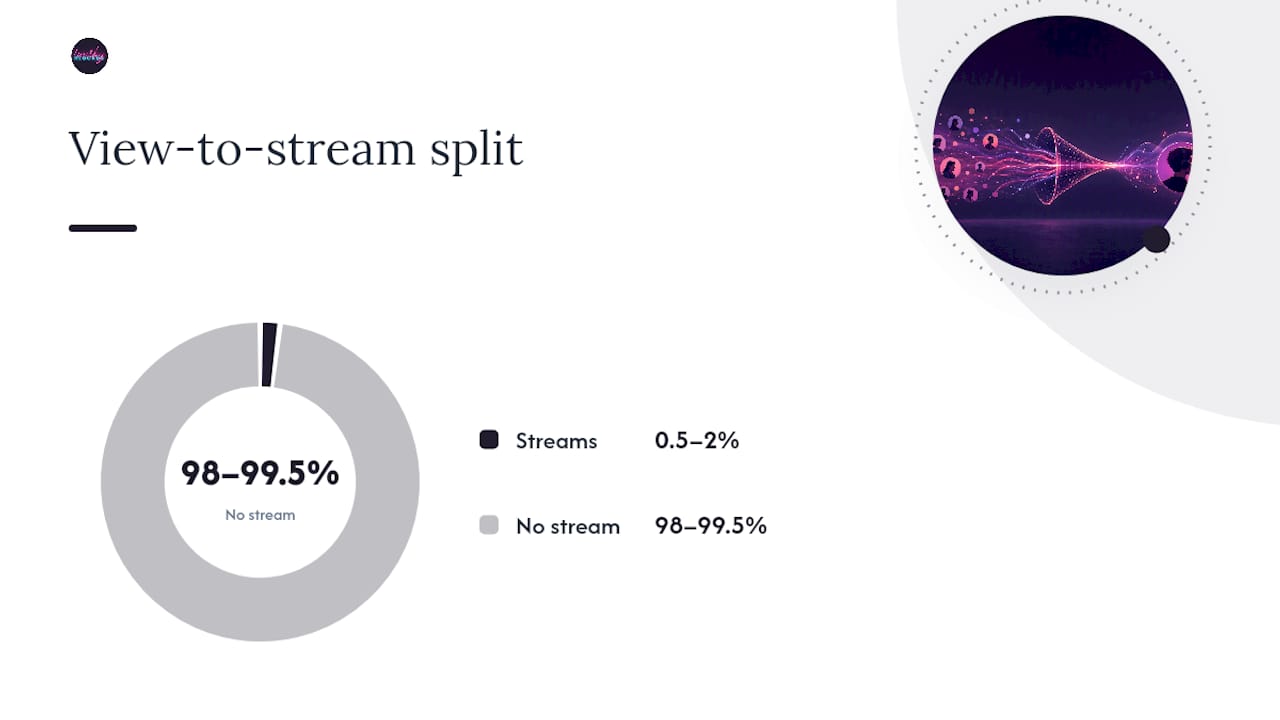
Industry estimates put organic view-to-stream conversion from platforms like TikTok at roughly 0.5% to 2%, depending on how clear the call to action is. That range should set your expectations before you panic over a “low” conversion rate that’s actually normal.
Setting Up Campaigns That Turn Intent Into Plays
Objective selection determines everything downstream. Link Clicks and Video Views optimize for cheap volume; Conversions optimizes for people likely to complete the action you define, which is why conversion-optimized campaigns tend to produce fewer clicks but more meaningful outcomes that actually reach a stream.
Here’s the setup sequence we walk artists through:
- Choose Conversions as your objective, not Link Clicks or Video Views, once you have enough baseline data to define a conversion event.
- Build a tracked entry point. This is a landing page or smart link you control that fires the Meta or TikTok pixel on load and on click.
- Configure Conversions API (CAPI) alongside the pixel. Server-side events fill the gaps that iOS privacy restrictions create for browser-based tracking, and pairing pixel with CAPI improves event reliability significantly.
- Define music-specific conversion events, like a play-button tap or scroll-to-link click, rather than a shallow page-view event that fires the instant someone lands.
- Test before you spend real budget. Confirm the pixel fires in Meta’s Events Manager, validate CAPI server events are landing, and cross-check those counts against your link analytics dashboard.
Pro Tip: Run a $20 test campaign first. If your pixel and CAPI numbers don’t roughly match your link click count, fix the tracking before you scale spend, not after.
Our Spotify conversion ads checklist walks through each of these steps with screenshots if you want a visual reference while you build.
Creative Choices That Produce Higher-Quality Clicks
Not every click is worth the same. A click from someone who watched three seconds of a blurry ad converts differently than one from someone who watched a hook that made them lean in. Creative quality changes who clicks, and that changes your entire stream conversion rate downstream.
- Front-load your call to action in the first 3 to 5 seconds of any short-form video. Say “new song out now” before you say anything else.
- Test creative variations by audience segment on a steady cadence, weekly if budget allows, rather than launching once and hoping.
- Retarget warm audiences: people who watched 75% or more of your video or engaged with your page convert at a noticeably higher rate than cold traffic.
- Make sure the snippet in your ad matches the actual song. If your ad teases the chorus but the link drops fans into the intro, you’ll lose them at the exact moment they were ready to stream.
Our Instagram ads guide for independent artists covers format specifics if you’re building creative for that platform specifically.
Diagnosing Where Your Funnel Leaks Listeners
High clicks with low streams almost always point to one of three failures: a broken or slow landing page, a mismatch between what the ad promised and what the link delivers, or a tracking setup that’s misreporting conversions entirely.
| Symptom | Likely Cause | First Experiment |
|---|---|---|
| High clicks, low landing page opens | Slow load time or broken link | Test page speed, swap in a direct DSP link |
| High landing page opens, low plays | Too many choices on the page | Strip to single-destination link |
| High plays, low repeat streams | Creative promise doesn’t match song | Re-align ad snippet with actual track |
| Conversions look strong, streams look flat | Tracking mismatch | Cross-check UTM/link analytics against Spotify for Artists |
Run A/B tests one variable at a time: direct link versus smart link, CTA placement, or a full creative swap. If the mismatch persists after two rounds of testing, bring in a dedicated attribution tool or a managed provider rather than guessing further.
Practitioner Notes From 35+ Years in the Studio
With over thirty years in audio production and Apple Digital Masters certification, the mastering process meets Apple Music’s technical bar for quality, and that same rigor is applied to advertising campaigns.
Our internal checklist before any campaign goes live:
- Audio quality check. Master to around −14 LUFS integrated for streaming platforms before you spend a dollar promoting the track.
- Two-tap landing page rule. No exceptions, no extra menus.
- Pixel and CAPI verification. Confirmed working before spend, not after.
- Creative requirements. Vertical video, spoken hook in the first five seconds.
- Reporting cadence. Weekly comparison of Ads Manager conversions against Spotify for Artists listener data.
The Gap Between What Ad Platforms Promise and What Streaming Rewards
Most advice on this topic treats clicks as the finish line. That’s backwards. A click is the cheapest, least meaningful action a listener can take, and optimizing an entire campaign around minimizing cost-per-click almost guarantees you’ll attract people who tap and bounce.
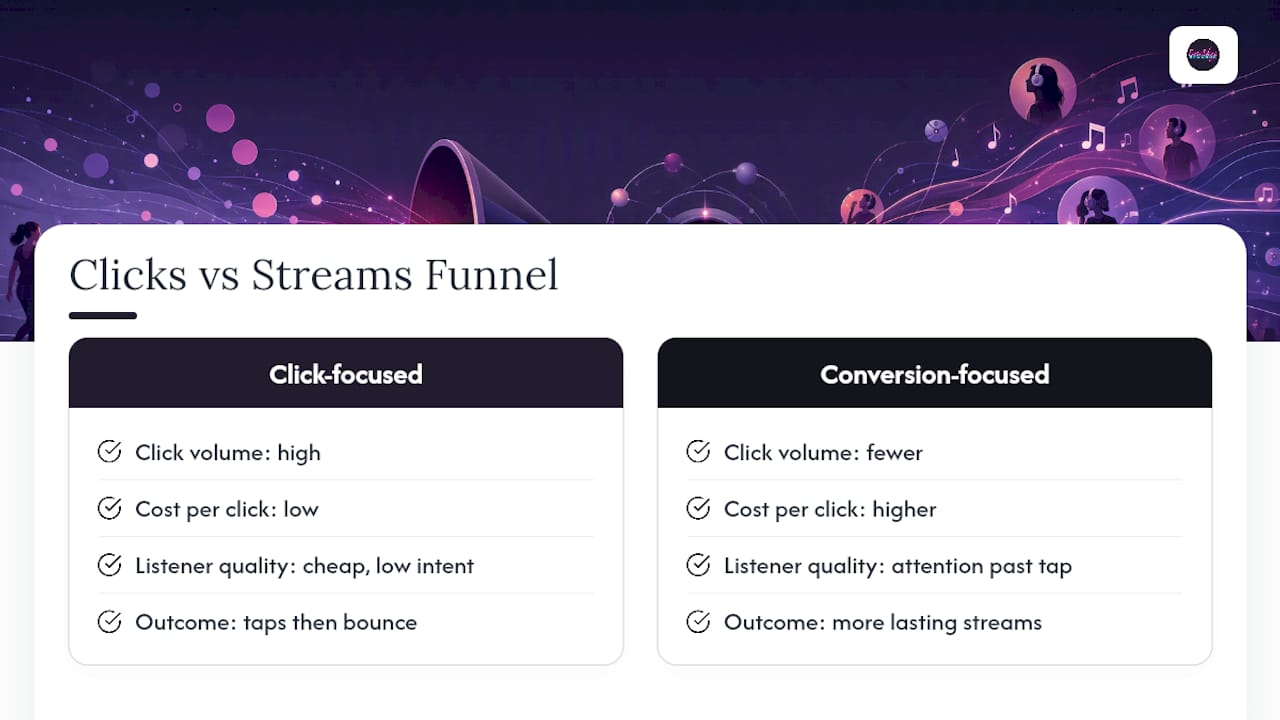
What the evidence actually supports is a shift in what you measure success by. Conversion-optimized campaigns produce fewer clicks and cost more per click, and that’s the point. You’re paying for attention that survives past the tap, not attention that evaporates the second the ad stops showing.
The overlooked piece, though, is audio quality. Marketers obsess over pixel setups and creative hooks, and rightly so, but a track mastered too quietly or with muddy low end loses listeners in the first fifteen seconds regardless of how good your funnel is. Technical ad setup gets someone to press play. What happens in the next thirty seconds decides whether Spotify ever counts it as a stream. Treat both halves of that equation as equally important, because the industry rarely does.
— Kreg
Managed Setup: What Twisby Records Handles End to End
If you’d rather have someone else configure the pixel, build the landing page, and master the track to platform standards, that’s the entire premise of Twisby Records’ advertising service. We handle conversion-optimized ad setup, pixel and CAPI configuration, smart link or landing page builds, and mixing and mastering that meets streaming loudness standards, all under one engagement instead of piecing together three vendors.
A first engagement typically starts with an audience and audio review: we check whether your track is mastered for streaming, then build the tracked entry point and campaign structure around it. Early deliverables include a working smart link or landing page, a verified pixel and CAPI setup, and an initial creative test round. If your track needs work before it’s ready to promote, our mixing and mastering service handles that first. Ready to see what a conversion-focused campaign looks like for your release? Check our services and get a custom quote started.
Primary Sources and Tools to Consult
Spotify’s own Streams Objective Onboarding Guide explains delivery goals and reporting directly from the platform. For attribution mechanics, the Meta ads to Spotify streams attribution guide breaks down tracked entry points in detail. For release-day funnel planning, THE GURLZ’s distribution guide covers timing your funnel around a release. Instrument your links with UTM parameters or a dedicated link tracker before spending any ad budget.
Sources
- Streams Delivery Goal Reporting – Help Center – Spotify
- Music advertising has a streaming attribution problem – Music Ally
- Why TikTok Views Do Not Turn Into Spotify Listeners | Soundlink
FAQ
How Much Is 10,000 Streams Worth?
Payout varies by market and listener location, but streams typically generate a small amount, often just a few dollars to a few tens of dollars, since Spotify’s per-stream rate is fractions of a cent. Streams matter more for algorithmic placement and audience growth than for direct royalty income at that volume.
How Do I Turn Clicks Into Conversions?
Optimize your campaign for the Conversions objective, build a tracked entry point that fires pixel and CAPI events, and strip your landing page down to a single play action. Fewer choices and clearer intent tracking are what actually move the needle, not more clicks.
Can Spotify Detect Fake Streams?
Yes, Spotify has systems designed to detect and filter artificial streaming activity, and flagged tracks can be removed from playlists or have royalties withheld. Focus on real conversion-optimized advertising instead of shortcuts that risk your catalog.
How Many Spotify Streams Does It Take to Make $1,000,000?
Because per-stream payouts are fractions of a cent and vary by market, reaching that figure typically requires hundreds of millions of streams. The exact number shifts based on listener location and your distributor’s royalty split, so there’s no single fixed figure.
What Counts as a Stream in Spotify Ads Manager?
Spotify counts a stream in its Ads Manager reporting once a listener plays at least 30 seconds of the promoted content, tracked within a 14-day conversion window.