

The best mixing engineers working today are Serban Ghenea, Derek “MixedByAli” Ali, Tony Maserati, Dave Pensado, Chris Lord-Alge, Manny Marroquin, Phil Tan, Bob Clearmountain, Jaycen Joshua, Andrew Scheps, Spike Stent, Mike Dean, and Leslie Brathwaite. Each earned this list on track record, sonic signature, and the kind of marquee credits that define eras of recorded music.
Here’s the short version of why each one belongs:
- Serban Ghenea — the go-to finisher for pop’s biggest moments, with credits spanning Taylor Swift, The Weeknd, and Cardi B
- Derek “MixedByAli” Ali — Kendrick Lamar’s longtime mixer and the defining voice of West Coast hip-hop sonics
- Tony Maserati — known for warmth and groove; credits include Beyoncé, Jay-Z, and Alicia Keys
- Dave Pensado — a pop and R&B veteran whose educational platform Pensado’s Place made him a household name in pro audio
- Chris Lord-Alge — five-time Grammy winner whose punchy, compressed rock sound shaped Green Day, Muse, and U2
- Manny Marroquin — Rihanna, Kanye West, John Legend; a master of spatial depth and emotional clarity
- Phil Tan — Mariah Carey, Usher, Nicki Minaj; precision pop and R&B with a clean, radio-ready finish
- Bob Clearmountain — the architect of the 1980s rock mix; Bruce Springsteen and Bryan Adams owe him enormously
- Jaycen Joshua — Beyoncé, Drake, Bruno Mars; one of the most in-demand mixers in modern pop
- Andrew Scheps — Adele, Red Hot Chili Peppers, Metallica; a rare engineer equally at home in rock and pop
- Spike Stent — Madonna, Björk, Massive Attack; the British mixer who defined the sound of alternative and electronic pop
- Mike Dean — Kanye West’s right hand and a producer-mixer hybrid who blurs the line between mixing and composition
- Leslie Brathwaite — Pharrell, Ariana Grande, Childish Gambino; Full Sail Hall of Fame inductee and one of the most decorated mixers of the streaming era
According to ZipRecruiter salary data, mixing engineers in the U.S. have annual earnings that range from approximately $76,000 at the 25th percentile to $118,500 at the 75th percentile, depending on experience and role. Top-tier names on this list command rates well above that ceiling on a per-project basis.
Table of Contents
- Who are the best mixing engineers and what makes them elite?
- How this list was compiled
- How to choose and hire the right mixing engineer
- Market demand and practical options for independent artists
- Key Takeaways
- What most people get wrong about hiring a mixing engineer
- Twisbyrecords offers professional mixing for independent artists
- Useful sources and further listening
- FAQ
Who are the best mixing engineers and what makes them elite?
These profiles are built on credits, sonic identity, and continued relevance. Industry roundups consistently use the same signals: hit volume, genre range, and technical innovation. Here’s what you need to know about each one.
Serban Ghenea
Ghenea is arguably the most commercially successful mixer alive. His credits read like a Billboard Hot 100 archive: Taylor Swift’s 1989 and Reputation, The Weeknd’s After Hours, Cardi B, Dua Lipa, Katy Perry, and dozens more. His signature is a hyper-polished, three-dimensional stereo image that translates perfectly on earbuds and arena speakers alike. He works almost entirely in-the-box (ITB) and is known for a meticulous gain-staging approach that gives his mixes their characteristic loudness without harshness.
Derek “MixedByAli” Ali
Ali built his reputation inside Top Dawg Entertainment, mixing every major Kendrick Lamar project including To Pimp a Butterfly and DAMN. His mixes carry a raw, organic low end and a vocal presence that feels intimate even at high volumes. He’s expanded beyond TDE in recent years, working with SZA, ScHoolboy Q, and other artists who want that same West Coast clarity. His willingness to discuss his process publicly has made him one of the most studied engineers in hip-hop.
Tony Maserati
Maserati’s strength is warmth. His work with Beyoncé (Lemonade), Jay-Z, Alicia Keys, and Mary J. Blige has a soulful, analog-adjacent quality even when the sessions are digital. He’s a heavy user of outboard gear and approaches mixing as a musical act rather than a technical one. His credits span four decades, and his consistency across genres from R&B to gospel to pop is what keeps him on every serious list.
Dave Pensado
Pensado’s career spans work with Christina Aguilera, Destiny’s Child, Mariah Carey, and Kelly Clarkson. His technical fluency in Pro Tools and his deep knowledge of dynamics processing made him a sought-after pop and R&B mixer for two decades. He’s equally influential as an educator: Pensado’s Place, his long-running video series, has trained a generation of engineers. That combination of practice and pedagogy is rare at his level.
Chris Lord-Alge
CLA is the definitive rock mixer. His five Grammy wins and a discography that includes Green Day’s American Idiot, Muse, My Chemical Romance, Bruce Springsteen, and U2 speak for themselves. His signature style is bold compression, punchy low mids, and a clarity that cuts through distorted guitars without losing weight. He started as an assistant at H&L Studios in New Jersey and worked his way through Sugarhill Records before his big break in the 1980s. Waves Audio modeled a plugin suite after his console settings, which tells you everything about his influence.
Manny Marroquin
Marroquin is the spatial engineer. His work with Rihanna, Kanye West, John Legend, Alicia Keys, and Maroon 5 is defined by a sense of three-dimensional depth that makes even dense productions feel open. He’s a heavy user of reverb and delay as tonal tools rather than effects, and his low-end management on hip-hop and R&B records is consistently praised. Multiple Grammy wins back the reputation.
Phil Tan
Tan is the precision specialist. His credits include Mariah Carey, Usher, Nicki Minaj, and Rihanna, and his mixes are known for a clean, uncluttered high end and a vocal chain that sits perfectly in the mix without fighting the production. He’s one of the most technically consistent engineers on this list, which is why pop and R&B labels return to him repeatedly.
Bob Clearmountain
Clearmountain defined the sound of mainstream rock in the 1980s. His work with Bruce Springsteen (Born in the USA), Bryan Adams (Reckless), The Rolling Stones, and David Bowie established the template for large-format rock mixing. He was among the first engineers to embrace digital tools while preserving the warmth of analog signal chains. His influence on how engineers think about room sound and reverb depth is still felt in every rock mix made today.
Jaycen Joshua
Joshua is one of the busiest mixers in modern pop. His credits include Beyoncé, Drake, Bruno Mars, Justin Timberlake, and Kendrick Lamar. He’s known for a clean, punchy aesthetic that works across streaming platforms and is particularly strong on vocal layering. His speed and consistency have made him a first call for major-label projects with tight deadlines.
Andrew Scheps
Scheps is the genre-agnostic engineer. His work spans Adele’s 21, Red Hot Chili Peppers, Metallica, Jay-Z, and Lana Del Rey. He’s one of the few mixers who can move between stadium rock and intimate pop without losing identity. He was an early adopter of fully ITB mixing and has been vocal about the creative freedom that comes with removing hardware constraints. His mixing credits are among the most diverse on this list.
Spike Stent
Stent built his reputation in the UK working with Madonna, Björk, Massive Attack, Oasis, and U2. His mixes have a cinematic width and an emotional texture that suits alternative, electronic, and art-pop particularly well. He’s worked extensively in both London and Los Angeles, and his ability to serve artists with unconventional sonic goals sets him apart from more formula-driven engineers.
Mike Dean
Dean occupies a unique position: he’s a producer, mixer, and sonic architect rolled into one. His decades-long collaboration with Kanye West (My Beautiful Dark Twisted Fantasy, Yeezus, The Life of Pablo) produced some of the most sonically adventurous records of the 2000s and 2010s. He also has deep roots in Houston rap, having worked with UGK, Scarface, and Travis Scott. His mixes are dense, layered, and intentionally abrasive in ways that most engineers would avoid.
Leslie Brathwaite
Brathwaite is one of the most decorated mixers of the streaming era. His credits include Pharrell’s Happy, Ariana Grande, Childish Gambino’s “This Is America,” and Outkast. He’s a Full Sail Hall of Fame inductee and a multiple Grammy winner. His mixes are known for a bright, forward vocal presence and a low end that translates cleanly across consumer playback systems, which is exactly what streaming-era production demands.
How this list was compiled
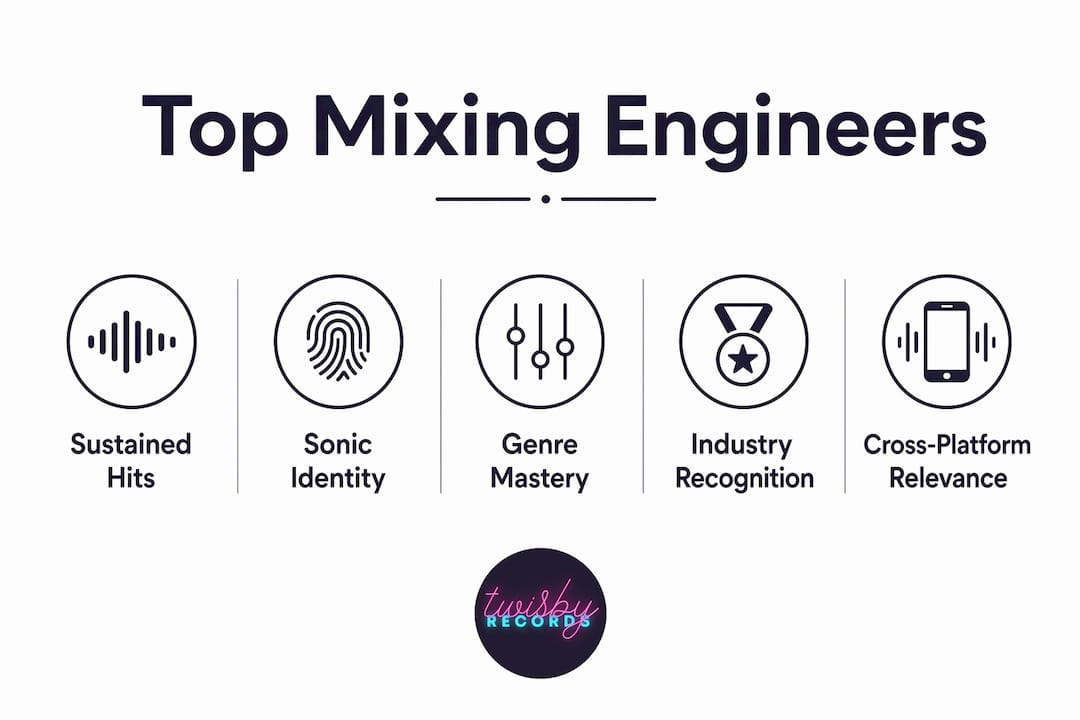
Placement on this list required meeting at least three of five criteria: sustained hit volume over multiple years, cross-genre mastery, technical or sonic innovation, recent high-profile credits (post-2020), and peer recognition through Grammy wins or industry awards.
Sources used include professional bios, verified discographies, editorial roundups, and mixing hall-of-fame compilations. Compensation data comes from ZipRecruiter’s U.S. aggregate. No engineer was included based on a single hit or a single genre.
Compensation snapshot
| Percentile | Annual salary (U.S.) |
|---|---|
| 25th percentile | $76,000 |
| 75th percentile | $118,500 |
Source: ZipRecruiter, Mixing Engineer Salary. These figures reflect salaried and contract roles across experience levels. Top-tier engineers on this list typically work per-project at rates that exceed the 75th percentile on a single album.
Typical project timelines for top engineers range from three to seven business days per song for remote mixing, with major-label projects sometimes running two to four weeks for full album delivery, depending on revision rounds and stem complexity.
“Top mixers operate as sonic architects — their value is artistic judgment combined with technical mastery of both vintage and modern tools.” — Unison Audio editorial roundup
One honest limitation: “best” is always relative to project goals. Bob Clearmountain is the right call for a classic rock record. MixedByAli is the right call for a West Coast rap project. The engineers on this list are the best at what they do, not interchangeable. Use the profiles above to match sonic identity to your project, not just name recognition.
How to choose and hire the right mixing engineer
Hiring a top mixer without a clear process wastes time and money. Here’s a practical framework.
Step-by-step hiring checklist
- Define your sonic goals. Write down three reference tracks that represent the sound you want. Be specific: “the low end on Drake’s Certified Lover Boy” is more useful than “modern hip-hop.”
- Check credits and recent work. Look for mixes in your genre from the last three years. A mixer who was great in 2015 but hasn’t touched your genre since may not be the right fit.
- Request a stem format spec. Before you send anything, confirm the engineer’s preferred sample rate, bit depth, and file naming convention. Mismatched specs cost revision time.
- Clarify the revision policy. Top engineers typically include two rounds of revisions. Know this before you sign anything. Follow the stem prep checklist to minimize revision needs upfront.
- Ask about delivery specs. Confirm you’ll receive a stereo mix, an instrumental, an a cappella, and any stems you need for sync licensing or remixes.
- Understand rights and credits. The engineer owns no copyright in the mix, but they do expect a mixing credit on the release. Confirm this in writing.
- Discuss turnaround time. Top-tier engineers are often booked four to eight weeks out. If you need a fast turnaround, ask explicitly and expect a premium.
Hiring options compared
| Option | Typical price tier | Best for | Turnaround | Deliverables |
|---|---|---|---|---|
| In-studio top-tier | above typical range per project | Major-label, high-budget projects | 1–4 weeks | Stereo mix, stems, revisions |
| Remote top-tier | — | Serious indie, label-ready releases | 3–7 business days | Stereo mix, instrumental, revisions |
| Boutique/indie mixer | — | Independent releases, demos | 2–5 business days | Stereo mix, 1–2 revisions |
| DIY + professional mastering | — | Budget projects, learning | 1–3 business days | Mastered stereo file |
For a detailed breakdown of what drives these price differences, the mixing and mastering pricing guide at Twisbyrecords covers the variables clearly.
Red flags to watch for
- No written revision policy before payment
- Requests for full master rights or production credits on a mixing-only engagement
- No portfolio or verifiable credits
- Vague delivery specs (“I’ll send you the mix when it’s done”)
- Pressure to skip a trial mix or reference-track conversation
Questions to ask on first contact
- “Can I hear three recent mixes in my genre?”
- “What’s your revision policy and turnaround time?”
- “What file format and sample rate do you prefer for stems?”
- “Do you work with reference tracks, and how do you use them?”
Market demand and practical options for independent artists
Demand for mixing engineers remains steady across music, film, and advertising. Employers consistently seek professionals with DAW fluency and flexible remote workflows, which means the market rewards engineers who can deliver broadcast-quality results without requiring a physical studio session.
The practical reality for independent artists is that the engineers on this list are largely inaccessible. Serban Ghenea and Jaycen Joshua work with major labels. MixedByAli’s calendar is controlled by TDE. That’s not a reason to settle for a bad mix. It’s a reason to understand the tiers and find the right fit for your budget and timeline.
Hybrid workflows close the gap
The most effective route for most indie artists is a hybrid approach: clean, well-organized stems prepared by the artist, sent to an experienced remote engineer. This model delivers professional results at a fraction of the cost of a top-tier in-studio session. The key variable is stem quality. Poorly organized, clipping, or phase-conflicted stems will limit even a great engineer.
Twisbyrecords publishes a practical home studio mixing guide that walks through the prep process in detail. Getting stems right before you send them is the single highest-leverage thing you can do to improve your final mix.
For rap and hip-hop artists specifically, remote mixing workflows built around clean vocal chains and well-separated beat stems have become the standard. The online mixing and mastering options for rappers at IndepthJayBeats covers this workflow in depth and is worth reading before you send your first session.
Hardware and software tradeoffs
Modern top-tier mixing is frequently done entirely in-the-box. Pro Tools, Logic Pro, and Ableton Live are the dominant DAWs. Selective analog coloration through outboard preamps or summing mixers adds character, but it’s not a requirement for a professional result. For home engineers, the priority should be accurate monitoring (studio headphones or near-field monitors in a treated space) before investing in hardware.
Pro Tip: Before sending stems to any engineer, export a rough mix and compare it on three different playback systems: studio monitors, earbuds, and a phone speaker. If the low end disappears on earbuds, your stems need work before a pro can fix the mix.
If you want to improve your home recordings before sending them out, the guide to making home recordings sound professional at InDepthJayBeats is a practical starting point.
Key Takeaways
The best mixing engineers earn their reputation through sustained hit volume, cross-genre mastery, and a sonic identity that artists and labels return to repeatedly.
| Point | Details |
|---|---|
| Top engineers are genre-specific | Match the engineer’s sonic identity to your project; CLA for rock, MixedByAli for hip-hop, Ghenea for pop. |
| Compensation varies widely | U.S. mixing engineers earn between $76,000 and $118,500 annually; top-tier per-project rates exceed the upper band. |
| Stem prep determines mix quality | Clean, well-organized stems are the single biggest factor in getting a great result from any remote engineer. |
| Hybrid remote workflows work | Most indie artists get professional results through remote mixing, not in-studio sessions with name engineers. |
| Twisbyrecords serves independent artists | With over 35 years of experience and Apple Digital Masters certification, Twisbyrecords offers professional mixing and fast turnaround for DIY and independent musicians. |
What most people get wrong about hiring a mixing engineer
The conventional wisdom says: hire the most famous engineer you can afford. That framing misses the actual decision. Prestige and fit are different things, and confusing them is expensive.
The engineers on this list are elite because they’ve developed a repeatable, identifiable sound. That’s exactly what makes them wrong for some projects. If your record is a lo-fi bedroom pop album, Serban Ghenea’s hyper-polished aesthetic will work against you. If you’re making a raw punk record, Phil Tan’s precision pop approach will sand off the edges you need. The best mixer for your project is the one whose existing body of work sounds like what you’re trying to make, not the one with the most Grammys.
There’s a second mistake that costs indie artists more money than anything else: sending bad stems and expecting the engineer to fix them. Mixing is not repair work. A great engineer can shape, balance, and enhance a well-recorded session. They cannot fix a vocal that was recorded in a bathroom with no acoustic treatment, or a kick drum that’s clipping at the source. The prep work is your job. The mix is theirs.
The market for remote mixing has matured to the point where independent artists can access genuinely professional results without a major-label budget. The gap between a top boutique remote engineer and a name engineer is smaller than it’s ever been, especially for streaming-first releases where the playback environment is earbuds and phone speakers rather than a mastered vinyl pressing. Know what you’re optimizing for, and hire accordingly.
Twisbyrecords offers professional mixing for independent artists
Independent artists who need a polished, streaming-ready mix without the wait time and cost of a name engineer have a direct option. Twisbyrecords brings over 35 years of experience and Apple Digital Masters certification to every project, with a process built specifically for DIY and independent musicians.

The workflow is straightforward. You send your stems, reference tracks, and a note on your desired sound. Twisbyrecords handles the mix with a collaborative revision process focused on your goals, not a formula. Turnaround is fast, and the deliverables include everything you need for a professional release: stereo mix, instrumental, and mastered files ready for streaming platforms.
Packages are available per-track or as part of a broader mixing and mastering bundle. To see current options and get a quote, visit the Twisbyrecords services page. If you’re also planning a release campaign, the advertising services cover audience targeting, streaming growth, and platform promotion alongside your mix.
Useful sources and further listening
Research sources cited:
- ZipRecruiter: Mixing Engineer Salary (U.S.)
- ZipRecruiter: Are Mixing Engineers in Demand?
- Unison Audio: The 17 Best Mixing Engineers in the Music Industry
- MixChecks: World’s Best Mixing Engineers
- Chris Lord-Alge official site
- Full Sail Hall of Fame: Leslie Brathwaite
- Twisbyrecords: How to Choose the Right Mixing Engineer
- Twisbyrecords: How to Prep Your Song for Mixing
- Twisbyrecords: Home Studio Mixing Guide 2026
Suggested listening by engineer:
- Serban Ghenea: Taylor Swift’s 1989, The Weeknd’s After Hours
- MixedByAli: Kendrick Lamar’s DAMN., SZA’s SOS
- Tony Maserati: Beyoncé’s Lemonade, Alicia Keys’ The Diary of Alicia Keys
- Chris Lord-Alge: Green Day’s American Idiot, Muse’s Black Holes and Revelations
- Manny Marroquin: Rihanna’s Good Girl Gone Bad, John Legend’s Get Lifted
- Andrew Scheps: Adele’s 21, Red Hot Chili Peppers’ Stadium Arcadium
- Leslie Brathwaite: Childish Gambino’s “This Is America,” Pharrell’s G I R L
FAQ
Who are the top 5 mixing engineers right now?
Serban Ghenea, Derek “MixedByAli” Ali, Jaycen Joshua, Manny Marroquin, and Chris Lord-Alge are consistently cited as the top five active mixing engineers based on hit volume, recent credits, and industry recognition.
Who is the greatest mixing engineer of all time?
Bob Clearmountain is widely considered the most historically influential mixing engineer, having defined the sound of mainstream rock in the 1980s with credits including Bruce Springsteen and Bryan Adams. Serban Ghenea holds a comparable position in the modern pop era.
How much do top mixing engineers make?
Mixing engineer compensation in the U.S. ranges from $76,000 to $118,500 annually, according to ZipRecruiter. Top-tier engineers working per-project on major-label albums earn well above that range on individual projects.
Are mixing engineers in demand?
Yes. Demand remains steady across music, film, and advertising, with employers prioritizing DAW expertise and remote workflow flexibility. The growth of independent music distribution has expanded the market beyond major labels.
Can an independent artist access professional mixing without a major-label budget?
Yes. Remote mixing services like Twisbyrecords offer professional-grade results with Apple Digital Masters certification and fast turnaround, specifically built for independent and DIY musicians who need a polished mix without the cost or wait time of a name engineer.