

The right move for an independent musician preparing a release is to hire one partner for both post-production and promotion, as long as that partner treats mixing and mastering as two separate, clearly defined stages. Judge any option on three things: the quality of finished work, exactly what you get delivered, and the revision policy in writing. Before you reach out, prepare your stems and one or two reference tracks. That single step saves more time than anything else on this list.
TL;DR:
- Choosing a partner that clearly separates and documents mixing and mastering stages ensures better quality control and revision management.
- Human engineers charge between $150 and $800 per track, and a full professional release typically costs $1,275 to $4,500 when including promotion.
- Proper preparation of stems and reference tracks before submitting files can significantly reduce revision time and overall costs.
- Confirming equipment, software versions, and communication workflows upfront helps avoid technical issues and delays.
- Studios that provide transparent contracts with clear ownership rights and revision policies prevent future misunderstandings.
Table of Contents
- What Should You Look for When Choosing a Recording Studio in Pittsburgh?
- What Do Mixing and Mastering Cost, and Which Tier Fits Your Release?
- What Does the Workflow Look Like From Intake to Final Master?
- How Do You Prepare Your Tracks Before Contacting a Partner?
- What Do Experienced Mastering Engineers Wish Artists Knew?
- How Do Pittsburgh Studios Build Local Trust With Independent Artists?
- What Services Should Pittsburgh Studios Offer Independent Musicians?
- How Do You Judge a Pittsburgh Studio’s Equipment and Software?
- How Do You Judge a Studio’s Communication Style Before You Commit?
- What Should You Understand About Contracts and Rights?
- The Prep Work Matters More Than the Studio Name
- How Twisby Records Fits Into Your Release Plan
- Sources
- FAQ
What Should You Look for When Choosing a Recording Studio in Pittsburgh?
Independent musicians looking into how to choose a recording studio in Pittsburgh usually make one mistake early: they judge a partner on price or gear before checking whether the workflow itself is sound. Run through this checklist on your first call or in your intake form before you sign anything.
- Relevant genre experience. Ask for two or three recent credits in your genre, not just a general portfolio. A hip hop mix and a folk mix demand different ears.
- Certifications that mean something. Apple Digital Masters certification signals a workflow built around consistent, high resolution translation to streaming platforms, not just louder finished tracks.
- Exact deliverables in writing. You want stems, labeled tracks, and confirmed sample rate and bit depth specified before you pay, not after.
- Revision policy on paper. Two to three rounds is the standard benchmark; ask what counts as a round and what triggers a rush fee.
- A real communication workflow. Look for a shared project portal, timestamped notes, and a single consolidated feedback document instead of scattered email threads.
- Advertising capability. If you need release promotion too, ask whether the same team runs the Facebook and Instagram campaigns or hands you off to a stranger.
Pro Tip: Ask every potential partner one question directly: “What happens if I ask for a fourth revision?” Their answer tells you more about their workflow than any portfolio link ever will.
What Do Mixing and Mastering Cost, and Which Tier Fits Your Release?
Pricing for post-production work splits into four rough tiers, and picking the wrong one for your release stakes is the most common budgeting mistake independent artists make. Automated, AI-driven mastering platforms run about $5 to $25 per track. Budget online mixing services land around $30 to $150 per song. Independent professional engineers, the tier most working DIY artists actually use, charge roughly $150 to $800 per mix. A-list engineers with major label credits start at $1,000 and climb from there.
| Tier | Typical cost per track | Best for |
|---|---|---|
| Automated/AI mastering | $5 to $25 | Demos, tight budgets, quick reference checks |
| Budget online mixing | $30 to $150 | Early releases, low-stakes singles |
| Independent professional | $150 to $800 | Releases you plan to promote and pitch |
| A-list engineer | $1,000+ | High-stakes singles, label-adjacent projects |
Map these onto your whole release, not just one song. A basic release using automated mastering and budget distribution runs $25 to $100 total. A mid-range release with a human engineer and modest promotion lands around $375 to $1,275. A professional release with an experienced mixer, mastering, and a real ad budget commonly runs $1,275 to $4,500. Automated mastering is fine for a demo you’re sending to bandmates. Once you’re spending money on ads or pitching playlists, human mastering earns its fee because a real engineer applies judgment across an entire EP rather than a one-size algorithm. Before you sign a quote, confirm whether stems, extra revisions, and rush turnaround are included or billed separately.
What Does the Workflow Look Like From Intake to Final Master?
A clean workflow follows a predictable order, and knowing it in advance keeps you from losing days to back-and-forth emails.
- Intake. Submit labeled stems, one to three reference tracks, tempo and key notes, and any specific concerns about the mix.
- Technical prep. Files should be 24-bit WAV at a consistent sample rate, with stems named by instrument, not “Track 1,” “Track 2.”
- Mix pass and review. You’ll get a version to review against your references, timestamped so notes are specific instead of vague.
- Revisions. Two to three rounds is the norm here too. Consolidate every note into one message rather than sending five separate emails.
- Mastering and handoff. Final masters arrive ready for distribution, correctly formatted for whichever distributor you’re using.
Standard turnaround runs from a few days for a single to a couple of weeks for a full EP; rush fees typically apply for anything faster.
Pro Tip: Never send stems to mastering until your mix is fully signed off. Mastering can polish a good mix, but it can’t fix a vocal fighting the beat or an inconsistent low end.
How Do You Prepare Your Tracks Before Contacting a Partner?
Preparation is the cheapest way to cut your revision count and your total bill. A few minutes of file organization saves engineers hours of detective work, and that time savings usually shows up in your invoice.
- Export each stem as its own labeled, separated file (vocal lead, vocal harmony, kick, bass, guitar left, guitar right), never a single stereo bounce.
- Choose one to three reference tracks and note the exact timestamps you want matched, with loudness roughly aligned so the comparison is fair.
- Write revision notes as specific, actionable lines: “Vocal too buried at 1:24” beats “make it sound better.”
- Check metadata (song title, artist name, ISRC if you have one) and confirm every file opens cleanly before you send it.
Our own guide to prepping a song for mixing walks through stem labeling in more detail, and the home studio mixing guide covers what to fix yourself before you ever send a file out.
What Do Experienced Mastering Engineers Wish Artists Knew?
Apple Digital Masters certification exists because streaming platforms compress and normalize audio in ways that punish sloppy mastering, and after years of running tracks through that certification process, one pattern stands out above all others: artists who keep mixing and mastering separate almost always end up with a cleaner-sounding, more consistent final product than artists who rush both into one pass.
That separation matters because mastering is a translation check, not a repair job. It can’t rescue a mix where the vocal fights the beat. When mixing and mastering run as distinct stages, the mastering engineer can focus entirely on how the song holds up across earbuds, car speakers, and club systems, rather than trying to fix balance problems on the fly.
The other advantage of a combined post-production and advertising partner is alignment. When the same team handling your master also builds your ad campaign, the sonic choices and the promotional strategy point in the same direction instead of working against each other.
How Do Pittsburgh Studios Build Local Trust With Independent Artists?
Reputation in Pittsburgh’s music scene travels through word of mouth almost as much as it does through reviews. Independent musicians talk to each other, and a studio that delivers consistent, on-time work for one artist tends to get referred to the next artist in that same circle within weeks.
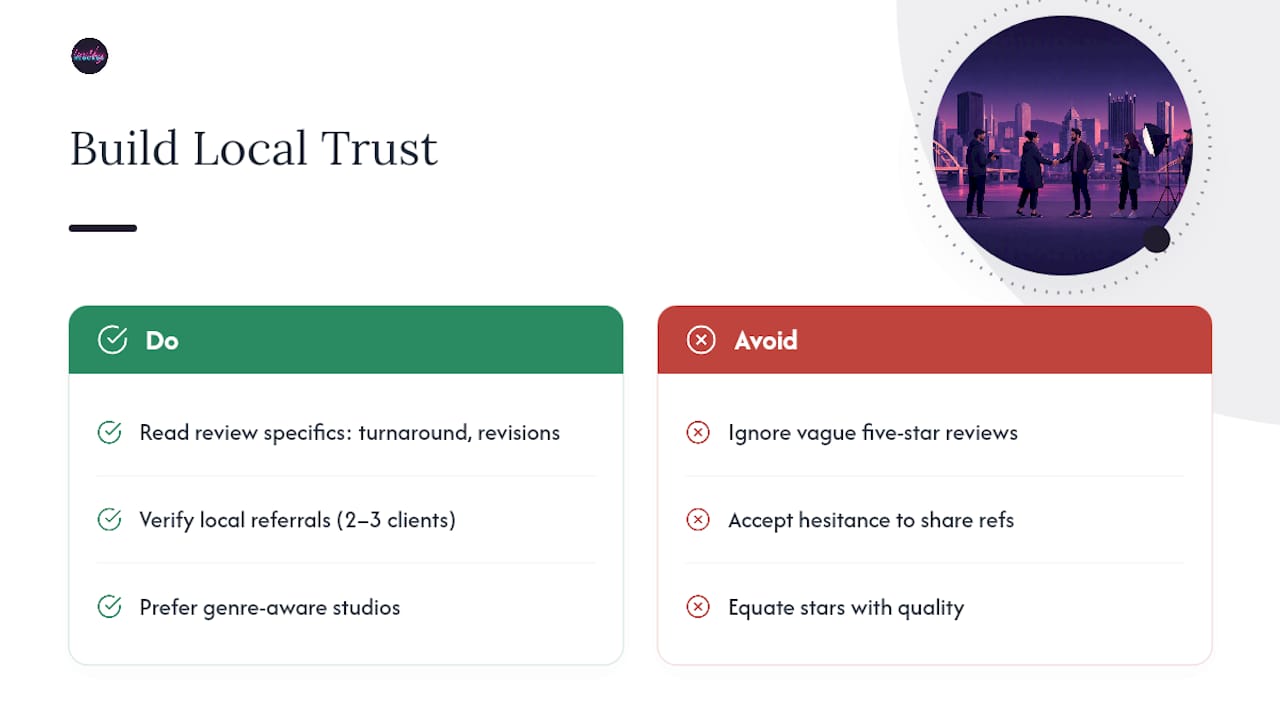
When you’re researching Pittsburgh recording studio reviews, look past star ratings and read for specifics: did the reviewer mention turnaround time, communication, or how many revisions it took to get the sound right? Vague five-star reviews with no detail tell you less than a three-star review that explains exactly what went wrong. Pittsburgh’s hip hop and R&B scene in particular has its own rhythm of releases and local events, and a partner who understands that scene’s pace and expectations, the kind of context you’ll see reflected in coverage of local hip hop and R&B events, often serves genre-specific artists better than a generalist.
Ask any potential partner directly for two or three recent local clients you can look up. A studio confident in its work will hand those names over without hesitation. One that hedges or deflects is telling you something too.
What Services Should Pittsburgh Studios Offer Independent Musicians?
Tracking time is only part of what a modern independent artist needs, and studios serving Pittsburgh’s DIY scene increasingly recognize that. The services that actually move a release forward go beyond a recording booth.
Remote vocal production has become standard for artists who record their own instrumentals or work with a producer elsewhere but still want professional-grade vocal comping, tuning, and editing. Look for a partner who handles this as a stand-alone service, not just an add-on tacked onto a full studio package.
Release advertising is the piece most local studios skip entirely, and it’s the piece that determines whether your finished master ever reaches an audience. Targeted Facebook and Instagram campaigns built specifically around a release, paired with audience research and a landing page instead of a generic link, function differently than boosting a post yourself. A studio or post-production partner that offers both the audio work and the promotional campaign under one roof removes the coordination problem of hiring two separate vendors who’ve never spoken to each other.
How Do You Judge a Pittsburgh Studio’s Equipment and Software?
Gear lists look impressive on a website, but the real test is whether the equipment matches the work you’re paying for. A studio bragging about a vintage analog console means little if your project is entirely remote, in-the-box mixing.
Ask what plugins and hardware the engineer actually reaches for during a typical mix, not just what’s sitting in the room. Industry-standard tools like iZotope’s mastering suite, Waves plugins, and well-maintained monitor speakers in a treated room matter far more than a wall of vintage gear that never touches your file. For a remote engagement, which is how most independent artists work with post-production partners today, ask specifically about their monitoring setup and room treatment, since that determines whether what they hear matches what you’ll hear on your own speakers.
Software currency matters too. A partner still running outdated plugin versions or unsupported converters can introduce compatibility problems with your files. If a studio can’t answer a direct question about their sample rate workflow or plugin versions, that’s a signal to keep asking.
How Do You Judge a Studio’s Communication Style Before You Commit?
Communication style predicts more about your experience than almost any other factor, and it’s the easiest thing to test before you spend a dollar. Send a detailed question in your first email and see how the response comes back.
A strong partner replies with specifics: turnaround estimates, a clear next step, direct answers to what you actually asked. A weak one replies with vague reassurance and no timeline. Pay attention to whether notes get consolidated into a single organized document or scattered across texts, emails, and voice memos, since that difference shows up again during your revision rounds.
Ask how revisions get delivered too. A partner using a shared project portal with timestamped comments moves faster than one relying on back-and-forth email chains, and that speed difference compounds when you’re trying to hit a release date.
What Should You Understand About Contracts and Rights?
Every mixing and mastering agreement, whether the studio is in Pittsburgh or anywhere else, should spell out who owns what once the work is done. You retain ownership of your master recording and composition unless a contract explicitly states otherwise. What you’re paying for is the engineer’s labor and expertise, not a transfer of your rights.
Confirm in writing what happens with your stems after the project closes. Some studios return every file; others retain project files on their own systems for a limited period. Ask about revision windows tied to the contract (how long after delivery you can request changes at no extra cost) and get the rush fee structure in writing before you need it. A vague verbal promise about “unlimited support” isn’t a substitute for a clear written policy, and studios that resist putting terms in writing are worth a second look before you commit.
The Prep Work Matters More Than the Studio Name
Most guides to picking a recording partner spend all their energy comparing studios and almost none on what the artist controls before that first phone call. That’s backward. The single biggest factor in how your release turns out isn’t which engineer you hire. It’s whether your mix was actually finished before it reached mastering, and whether you handed over stems and references clean enough to use.
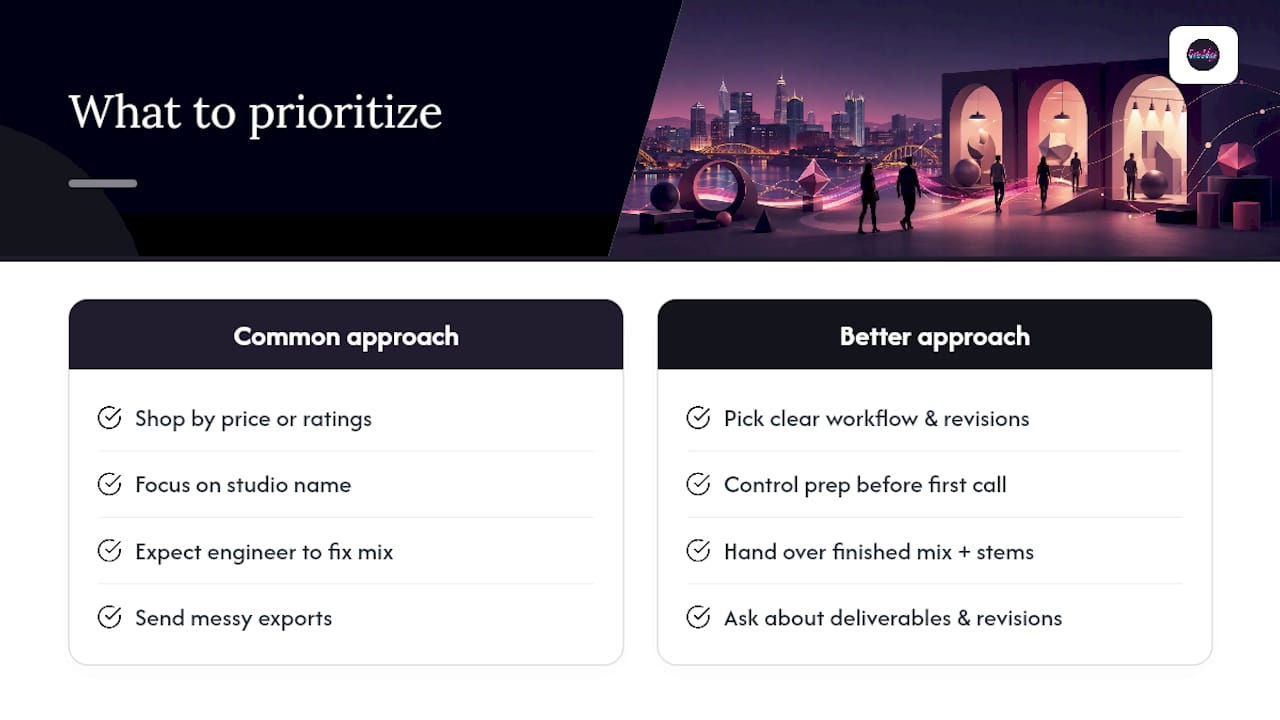
The conventional advice tells you to shop around for the best price per track. The better advice is to shop for the clearest workflow and revision policy, then spend your prep time making sure your files are already in shape. An engineer working from a well-labeled session with a matched reference track will consistently outperform the same engineer working from a messy export, regardless of price tier.
If you’re an independent artist trying to figure out how to choose a recording studio in Pittsburgh, spend less time reading star ratings and more time asking pointed questions about deliverables, revisions, and how mixing and mastering are actually separated. That’s the filter that keeps you from wasting a release budget on the wrong partner.
— Kreg
How Twisby Records Fits Into Your Release Plan
Twisby Records offers professional mixing and mastering as separate stages, along with release advertising services. Experienced engineers with recognized certification back the audio services, and the advertising side runs targeted Facebook and Instagram campaigns built around audience research and custom landing pages, not generic templates.

Getting started is straightforward. Reach out through the mixing and mastering services page with your stems and reference tracks ready, and you’ll hear back with a clear scope and revision policy before any money changes hands. If promotion is the piece you’re missing, the advertising services page lays out how a release campaign gets built around your specific song and audience. Start there, send your files, and get a real quote instead of guessing at a price tier on your own.
Sources
- Mixing and mastering services: what they cost in 2026 · Paradise Recording
- How to release music independently: a step-by-step guide | Tools 4 Music (2026)
FAQ
What Is the Difference Between Mixing and Mastering?
Mixing balances and shapes individual tracks within a song; mastering applies a final global polish that ensures the finished track translates consistently across streaming platforms and playback systems.
How Many Revisions Should Be Included in a Mixing or Mastering Quote?
Two to three revision rounds is the industry standard; be cautious of “unlimited revisions” offers, since they often signal a slower or lower-quality workflow.
How Much Should an Independent Artist Budget for a Release?
A basic release using automated mastering can cost $25 to $100 total, a mid-range release with human mastering and some promotion runs $375 to $1,275, and a professional release with an experienced engineer and a real ad budget typically lands between $1,275 and $4,500.
Can Mastering Fix a Bad Mix?
No. Mastering applies global polish and translation checks, but it can’t correct fundamental mix problems like a buried vocal or an inconsistent low end, so the mix needs to be finished and signed off first.
Does Twisby Records Handle Both Audio Production and Release Advertising?
Yes. Twisby Records offers mixing, mastering, remote vocal production, and targeted advertising campaigns for independent artists, keeping the audio work and the promotional strategy aligned under one team.