

Monthly listeners count the different people who played your music in the last 28 days. Followers count the people who chose to follow your artist profile and stay until they unfollow. Monthly listeners measure reach right now. Followers measure commitment over time. For an independent artist, the real work is turning the first into the second.
TL;DR
- Monthly listeners are a rolling 28-day count of unique people who played your music, including people a playlist or autoplay handed you. The number rises and falls fast.
- Followers are people who opted in. They get your new music through Release Radar and other personalized spots, so the count is steadier and more useful for your next release.
- Neither number pays you directly. Payouts follow streams, not either of these counts.
- Watch the ratio of followers to monthly listeners, plus saves and first-week streams, instead of chasing one big number.
- Convert listeners to followers by giving new listeners a reason to follow at every touchpoint: ads, landing pages, social posts and release-week messaging.
Table of Contents
- What a monthly listener actually is
- What a follower actually is
- Monthly listeners vs followers: side by side
- Why monthly listeners swing and followers hold
- What each number reveals about your audience
- Do monthly listeners or followers pay you?
- How to read the two numbers together
- How to turn monthly listeners into followers
- Our perspective
- Work with us on the sound and the campaign
- FAQ
- Sources
What a monthly listener actually is
Spotify’s own support page says monthly listeners are everyone who listened in the last 28 days, and that the group includes both active and programmed listeners. The listening can come from your artist profile, a listener’s library, playlists, radio and autoplay.
Three things follow from that definition.
- It is unique people, not plays. One person who plays your song 50 times is one monthly listener. A person who hears it once on a playlist is also one.
- It is a window, not a running total. On day 29, someone who listened on day 1 drops out unless they come back.
- It mixes intent. A fan who sought you out and a stranger whose autoplay queue landed on your track both count.
That last point is why monthly listeners are a flattering number and a noisy one. It tells you how many ears touched your music. It does not tell you how many of them cared.
Active vs. programmed listeners
Spotify splits the monthly total into segments. Programmed listeners heard you because the platform surfaced your music. Active listeners chose to stream you. Spotify says monthly active listeners are a subset of your monthly listeners, and that active streamers go on to play an artist’s music 4x more over the next six months.
So if your monthly listeners jumped from 800 to 8,000 but your active segment barely moved, most of that jump is borrowed attention.
What a follower actually is
A follower is someone who pressed Follow on your artist profile. Spotify says followers get new music in several ways, including personalized playlists like Release Radar and the What’s New feed. Spotify also says following means people receive notifications about new music or tours and see an artist in personalized sections of the app.
Followers also get a head start on your releases. Spotify has said that your followers are prioritized in Release Radar, a weekly personalized playlist that also draws on each listener’s history and the artists they follow. That is a free delivery channel on release day, which is why followers matter more than their raw count suggests.
Followers do not expire on a 28-day clock. Someone who followed you two years ago and has not played you since is still counted. That cuts both ways: the number is stable, but it can also include people who drifted away.
Monthly listeners vs followers: side by side
| Monthly listeners | Followers | |
|---|---|---|
| What it counts | Unique people who played you in the last 28 days | People who chose to follow your profile |
| Time frame | Rolling 28 days | Cumulative until someone unfollows |
| Volatility | High: swings with playlists, ads and releases | Low: grows slowly, rarely drops sharply |
| Intent signal | Mixed: active and programmed listeners | Strong: a deliberate action |
| Helps with | Gauging current reach | Reaching people on release day |
| Easy to inflate | Yes, with a single playlist placement | Harder, because it takes a click per person |
Analytics firm Chartmetric has described followers as a vote of long-term confidence and monthly listeners as a dynamic count of unique listeners over a rolling 28 days. That is a fair shorthand: one is a snapshot, the other is a membership list.
Why monthly listeners swing and followers hold
A playlist placement, an ad campaign, a release, press coverage or a viral moment can add many listeners quickly. When that source ends or the release cools, those listeners may age out without being replaced, and the monthly total falls.
Here is a typical pattern we see described by artists:
- Week 1: you release a single and land on a mid-sized playlist. Monthly listeners go from 1,200 to 9,000.
- Week 3: the playlist rotates you out. The number slides.
- Week 5: you sit at 2,500. Nothing is wrong. The borrowed audience left, and the people who stayed are the real audience.
The same applies to paid promotion. Promotion can lift your count for a while, and a clear look at what music promotion services realistically do helps you set expectations: exposure raises reach, and what you keep afterward depends on whether listeners had a reason to stay. If your monthly listeners fall after a campaign ends, that is the 28-day window doing what it does.
Followers behave differently because each one required a decision. They do not age out. Your follower line on a chart should climb in steps and rarely fall.
What each number reveals about your audience
Monthly listeners tell you about discovery. If the number rises after a release, ad flight or playlist add, your music is reaching new ears. That is the top of the funnel.
Followers tell you about conversion. If people hear you and follow, your music and your profile are doing their jobs. If listeners rise and followers do not, people are sampling and moving on.
Spotify’s 2025 fan funnel goes further. It separates programmed and previously active listeners from monthly active listeners, which include super listeners. Spotify reported that super listeners averaged only 2% of an artist’s monthly listeners but generated more than 18% of monthly streams.
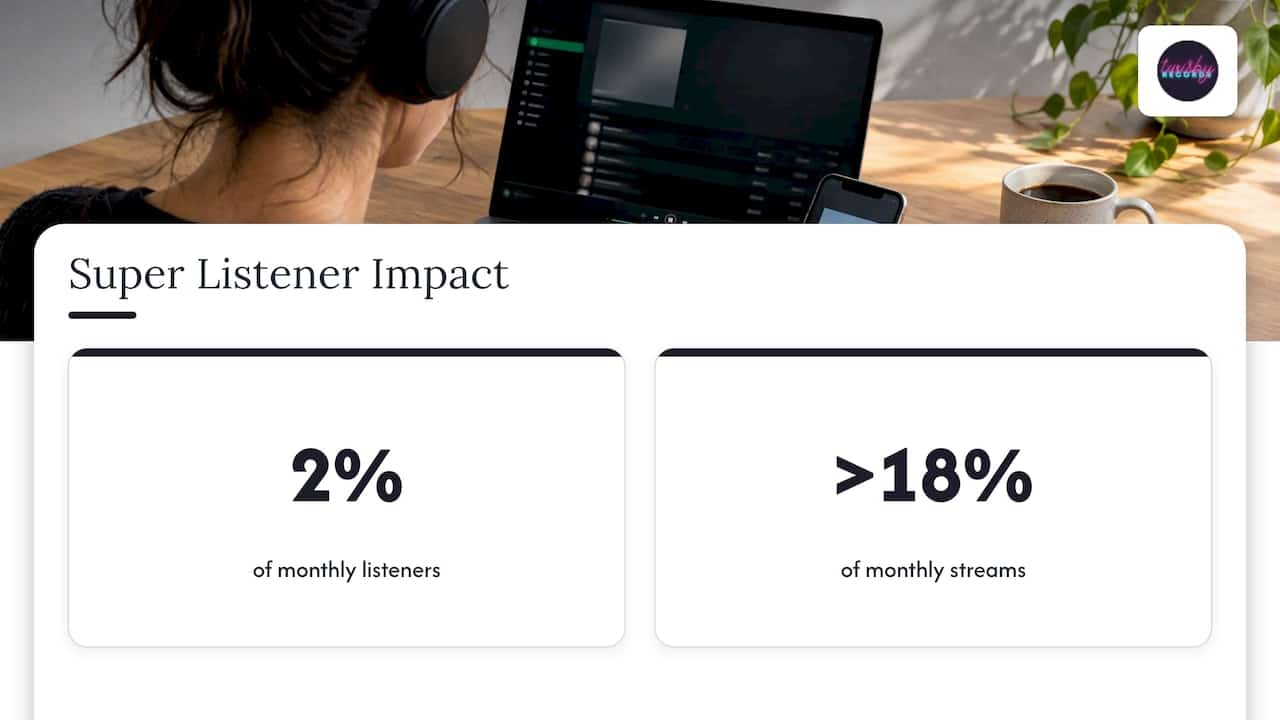
The takeaway: a small core carries a big share of your listening. A swing in the monthly total says little about that core. If you want to find more people like them, our guide to 1% lookalikes built on super listeners shows how to test it with small budgets.
Do monthly listeners or followers pay you?
Neither one pays directly. Reporting on Spotify’s model explains that monthly listeners do not determine income, and that payouts are based on an artist’s share of total platform streams (streamshare), not the absolute count of monthly listeners.
That matters because “how much do 100,000 monthly listeners earn?” has no fixed answer. A small group of devoted listeners streaming your catalog repeatedly can out-earn a large group who each played one track once. Followers matter indirectly: they are likelier to be among those repeat listeners, and they are delivered your new music automatically.
If stream count is the goal, start with how to increase Spotify streams as an indie artist.
How to read the two numbers together
Track the ratio
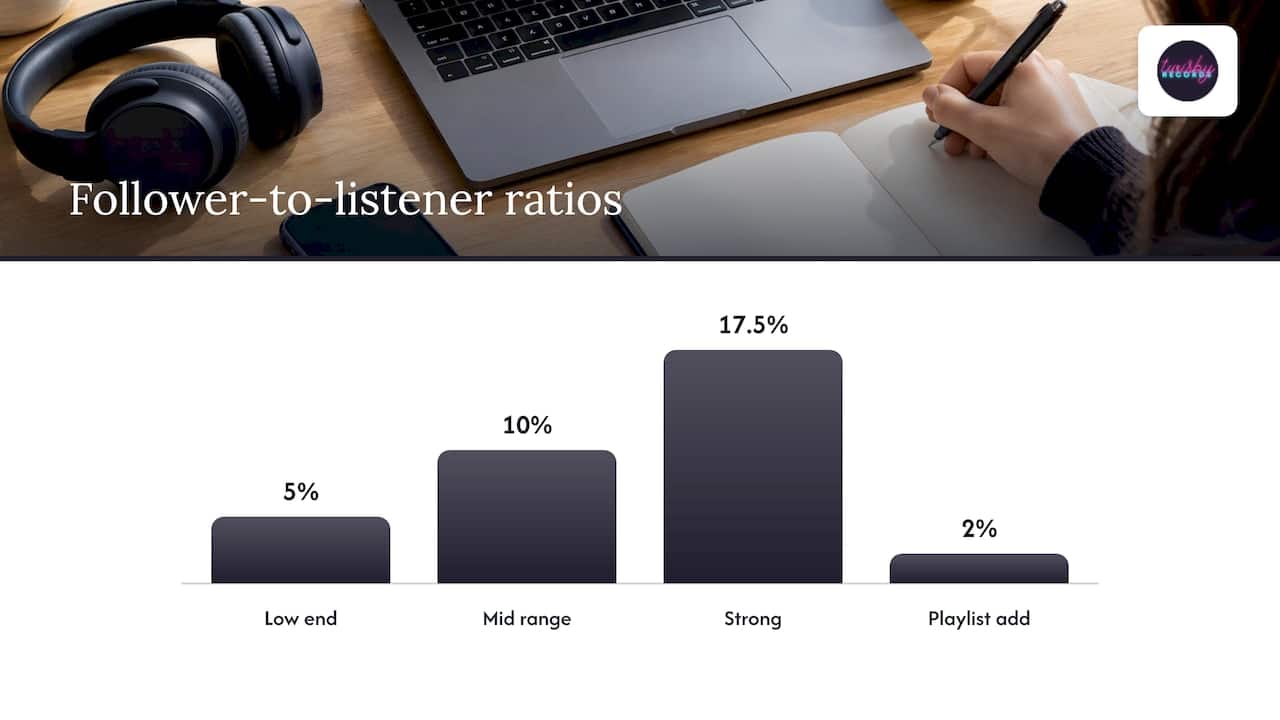
One published benchmark puts a normal ratio between followers and monthly listeners at 5% to 15%, with above 15% counted as strong. Treat that as a rough guide, not a rule. It comes from a company blog, and your genre, release history and audience age will move it.
A worked example:
| Monthly listeners | Followers | Ratio | How to read it |
|---|---|---|---|
| 4,000 | 200 | 5% | Low end. Listeners are arriving, few are committing. |
| 4,000 | 400 | 10% | Mid range. Healthy for most independent artists. |
| 4,000 | 700 | 17.5% | Strong. Your audience is mostly people who chose you. |
| 40,000 | 800 | 2% | Reach without commitment, typical after a big playlist add. |
The ratio helps most when you watch it move. If it drops right after a playlist add, that is expected: listeners spiked and followers have not caught up. If it keeps dropping for months, your profile or your next-step prompts need work.
Add saves and first-week velocity
The same source recommends tracking first-week velocity and save rate rather than relying on total streams. Saves show people want to keep a song. First-week streams show how well your launch activated the people you already have. Our walkthrough on what to track in Spotify for Artists covers where to find each one.
Use a calendar, not a daily check
Because the window is 28 days, checking daily mostly measures noise. A simple routine:
- Note monthly listeners and followers on the day before a release.
- Check again at day 7, day 28 and day 56.
- Compare the day 56 followers with day 0. That net gain is what the campaign left behind.
If you want to understand lag in other Spotify numbers too, see why popularity scores can trail by days.
How to turn monthly listeners into followers
Listeners follow when the next step is obvious and the reward is clear. The reward is real: followers are pitched unreleased songs in Release Radar and get notified about new music and tours.
- Ask directly, everywhere. Put “Follow on Spotify” in your social bios, your newsletter, your video descriptions and your release-day posts. Do not assume anyone will find the button.
- Make the profile worth following. Set an artist pick, update your bio and make sure your best track is the first one a new listener sees.
- Release on a rhythm. Followers see you again when new music lands. A steady schedule gives them a reason to stay. A 48 to 72 hour launch plan for algorithmic playlists helps you make the first days count.
- Collect pre-saves. A pre-save adds the release to a fan’s library before it drops, and it is a natural moment to ask for a follow. Our pre-save campaign guide walks through setup.
- Pitch the right playlists. Editorial pitching is free and lands you in front of listeners who may follow. See our practical guide to playlist pitching.
- Send paid traffic to a page built to convert. An ad that drops people on a plain streaming link loses the follow. A page with a clear follow prompt keeps more of them. Setup details are in our Spotify conversion ads checklist.
- Shape who hears you next. Your “Fans Also Like” neighbors influence who gets introduced to you. Read how that section works and build the audience around it.
Every one of these steps works better when the music itself holds up on repeat listening. Listeners do not follow a track that sounds rough next to the songs around it, and a clean mix and master is the quiet foundation under all the numbers above.
Our perspective
We have worked in audio for over 35 years, and the most common mistake we see from independent artists is celebrating the wrong number. A monthly listener spike feels like proof. Then the 28 days pass, and the artist is confused.
Here is how we think about it. Monthly listeners are how many people were handed your song. Followers are how many people decided to keep you. The first can be bought with a good placement or a well-aimed campaign. The second has to be earned by the music, the profile and the follow-up.
That is why we do not treat mixing, mastering and advertising as separate worlds. A track that is mixed with care and mastered to hold up next to other releases gives a new listener a reason to follow. An ad campaign that sends them to a page built for that one action turns the visit into a follower. Our work on both sides is personalized, with real engineers and real analog gear, and it is built around creative collaboration and fast turnaround, not off-the-shelf shortcuts.
If you are going to spend on reach, make sure the song deserves the follow, and make sure the follow button is the easiest thing to click.
Kreg
Work with us on the sound and the campaign
If your listeners are showing up but not sticking, there are two places to look: the music and the path from ad to follow.
On the music side, we offer mastering for a one-off $50 per track, along with mixing and recording. Our work carries Apple Digital Masters certification.

On the audience side, our advertising packages run targeted Facebook and Instagram campaigns for music releases, with audience research, custom landing pages, reporting and optimization. Standard Packages are $25 per month plus a 20% monthly fee on ad spend, and there is a one-time onboarding fee of $99. Premium Packages carry a 20% monthly fee on ad spend. Want a number for a mix? Request a mix quote.
FAQ
Are followers more important than monthly listeners?
For building a lasting audience, followers usually matter more, because each one made a deliberate choice and receives your new music automatically. Monthly listeners are still useful as a reach gauge. The healthiest profile grows both and watches how many listeners become followers.
Why did my monthly listeners drop when I did nothing wrong?
The count covers only the last 28 days, so people who listened earlier drop out unless they return. A playlist rotating you off or a campaign ending removes a source of listeners without replacing it. Plan a steady release schedule and follow prompts so more of each wave stays.
What is a good ratio of followers to monthly listeners?
One published benchmark calls 5% to 15% normal and anything above 15% strong. Use it as a rough guide, and compare your own numbers over time rather than against other artists. A ratio that dips after a playlist add is expected, since listeners arrive before followers do.
Does Spotify pay me based on monthly listeners?
No. Payouts are tied to your share of total streams on the platform, not your monthly listener count. A smaller group of repeat listeners can generate more income than a large group that played one song once.
Do monthly listeners include people who never chose my music?
Yes. Spotify says the number includes both active and programmed listeners, and programmed listeners are people the platform surfaced your music to. The active segment, which Spotify breaks out separately, is closer to your real fans.
Sources
- Audience segments on Spotify
- Understanding your listener and follower stats
- Promoting music on Spotify
- Promoting New Releases to Your Followers
- Super Listeners: Your Guide for Developing Fans Who Go Deeper
- What Does Monthly Listeners Mean on Spotify: 2026 Guide
- The Meaning of Spotify Stats: Spotify Followers vs. Monthly Listeners
- 5 Streaming Platform Metrics Worth Tracking
- Spotify: So viel verdienen Musiker und Bands wirklich