

Cost per fan is your marketing spend divided by the number of new, qualified fans that spend brought in. If you spend $200 and gain 40 people who meet your definition of a fan, your cost per fan is $5. The math takes ten seconds. The hard part is deciding who counts as a fan, and that decision changes your number more than any ad setting will.
This guide walks through the definition, the formula, a full worked example, the factors that move the number, and how to bring it down. It is written for independent musicians who run ads or plan to. (If you landed here looking for ceiling fan prices, wrong page, but the same rule applies: know what you are counting before you divide.)
TL;DR
- Cost per fan = total campaign spend ÷ new qualified fans that campaign brought in.
- Pick your definition of “fan” before you spend. A stream and a follower are not the same thing as a fan.
- Count only growth the ads caused, and include creative costs for a true number.
- Owned contacts, like email signups, are the most durable fans you can buy.
- Lower the number by testing creative, refining audiences, and tracking what happens after the click.
Table of Contents
- What counts as a fan?
- The cost per fan formula
- How cost per fan differs from cost per click, stream and follower
- What moves your cost per fan
- How to measure whether the fans are real
- Turn cheap fans into owned fans
- How to lower your cost per fan
- Our perspective
- Work with Twisby Records
- FAQ
- Sources
What counts as a fan?
This is the question that decides everything. Count too loosely and your cost per fan looks great while your career does not move. Count too strictly and you will think every campaign failed.
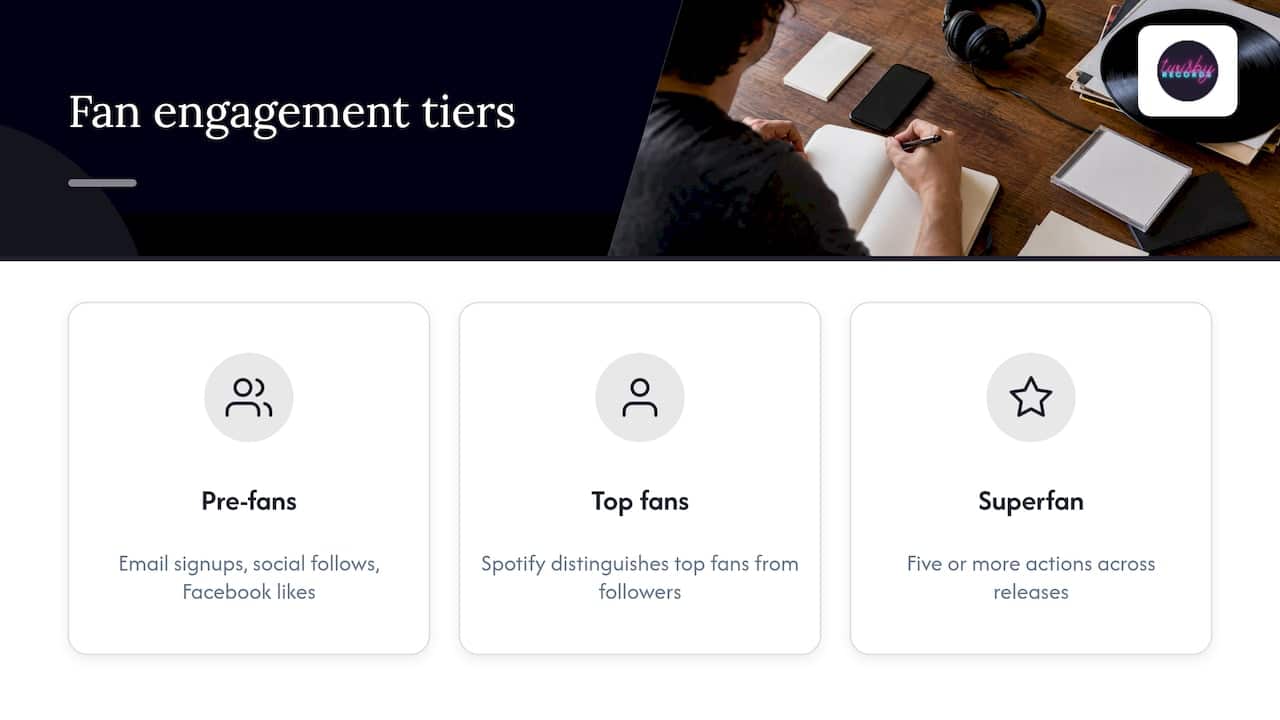
There is a useful split between casual and committed audiences. One music-industry framework treats email signups, social follows and Facebook likes as “pre-fans,” separate from paying fanatics. Its advice is to model two steps: exposure to an engaged prospect, then prospect to buyer. Not every click, like or follow carries the same economic value.
Platforms draw the same line. Spotify’s U.S. support page explains that its artist-offer emails go to an artist’s top fans and/or anyone who follows them. Followers and top fans are different categories even inside the platform.
For a stricter standard, one industry guide describes a superfan as someone who repeatedly streams, saves, follows, shares, comments, attends shows, buys merch, joins the community or refers others, performing five or more of these actions across releases.
Pick a definition that matches your goal
Your definition should follow the campaign objective. Here are four practical tiers:
| Tier | What counts | Best for |
|---|---|---|
| Listener | A new listener who streams the track | Early testing of creative |
| Follower | A new Spotify or Instagram follower | Building a base for release-day notifications |
| Saver | A listener who saves the song or adds it to a playlist | Signaling real interest to the platform |
| Owned fan | An email or SMS signup, show attendee or buyer | Long-term revenue |
There is no single right row. A debut single may be judged on savers. A tour announcement should be judged on email signups. Write the definition down before launch so you cannot move the goalposts when the results arrive.
The cost per fan formula
The formula is simple:
Cost per fan = total attributable campaign spend ÷ new qualified fans acquired
One music-marketing calculator shows the idea with round numbers: $200 spent and 40 qualified fans gives a $5 cost per fan. The same page warns against counting impressions, views or one-off streams as fans automatically.
Three details keep the number honest.
- Attribute only what the campaign caused. If your following was already growing from playlists and word of mouth, counting that growth against paid spend makes the ads look cheaper than they were. One calculator guide specifically warns that counting organic growth against paid spend artificially lowers the reported cost.
- Use net new, not gross. Followers who leave a week later should come out of the count.
- Include creative costs. The ad budget is not your only expense. A fully loaded calculation also adds the cost of making the video, artwork or landing page, and subtracts the growth you would have had anyway from the denominator, as this guide lays out.
A worked example
Say you release a single and run a four-week campaign. Here is how two ways of counting compare.
- Ad spend: $300
- Creative and landing page costs: $100
- Total cost: $400
- New Spotify followers during the campaign: 260
- Followers you would likely have gained anyway (based on your prior four weeks): 60
- Email signups from the campaign landing page: 55
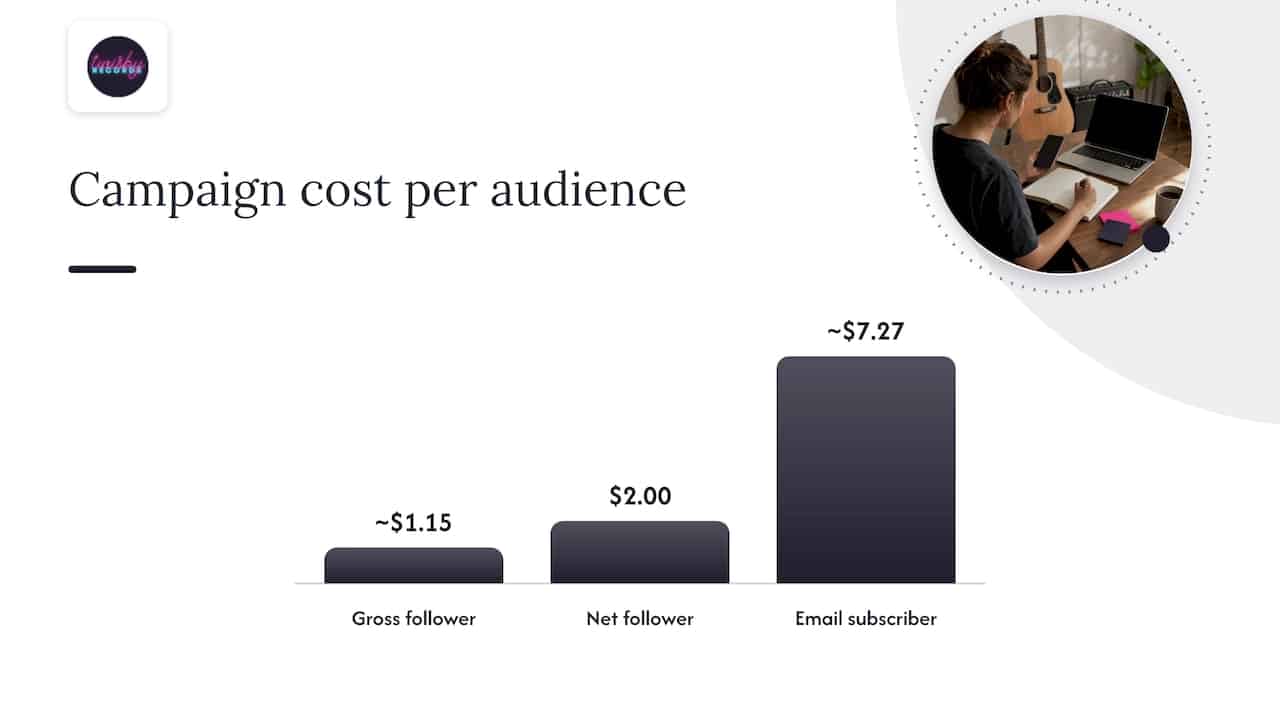
Ad-only, gross, follower-based: $300 ÷ 260 = about $1.15 per follower. It looks great, but it is flattering.
Fully loaded, net follower-based: $400 ÷ (260 − 60) = $2.00 per follower.
Owned-fan based: $400 ÷ 55 = about $7.27 per email subscriber.
None of these is wrong. They answer different questions. The first tells you how efficient your ad delivery was. The second tells you what growth actually cost. The third tells you what it cost to build an audience you can contact directly. Track all three and you will know where your money does the most work.
How cost per fan differs from cost per click, stream and follower
These metrics get mixed up constantly, so here is the ladder from shallow to deep.
- Cost per click (CPC): what you pay when someone clicks your ad. It measures interest in the ad, not the music.
- Cost per stream (CPS): what you pay per play that traces back to the campaign. It measures listening, but one play from one person is not a relationship.
- Cost per follower: what you pay for each new follower. Followers can be notified of future releases, which is a real step up from a stream.
- Cost per fan: what you pay for someone who meets your fan definition, whether that is a saver, a subscriber or a buyer.
Each step costs more than the one before, and each is worth more. A cheap click that never streams is cheap for a reason. If you want the stream-level math in detail, our guide on budgeting $100 to $1,000 for cost per stream ads covers it, and our piece on music ads benchmarks and real cost math shows how the pieces fit together.
What moves your cost per fan
No honest article can give you one number that applies to every artist. Cost per fan depends on the campaign, the audience and the song. These are the factors that matter most.
Creative
Your ad is the first thing anyone hears or sees. A strong ten- to fifteen-second hook with a clear call to action will usually beat a generic “new music out now” post. One benchmark guide reports that creative quality can swing cost per stream two- to fivefold, so treat creative as your biggest lever and test several versions.
Audience and geography
The same guide notes that North American and Western European audiences generally cost more to reach and convert than lower-CPM regions. If you are a U.S. artist who wants U.S. fans, that is simply the price of the market you want. What you can control is precision: a tight audience built around artists your music genuinely resembles will beat a broad one. Our audience recipes for $50 tests show how to build those starting audiences, and our guide to finding your music audience with a $30 test covers the first small experiment.
Platform
Meta ads (Facebook and Instagram) are good at pushing a message to people who match a profile. Streaming-platform ad tools reach people already listening. They cost different amounts and produce different kinds of fans, so compare them using the same fan definition. If Instagram is your main channel, start with our how-to for Instagram ads for music.
Timing
Release momentum helps. Ads that run while a track is fresh, with playlist adds and press arriving at the same time, tend to convert better than ads for a song that has been out for a year. Plan your spend around release windows instead of spreading it thin.
The song itself
Mixing and mastering affect cost per fan more than most artists expect. A track that sounds unfinished next to a playlist neighbor loses listeners in the first seconds, and those lost seconds are money you already paid for. A polished master is part of the advertising budget, not separate from it.
How to measure whether the fans are real
Counting is only useful if you check quality afterward. Here is a simple routine.
- Track the whole path. Know what happens between the ad click and the follow, save or signup. Our walkthrough on tracking music ad conversions shows how to set that up so you stop paying for clicks that go nowhere.
- Read your audience insights. Spotify’s advertising team explains that you can compare the share of ads served to a group with that group’s share of listeners and new listeners. A group whose listener share beats its served-ad share is comparatively effective, and intent-rate data can point to groups more likely to save. Shift budget toward those groups.
- Look beyond impressions. Spotify for Artists reports that its display campaigns are associated, on average, with listeners being over 3.7 times more likely to stream the promoted release and over 2.2 times more likely to save or playlist it. Whatever tool you use, measure downstream listening and saves, not just reach. Our guide to Spotify for Artists analytics explains which numbers to watch.
- Check retention after 30 days. How many of the new followers still stream your music a month later? Those are your real fans.
- Report on a schedule. A two-week check-in with honest numbers beats a gut feeling. See how we approach this in Facebook ads reporting for musicians.
Turn cheap fans into owned fans
Streams do not give you a way to contact anyone. Songtrust makes this point in its fanbase guide, recommending an email list or other direct-to-fan database rather than judging success by streams alone. Email lets you announce shows, releases and merchandise on your own terms.
This changes how you read cost per fan. A $7 email subscriber can be a better buy than a $1 follower, because you can reach that person every time you release something. A simple welcome sequence helps: a thank-you message, a story about the song, a link to your best tracks, and a reason to stay. This email welcome flow for musicians is a good model to adapt to your own voice.
To capture those emails, you need somewhere to send ad traffic that is not just a streaming link. A simple landing page with the song, a signup box and your socials does the job, and it lets you measure cost per owned fan directly.
How to lower your cost per fan
Once you can measure the number, improving it is a loop of small changes.
- Test creative in batches. Run three to four short video or image variants with the same small budget. Keep the winner, retire the rest.
- Refine audiences that click but do not stream. If an audience clicks but never listens, the targeting or the ad promise is off. Cut or rework it.
- Build lookalikes from real listeners. Use your existing engaged listeners or subscribers as the seed for new audiences.
- Use a clear call to action. “Save this song” or “Join the list” gets a better response than “check it out.”
- Time spend to momentum. Concentrate budget around release week and playlist adds.
- Fix the product. If people stream for ten seconds and leave, the problem may be the mix, not the ad.
These tactics are also the ones the benchmark guide recommends: testing creative variants, refining audiences that click but do not stream, and building lookalikes from existing listeners. For a conversion-focused campaign on Spotify, our setup checklist for Spotify conversion ads is a good next read, and it is worth understanding how Fans Also Like works, since good ad-driven listening can shape those recommendations.
Our perspective
We have been mixing and mastering for independent artists for over 35 years, and the pattern is consistent: artists obsess over the ad dashboard and ignore the song it is advertising.
Cost per fan is not only an ad metric. It is a sound metric. When the mix is balanced and the master is competitive, listeners stay past the first thirty seconds, they save the track, and the same ad money buys more real fans. That is why we handle audio and advertising under one roof. Our engineers use real analog gear, our work carries Apple Digital Masters certification, and we collaborate with each artist instead of handing over an off-the-shelf result.
On the advertising side, we run Facebook and Instagram campaigns with audience research, custom landing pages, reporting and optimization, so you see what each dollar did. Our approach is to define the fan first, build the path to your own list, then optimize toward it.
Start with a clear definition and a small, honest test. You will learn more from $50 and a good tracking setup than from $500 and a guess.
Kreg
Work with Twisby Records
If you want the song and the campaign handled by people who do both, we can help. Our advertising service is built around managed Facebook and Instagram campaigns for music releases, with audience research, custom landing pages and reporting.
The published pricing for the advertising packages is a Standard Package at $25 per month plus a 20% monthly fee on ad spend, with a one-time onboarding fee of $99. If your track is not ready for ads yet, our mastering service is $50 one-off, and we also offer mixing and recording for artists who want a stronger foundation before spending a dollar on promotion. You can also start from our home page.
FAQ
What is a good cost per fan for a musician?
There is no universal figure, because it depends on your fan definition, genre, audience and creative. A follower costs less than an email subscriber, and a buyer costs more than both. Set a target based on what a fan is worth to you, then improve from your own baseline.
Is a Spotify follower the same as a fan?
Not necessarily. Spotify itself treats followers and top fans as separate groups when it sends artist offers. A follower who also saves your songs, returns for new releases or joins your email list is much closer to a fan.
How many fans do I need to count for the number to mean anything?
The more, the steadier. With a handful of fans, one good or bad day swings the result a lot. Run the same test long enough to gather a meaningful sample, then compare variants against each other instead of against a single figure.
Should I include organic growth in my calculation?
No. Count only the new fans the campaign brought in, and compare against your growth before the ads started. Mixing in organic growth makes the cost look lower than it was and leads you to scale campaigns that are not doing the work.
Sources
- Getting the music advertising ROI calculation correct (Music Think Tank)
- Presale and merch emails (Spotify Support)
- What Is a Superfan and How to Identify Yours (Tools 4 Music)
- Cost Per Music Fan Calculator (Yona Marie Music)
- Cost Per Follower Calculator (CUFinder)
- Cost per Follower Calculator (OmniCalc)
- Average Cost Per Stream for Music Ads (Music Ad Guides)
- Explore Audience Insights On Spotify (Spotify Advertising)
- The 9-Step Musician’s Guide to Building a Fanbase (Songtrust)