


Rush mastering costs your standard per-track price plus a surcharge for jumping the queue. The surcharge is usually a flat add-on or a percentage of the job, and it depends on how tight your deadline is and how many tracks you send. Our standard mastering is $50 per track, and the cheapest rush is the one you never need: send a finished mix, a clear deadline and your reference notes up front.
This guide shows how rush fees are built, how to work out your own total before you hit send, and how to avoid paying for urgency you could have planned away.
TL;DR
- A rush fee is a premium on top of the normal mastering price. It pays for moving your track ahead of other paid work.
- Three things set it: how fast you need the master, how many tracks you have, and what the engineer has to push back to fit you in.
- Ask for the all-in number before you book: base price, rush fee, revisions and delivery formats.
- Our mastering starts at $50 per track, and our mastering page is where to start a project.
- The best way to cut a rush fee is a clean, final mix, delivered with the deadline stated at the start.
Table of Contents
- What a rush fee actually pays for
- How rush fees are usually quoted
- Standard turnaround versus rush: what you are really buying
- Why the base price matters more than the rush fee
- What a mastering quote should include
- How to avoid paying a rush fee at all
- When paying for rush is the right call
- Cheap and fast does not mean good
- Get a master on your timeline
- A quick pre-release timeline
- FAQ
- Sources
What a rush fee actually pays for
Mastering is the last step before release. An engineer checks tonal balance, loudness, stereo image and consistency across tracks, then delivers files for each place your music will live. A normal job sits in a queue behind other clients’ bookings.
A rush request asks the engineer to break that queue. The fee compensates for the disruption. Business-side guidance on rush pricing says the same thing in general terms: a surcharge is shaped by urgency, project size and the impact on existing commitments. In plain music terms:
- Urgency. A master needed tomorrow costs more than one needed in four days, because it displaces more work.
- Size. One single is easy to slot in. Ten album tracks can take over a day or more of focused listening and revisions.
- Impact on other work. If the engineer must delay another artist’s paid job to fit you, that is what the premium covers.
The same source offers a simple way to think about it: the fee is a percentage of the project value, plus any overtime cost. That is a general business framework, not a music industry price list. Mastering engineers set their own policies, so the percentage you see will differ from one engineer to the next.
How rush fees are usually quoted
You will run into three common patterns when you ask for a fast turnaround:
- A flat add-on per track. A fixed dollar amount added to each song.
- A percentage uplift. A set percentage of the whole job, which grows with the number of tracks.
- A custom quote. Common for albums, tight deadlines, or work that needs revisions inside the rush window.
None of these is wrong. What matters is that you see the number before you commit, and that it covers what you need. A quote that says “rush” without saying how fast is not a quote.
A worked example with your own numbers
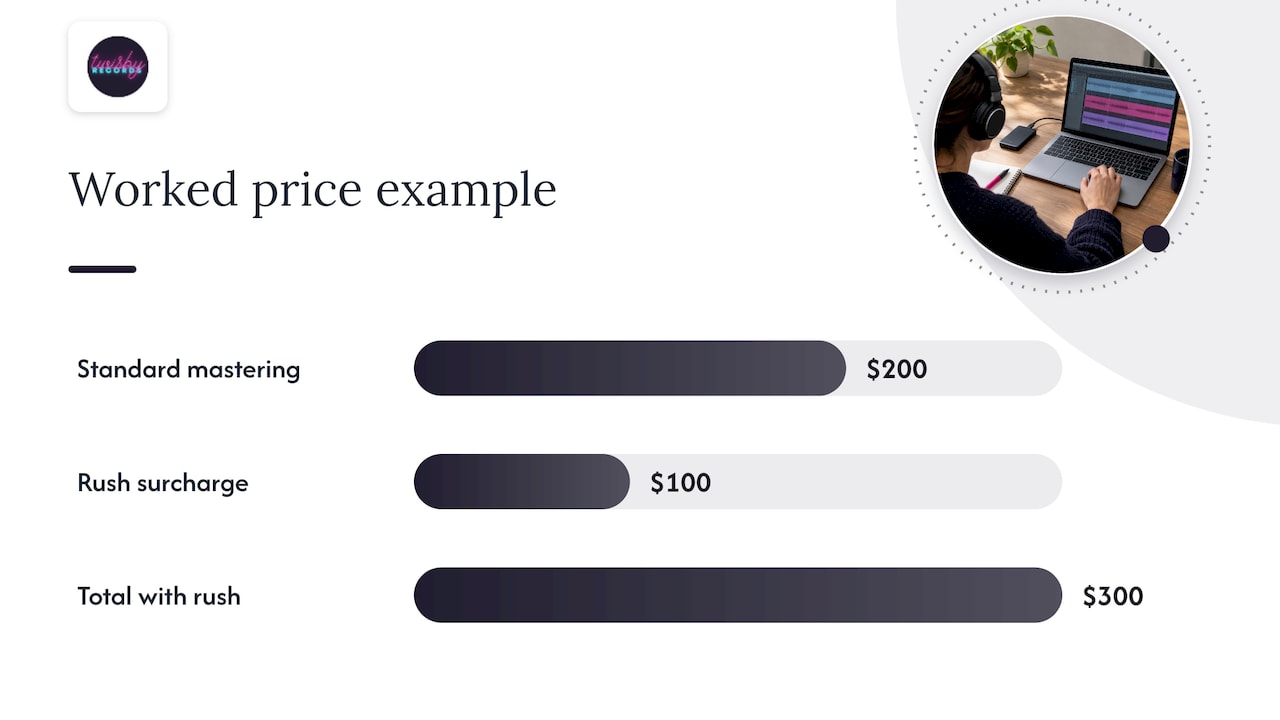
Here is how to run the math yourself. The surcharge below is made up for illustration. It is not our rush rate or anyone else’s, so swap in the figure from your own quote.
Say you have a four-track EP and a base price of $50 per track:
| Line | Calculation | Amount |
|---|---|---|
| Standard mastering | 4 tracks × $50 | $200 |
| Example rush surcharge | 50% of the base | $100 |
| Total with rush | $200 + $100 | $300 |
The lesson is not the percentage. It is that a percentage surcharge scales with the size of the job, so the same rush costs far more on a ten-track album than on one single. If you only need one song by Friday, ask whether the rest of the project can follow on a standard schedule.
Standard turnaround versus rush: what you are really buying
The premium buys you days. If a standard turnaround is a few business days, a rush shortens that to a day or two, depending on the engineer’s calendar. We cover the real timelines in our guide to mastering turnaround time, including what slows a job down even before a rush is in play.
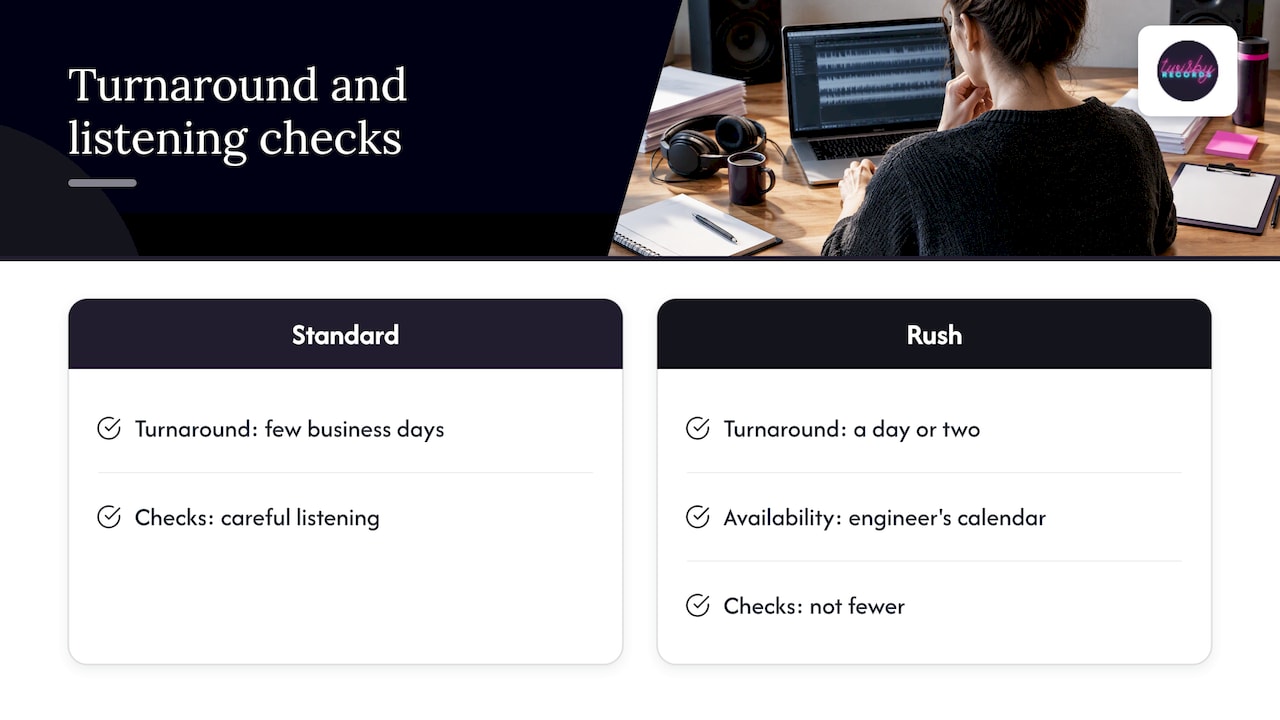
A fast delivery does not mean a rushed ear. A good master still needs a careful listen on more than one playback system. What you are paying for is priority. You are not paying for fewer checks, and you should not accept fewer checks. If an engineer cannot do the job properly in your window, a straight answer is worth more than a promise.
Why the base price matters more than the rush fee
Because most rush fees are tied to the base price, a fair base price keeps the total in check. For independent artists, our own breakdown shows most pay between $50 and $150 per track for professional mastering, and the range goes up for established studios and down for automated tools. Add a surcharge to a price at the low end and the total can still land at a reasonable level. Add the same surcharge to a premium rate and it becomes a real line in your budget.
If you are comparing quotes, compare them on the same footing. Ask each engineer for:
- The base price per track and the price for the whole project.
- The rush fee, and exactly what turnaround it guarantees.
- How many revision rounds are included.
- Which files you get back.
Our article on how mixing and mastering are priced walks through why the same-looking numbers can hide very different scopes.
What a mastering quote should include
When the clock is ticking, it is tempting to skip the details. That is where surprise charges hide. Before you pay, confirm these items in writing:
- Revisions. How many rounds of changes are included, and whether a revision is also covered by the rush timeline. A fast first delivery followed by a slow revision does not help you hit a release date.
- File formats. Most releases need a high-resolution WAV master. Some need extra versions for specific uses, and a CD master is a different preparation. See mastering for CD if you are pressing discs.
- Streaming readiness. Your master should translate well on the platforms where people will hear it. If you want to understand the loudness side, our guide to mixing for streaming at −14 LUFS explains it simply.
- Apple Digital Masters. If you want your release to carry the Apple Music badge, the master has to come from a workflow that follows Apple’s Digital Masters guidelines, which describe delivering from high-resolution sources. We hold Apple Digital Masters certification.
- Payment and delivery terms. When the clock starts: at payment, at file receipt, or at approval of your notes.
How to avoid paying a rush fee at all
Most rush jobs are not true emergencies. They are planning gaps. These are the habits that close them:
- Lock your mix first. Mastering a mix you will change later wastes the slot and doubles the work. If you are still deciding on the mix, it is not time to book the master. Our guide to mixing turnaround time helps you work backward from your release date.
- Work backward from the release date. Upload deadlines for distributors come before the date fans see the song. Build in time for your master, one revision round and your own review on headphones, a car and a phone speaker.
- Send clean files. Leave headroom on the mix and skip heavy limiting on the master bus. This is also a good way to protect the punch of your track.
- Include notes and a reference. Name a song whose sound you like and say what you want changed. That cuts back-and-forth, and back-and-forth is what blows through a short deadline.
- Book early, even if the files are not ready. Telling an engineer a date is coming lets them hold space, which often costs nothing.
- Stagger tracks. If a single is the priority, master it first and the rest of the project on the standard schedule.
When paying for rush is the right call
Sometimes the date is real. A playlist pitch has a deadline. A festival slot, a sync opportunity or a scheduled promotion is time-bound. A few cases where the premium earns its keep:
- A fixed pre-save or ad campaign. If you are running paid promotion for a release, a late master means ad spend aimed at nothing. Paying more for the master is cheap next to that.
- A single with a hard deadline and a fixed mix. One track, a final mix, one clear date.
- A live event tie-in. Releases timed to a show or tour date.
In each of these, the cost of missing the date is higher than the fee. If missing it costs you nothing but a few days, a standard schedule is the better value.
Cheap and fast does not mean good
The temptation with a short deadline is to grab the quickest, cheapest option. Automated tools are quick, but a track that sounds flat on release day is hard to fix later, and it follows your catalog. We wrote about the real costs in the hidden cost of cheap mixing and mastering. The short version: a fair price from an experienced engineer who listens to your song costs less than redoing it.
What we think about rush mastering
I have been mastering music for over 35 years, and the pattern is always the same. The artists who pay the biggest rush fees are rarely the ones with the hardest deadlines. They are the ones who were still changing the mix three days before release.
Our approach is personal. Every track is handled by an experienced engineer working with real analog gear, and our work is Apple Digital Masters certified. We focus on creative collaboration and quick turnaround, because we know independent artists run on tight calendars and small budgets.
My advice: tell us your release date early, send a final mix, and name a reference track. That gives us what we need to deliver a fast, polished master without drama. And when the date really is tight, talk to us before you assume the worst.
Kreg
Get a master on your timeline
If you have a release date and want to know what it takes to hit it, start with our mastering service. Mastering is $50 per track, and we handle each song personally. Tell us your deadline when you send the project, and we will come back to you on timing. If your song still needs a mix, our mixing service covers that first, and a mix and master can be planned as one schedule.

Ready to book? Head to our mastering page to start. If you are planning a release push, our advertising services can run targeted Facebook and Instagram campaigns so the finished master reaches listeners.
A quick pre-release timeline
Here is a simple calendar to work backward from. Adjust the days to your own distributor and engineer:
| When | What happens |
|---|---|
| 4 to 6 weeks before release | Finalize the mix. Book mastering. |
| 3 to 4 weeks before | Send the mix, references and notes. |
| 2 to 3 weeks before | Receive the master. Review on several systems. Request one revision if needed. |
| 1 to 2 weeks before | Approve the final master. Upload to your distributor. |
| Release week | Run your promotion and ads. |
Check your distributor’s own guidance for how early it needs files. The point is that a schedule like this leaves space for the unexpected, which is exactly what a rush fee otherwise pays for.
FAQ
How much does rush mastering cost?
It is the standard per-track price plus a surcharge, either flat or a percentage. The exact amount depends on the engineer, your deadline and the size of the project. Ask for the all-in total before you commit, and make sure it names the turnaround time.
How much do people charge for mastering?
Most independent artists pay between $50 and $150 per track for professional mastering, according to our pricing breakdown. Our mastering is $50 per track. Automated tools cost less, and established studios charge more.
How fast can a mastering job be delivered?
A standard job usually takes a few business days, and a rush shortens that depending on the engineer’s schedule. Our turnaround guide covers realistic timelines. A final mix and clear notes are what make fast delivery possible.
Does a rush master sound worse?
It should not. Priority changes when your track is worked on, not how carefully it is checked. If you need a short deadline, say so at the start and confirm that revisions are covered inside it.
Should I master before I finish my mix?
No. Mastering works on a finished mix, and changing the mix afterward means redoing the master. Lock the mix first, then book mastering. Our guide on how to master a song explains what the process involves.
Sources
- Rush Fee Explained: How Much to Charge for Urgent Work
- Apple Digital Masters: Music as the Artist and Sound Engineer Intended