


Pop vocal harmonies are extra vocal lines that sing different notes from the lead, in the lead’s rhythm, and fit the chords underneath. The quickest way to start is to pick a chord tone a third above or a sixth below each melody note, keep the harmony quieter than the lead, and save the fullest stack for the chorus. This guide shows you how to do that, even with very little music theory.
We work with independent artists every week, and harmonies are where a good demo becomes a record that sounds finished. They are also where most home sessions go wrong: parts clash with the chords, the timing drifts, and the lead gets buried. Let’s walk through it step by step.
TL;DR
- A harmony is a second (or third) voice on different notes that fit the chord. Thirds and sixths are the safest starting intervals.
- Reserve your biggest harmony stack for the chorus. Keep verses light, with one line recorded once or twice.
- No theory? Duplicate the lead, move it up an octave, then change notes that sound wrong.
- Blend with tight timing, a quieter level than the lead, a high-pass filter and a modest left/right pan.
- Send us clean, labeled stems and we will mix them so every part sits where it should.
Table of Contents
- What pop vocal harmonies actually are
- Where harmonies belong in a pop song
- Which intervals work: thirds, sixths and fifths
- How to create vocal harmonies, step by step
- Recording harmonies so they stay clean
- Blending harmonies with the lead
- Common mistakes
- Our perspective
- Get your harmonies mixed and released
- FAQ
- Sources
What pop vocal harmonies actually are
A vocal harmony is two or more voices, or vocal tracks, heard together on notes that fit the underlying chord structure. The simplest version pairs the lead melody with a second voice on a complementary note, usually a third or fifth above or below.
That second voice is not a copy of the lead. It is a supporting line with its own pitches that rides on the same words and rhythm. Song Cage’s Steve Canfield describes it as a second line singing the lead’s words in the lead’s rhythm, usually a third or a sixth away.
In pop, that line has a job. It can thicken a hook, highlight one word, or answer the lead after the phrase ends. Think of the harmony as the frame around the picture, not a second picture.
Where harmonies belong in a pop song
Placement matters as much as note choice. In pop, harmonies are often reserved for choruses and sometimes the bridge, because the contrast makes the chorus feel bigger. If every section is stacked, nothing stands out.
BMI notes that harmony can range from a basic third above the melody in a verse or chorus to layered backgrounds that support the lead or fill empty spaces. Sound On Sound adds that in modern pop, harmonies typically don’t appear until the melody is firmly established.
Here is a simple map you can copy:
| Section | Harmony approach |
|---|---|
| Verse 1 | Lead alone, or one subtle line on a few key words |
| Pre-chorus | One or two lines that rise with the lead to build tension |
| Chorus | High and low harmonies plus doubles, your fullest stack |
| Verse 2 | Slightly more than verse 1, such as a single added line |
| Bridge | Something different: a thinner stack, or a call-and-answer part |
| Final chorus | Your biggest version, with an extra high part or ad-libs |
On verses, a single harmony line is usually best recorded once, or at most twice, with little need for thick multitracking. Save the heavy layering for when the song earns it.
Three jobs a harmony can do
It helps to decide what each part is for before you write it:
- Shadow: follows the lead closely, a few notes above or below, to add weight.
- Spotlight: appears only on a key word or peak note to make it land.
- Answer: replies after the lead finishes a phrase rather than singing along with it.
This three-way split comes from a 2026 harmony guide, which also notes that pop favors clean, intentional, chorus-focused harmonies that reinforce the hook instead of competing with it.
Which intervals work: thirds, sixths and fifths
The most common intervals for pop harmonies are thirds, fifths and sixths. Here is how to think about each.
Thirds sound close and blended. In C major, if the lead sings C, a harmony a third above usually sings E, and a third below sings A. A third can be major or minor depending on the key and chord, so the harmony may need to change as the chords change.
Sixths open the voices up and leave more room between them. Canfield points out that a sixth is an inverted third, so “a third above or a sixth below” is really one decision about which chord note to sing and another about register. He uses Paul Simon and Art Garfunkel’s “America” (1968) as an example of a sixth at work.
Fifths sound open and strong, but can feel less characterful in a vocal stack, so use them with care.
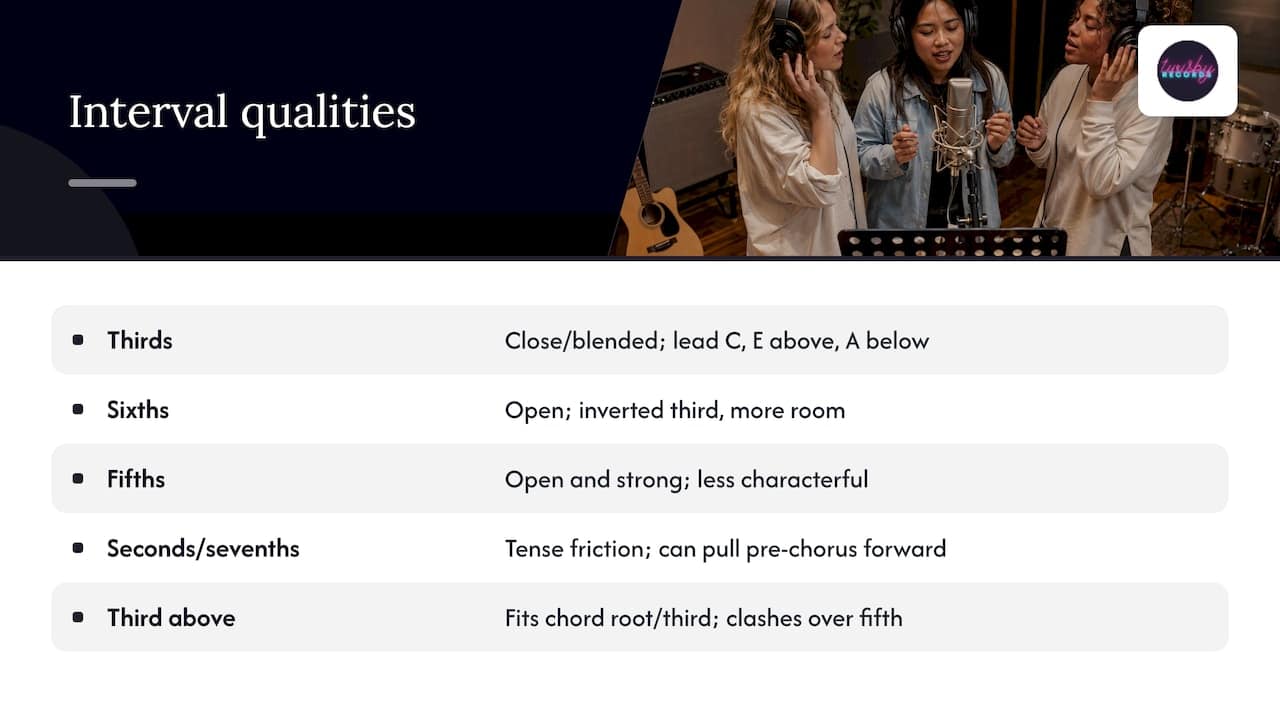
Seconds and sevenths create friction. Used deliberately, that tension can make a pre-chorus pull forward, but in an exposed spot they usually sound like a mistake.
One rule from the same song-writing guide saves a lot of headaches: a third above only fits when the melody sits on the root or the third of the chord beneath it. When the melody lands on the fifth of the chord, that same third above becomes a seventh, which clashes. If a harmony sounds wrong on one word, that is usually why. Move that note to a different chord tone.
How to create vocal harmonies, step by step
You do not need a theory degree. You need the key, the chords, and your ears. Here is a practical order of work.
Step 1: Know your key and chords
Find the key of the song and write out the chord for each bar. Every method below depends on this. If you produce in a DAW, your chord track or your guitar or piano part is the reference.
Step 2: Start on easy mode
If theory is the barrier, Waves suggests a beginner shortcut: duplicate the lead line and start with a high harmony one octave above, then tweak notes for variation and lower the harmony volume so the lead stays the focus. An octave line is not a true harmony yet, but it thickens the hook and gives you a base to edit.
If you want to hear how singers layer octaves and other parts in real time, a live vocal night in Amsterdam is the kind of show where you can study arrangements by ear.
Step 3: Use anchor notes
Splice describes an approach built on anchor and filler notes. In short:
- Identify the key.
- Mark the chords and the melody notes where you want harmony.
- Find an anchor note in the melody that is a chord tone.
- Move that anchor to another chord tone the melody isn’t using.
- Fill in the notes between anchors so the harmony follows the melody’s contour, staying within the same scale.
Strong notes tend to fall on stressed syllables, downbeats, long holds and chord changes, so start your anchors there.
Step 4: Keep the line singable
A good harmony follows the path of the melody and avoids big leaps. Chord tones (1-3-5 for a basic chord) on strong beats and simple passing notes on weak beats keep the line smooth. If you cannot sing it comfortably, your listener will not enjoy it either.
Step 5: Write at least two parts
A common arranging approach is to write one high harmony above the melody and one low harmony below it, both timed to overlap the melody perfectly. BMI also advises using the melody as one part of the triad rather than repeating the same line in the background.
Step 6: Learn from records you love
Pick a hit song, listen several times, learn to sing it, and note what the vocal arrangement is doing in the chorus. Songwriter Robin Frederick suggests using those ideas as a springboard, not copying the original. Berklee Online’s Andrea Stolpe goes further: transcribing songs you love shows you the same harmonic progressions turning up again and again.
Recording harmonies so they stay clean
Writing is half the job. A great arrangement can still sound messy if the takes do not match.
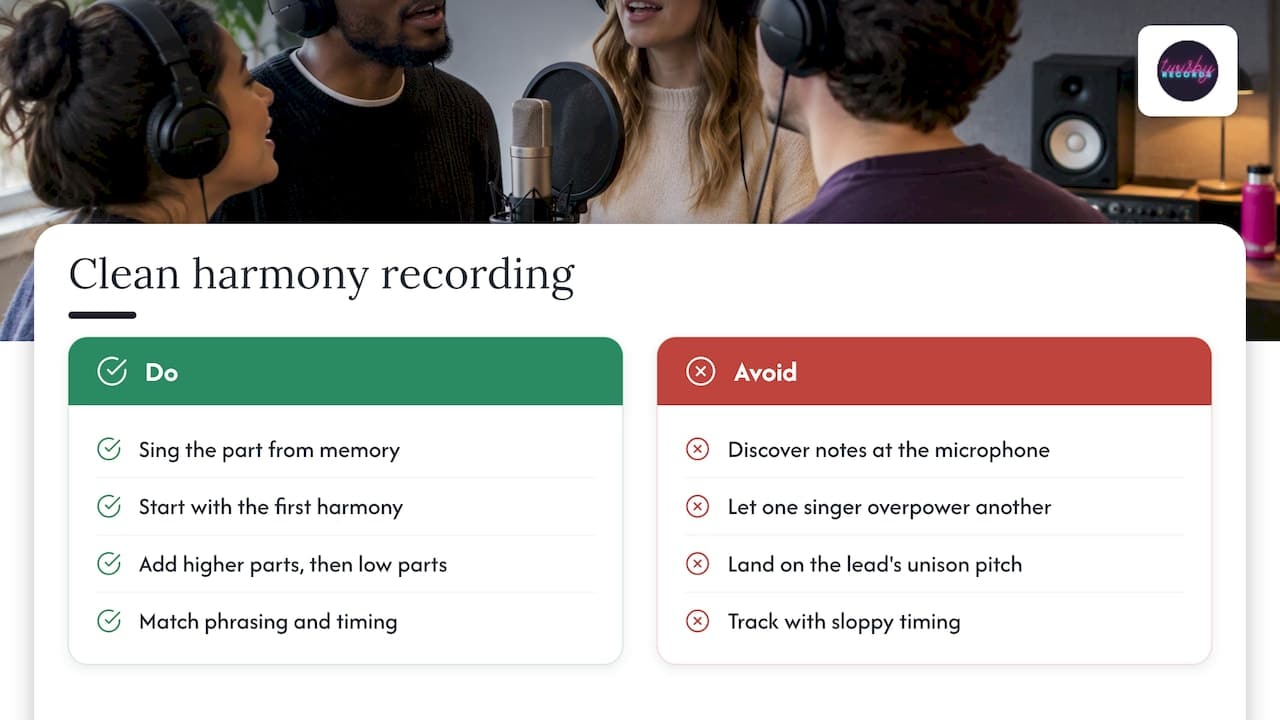
Learn the part first. Sing the harmony alone until you can do it from memory, then layer it against the lead. Do not discover the notes at the microphone with the clock running.
Work from the middle out. Sound On Sound suggests starting with a perfect take of the first harmony, then moving to the next one up, and finishing with any low parts beneath the lead. Keep notes so you do not get lost.
Rehearse phrasing and breathing. BMI’s recording advice stresses practicing before you track and checking that one singer isn’t overpowering another. Matching where each word starts and stops matters more than most people expect.
Avoid unison notes with the lead. When a harmony lands on the same pitch as the melody, the combined level can jump noticeably. Choose a different chord tone, or avoid the unison altogether.
Line up the timing. Sloppy edges are the fastest way to make harmonies sound amateur. Our guide to time aligning vocals walks through a five-point check, and our piece on vocal pocketing explains how consistent timing makes stacks feel like one performance.
If you track at home, record vocals at home covers the setup that gives a mixer clean stems, and how to record vocal doubles helps when you want thickness without the phasey, copy-paste sound. For the full picture of stacking parts, see how to layer vocals.
Blending harmonies with the lead
The goal is for the listener to hear a lead vocal with harmony, not several competing singers. These moves get you most of the way.
- Level: Keep the harmony below the lead. Waves recommends reducing harmony volume until the parts read as lead plus support.
- Pan: Keep the lead centered and place harmonies slightly left and right, without spreading them too far apart. Working in matched pairs keeps the image balanced.
- EQ: Harmonies do not need the low end the lead owns. A high-pass filter on harmony tracks, set higher than on the lead, clears mud. A gentle dip in the presence range can also leave the lead more clarity. Set these by ear, not by number.
- Timing: Tight edges matter more than any plugin.
Our vocal mixing techniques article goes deeper on EQ, compression and effects for the whole vocal chain.
Common mistakes
- Harmonizing everything. Constant stacking flattens the chorus. Leave room.
- Staying parallel the whole song. Parallel thirds all the way through can sound predictable. Mix in a sixth, hold a note, or answer the lead.
- Ignoring chord changes. A harmony that fits bar one may clash in bar two.
- Recording too many takes. More layers are not more polish. Three tight parts beat ten loose ones.
- Sending messy files to mix. Unlabeled, unedited tracks slow everything down. Our checklist on how to prep your song for mixing fixes that.
Our perspective
We have been mixing and mastering for independent artists for over 35 years, and the pattern is the same every time. The writing is rarely the problem. The problem is that the harmonies were recorded as an afterthought and nobody decided what each part was for.
Our advice: choose the job of each line before you hit record. Is it a shadow, a spotlight or an answer? Then keep the stack small and honest. Three well-tuned, well-timed parts in the chorus beat a wall of vocals that fights the lead.
That is also why we do not treat harmonies as a preset. Every song has its own key, tempo, voice and story, and an off-the-shelf or AI-driven approach cannot hear what your lead vocal needs. Our engineers work with real analog gear and talk the song through with you, because the best vocal sound comes from creative collaboration, not a template.
If your harmonies feel good in the room but small on the record, that is a mix problem we can solve.
Kreg
Get your harmonies mixed and released
Once your parts are recorded, we can help you finish them. Our mixing service balances your lead and harmony stack, and you can request pricing through our mix quote page. Mastering is a one-off $50 per track on our mastering page, and our work carries Apple Digital Masters certification.

When the song is ready, we also run Facebook and Instagram ad campaigns for music releases. Our advertising packages start at $25 per month, plus a 20% fee on ad spend and a one-time $99 onboarding fee. Need help tracking vocals? Ask about recording, including occasional in-person sessions in Pittsburgh.
FAQ
What is the easiest harmony to start with?
A third above the melody is the most common starting point, and it works when the melody sits on the root or third of the chord. If you want something even simpler, duplicate the lead an octave up and edit the notes that clash. Then lower the volume so the lead stays in front.
Can I write vocal harmonies without music theory?
Yes. Start with an octave-above copy of your lead, then adjust any note that sounds off against the chords. Learning the key and the chord tones helps you fix problems faster, but your ear can get you a long way.
Should every section of a pop song have harmonies?
No. Pop tends to reserve harmonies for choruses and sometimes the bridge, so those sections feel bigger by contrast. Verses usually work best with a lead alone or a single light harmony line.
How loud should harmonies be compared with the lead?
Quieter. Aim for a balance where you hear one lead vocal supported by harmony, not several singers of equal weight. Keep the lead centered, pan harmonies slightly left and right, and roll off low end on the harmony tracks.
Do I need to hire someone to mix my harmonies?
If you want the stack to sound polished, tight and balanced against the lead, an experienced mix engineer saves time. We offer personalized mixing for independent artists. Send a quote request and tell us about your song.
Sources
- What Is Vocal Harmony in Singing?
- 5-Step Tutorial for Getting Rich Vocal Harmonies
- How to Write Vocal Harmonies (Song Cage)
- Best Examples of Vocal Harmonies and How to Write Them
- Perfecting Harmony (BMI)
- Five Essential Harmony Recording Tips (BMI)
- Crafting Perfect Pop Backing Vocals (Sound On Sound)
- How to Improve Vocal Melodies: Simple Harmonies
- How to Layer Vocals (Yamaha)
- How to Write Harmonies for Beginners (Waves)
- Vocal Harmonies Guide (Splice)
- How to Learn From Hit Songs
- Harmonic Progressions for Songwriters (Berklee Online)
- Vocal Night at Amsterdam Blue Dock