

Instagram Story ads work for a music release when you treat them as a small, measurable test: a vertical clip of your strongest 10 to 15 seconds, sent to one smart link, with a modest budget and a clear count of clicks, streams and follows. Done that way, they put a song in front of strangers who match your sound. Done as a “boost” with a vague audience, they burn cash. Below is the full routine, step by step, plus where it usually goes wrong.
We run Meta ad campaigns for independent artists at Twisby Records, so this is written from that side of the table: practical, with the traps marked.
TL;DR
- Story ads are full-screen vertical ads that appear between people’s Stories. Build them in 9:16 and open with your best musical moment.
- Send traffic to one destination, a smart link to your streaming services, and track the click so you know what each ad costs.
- Start small. Test two or three song sections side by side for several days before you add budget to a winner.
- Judge ads on the whole chain: views, clicks, click-outs to streaming, then saves and follows. A cheap click means little if nobody listens.
- Clearing the music rights for your ad and installing the pixel first saves more money than any targeting trick.
Table of Contents
- What Instagram Story ads are, and what they can realistically do
- Before you build anything: three things to have ready
- How to set up an Instagram Story ad for music
- Creative that holds attention in the first three seconds
- Budget and test length for independent artists
- How to measure whether Story ads are working
- Mistakes that waste money on Story ads
- What we do for artists running Story ads
- Our view on Story ads and your release
- FAQ
- Sources
What Instagram Story ads are, and what they can realistically do
A Story ad is a paid photo or video that appears full screen between the Stories someone is already tapping through. According to HubSpot’s guide to Story ads, these ads do not vanish after 24 hours like organic Stories. You choose how long they run, and Meta supports several goals for them, including reach, video views, traffic and conversions.
For a musician, that means three things:
- You pick who sees it. Organic Stories reach people who already follow you. Ads reach people who don’t.
- You get a button. The call to action sends a listener straight to your song instead of asking them to find it.
- You get numbers. Every view, click and cost is counted, so you can compare one clip against another.
What can you expect? Big campaigns show the ceiling. Music Ally reported that Esperanza Spalding’s campaign, which retargeted viewers and used a lookalike audience, drove 29,700 clicks to her album and drew 5.2 million Facebook video views. That is a major-scale budget and team. An independent release will not look like that. What you can realistically get is a repeatable way to turn a small spend into listeners, and the data to decide whether to spend more. If you want realistic cost math for indie budgets, our post on music ad benchmarks walks through it.
Before you build anything: three things to have ready
Most wasted Story ad money is lost before the ad goes live. Check these first.
1. A song that is finished and mastered
An ad sends strangers to your track within seconds of hearing a hook. If the mix is thin or the loudness is off next to the songs around it on a playlist, people click away and the platform learns nothing useful. Get the mix and master right before you pay to promote it. That is the part of the job our engineers handle with real analog gear, and we deliver Apple Digital Masters certified masters. Mastering is $50 per song, and it makes sense to finish it before the campaign starts, not after.
2. One smart link
A smart link (also called a fanlink) is a single page that lists your song on Spotify, Apple Music and the other services, so each listener taps their own. Use one link for the whole campaign. Splitting your traffic across several destinations makes the results impossible to compare.
3. Rights to the music in the ad
Your ad plays your song, and sometimes other people’s work: a sample, a cover, a trending sound. Licensing rules differ for each, and a rejected or flagged ad stops your campaign. Read our legal licensing guide for music in Instagram ads before you cut your creative.
How to set up an Instagram Story ad for music
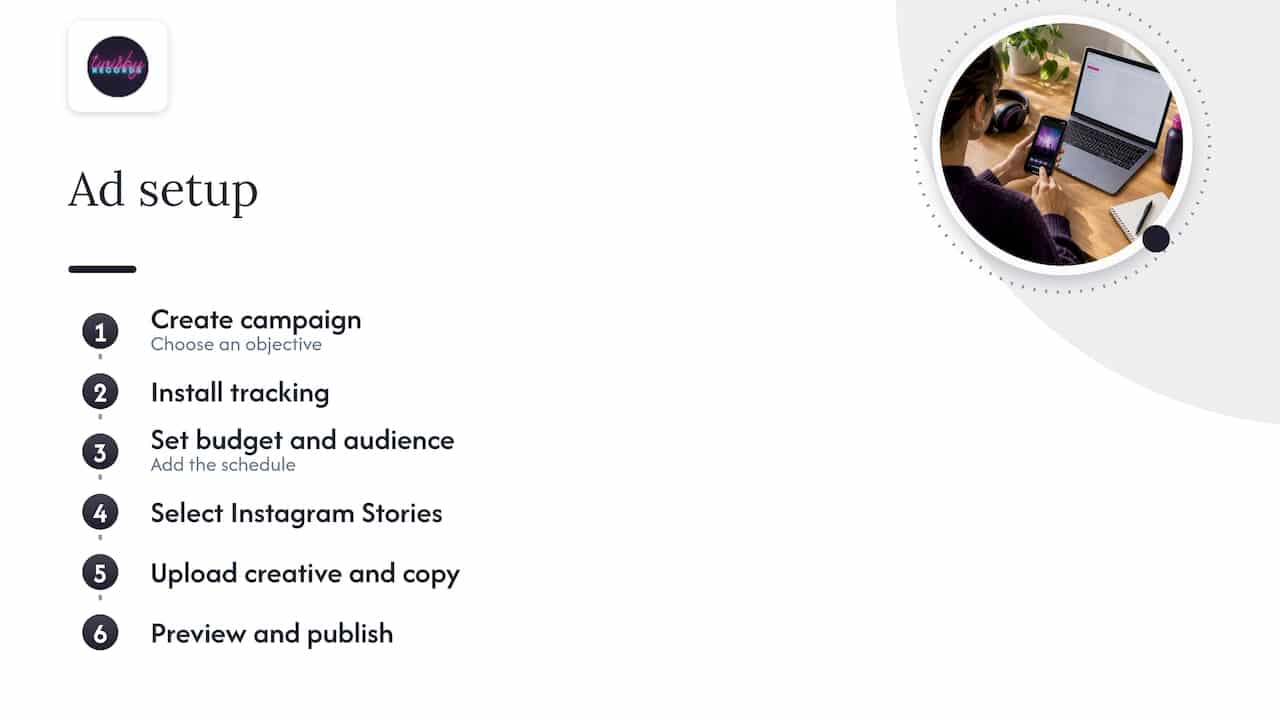
Meta’s own help pages describe the basic path: in Ads Manager you click Create, choose an objective, set budget, schedule and audience, then pick placements and build the ad. Here is that path with the music-specific decisions at each step.
Step 1: Choose the objective
Meta lists objectives such as Awareness, Traffic, Engagement, Leads, App promotion and Sales. For a release, you want people to act on a link, so Traffic or a conversion-style Engagement objective fits better than pure Awareness. Where you can, pick the option that counts a click to your smart link as the result.
Where it goes wrong: choosing “video views” because the numbers look big. Views are cheap and feel good. Streams are what you came for.
Step 2: Install tracking so Meta can see the click
The Meta pixel is a small piece of code that reports what people do after they click your ad. Without it you only see Instagram’s side of the story, not what happened afterward. Our 30-minute pixel setup for Spotify ads covers the install, and the post on tracking DSP click-outs with the pixel and CAPI explains how to count taps through to the streaming service (a DSP is a digital service provider, such as Spotify or Apple Music).
Step 3: Set budget, schedule and audience
At the ad-set level you choose daily budget, how long the ad runs and who sees it. Start with a small daily budget and a fixed window (more on numbers below). For audience, begin with a few interest groups built around artists who sound like you, a location you can serve and a sensible age range. Narrow audiences stall; extremely broad ones waste money on people who will never like your genre. Two or three focused ad sets give you something to compare.
Step 4: Pick the Stories placement
In placements, choose Instagram and select Stories. Meta lets you place ads across Facebook and Instagram automatically, but a song ad has a specific job and a specific format. Keeping the test to Instagram makes your cost per click honest. Adding more placements can make a cost per result look cheaper without sending more people to your song.
Step 5: Upload creative and write the copy
Upload a vertical video. Meta recommends a 9:16 aspect ratio to fit the full-screen format of Stories. Keep the text short, add your smart link as the destination and choose a call to action like Listen Now where it is offered.
Step 6: Preview, publish, then leave it alone
Preview the ad in the Stories view to make sure nothing is covered by Instagram’s interface. Then publish and resist the urge to tinker. Switching ads on and off every day resets the platform’s learning and muddies your results.
If this feels like a lot of moving parts, our own how-to on Instagram ads for music lays out the full campaign in one place.
Creative that holds attention in the first three seconds
Story ads are tapped through fast. Your clip has a moment to earn a second look. A few rules hold up across almost every music campaign.
Open with the hook. Do not build up to the chorus. Start at the most memorable line, riff or drop. Movement in the first frames helps stop the thumb.
Make it work on mute. Many people watch Stories without sound. Use burned-in captions or lyrics and a visual that tells them what the song feels like. Treat the audio as a bonus that lands once they turn it on.
Show a real person. Performance clips, studio footage and behind-the-scenes shots from your phone often connect better than glossy, over-produced visuals. You are selling a human voice, so let it look human.
Keep text short and out of the way. Instagram’s own buttons and your profile name cover the top and bottom of the screen. Keep your title, hook line and logo in the middle so they are never hidden. Preview before you publish.
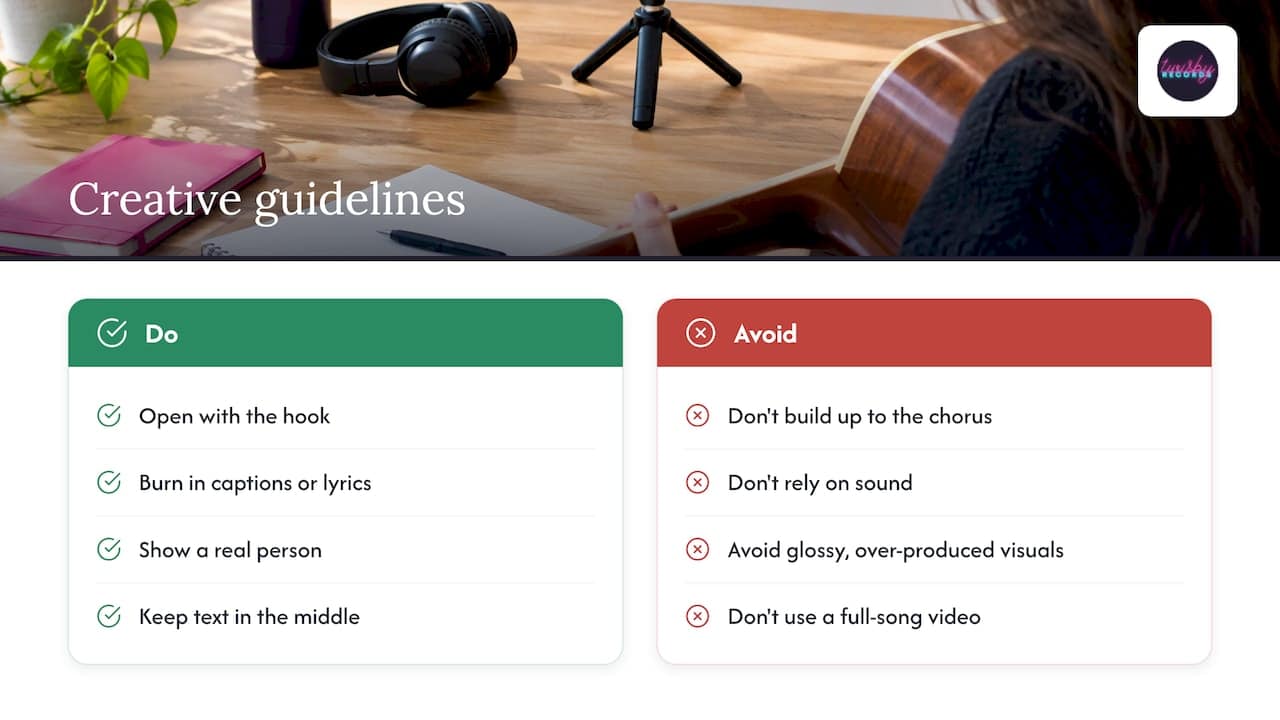
Keep it short. A 10 to 15 second clip of one section beats a full-song video. You are asking for one tap, not a listening session.
A simple creative checklist
| Check | What good looks like |
|---|---|
| Format | Vertical 9:16 video |
| First 3 seconds | The strongest musical moment, with movement |
| Sound off | Captions or lyrics carry the message |
| Text placement | Key words in the middle, clear of the top and bottom |
| Length | One section of the song, short and clear |
| Call to action | One button, one smart link |
Budget and test length for independent artists
You do not need a big budget to learn what works, and you should not start with one. A sensible first test looks like this:
- Daily budget: a small amount per ad set, in the range of a few dollars up to about $15 per day.
- Number of variations: two or three different song sections or visuals, each in its own ad set or ad.
- Duration: at least four days, ideally a week, before you judge anything.
- Decision rule: move more budget behind the clip with the cheapest click-out to streaming, and pause the rest.
That is a total test spend of a few hundred dollars at most, and often less. Our post on $50 A/B tests for music ads shows how to run a useful comparison on a very small budget, and the guide to budgeting $100 to $1,000 for cost-per-stream ads helps you plan what comes after the test.
Two cautions from experience. First, an ad needs time to leave the learning phase, so a one-day verdict is noise. Second, increase budget gradually once you find a winner. A sudden jump can disrupt delivery and push your costs up.
How to measure whether Story ads are working
A Story ad has a chain of results, and each link tells you something different. Track them separately.
- Views and reach: did people see the ad?
- Ad clicks: did the hook make them tap?
- Click-outs to the streaming service: did they arrive at the song? This needs the pixel from the setup step.
- Streams, saves and follows: did they stay? Spotify for Artists and Apple Music for Artists show these.
Then read the gaps:
- Plenty of views, few clicks: the hook or the call to action is weak. Test a new opening.
- Clicks but no click-outs: something breaks between the ad and the song. Check the smart link and the tracking.
- Cheap click-outs but little listening: the ad promises something the song does not deliver, or the audience is wrong. Revisit the section you chose and the interests you targeted.
Our post on tracking music ad conversions shows how to connect those links so you stop paying for clicks that go nowhere. And if you wonder whether paid social is worth it at all for your stage, do Facebook ads work for musicians answers that directly.
Mistakes that waste money on Story ads
Boosting a post instead of building an ad. The boost button skips the choices that matter: objective, placement and destination.
Targeting “music lovers.” That is almost everyone. Name the artists your fans already follow and start there.
Sending people to a profile. Every extra tap loses listeners. Send them straight to one smart link.
Running ads before tracking works. You will spend the budget and have nothing to learn from.
Changing everything at once. If you swap the clip, the audience and the budget on the same day, you will not know which change mattered.
Promoting an unfinished track. A song with a rough mix wastes the attention you paid for. Fix the sound first.
Ignoring the rights. Using uncleared music in the ad can get it rejected, which stops your spend from doing anything.
Judging on day one. Give the test a few days and a fair sample.
What we do for artists running Story ads
If you would rather not manage the whole thing yourself, our advertising service covers targeted Facebook and Instagram campaigns for music releases, including audience research, custom landing pages, reporting and optimization for streaming growth. The Standard Package is $25 per month plus a 20% adspend fee, with a one-time onboarding fee of $99. Details are on the advertising services page.
If the song itself still needs work, we handle mixing and mastering, so the track you promote is ready for the listeners the ad brings in.
Our view on Story ads and your release
After more than 35 years around records, the pattern I see is simple: the ad gets the credit or the blame, but the song decides. A Story ad is a very fast audition. A listener gives you a few seconds on the clip and a few more on the track. If the mix and master are polished, the hook is clear and the path to the song is one tap, small budgets can do real work.
That is why we keep audio and advertising under one roof. The same people who care how the chorus hits in the mix care which part of it opens the ad. Our work is personalized, creative and fast, not an off-the-shelf template or an AI shortcut. We talk with each artist about the sound, the audience and the goal, then build the campaign around that.
Start small, count everything and let the numbers tell you what to make more of. We are here to help you do it.
Kreg
FAQ
How much should I spend on Instagram Story ads for a single?
Start with a small daily budget, from a few dollars up to about $15 per ad set, and test two or three clips for at least four days. Put more money behind the one that produces the cheapest click-outs to streaming. A first test rarely needs more than a few hundred dollars.
What size should a music Story ad be?
Make it a vertical video in 9:16, which Meta recommends for the full-screen Stories format. Keep your title and key text in the middle of the frame so the interface does not cover it, and preview the ad before you publish.
Which part of my song should I use in the ad?
Use the section with your strongest hook, usually the chorus or the most distinctive line, and open the clip with it. If you are unsure, test two or three sections side by side and let the click-out numbers decide.
Can I use Instagram Story ads without a pixel?
Yes, but you will only see clicks and views on Instagram’s side, not what happens afterward. Installing the pixel lets you see click-outs to streaming services and compare clips by what they cost per listener, which is the number that matters.
Do I need permission to use music in my ad?
Yes. Your own song is yours to use if you control the rights, but samples, covers and trending sounds each have their own licensing rules. Check the rules before you build the creative, because a flagged ad stops your campaign.
Sources
- How to Run Instagram Story Ads, HubSpot
- Esperanza Spalding drove fans from Facebook and Instagram to Spotify, Music Ally
- How to create Instagram ads in Meta Ads Manager, Meta Business Help Center
- Design Requirements for Instagram Stories Ads, Meta Business Help Center