

Run isolated, sequential split tests: creative first, then audience, then copy, changing only one variable per round. Track cost-per-click to your streaming link, save rate after click, and cost per save, not just clicks. Give each variant at least 100 clicks or $20 to $40 in spend before judging it, and wait 48 to 72 hours before killing anything. Your next release deserves a $50, two-variant creative test before it deserves another boosted post.
TL;DR:
- Creative format testing should be prioritized first because it produces the widest performance swings across genres, with video favored by pop and hip-hop and static artwork sometimes better for ambient and classical music.
- Each split test should run for at least 48 to 72 hours with a minimum of 100 clicks per variant to ensure reliable data before making a decision.
- Cost-per-click, save rate, and cost per save are the key metrics; focusing on all three prevents choosing a winner based solely on clicks or impressions.
- Testing audiences is more effective after confirming a creative’s performance, with small, mutually exclusive segments revealing unexpected listener pockets.
- Platform-specific setup tips include avoiding automated bid shifting on Meta, comparing native tools against full ad manager, and carefully controlling visual or audio variables during creative tests.
Table of Contents
- Why A/B Testing Beats Boosting and Guesswork for Music Ads
- What to Split-Test First in Music Ads (And in What Order)
- A 3-Round Testing Sequence You Can Run on an Indie Budget
- Which Metrics Actually Prove a Winner
- Platform Setup Notes: Spotify, Meta, and Short-Form Placements
- Testing Audio Snippets and Hooks Without Contaminating Results
- Audience Tests That Find Real Listeners on a Small Budget
- Scaling Budgets and Timing Tests Around Your Release
- How Twisby Records Puts This Framework to Work
- What Artists Get Wrong About Split Testing
- Get a Managed Testing Plan for Your Next Release
- Sources
- FAQ
Why A/B Testing Beats Boosting and Guesswork for Music Ads
Hitting the boost button on your best post feels productive. It isn’t testing. One creative running alone gives you one data point, and one data point tells you nothing about whether a different hook, different artwork, or different audience would have performed better. You’re flying on instinct dressed up as strategy.
Real split testing works because it isolates a single variable and measures a single metric. Change the video thumbnail, keep everything else identical, and you learn something specific: whether that thumbnail moves the needle. Change three things at once and you learn nothing, because you can’t tell which change caused the result. This single-variable discipline shows up across nearly every serious music marketing guide because the alternative produces noise instead of insight.
The payoff isn’t from one test. It compounds:
- Round one tells you which creative style resonates with your genre
- Round two tells you which audience actually converts
- Round three tells you which words on the call-to-action button close the deal
Run this cycle across three or four releases and you build a playbook specific to your sound, not a generic template borrowed from a marketing blog.
What to Split-Test First in Music Ads (And in What Order)
Not every variable deserves equal attention. Prioritizing correctly is the difference between a testing habit that pays for itself and one that just burns ad spend.
- Creative format. Video, static artwork, and animated lyric snippets perform differently by genre. High-energy pop and hip-hop tend to favor short video with movement, while ambient, classical, and lo-fi artists sometimes see static artwork outperform video entirely. Test format first because it produces the widest performance swings.
- The hook. For video, that means the first three seconds. For audio, it means whether you lead with the chorus, a verse, or an instrumental intro. Meta’s own performance patterns show viewers decide to keep watching or scroll past within that opening window, so a weak hook sinks an otherwise strong ad.
- Audience segmentation. Interest-based targeting, lookalike audiences built from your existing fans, and broad targeting each surface different kinds of listeners. Test this only after you’ve locked in a winning creative.
- Copy and call-to-action. “Stream Now” versus “Listen Today” rarely swings results as hard as creative or audience does, but it’s cheap to test and worth a final pass.
- Placement. Feed versus Stories versus Reels comes last, mostly because platforms already optimize delivery across placements automatically once you have a proven creative and audience.
Creative goes first because it’s the biggest lever, as explained in how musicians tailor corporate setlists for any event to match audience expectations. Get the hook wrong and no amount of audience refinement will save the campaign.
A 3-Round Testing Sequence You Can Run on an Indie Budget
Here’s a sequence you can execute on a genuinely small budget, adapted from the framework independent marketing guides like MusicPulse recommend for artists testing without an agency behind them.
Round 1: Creative, $50 total. Split $50 across two creative variants, roughly $25 each, and run for 48 to 72 hours. That window matters. Platforms need time to exit the initial delivery phase, and killing a variant at hour six because it looks slow is the single most common mistake artists make. At the end of the window, kill the clear loser and keep the winner.
Round 2: Audience, $30 total. Take your winning creative and test it against two or three audience segments, split evenly. Keep the segments mutually exclusive so one person doesn’t see both variants and muddy your data. This is where a $30 audience test can reveal listener pockets you never would have guessed.
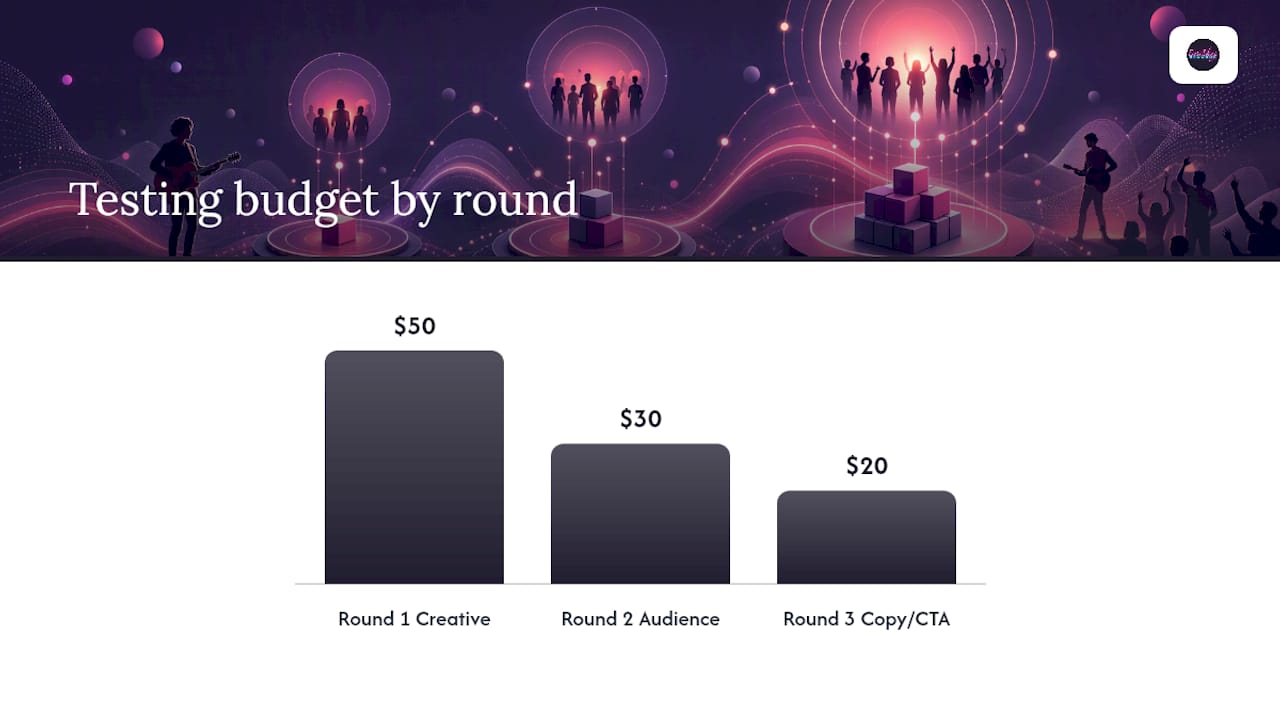
Round 3: Copy and CTA, $20 total. With winning creative and winning audience locked, test two or three CTA button texts or headline variations. This round moves the needle less than the first two, but it’s cheap insurance.
Log every round the same way:
- The metric you’re measuring and the hypothesis behind the test
- Total spend and spend per variant
- Sample size (clicks, not impressions)
- Platform and campaign name
- The winner and the margin of victory
Pro Tip: Keep a single spreadsheet across releases, not a fresh one per campaign. Six months in, you’ll see patterns in your own audience that no generic guide could tell you.
For a fuller breakdown of how these budgets scale as your releases get bigger, see this detailed music ad budget guide.
Which Metrics Actually Prove a Winner
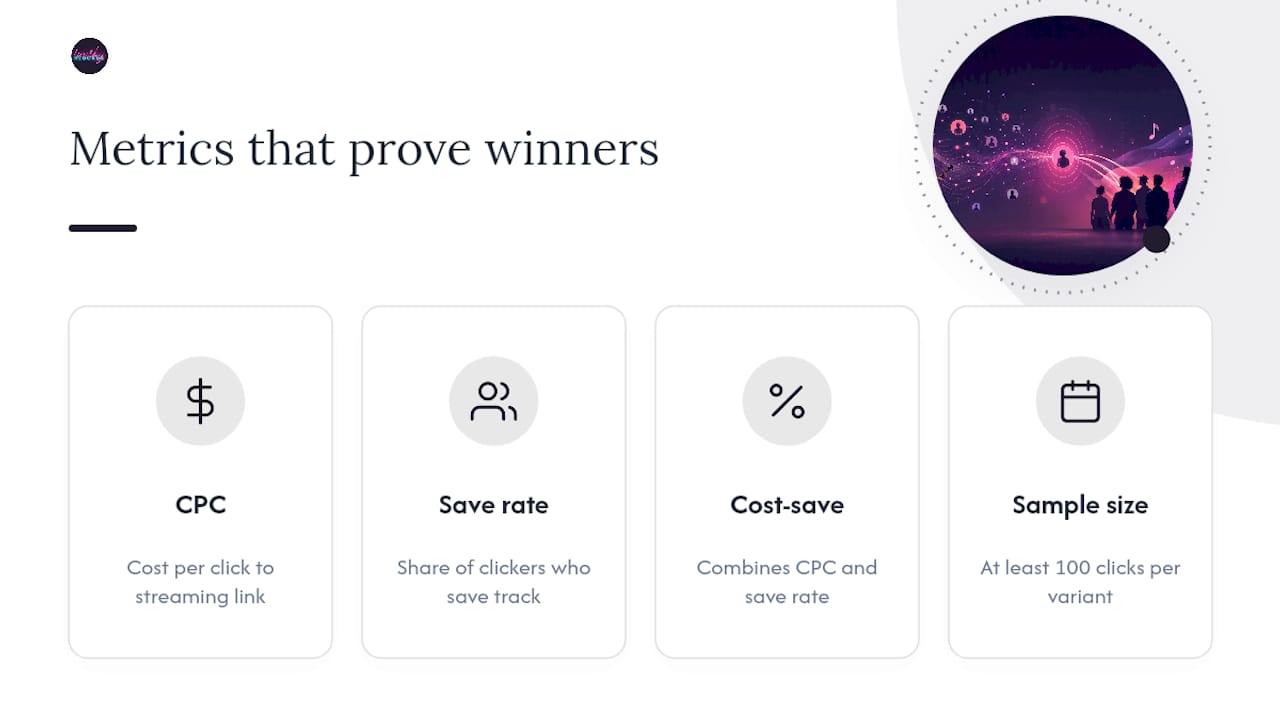
Clicks feel like progress. They aren’t the finish line. The three numbers that actually tell you whether an ad is working for a music release are cost-per-click to your streaming link, save rate after that click, and cost per save.
Cost-per-click tells you whether the ad grabs attention cheaply. Save rate tells you whether the people who click actually like what they hear enough to save it. Cost per save combines both into the number that matters most: what you’re actually paying for a listener who takes action. A campaign with the lowest CPC but a weak save rate is often the worse spend, not the better one.
A well-known example: an image-only ad campaign beat video on cost-per-click for certain genres, yet the quality of downstream engagement, meaning saves and follows, varied enough that judging the test on CPC alone would have picked the wrong winner.
Before calling a winner, hit a minimum sample. The practical rule most testing guides converge on: at least 100 clicks per variant before you trust the result. Fewer than that, and you’re reading tea leaves, not data. Platforms like Spotify Ads Manager flag a winner once a variant crosses roughly 65% confidence, per Spotify’s own documentation, but treat that flag as a signal to watch, not a command to act on immediately if your sample size is thin.
Platform Setup Notes: Spotify, Meta, and Short-Form Placements
Each platform handles split testing differently, and the gotchas aren’t always obvious until you’ve burned a budget learning them the hard way.
Spotify Ads Manager runs formal experiments: it splits your audience and budget evenly across up to four variants, requires identical targeting for each one, and displays a winner flag once a variant clears its confidence threshold. Spotify’s split-testing documentation is worth reading before your first experiment, since setup mistakes here (like mismatched targeting between variants) invalidate the whole test.
Meta Ads Manager requires more manual discipline. Isolate your variable at the ad level rather than the campaign level, and turn off Advantage+ automation when you want a genuinely controlled test, since Meta’s automated optimization will otherwise shift budget toward one variant before you’ve gathered enough data to know why. Respect the learning phase fully before judging anything.
Short-form placements like Reels and TikTok reward hook testing above everything else, since scroll speed there is brutal. Two additional wrinkles: watch for music licensing restrictions that can mute or strip your audio on these placements, and consider comparing native promote tools against full ad manager control, covered in this Reels and Instagram ad setup guide.
- Spotify: up to four variants, even budget split, automatic winner flag
- Meta: manual isolation required, disable Advantage+ for clean data
- Short-form: hook-first testing, check licensing before you spend
Testing Audio Snippets and Hooks Without Contaminating Results
The fastest way to ruin an audio test is to change the visual at the same time. If you’re testing chorus versus verse versus an instrumental intro, keep the artwork, captions, and video frame completely identical across variants. The only thing that should differ is the audio clip itself.
Video hook testing follows the same rule in reverse: swap only the first three seconds of footage and leave the rest of the clip untouched. That three-second window is where scroll decisions get made, and industry data on digital audio creative consistently shows completion rates rise when that opening moment is optimized deliberately rather than picked at random.
For clip length, 15 to 30 seconds covers most testing needs. Longer samples make sense only when you’re specifically testing whether a full song structure, build into chorus, for instance, changes save behavior compared to a tighter loop.
- Keep visuals frozen when testing audio; keep audio frozen when testing visuals
- Test chorus vs. verse vs. instrumental intro as three distinct variants
- Default to 15 to 30 second clips unless testing full song structure
Pro Tip: If you only have budget for one audio test this cycle, test the opening three seconds. It has more influence on completion rate than almost anything else in the clip.
Audience Tests That Find Real Listeners on a Small Budget
Audience testing only makes sense once you already have a creative winner. Testing audiences against an unproven creative just adds a second layer of noise on top of the first.
- Split your budget evenly across two or three audience segments, interest-based, lookalike, and broad are the standard trio.
- Keep the segments mutually exclusive using platform exclusion controls, since overlapping audiences make it impossible to know which segment actually drove a save.
- Watch for saturation, if cost per save starts climbing after steady performance, the audience is likely tapped out, not the creative failing.
- When saturation hits, decide between refreshing the creative for that same audience or expanding to a new lookalike percentage rather than assuming the whole campaign is dead.
A $30 audience discovery test run this way has surfaced listener segments that outperformed artists’ assumed core fan base entirely, which is the entire point of testing instead of guessing.
Scaling Budgets and Timing Tests Around Your Release
Once you have a winning creative and audience combination, resist the urge to triple the budget overnight. Jump too fast and platforms like Meta can reset the campaign into a fresh learning phase, which erases the optimization you just paid to build, according to practitioner scaling guidance.
Timing matters just as much as budget. Start your creative testing at least two weeks before release day, so you walk into launch with a proven winner rather than a guess, an approach MusicPulse’s framework specifically recommends for maximizing release-day algorithmic momentum.
- Scale spend 20% every 48 hours, not in one large jump
- Begin testing two weeks pre-release; launch the winning combo on release day
- Retest every 7 to 10 days after launch to counter creative fatigue as the same audience sees the ad repeatedly
How Twisby Records Puts This Framework to Work
A music production team with extensive experience and advanced certification runs advertising campaigns built specifically around the sequential testing model outlined here. That mix of mixing, mastering, and ad management means the creative going into a test isn’t guesswork either, it’s already been shaped for streaming platforms before a single dollar gets spent testing it.
A managed testing workflow generally follows onboarding to understand the release and audience, a structured test plan built around the creative-audience-copy sequence, and a reporting cadence that tracks cost per save, not vanity metrics.
[Detailed author bio for Kreg to be inserted]
[Case studies demonstrating Twisby Records’ impact on independent artists to be inserted]
[Client testimonials with named artists to be inserted]
What Artists Get Wrong About Split Testing
The biggest mistake isn’t a bad hypothesis, it’s impatience. Artists kill a variant at hour twelve because the early numbers look weak, before the platform has even exited its learning phase. A close second: launching a campaign with a single creative and no comparison point at all, then wondering why performance plateaus with no way to improve it.
Small budgets don’t have to mean small testing. Repurposing the same creative across Meta and short-form placements, or running quick email subject line splits if you have a list, gets you testing reps without a bigger budget. On day one of a single rollout, the checklist is short: two creative variants, identical targeting, $50 total, 72 hours before judgment.
— Kreg
Get a Managed Testing Plan for Your Next Release
If running three testing rounds across two platforms sounds like more time than you have between mixing sessions and day-job hours, that’s exactly the gap Twisby Records’ advertising service is built to close. Instead of piecing together Spotify Ads Manager, Meta Ads Manager, and a spreadsheet on your own, you get a structured test plan, creative variants built from audio prepared for streaming, and reporting that tracks cost per save instead of clicks that don’t convert.
This fits artists scaling past their first few campaigns or anyone short on the hours it takes to run a proper three-round sequence correctly. If your next single is coming and you want the creative testing handled before release day, check out the advertising service page and get a plan built around your release timeline.
Sources
- Split Testing in Spotify Ads Manager
- A/B Testing Your Music Ads: A Framework for Artists
- A/B Testing Your Music Marketing: What to Test and How | Tools 4 Music
- Brian Hazard tests image-only ads for music (Hypebot)
- Meta Ads For Music: Spotify Growth (Step by Step Tutorial) – Andrew Southworth
FAQ
What Is A/B Testing in Advertising?
A/B testing means running two or more versions of an ad that differ in exactly one variable, then measuring which version performs better on a specific metric. For music ads, that usually means comparing creative, audience, or copy while holding everything else constant.
How Can I Perform A/B Testing in Meta Ads Manager?
Create your variants at the ad level, keep targeting identical between them, and disable Advantage+ automation so Meta doesn’t shift budget before you’ve collected enough data. Wait 48 to 72 hours to respect the learning phase before comparing results.
Is A/B Testing Worth It on Facebook for Music Ads?
Yes, particularly for artists spending real money on ads repeatedly. A single isolated test costing $50 can reveal which creative or audience converts at a meaningfully lower cost per save, savings that compound across every future campaign.
What Is the A/B Test in Facebook Reels?
Reels testing typically focuses on the hook, the first three seconds of video, since that’s the window where viewers decide to keep watching or scroll past. Keep the rest of the clip identical between variants so the hook is the only variable changing.
How Many Clicks Do I Need Before Calling a Winner?
Aim for at least 100 clicks per variant before trusting the result, a threshold drawn from indie-budget testing guidance. Fewer clicks than that and the “winner” may just be noise.