
A short, hook-first snippet of your real music, edited for the platform it runs on and tested against two or three variants, is the single highest-leverage move for music ad creative. Recognition happens fast, often within a single second, and matching musical style to the right audience measurably improves how ads perform.
TL;DR:
- Recognizable, short musical snippets drive high engagement, with recognition occurring in about one second and significantly boosting ad impressions.
- Matching the song’s vibe to the target audience’s preferences reduces viewer drop-off and improves overall ad relevance and effectiveness.
- Using authentic artist tracks and clear, well-mastered audio enhances recognition and engagement while fighting ad fatigue.
- Platform-specific edits, like vertical formats for Stories and loopable clips for Reels, maximize performance across social media channels.
- Pre-planning audio licensing, mastering, and creating multiple variants streamline quick re-cutting and testing during campaigns.
Table of Contents
- What Makes Music Ad Creative Work
- 10 Music Ad Creative Ideas Worth Testing
- What Research Says Drives Music Ad Performance
- Your Pre-Launch Production and Licensing Checklist
- Platform-Specific Rules for Music Ad Creative
- The Evidence Behind Music-First Advertising
- Creative Formats That Actually Get Watched
- Matching Music Mood to Your Brand Message
- Targeting Audience Demographics Through Music Style
- Pairing Music With Visual Storytelling
- Tools for Editing and Syncing Music Ad Creative
- Prioritizing Music Vs Visuals: An Editorial Perspective
- How Twisby Records Turns Your Track Into Ad-Ready Creative
- Sources
- FAQ
What Makes Music Ad Creative Work
Music ad creative is any advertisement built around a song, snippet, or original track as the primary creative element, not background filler. For independent artists, that distinction matters because your music IS the product. The ad’s job is to make a stranger recognize your sound, feel something specific, and want to hear more within a few seconds.
Most artists still treat music as an afterthought in their ads, dropping a track under stock footage or a static image and calling it done. That approach ignores what every platform algorithm now rewards: sound-first attention. When you flip the order, and let the music drive the edit instead of decorating it, you get creative that performs differently. This guide walks through ten concrete concepts, the evidence behind what makes them work, a production checklist, platform rules, and where Twisby Records fits if you’d rather hand off the technical parts.
10 Music Ad Creative Ideas Worth Testing
Each of these concepts targets a different outcome. Pick based on what you’re optimizing for this campaign, not what looks impressive.
- The one-second hook. Open on the most recognizable four bars of your chorus before any logo or visual. Best for awareness.
- Lyric snippet overlay. Pair a punchy lyric line, animated as text, with the exact moment it’s sung. Best for engagement and shares.
- Loopable moment. Cut a 3 to 6 second segment that repeats seamlessly, ideal for platforms that auto-loop short video. Best for watch time.
- UGC-style reaction cut. Show a real or simulated first-listen reaction synced to the drop. Best for conversions to streams.
- Behind-the-scenes stem reveal. Show isolated vocals or a single instrument layer building into the full mix. Best for engagement and perceived authenticity.
- Genre-tailored variant. Re-edit the same song’s hook with different pacing for different audience segments. Best for relevance and click-through.
- Silent-to-sound reveal. Start muted with visual tension, then unmute at the hook. Best for platforms with default-muted autoplay.
- Call-and-response teaser. Use a lyric that poses a question, cut right before the answer plays. Best for curiosity-driven engagement.
- Live performance cutdown. Trim a live clip to its highest-energy 15 seconds. Best for building tour or release-week buzz.
- Before/after mix reveal. Contrast a rough demo with the final master for 2 to 3 seconds each. Best for building trust with music-savvy listeners.
Pro Tip: Keep every stem, alternate mix, and raw take from your session organized by project folder. When an ad underperforms, you’ll want to re-cut the hook or swap in a different instrumental layer within minutes, not hours.
What Research Says Drives Music Ad Performance
Four measurable factors separate music ad creative that performs from creative that gets skipped.
- Recognition speed. A campaign built entirely around one-second snippets of iconic songs generated more than 68 million impressions in its first two weeks, driven largely by rewatch behavior as viewers tried to identify the track.
- Contextual fit. The IAB Tech Lab’s case for dynamic music creative argues that matching a track’s vibe to a listener’s preferences or context reduces the risk of musical mismatch, the single biggest reason viewers tune out.
- Fighting sonic sameness. Swapping generic stock music for authentic artist tracks breaks ad fatigue and tends to boost engagement, since listeners can tell the difference between library music and something real.
- Production clarity. A muddy mix undercuts recognition no matter how good the hook is. Track view rate, average view duration, and stream lift as your core metrics, rather than impressions alone.
Recognition happens in about one second. That’s the entire window you have to make someone care before their thumb moves.
Your Pre-Launch Production and Licensing Checklist
Skipping this step is how good creative gets pulled mid-campaign. Work through it in order before you spend a dollar on media.
- Cut a hook-first edit at 1 to 6 seconds for feed and Stories, and a second version at 15 seconds for in-stream placements.
- Pull instrumental and vocal stems separately so you can rebalance the mix for small speakers or muted autoplay.
- Export platform-specific specs: vertical 9:16 for Reels and Stories, square or 16:9 for YouTube and feed.
- Confirm you hold both the master recording rights and the composition rights, or use pre-cleared music if the track isn’t fully yours.
- Keep a simple record: date, platform, edit version, and rights confirmation for every asset you run.
- Build 2 to 3 musical variants of the same visual, changing only the hook or genre lean, so you can A/B test cleanly.
Pro Tip: A track that’s already gone through professional mastering, like the kind Twisby Records provides, holds up far better when compressed for social platforms. Poorly mastered audio gets muddier the more a platform’s algorithm re-encodes it.
Platform-Specific Rules for Music Ad Creative
Each platform rewards a different kind of musical moment, and the rules genuinely change your edit.
- YouTube: Hook viewers in the first 5 seconds regardless of skippable or discovery format. Skippable in-stream rewards a strong cold open; discovery ads work better for listeners already searching your genre. Track view rate (above 15% is acceptable, above 20% is good, above 30% is excellent), average view duration, and subscriber lift.
- Spotify and audio-first placements: Lean on short audio-first hooks paired with Canvas loops or display companions. Genre-personalized audio variants have measurably lifted ad consideration by 22 points in Spotify’s Lazada case study.
- TikTok and Reels: Prioritize loopability and native, unpolished framing over slick production. Vertical-first edits that invite duets or remixes extend reach organically.
- Instagram feed and Stories: Add text overlays for the majority of viewers who watch on mute, and keep edits under 15 seconds for Stories.
Run at least two variants per platform for 5 to 7 days before calling a winner. That window is usually enough to separate a genuine hook from a lucky first-day spike.
The Evidence Behind Music-First Advertising
Independent artists don’t need to guess at what works; several documented experiments already answer the question.
- The One Second Ads campaign proved that even a single second of a recognizable riff can drive tens of millions of impressions through rewatch behavior alone.
- The IAB’s dynamic music creative model shows relevance improves when the music, not just the visual, adapts to the viewer.
- Spotify’s Lazada campaign tied genre-targeted audio variants directly to a measurable jump in ad recall.
The direct test to run: three visually identical ads, one with a generic instrumental, one with your real hook, one genre-tailored, over a 14-day window measuring completion rate and stream lift.
Creative Formats That Actually Get Watched
The concepts that consistently outperform generic music ads share one trait: they make the listener do a small amount of active recognition work instead of passively absorbing background audio.
Short hooks under 6 seconds work because they mirror how people already discover music, through a preview, not a full listen. Loopable moments extend that further by rewarding repeat viewing rather than requiring it. A clip that loops cleanly at the beat gets watched three or four times before a viewer consciously registers why.
UGC-style formats, even lightly staged ones, borrow credibility from how discovery already happens on social platforms: someone reacting to a song feels more trustworthy than a polished commercial. Lyric snippets do similar work through text. A single striking line, timed to land exactly as it’s sung, gives viewers something to screenshot or quote in comments, which is where a lot of organic reach actually comes from.
One tactic borrowed from award-winning campaigns is deliberately withholding the payoff. The Spreadbeats concept built engagement by encouraging viewers to guess the next musical beat before it landed, turning a passive ad into a small game. You don’t need an agency budget to borrow that logic. Cut your hook one beat before the drop, hold for half a second, then pay it off. That tiny delay does real work.

Matching Music Mood to Your Brand Message
Your ad’s music has to say the same thing your caption and visuals are saying, or the whole creative reads as confused. A moody, minor-key track paired with an upbeat “new single out now” message creates friction that costs you completions.
Start by naming the single emotion you want the viewer to feel in the first three seconds: urgency, nostalgia, joy, tension. Then choose the hook segment that delivers that emotion fastest, not necessarily the segment that’s most technically impressive. A verse can outperform a chorus if the verse hits harder emotionally in isolation.
Tempo matters more than most artists assume. Faster tempos read as energetic and urgent, which suits release announcements and tour promotion. Slower, sparser sections read as intimate, which works better for storytelling formats like behind-the-scenes content or lyric-driven emotional hooks. If your brand messaging is aspirational or personal, don’t default to your most aggressive hook just because it’s the loudest moment in the song.
Consistency across a campaign also builds recognition over time. If every ad in a release cycle pulls from the same three or four seconds of music, audiences start to associate that specific sound with you, which is exactly the recognition effect that made the one-second campaign format work at scale. Rotating too many different moments dilutes that.
Targeting Audience Demographics Through Music Style
The genre and production style of your hook functions as a targeting signal on its own, sometimes more than your actual ad targeting settings do. A trap-influenced beat and a folk-acoustic hook will pull structurally different audiences even with identical captions and calls to action.
This is where Spotify’s genre-targeted variant approach becomes directly useful for independent artists, not just major-label campaigns. The same underlying Lazada case study that lifted consideration by 22 points worked because the audio variant matched the listener’s existing genre preference rather than trying to appeal broadly. You can apply the same logic at a much smaller scale: if your track blends genres, cut separate hook edits that emphasize each influence, and run them against the audience segments most likely to already listen to that style.
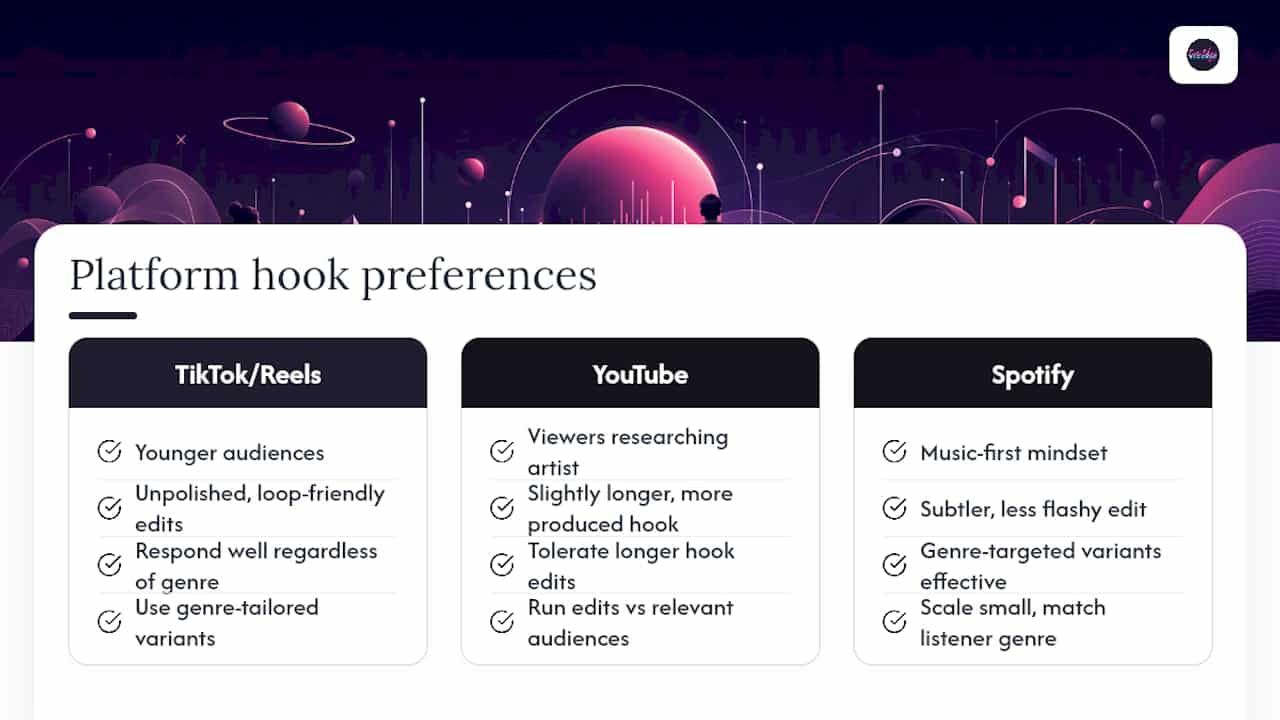
Age and platform habits also interact with music style in ways worth planning for. Younger audiences on TikTok and Reels respond well to unpolished, loop-friendly edits regardless of genre, while YouTube viewers researching an artist tend to tolerate a slightly longer, more produced hook. Spotify listeners are already in a music-first mindset, which means a subtler, less flashy edit can still perform because the platform context is doing some of the work for you.
Don’t assume one hook serves every demographic slice equally. A genre-tailored variant costs little more to produce than a single generic cut, and the Just Eat success story shows measurable fan growth tied directly to matching creative variation with audience segments.
Pairing Music With Visual Storytelling
Music and visuals should be edited together, not layered afterward. When the beat drops before the visual cut lands, or a lyric arrives half a second after the on-screen text, the mismatch is subtle but it reads as unpolished even to viewers who couldn’t articulate why.
Build your edit timeline around the music’s rhythmic structure first. Mark where the hook starts, where it peaks, and where it resolves, then cut visuals to those exact points. A cut that lands on a snare hit feels intentional even if the footage itself is simple. A cut that ignores the beat feels sloppy no matter how expensive the footage looks.
Text overlays deserve the same rhythmic treatment. Time a lyric line’s appearance to the syllable it corresponds to, not just somewhere in the general vicinity. That level of sync is what separates ads that feel produced from ads that feel thrown together, and it’s usually a five-minute fix once you know to look for it.
Color and pacing can reinforce mood established by the music, but they shouldn’t fight it. A high-energy hook paired with slow, static visuals creates the same friction as mismatched mood in messaging. Match your cut frequency to your tempo: faster songs generally want faster cuts, and a ballad-style hook usually performs better with fewer, longer shots that let the music breathe.
Tools for Editing and Syncing Music Ad Creative
You don’t need professional-grade software to produce competent hook-first edits, but a few tools genuinely make the sync work faster.
For rough cuts and quick platform exports, CapCut and Adobe Premiere Rush handle vertical formatting and basic beat-marking well, and both export directly to the aspect ratios most platforms expect. For more precise audio work, isolating stems, adjusting levels between vocal and instrumental layers, or cleaning up a rough live recording, a full DAW like Logic Pro or Ableton Live gives you the control a simple video editor won’t.
If your source track hasn’t been mixed or mastered with ad use in mind, that’s usually where edits start sounding thin once compressed for social platforms. Professional mixing and mastering produces a file that holds up better through the repeated compression every platform applies, which matters more than most artists expect until they hear the difference side by side.
For syncing text overlays precisely to lyrics, most editors now include waveform visualization, which lets you place text at the exact frame a word lands rather than guessing. Take the extra few minutes to use it. That precision is invisible when done right and glaringly obvious when skipped.
Prioritizing Music Vs Visuals: An Editorial Perspective
Spend your limited budget on mastering before production value. A pristine visual edit built on a poorly mixed track still sounds like a demo. Twisby Records exists because most indie artists need that audio foundation fixed first, faster than DIY allows.
— Kreg
How Twisby Records Turns Your Track Into Ad-Ready Creative
If you’ve read this far, you already know the bottleneck isn’t ideas, it’s execution speed. Twisby Records exists for the gap between “I know what hook to test” and “I have a properly mixed, mastered, licensed-clear asset ready to upload today.”
The team offers mixing and mastering services designed so your hook survives the compression every platform applies without turning muddy. Beyond audio, the team produces ad-ready edits and runs managed Facebook and Instagram advertising campaigns, including audience research and custom landing pages, for artists who’d rather not learn ad platforms from scratch mid-release. If your budget and timeline allow a few weeks of DIY testing, the ideas in this guide will get you moving. If you’re on a release deadline and need mastering, ad edits, and campaign setup handled by people who do it daily, that’s exactly what the advertising services at Twisby Records are built for. Start by reviewing Twisby’s full services and requesting a quote for your next release cycle.
Sources
- The Case for Dynamic Music Creative – IAB Tech Lab
- One Second Ads — The One Club / The One Show
- Lazada’s Catchy Audio Campaign | Spotify Ads
- How to Fight Ad Fatigue with Music | Kurve
FAQ
What are some catchy music ads?
The most memorable music ads tend to use instantly recognizable song snippets, sometimes just one second long, which drive rewatch behavior as viewers try to identify the track, as shown in the One Second Ads campaign.
What does ad creative mean?
Ad creative refers to the actual content of an advertisement, the video, audio, images, and copy a viewer sees or hears, as opposed to targeting settings or placement decisions.
What are some catchy ads for promoting music?
Effective music ads usually lead with a hook-first snippet of the real track, use loopable moments that reward repeat viewing, and match musical style to the audience segment being targeted, an approach validated by Spotify’s genre-targeted campaigns.
How do I know if my music ad creative is working?
Track view rate, average view duration, and stream or follower lift rather than impressions alone; for YouTube specifically, a view rate above 20% is considered good and above 30% excellent.
Should I hire help or DIY my ad creative?
DIY works if you have editing skills and a properly mastered track already; if your audio needs polishing or you’re on a tight release deadline, a service like Twisby Records’ mastering or managed advertising can close that gap faster.