

You get a booking agent by proving there is already a live business for them to grow. That means a show people pay to see, a documented draw in specific markets, a professional press kit, and a warm introduction or a well-researched pitch. Agents work on commission, so they sign artists who already make money. This guide covers what they look for, how to approach them, what to check before you sign, and how to book your own shows until one says yes.
TL;DR
- Agents take a percentage of what you earn, so they sign artists with a proven live draw, not just good songs.
- Build the case first: strong live video, show history, ticket numbers by market, streaming data and an active audience.
- A warm introduction from a manager, label contact or another artist beats a cold email, but a short, factual, personalized pitch can still work.
- Read the agreement closely: commission, length, exclusivity and what happens after you part ways.
- Until then, book your own local shows and keep your recordings and audience growth moving.
Table of Contents
- What a booking agent actually does
- Booking agent vs. manager
- Are you ready? What agents look at first
- Build a press kit an agent will actually open
- How to find agents who fit you
- How to pitch an agent
- What commission to expect and what to check in the agreement
- Perspective: the agent is the last piece, not the first
- Get your recordings and audience agent-ready
- Book your own shows while you build the case
- FAQ
- Sources
What a booking agent actually does
A booking agent sells your live performances. Spotify for Artists describes the agent as a strategic partner in your touring career: booking shows, planning tours, securing venues, negotiating ticket prices and your pay, helping shape the bill, reviewing tour budgets and handling merchandise terms. Entertainment attorney Daniel Satorius’s contract summary adds that agents identify employment opportunities and are generally your exclusive representative for securing engagements.
Notice what is missing: an agent does not build your fan base, fix your recordings or run your release strategy. They monetize momentum that already exists. That is why timing matters more than any pitch.
Booking agent vs. manager
Musicians mix these up all the time, and the order you add them matters.
| Booking agent | Manager | |
|---|---|---|
| Main job | Procures live engagements and tours | Guides overall, long-term career strategy |
| Focus | Shows, routing, fees, contracts for gigs | Business decisions, team, releases, labels |
| Paid by | Commission on engagements | Usually a percentage of broader income |
| When you need one | When you have a live draw to grow | When opportunities outgrow your time |
Spotify for Artists puts it this way: an agent handles touring and events, while a manager is the business arm of the artist and develops broader strategy. SAG-AFTRA makes a similar distinction for performers generally: managers focus on the long-term career path, while an agent’s primary function is procuring employment.
Which comes first depends on your priorities. A manager can help you get noticed by labels and agents. If your pressing need is more shows in more cities and you already have the draw, an agent may come first. Many agents also take meetings because a manager or label they trust made the call, which is one more reason the two roles often arrive together.
Are you ready? What agents look at first
Be honest here. Hypebot’s 2021 guide says an independent artist generally needs a strong live show, successful shows already played, professional branding, an active social presence and a dedicated fan base before an agent has a commercial reason to take them on. The same guide points out the plain economics: agents work on commission, so they have no incentive to represent artists who are not making money.
What does “making money” look like to an agent? Music Consultant says agents mainly assess your existing live business: how many tickets you sell and at what price, plus partner involvement, streaming, video views and social engagement. Orphiq recommends giving agents streaming numbers, social following, email-list size and, most importantly, ticket draw by market.
Run this checklist before you send a single email:
- Show history. Dates, venues, cities, attendance and ticket prices, all accurate.
- Professional live video. Full songs, good sound, a real room with a crowd.
- Draw by market. Where do people actually show up for you?
- Streaming and audience data. Monthly listeners, playlist placements, email list and social engagement.
- A plan. Where you want to tour, when, and why an agent is the next step.
- Outside signals. Press, radio, word of mouth. Bowery Presents talent buyer Sebastian Freed says hearing about an artist from multiple sources can signal meaningful momentum.
If you cannot fill most of that in yet, skip ahead to the section on booking your own shows. That is not a consolation prize. It is how most agent-ready acts get ready.
Build a press kit an agent will actually open
Hypebot’s November 2024 guide recommends an electronic press kit with professional recordings and live video, a website, an active social presence and proof of an engaged audience. Orphiq adds that a booking-ready kit should stress full-song live video, show history, ticket-sales data and live-performance press.
Keep it to one page or one link. Include:
- A two-sentence description of your sound and who it is for
- Two or three live videos, best one first
- Recent show history with cities and attendance
- Streaming and audience numbers, with dates
- Press quotes, if you have them
- One contact person and one email address
The recordings matter more than most artists think. An agent will play your music before they read your bio, and a thin mix undercuts a great live act. If the sound is the weak link, fixing it is cheaper than losing a first impression. We come back to that below.
How to find agents who fit you
Do not blast a list. Agents work with a roster, and a country act in a pitch to a metal agent is an instant delete.
Start with your peers. Look up who books the artists you play with or sound like. Spotify for Artists advises researching an agent’s roster and looking for people you know who work with them, then asking those contacts for an introduction. Agent Ali Hedrick says an introduction from someone already working with the agent gets serious attention.
Use directories and trade groups. Hypebot suggests researching agents by genre, track record, reputation and fit, using music-industry directories and trade associations.
Work the scene. Keep playing locally and build relationships with bands and promoters. Promoters and other bands know agents, and they notice who is reliable. Agents also care about their standing with venues and other artists, so they tend to listen to people they already trust.
How to pitch an agent
Hypebot recommends a concise, respectful pitch email with factual reasons you are a good fit and why you picked that particular agent, followed by restrained follow-up. Here is the structure we would use:
- Subject line: your name, genre and one proof point (for example, a sold-out headline in a named market).
- Opening line: why this agent. Name an artist on their roster you share a bill or audience with.
- Three facts: draw, recent shows, audience growth. Numbers, not adjectives.
- Links: one live video and your press kit.
- The ask: a short call, and what you are planning in the next year.
- Follow-up: one polite nudge after a couple of weeks, then move on.
ANDR Music’s April 2026 guidance on what agents need says to explain your show format, personnel, set length, technical requirements, markets, availability, travel needs and existing commitments, and to clearly separate actual history from assumptions. That last point is gold. If you say you drew 150 in Columbus, be ready to show it. Claims that cannot be checked cost you the agent’s trust for good.
What commission to expect and what to check in the agreement
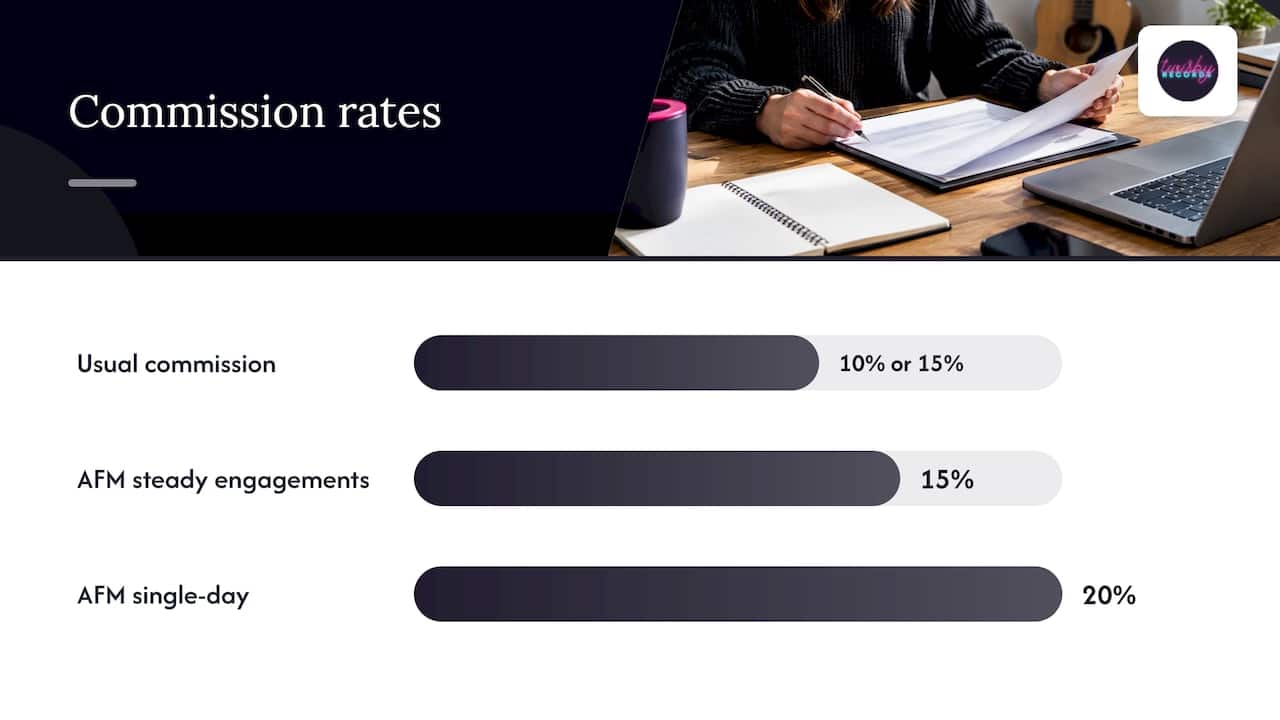
Agents are paid by commission. For union members, the American Federation of Musicians’ standard Booking Agent Agreement sets maximum commissions of 15% for steady engagements and 20% for certain single one-day engagements, due after completion and within 10 days. The same document says no commission is payable when you are not paid, unless the nonpayment was your fault, and it covers escrow for deposits and written engagement contracts. Satorius reports the usual commission is 10% or 15% of gross income from engagements.
Those figures are a guide, not a promise. Your own contract controls. Before you sign, check:
- Commission and base. Percentage of gross or net, and how it is calculated per show.
- Term. Satorius notes booking agreements commonly run three years or less.
- Book-back clause. It can let an agent collect commission on engagements contracted during the agreement even after it ends.
- Exclusivity. Which territories and which kinds of shows.
- Authority. Whether the agent can sign contracts or handle your money.
- Exit. Notice period and what you still owe after leaving.
- Capacity and experience. Who else is on the roster, and what comparable acts they have moved.
Hypebot recommends having a qualified music lawyer review any agreement. We agree. A few hundred dollars of legal review beats three years in a deal that does not fit.
Perspective: the agent is the last piece, not the first
We have spent more than 35 years in audio, and the pattern we see with independent artists is consistent. People ask us how to get an agent when the real gap is somewhere earlier: recordings that do not sound like the live show, a release with no audience behind it, or a catalog nobody can find.
An agent looks at your music and your numbers in the same sitting. If the record sounds thin, if your streaming profile looks dormant, or if there is no proof anyone beyond your friends is listening, the live pitch gets weaker no matter how good you are on stage. That is fixable, and usually in a few steps:
- Make your released songs sound as good as your best live set. Careful mixing and mastering do that.
- Grow a real audience in the markets where you want to tour, with targeted advertising that points listeners to your music and your shows.
- Document everything. Dates, draws, listeners by city, email sign-ups.
We do not book tours and we are not a substitute for an agent. What we do is help you arrive at that first email with a sound and an audience worth representing. Do the work in that order and the conversation with an agent gets much easier.
— Kreg
Get your recordings and audience agent-ready
If your music or your reach is what holds the pitch back, we can help. Mastering at Twisby Records is $50 one-off, and our work carries Apple Digital Masters certification. For tracks that need more than a final polish, we offer mixing and recording, with pricing quoted per project.
On the audience side, our Facebook and Instagram advertising packages include audience research, custom landing pages, reporting and optimization. Standard packages are $25 per month plus a 20% adspend fee, with a one-time onboarding fee of $99. Premium packages are priced at 20% per month per adspend. That kind of targeted growth gives you the streaming and audience data agents ask for. You can also start from our main site.
Book your own shows while you build the case
No agent yet is normal. Plenty of acts book themselves for years, and the experience becomes your pitch.
Flypaper’s guide to booking local shows suggests building experience through house shows, open mics or busking, then contacting suitable local venues with an honest, professional introduction: a link to your music, a description of your sound and a realistic estimate of your local draw. Ask to be considered for future opportunities, including smaller or opening slots.
The Touring as an Indie guide recommends thinking small and targeting venues and bills that fit your act. It also suggests building several smaller shows around a larger target show, and using house concerts to fill dates, meet fans, sell merchandise and earn money.
A practical routine:
- Pick three venues that book acts at your level, and one stretch venue.
- Offer a bill with two other local acts so the draw stacks.
- Record every show, count the door, and log it.
- Collect emails at every gig.
- Treat every show like a job. Spotify for Artists says exactly that, and the reliability gets noticed.
Twelve months of that gives you the show history, video and draw numbers an agent wants to see.
FAQ
Do I need a booking agent to get shows?
No. Many artists book their own local and regional shows through venues, promoters and other bands. An agent becomes useful when your draw is large enough that managing routing, negotiation and contracts costs you more time than it is worth.
What percentage does a booking agent take?
It varies by contract. The AFM’s standard agreement caps commission at 15% for steady engagements and 20% for certain single one-day engagements, and an attorney’s contract summary reports 10% or 15% as usual. Have a music lawyer review the exact terms before you sign.
Should I get a manager before an agent?
It depends on your needs. A manager guides overall career strategy and can help you attract agents and labels, while an agent focuses on live bookings. If you already have a live draw, an agent may come first. If your career has many moving parts, a manager often does.
How do I get a booking agent with no connections?
Research agents whose rosters match your genre and level, then send a short, factual pitch explaining why you chose them, with live video and numbers. Build connections in parallel by playing with other acts and working with local promoters. Introductions from people the agent already trusts are the strongest route.
Sources
- Booking Agents: How to Get ‘Em and Why, Spotify for Artists
- How to Create an Effective Team That Is an Extension of You, Spotify for Artists
- Industry Insider: Bowery Presents Talent Buyer Sebastian Freed
- Guide to finding a booking agent as an independent musician, Hypebot
- How To Find a Booking Agent for your Music, Hypebot
- Getting A Booking Agent, Music Consultant
- Finding a Booking Agent: Getting Representation, Orphiq
- Booking Agent Agreement, AFM
- The Business of Music: A Summary of Contracts, Daniel M. Satorius
- Do I Really Need a Manager if I Have an Agent?, SAG-AFTRA
- How to Start Booking Your Own Local Shows, Flypaper
- Touring as an Indie