
Your first 1,000 fans are not 1,000 followers. They are the people who stream your music on purpose, come back for each release, show up when you play, and tell someone else about you. You find them by releasing music that sounds finished, putting it in front of the right listeners with small, measured tests, and giving the people who respond a reason to stay. This guide walks through the idea behind the number, the math that gets left out, and a step-by-step plan you can start this month.
TL;DR
- The “1,000 true fans” idea comes from Kevin Kelly: fans who buy nearly everything you make, about $100 a year each, which adds up to roughly $100,000 before expenses.
- It is a framework, not a promise. Your own number depends on what you earn per fan, how many people you work with, and how well you keep fans over time.
- Start with the music itself. A mix and master that hold up on every playback system make a first-time listener far more likely to press play a second time.
- Find fans with small paid tests, track your “super listeners,” and build a way to contact people directly.
- Keep them with a steady release rhythm, a real connection, and something to buy or attend.
Table of Contents
- Where the “1,000 true fans” idea comes from
- Why the first 1,000 are the hardest
- Do your own fan math
- Step 1: Make the music worth a second listen
- Step 2: Find the right listeners with small tests
- Step 3: Spot your super listeners
- Step 4: Move people off the platform
- Step 5: Give fans a reason to stay
- A realistic first-year plan
- Our perspective
- How we can help
- FAQ
- Sources
Where the “1,000 true fans” idea comes from
In 2008, Kevin Kelly published an essay called 1,000 True Fans. His argument was that a creator does not need millions of listeners. Kelly defines a true fan as someone who will buy anything you produce and may travel 200 miles to see you. These people are different from casual fans, who might buy something once or now and then.
The arithmetic is simple. If each true fan spends about a day’s wages with you in a year, and Kelly’s illustrative figure for that is $100, then 1,000 of them produce $100,000 a year before modest expenses. He presents that as a possible living for a solo creator.
Two conditions matter, and people skip them. First, Kelly’s version counts $100 of profit per fan, not $100 of revenue. Second, the model assumes you keep that money by dealing with fans directly, without a label, publisher or other middleman taking a cut.
What a true fan is not
A true fan is not a follower who tapped a button, and not a stream from a playlist where the listener never knew your name. An academic discussion of Kelly’s work describes true fans by what they contribute: a larger share of your income and word-of-mouth promotion, while lesser fans may not buy everything or seek direct contact.
That gives you a useful test for your own audience. Ask who would notice if you disappeared for a year. Those are your early true fans, and there are usually fewer of them than your follower count suggests.
Why the first 1,000 are the hardest
The number sounds modest. In practice, it takes time, and Kelly says so himself: cultivating true fans is time-consuming and can become a full-time job. You also have to make enough every year to earn that $100 of profit from each of them.
Author John Scalzi pushed back on the idea in 2008. He wrote that reaching 1,000 supporters took him a daily audience of 30,000 to 40,000 built over a decade. He also pointed out that fans drift. A fan may stop buying when your output slows, a release misses their taste, their income drops, or life changes.
Those are fair points, and they are useful to you. They tell you where to spend effort:
- Reach. You need enough of the right people to hear you at all.
- Conversion. A small fraction of listeners will become repeat supporters.
- Retention. Fans need a reason to stay, release after release.
Most advice only talks about the first one. Plan for all three.
The income reality
It is worth being straight about where most independent musicians start. The 2015 Austin Music Census surveyed 1,883 local musicians and found that 68.4% earned less than $10,000 from music-related income in 2013. That is one city and an older data set, so treat it as a snapshot rather than a national figure. The point is that early income is usually small, and a plan built on fans you actually keep beats a plan built on one viral week.
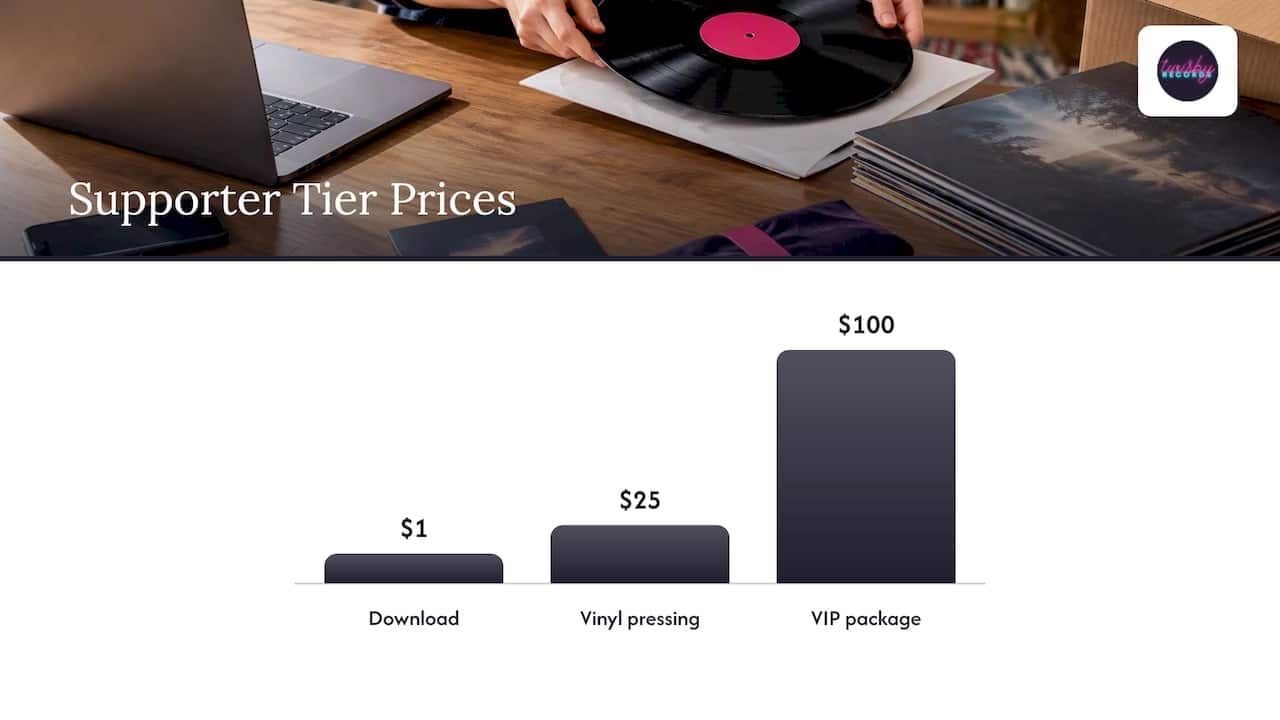
It also helps to remember that Kelly did not present 1,000 as a literal requirement. The same academic discussion notes he said needs vary by medium, and that the work you do to serve true fans also nurtures lesser fans. Another view, from an a16z essay, treats the model as a framework that can be segmented: different products at different price points for different levels of fandom. For a musician, that could mean a $1 download, a $25 vinyl pressing and a $100 VIP package, each aimed at a different kind of supporter.
Do your own fan math
Kelly’s $100 per fan is an illustration. Your numbers will differ, so run them.
- Income goal. What do you need music to cover? Maybe it is $12,000 a year for gear, studio time and ads, not a full salary.
- Profit per fan. After manufacturing, shipping, platform and processing fees, what is left from a $30 shirt or a $25 ticket? A commenter on Jonathan Coulton’s post made exactly this point: product costs, shipping and touring middlemen can shrink your net per fan.
- Fans needed. Divide the goal by the profit per fan. At $12,000 and $40 of profit per fan per year, you need 300 engaged supporters, not 1,000.
Write that number down. It turns a vague dream into a target you can measure against.
Step 1: Make the music worth a second listen
Before you pay to reach a single stranger, check what that stranger will hear. A listener gives you about thirty seconds. If the vocal is buried, the low end is muddy on earbuds, or the track is much quieter than the one before it in a playlist, they skip and rarely return.
This is the least glamorous part of fan building and the one with the most leverage. A professional mix and master do three things for you:
- They make the song translate across phones, cars, headphones and club systems.
- They put your release at a competitive level next to everything else on a playlist.
- They make you look like an artist worth following, which matters when your ads and pages are the first impression.
We master tracks for $50 each, and mixing is quoted per project through our mix quote page. If you are unsure whether a song is ready, our over-the-shoulder critique is a way to get a second set of experienced ears before release.
Step 2: Find the right listeners with small tests
Once the music is ready, you need people who might love it. The mistake we see most often is broad targeting: “music fans, ages 18 to 45, United States.” That reaches a lot of people who will never care.
Narrow it down:
- Name your closest artists. Pick three to five acts whose fans would plausibly like you.
- Run small tests. Spend modest amounts on two or three audiences and compare the results. Our guide on 1% lookalikes and $20 to $50 tests shows how to set these up using your best listeners as the seed.
- Pick the right objective. Whether you send people to Spotify or to your own page changes who you attract. We compare options in our article on Facebook objectives for musicians.
- Make short, real video. Our how-to on Instagram ads for music covers creative and setup.
- Test organic content too. A two-week experiment with shares and saves, described in our Instagram strategy for musicians post, tells you what people pass along.
Shares and saves matter more than likes for fan building, because they are what people do when they want to keep or spread something.
Use the platform’s algorithms, then help them along
Streaming platforms recommend you to people who resemble your current listeners. The tighter and more engaged your early audience, the better those recommendations get. Two of our guides go deeper: launching in a 48 to 72 hour window to give algorithmic playlists a strong signal, and how the Fans Also Like section works and how to shape it. For a broader overview, see how to increase Spotify streams as an indie artist.
One case worth reading: the artist mehro used social engagement together with Spotify for Artists tools, including Discovery Mode, to grow monthly new listeners and deepen engagement. It is one artist’s story, not a guarantee, but it shows the pattern of pairing outside attention with platform tools.
Step 3: Spot your super listeners
You do not have to guess who your early true fans are. Spotify for Artists defines “super listeners” as monthly active listeners who streamed your music on purpose 15 or more times in the last 28 days. That is about the closest platform data comes to a true fan.
The same page reports that, on average, monthly active listeners make up 33% of an artist’s total audience but drive 60% of streams and 80% of merch purchases made through the platform. A small group does most of the work. That is Kelly’s logic showing up in real data.
What to do with it:
- Check the size of your super listener group after each release and write the number down.
- Compare it to your total audience to see your rough conversion rate.
- Use your best listeners as the starting point for the lookalike tests above.
The analytics tools can show audience changes, engagement and conversion metrics, and our walkthrough of what to track in Spotify for Artists explains which numbers deserve your attention and which are noise. Also remember that popularity scores can lag by days, so avoid reacting to a dip on day one.
Step 4: Move people off the platform
Kelly’s model depends on a direct relationship. Streaming platforms do not give you an email address or a phone number. If your only link to a fan is a follow button on someone else’s service, you do not really own the relationship.
Build one simple place that does the job:
- A page with one clear action: stream, join the list, or buy.
- An email or text sign-up with a reason to join, such as a demo, an early listen or a ticket presale.
- A link in your bio that leads to that page, not to a menu of eight options. We wrote about this in Linktree alternatives that convert fans, not clicks.
A custom landing page is part of what we set up with our advertising service, so the traffic you pay for lands somewhere that captures it.
Step 5: Give fans a reason to stay
This is the retention work Scalzi’s critique points to. People leave when nothing is happening. Keep them with rhythm and recognition.
- Release on a schedule. A single every six to eight weeks keeps your name in front of fans better than one album every two years.
- Answer people. Reply to comments and messages in the first week of a release. A real reply from an artist is memorable.
- Mark milestones together. Celebrating a first anniversary, a first thousand listeners or a release date gives fans something to join. If you want ideas for that kind of community moment, these YouTube channel anniversary ideas translate well to musicians marking a milestone.
- Offer tiers. Following the segmented approach mentioned earlier, give the casual fan something cheap and the devoted fan something special.
- Show up live. Even a small local show or a livestream turns a listener into someone who knows your face.
True fans also recruit. Kelly argues they spread word of mouth and help lift regular fans’ patronage. Treat your best ten as your most valuable marketing channel and make it easy for them to share.
A realistic first-year plan
| Phase | Focus | What you measure |
|---|---|---|
| Months 1 to 2 | Finish and polish two or three songs, set up your page and sign-up | Songs mixed and mastered, sign-up page live |
| Months 3 to 4 | Release one single, run small audience tests | Cost per listener, saves, super listener count |
| Months 5 to 8 | Double down on the best audience, release again | Repeat listeners, email sign-ups |
| Months 9 to 12 | Add a paid offer or a live show for your best fans | Revenue per fan, retention after release |
The exact timeline will shift with your budget and release pace. The sequence matters more than the dates: quality first, then reach, then relationship, then revenue.
Our perspective
After more than 35 years of working with sound, here is what we tell every artist who asks about the first thousand fans: start with the record, not the reach.
We have watched artists spend good money on ads for tracks that were not ready, then decide that advertising does not work. It usually did. The song just did not hold a stranger’s attention. That is why we put mixing and mastering first, and why every track here is handled by experienced engineers working with real analog gear. Our work carries Apple Digital Masters certification, and we collaborate with each artist instead of pushing a one-size-fits-all preset or an automated process.
Once the music is ready, the job becomes about targeting and patience. Our advertising work for independent releases focuses on Facebook and Instagram campaigns, audience research, a custom landing page and clear reporting, so you can see which listeners come back. We think the artists who build lasting audiences are the ones who test small, measure honestly and keep their fans close.
You do not need a thousand people tomorrow. You need the next fifty to care a lot.
Kreg
How we can help
If your songs are ready for an audience, we can help you reach one. Our advertising service runs Facebook and Instagram campaigns for music releases, with audience research, a custom landing page, reporting and optimization. Standard Packages are $25 per month plus a 20% fee on ad spend, with a one-time onboarding fee of $99. You can see the details on our advertising page.
If the music still needs work, start with mastering at $50 a track or ask about mixing. Questions about which step fits your release? Visit Twisby Records and tell us where you are.
FAQ
How long does it take to get your first 1,000 fans?
There is no fixed answer. Kelly himself says building true fans can take enormous time, and Scalzi describes a decade of audience building. A focused artist releasing regularly and testing audiences can build a first few hundred engaged listeners much sooner, but plan in years, not weeks.
Is 1,000 followers the same as 1,000 true fans?
No. A follower costs a tap. A true fan keeps buying, listening and sharing. Spotify’s super listener metric, 15 or more streams in 28 days, is a more useful signal than a follower count.
Can I really make a living from 1,000 fans?
The math works only if each fan brings you about $100 of profit a year and you deal with them directly. Many artists need more fans or higher-priced offers. Run the numbers on your own costs before treating any figure as a target.
Should I pay for ads before I have fans?
Ad spend works best once your music is mixed and mastered and you have a page to capture interest. Start with small tests of $20 to $50 per audience, then scale what produces repeat listeners instead of one-time clicks.
Sources
- The Technium: 1,000 True Fans
- HOWTO Earn an artist’s living in the 21st century: 1000 True Fans
- Farewell to the casual music fan?
- The Problem With 1,000 True Fans, Whatever
- 1,000 True Fans? Try 100, Andreessen Horowitz
- 1000 True Fans, Jonathan Coulton
- Austin Music Census 2015
- How mehro Discovered New Fans, Spotify for Artists
- The Complete Guide to Audience Segments in Spotify for Artists
- Spotify for Artists analytics
- YouTube channel anniversary ideas