

Good mix feedback says where the problem is, what you hear and which direction you want it to go, then leaves the technical fix to the engineer. Send it as one organized batch, not a stream of texts. At Twisby Records we mix and master for independent and DIY artists, and the mixes that finish fastest almost always start with notes written this way.
TL;DR
- Give every note three parts: a timestamp, the element, and the direction (“1:20, guitar, a little quieter”).
- Describe what you hear and what you want to feel. Let the engineer choose the EQ, compression or reverb move.
- Use reference songs for direction, and say what to borrow from each one and what to leave behind.
- Collect everything into one document per round, ranked by importance, with one person speaking for the band.
- Say what you like too, so the engineer knows what not to touch.
Table of Contents
- Why feedback goes wrong
- Before you write a single note
- The three-part note
- Describe the problem, not the fix
- Use reference songs the right way
- Organize your notes into one batch
- How many rounds, and what counts as a round
- Common mistakes, and the quick fix
- Getting your next mix started
- FAQ
- Sources
Why feedback goes wrong
Most artists are not bad at hearing. They are bad at translating. You hear “the chorus doesn’t hit,” and you send exactly that. The engineer now has to guess: louder drums, a wider guitar, less vocal reverb, a different arrangement?
Two habits cause most of the trouble. The first is vagueness. Larry Crane, writing in Tape Op magazine, notes that “there’s a tick sound at 3:45” is far more useful than “something makes an odd noise in the third chorus.” He also warns that words like “warm” or “bring out” leave a mixer unsure whether to make something louder or take something away.
The second habit is the opposite: too much. Crane says four pages of notes per song leave the mixer more overwhelmed rather than aided. The goal is not more words. It is fewer, sharper ones.
There is also a trap that has a name. SonicScoop’s piece on “demoitis” describes artists who fall in love with their rough demo, then hear the finished mix as having lost the magic. After hundreds of listens, the demo feels like the song itself. Anything different sounds wrong, even when it is better.
Before you write a single note
Good notes come from good listening. Do this before you open an email.
- Listen once with no notes. Hear the mix as a fan would. Does it make you feel what the song is supposed to make you feel?
- Listen again and mark moments. Write down the exact minute and second from your player, such as 1:32, not “around 1:30.”
- Check on more than one system. Headphones, car speakers and a phone each reveal different things. A problem that shows up everywhere is real. A problem on one speaker may be that speaker.
- Wait a day. SonicScoop’s advice is to avoid listening to the demo right before the new mix, because the demo will bias you. Give your ears a reset.
- Compare against a professional release in your genre. Match the volume first, since louder almost always sounds better, and then judge the balance.
If you have not yet prepared your session, our guide on how to prep your song for mixing covers what to send so the first mix lands closer to your vision.
The three-part note
Every useful note answers three questions:
- Where? A timestamp or section name.
- What? The element: lead vocal, kick, acoustic guitar, the whole chorus.
- Which way? A direction, ideally with a rough amount: a little, a lot, just in the second verse.
| Vague note | Usable note |
|---|---|
| Something is missing in the chorus | 1:05, chorus, the vocal feels buried under the guitars. Can we make the lyric easier to follow? |
| The drums sound weird | 2:10, snare is much louder than in verse two. Can it sit closer to the verse level? |
| Make it warmer | The whole mix feels sharp on my car speakers, especially the cymbals and the vocal “s” sounds. Can we soften the top end a bit? |
| I don’t like the bass | 0:45 to 1:00, bass disappears on my phone. Can it be more audible without getting boomy? |
Notice what the right column does not do. It does not say “boost 2 kHz on the vocal.” That brings us to the most important rule.
Describe the problem, not the fix
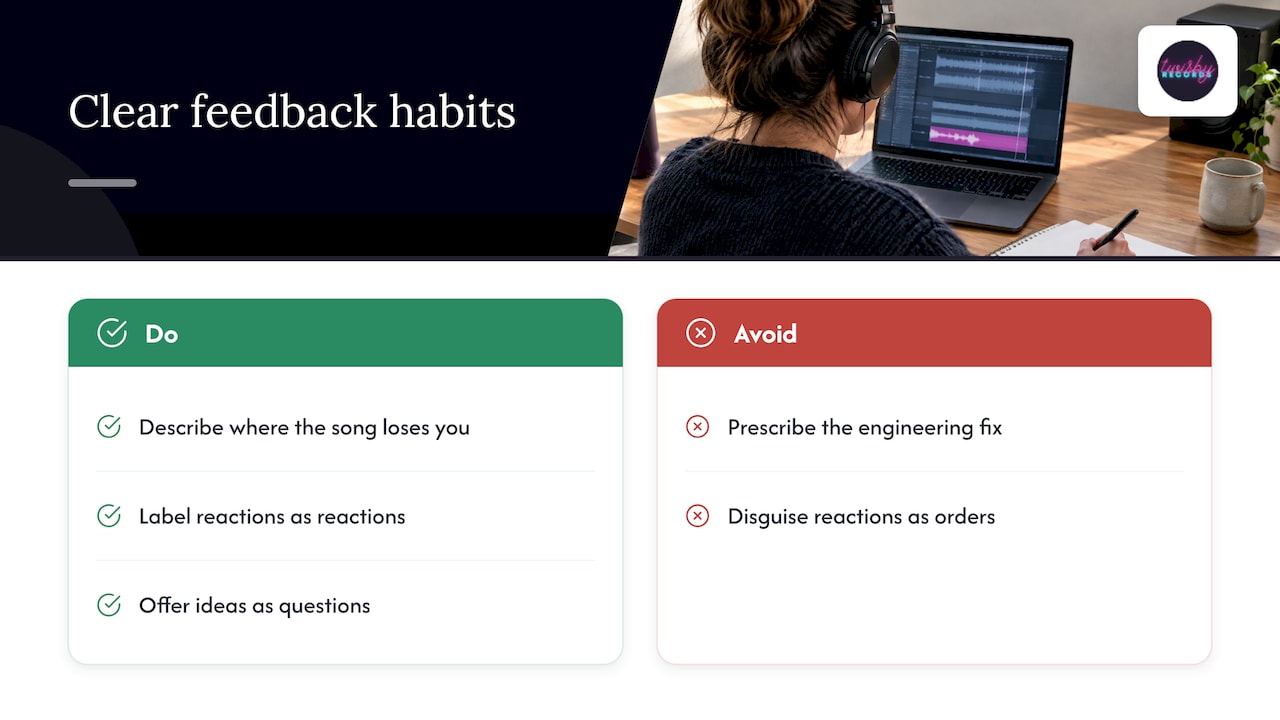
It is tempting to prescribe. You have read forum threads, you know a few plugin names, and you want to help. But you may be wrong about the cause. If a vocal feels buried, the vocal might not need more brightness at all. The guitars may be crowding it. If you ask for the wrong fix, the engineer either follows it and the problem stays, or has to spend time talking you out of it.
You are working with someone whose experience lets them hear which tool solves which problem. Your job is to be the authority on the music: what the song is about, how it should feel, where it lost you. Say “I stop believing the chorus here” and mean it. A reaction is a legitimate note. Just label it as a reaction rather than disguising it as an engineering order.
If you do have an idea, offer it as a question: “Could a longer reverb tail help the transition feel less abrupt?” That keeps the conversation open and lets the engineer say, “Yes, and here is another way to get there.”
Words that help and words that hurt
Some common descriptions translate well, and some do not.
- Helpful: “louder,” “quieter,” “further back,” “closer,” “wider,” “more aggressive in the chorus,” “I can’t understand the words,” “the bass vanishes on my phone.”
- Risky on their own: “warm,” “muddy,” “airy,” “punchy,” “bring it out,” “make it pop.” These mean different things to different people. If you use one, pin it to a place and an element: “The guitar at 1:50 sounds muddy to me.”
- Unhelpful: “It’s not there yet,” “it lacks something,” “it ruined the vibe.” Replace with what specifically feels different from your demo, such as less punch, less fullness, less excitement.
You do not need engineering vocabulary. Plain language tied to a moment in the song is better than a half-remembered technical term.
Use reference songs the right way
Reference tracks are the fastest way to show what you mean, and engineers expect them. In a 2023 exploratory study of mixing engineers’ communication (five interviews and a questionnaire of 22 engineers), 90% of the engineers said they use more than one reference song. About 42% of the time clients sent the references, and engineers found the rest themselves. And 78% passed the references they found back to the client for confirmation.
The study also found that engineers use references for direction, for A/B comparison and to understand the client’s vision, not to clone another record. One engineer put it as being interested in whether their mix feels the same, not sounds identical.
So do not just send three links. Send three links with a purpose:
- “I like how forward the vocal is in this one.”
- “I like the space around the snare here, but I don’t want my mix as bright.”
- “The low end in this track is the target for the chorus only.”
Pick songs close to your genre and era, and choose a version of each that is not heavily compressed by streaming. If a reference is a sonic world rather than a mix, such as a film composer with a unique palette, describe the texture you are after. Hans Zimmer’s signature sound is the kind of reference where you would name the feeling, scale and tone, not ask for a copy.
When you compare your mix against a reference, bring the reference down until the two play at the same loudness. Otherwise you will judge the volume, not the mix.
Organize your notes into one batch
Here is where many projects drift. Notes arrive one at a time over three days. A band member forwards a different opinion. Someone listens in the car and adds two more. The engineer is now fixing a moving target.
The cure is simple: one round, one document, one sender.
Rank what you send
Sort your notes into three buckets:
- Must change. Something is wrong: a click, a missing part, a lyric you cannot understand, a vocal that sounds distorted.
- Preference. You would like it different, but the song works without it.
- Question or idea. You noticed something and are not sure what it means. “Is the outro too long?”
This helps the engineer prioritize, and it helps you. Some preference notes disappear after the must-fix items are handled, because the mix changes around them.
One voice for the band
If you are in a band, pick one person to collect everyone’s comments and resolve contradictions before anything is sent. Crane points out that notes from several members can be so contradictory that they cancel each other out. If you truly disagree, say so plainly and say who makes the final call.
Tell the engineer what is working
Include two or three things you love. “The vocal tone in verse one is exactly right, please don’t change it” protects the good parts from well-meaning edits.
A simple template
Mix 1 notes, from Jordan (on behalf of the band)
What’s working: Vocal tone in verse one, the drum feel in the bridge.
Must change:
- 0:48, lead vocal, a little louder against the guitars.
- 3:45, there is a tick in the left channel.
Preference:
- 2:10, snare, a bit quieter in the second verse.
Question:
- Does the outro feel too long to you?
If you want a ready-made structure, we have written up five fields to include in each mix note to keep a project to a single revision.
How many rounds, and what counts as a round
A round is one consolidated set of notes followed by one updated mix. It is not a running chat. A healthy project usually looks like this: first mix, your notes, a revision, a few small notes, then approval. If you are heading into round five or six, the issue is rarely the mix. It is more often the arrangement, the performance, or a band that has not agreed on what it wants.
A few habits keep rounds short:
- State what the mix is for. “This is the first full mix. Please focus on vocal clarity and the energy into the choruses.”
- Do not reopen settled choices. Repeated listening makes familiar things feel like flaws. If you approved the drum sound in round one, ask yourself whether it is truly wrong or simply no longer new.
- Separate revisions from new work. Changing levels, balance and effects is mixing. Re-recording a vocal or rewriting a part is production, and it is a different job.
- Confirm approval clearly. Name the exact version you approve, so final delivery is built from the right file.
For a deeper look at pacing, see our playbook for finishing revisions in two rounds, and our notes on working with a mixing engineer for fast revisions. If you are working remotely, these remote mixing workflow rules apply to every file you exchange.
Common mistakes, and the quick fix
- Sending notes in pieces. Hold them until you have listened on several systems, then send once.
- Comparing the mix to the demo only. The demo has your memories attached. Compare both to a professional release.
- Writing a novel. If you need more than a page for a four-minute song, rank harder. Cut the preferences.
- Hiding the real feeling. If the song feels lifeless, say that. The engineer can work with an honest reaction far better than with a guessed technical order.
- Being too rigid. Leave room for the engineer’s creative stamp. The best mixes often include a good idea you did not ask for.
Perspective
Here is what we have learned from working with independent artists: the hardest part of a mix is rarely the technical work. It is the conversation. An artist who can say “I lose the lyric in the second chorus” gives us something to solve. An artist who says “make it better” gives us a guessing game.
That is why our work is personal rather than off-the-shelf. Our engineers bring over 35 years of experience and work on real analog gear, and our focus is creative collaboration and quick turnaround. We would rather talk through what you hear than hand you a preset result. Mixes and masters are held to Apple Digital Masters certification, and we stay available to you after delivery.
If you are unsure how to put a feeling into words, start with the moment in the song, tell us how it makes you feel, and trust us to translate. That is the job we do every day.
Kreg
Getting your next mix started
If you are ready to put these notes to work, our mixing service is built around exactly this kind of back-and-forth: you tell us what the song should feel like, and we handle the technical moves. Mixing does not have a published price, so we quote it for your project. Mastering is a flat $50 per track on our mastering page.

Once the mix is approved and the song is out, our advertising services help you find listeners on Facebook and Instagram, with audience research, custom landing pages and reporting. Standard packages are $25 per month plus a 20% fee on ad spend, with a one-time $99 onboarding fee.
FAQ
How detailed should my mix feedback be?
Detailed enough to locate and name every problem, and short enough to read in a few minutes. One line per note, with a timestamp, an element and a direction, is the sweet spot. If you are writing paragraphs for each moment, rank your notes and cut the least important ones.
What if I don’t know the technical terms?
You do not need them. Describe what you hear (“the vocal is hard to understand,” “the bass disappears on my phone”) and how you want it to feel. The engineer turns that into the technical move. Plain words tied to a timestamp beat jargon used incorrectly.
Should I send reference songs?
Yes, with a note on what you like about each. The 2023 study of mixing engineers found that most use several references to understand a client’s vision, and that references work best as direction rather than something to copy. Say what to borrow and what to leave behind.
How do I give feedback as a band without chaos?
Choose one person to collect everyone’s comments, settle contradictions internally, and send a single document. If the band truly disagrees, state the disagreement and name who decides. This stops conflicting notes from canceling each other out.
When is a mix finished?
When the remaining notes are preferences that do not change how the song feels, or when each new round creates as many wishes as it solves. Name the exact version you approve so the final files come from the right mix.
Sources
- Working With a Mix Engineer, Tape Op #158
- Curing Demoitis and Preserving the Magic, SonicScoop
- The Role of Communication and Reference Songs in the Mixing Process, arXiv