
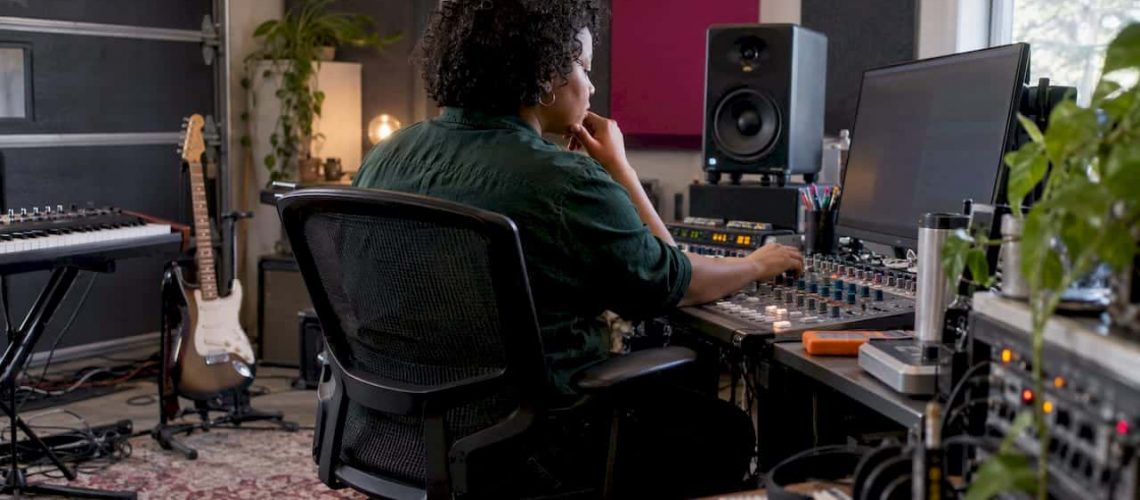

Arrangement decides what happens in your song: which instruments play, when they enter, and how each section differs from the last. Mixing takes those decisions and balances them into one stereo track. The stages overlap, but a mix can only polish an arrangement, not rescue one. If you get the arrangement settled before the mix starts, your mixing engineer spends their time on tone and depth instead of patching holes. That is the idea behind everything we do at Twisby Records, where mixing is personal work done by experienced engineers.
TL;DR
- Arrangement is the plan (parts, structure, who plays when). Mixing is the balance (levels, panning, EQ, compression, effects).
- Fix arrangement problems before mixing: a mix engineer shouldn’t have to rearrange structure or add instruments.
- If a chorus feels weak, ask first whether too many parts compete. Subtracting often beats EQ.
- Prepare your session, send clean stems, and use a reference track so revisions stay short.
- Check the finished mix on several playback systems, then move on to mastering.
Table of Contents
- Arrangement vs. mixing in plain terms
- Why the order matters
- Name the stage before you reach for a tool
- Fix the arrangement first: five moves
- Prepare the session so the mix starts on day one
- What the mix stage actually does
- Check that the mix translates
- What mixing costs and what moves the price
- When the mix is ready for mastering
- Where Twisby fits in
- Our perspective
- FAQ
- Sources
Arrangement vs. mixing in plain terms
Arranging means choosing instruments, locking down the structure and building the parts under the melody. Mixing means making those instruments sound good together using a DAW (digital audio workstation, the recording software) and tools like EQ, compression, reverb, delay and panning.
A simple example from Waves’ production guide: verse one has only guitar and vocal, verse two adds bass and drums, and chorus one adds synths and vocal harmonies. That is arrangement. Deciding how loud the guitar sits against the vocal, and how far back the synths feel, is mixing.
Berklee’s songwriting and producing handbook sums up mixing as balance: levels, left-center-right placement, frequencies (brighter or darker sounds) and depth (closer or farther away). Arrangement gives the mix something worth balancing.
| Arrangement | Mixing | |
|---|---|---|
| Main question | What plays, and when? | How do the parts sit together? |
| Tools | Writing, muting, adding or removing parts, section structure | Levels, panning, EQ, compression, reverb, delay, automation |
| Typical fix | Drop the second guitar in verse one | Cut the guitar’s low end so the vocal speaks |
| Who decides | You and your producer | Your mix engineer, with your direction |
Why the order matters
The typical pop production cycle runs songwriting, composition, arranging, mixing, then mastering. iZotope’s team notes that later steps aren’t supposed to fix what came before: a mix engineer shouldn’t have to rearrange song structure, tune vocals or bring in a new instrument. Their advice is to bounce your tracks to audio so you commit to the sounds you produced.
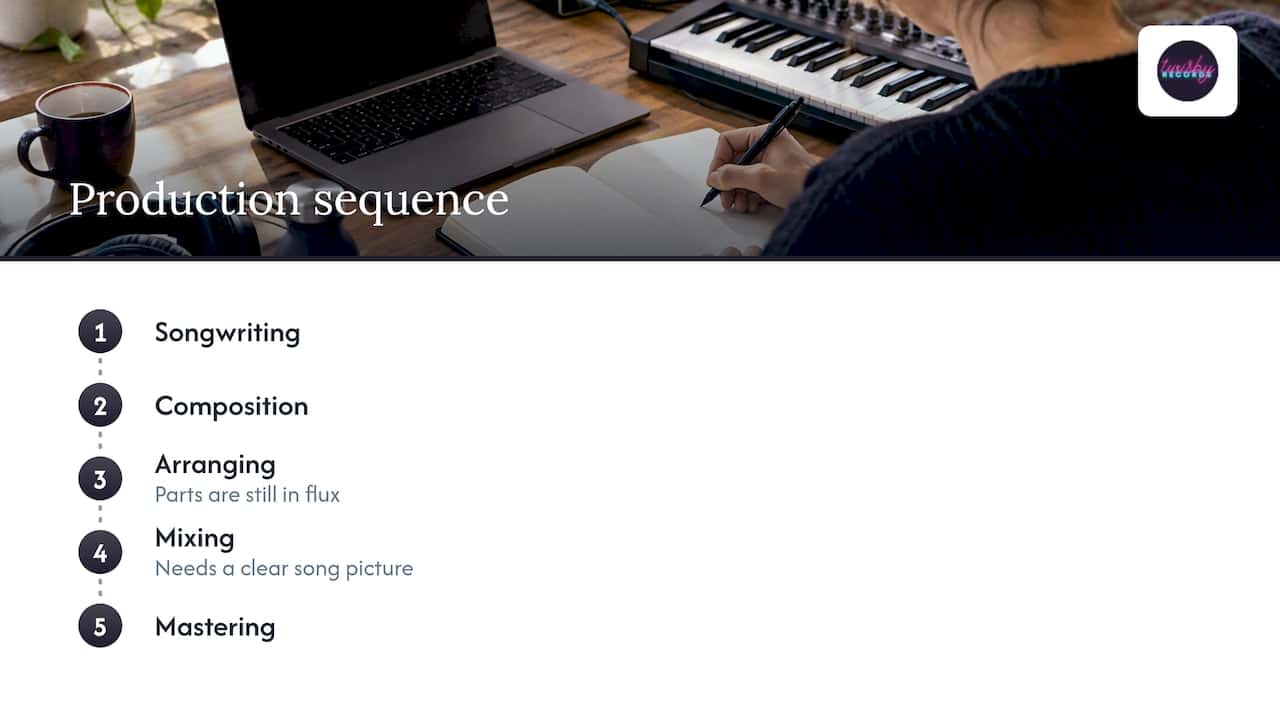
The reason is simple. While you arrange, everything is in flux. You add a part, delete it, try it again. Mixing needs a clear picture of where the song ends up, so every decision pulls the same direction.
The stages do overlap. Yamaha’s beginner guide says their order can change with the producer, genre and project. Nobody mutes a clashing synth only after the final mix. The point is to keep the overlap small and know which stage you are in.
Name the stage before you reach for a tool
Most wasted mixing time comes from solving an arrangement problem with a mixing tool, or the other way round. Open Music Business gives two clear cases:
- A chorus feels weak because too many parts compete. An equalizer can tidy the parts, but it won’t make the chorus more exciting. Removing a part will.
- A vocal is buried. Changing the level or the arrangement around it may help more than editing individual consonants.
Here is a quick way to sort your own problems.
It is probably an arrangement problem if:
- The chorus has the same instruments as the verse and doesn’t lift.
- Two parts play the same notes in the same range.
- You keep adding layers and the song gets smaller, not bigger.
- Every section feels the same length and energy.
It is probably a mixing problem if:
- The parts are right, but one is too loud or too quiet.
- The low end is muddy or the top is harsh.
- The vocal is there but doesn’t sit in the track.
- The song feels flat and close, with no sense of space.
Fix the arrangement first: five moves
1. Pick the one or two elements that matter most
Waves frames the arranger’s job as first picking the one or two elements most important to the song, then asking what could vary each section. For a singer-songwriter track that is usually the vocal and one chordal instrument. Everything else supports them.
2. Build contrast between sections
Contrast is what makes a chorus feel like a chorus. Hold parts back in verse one, add them in verse two, bring everything in for the chorus, and pull back again in the bridge. Planners of live events think the same way when they work out the order and timing of wedding ceremony music: what enters when, and how energy rises and settles.
3. Give each part its own space
If the bass and a low synth play in the same octave, no amount of mixing will fully separate them. Move one up, change the rhythm, or drop one in that section. You are making room in the arrangement so the EQ has less to do.
4. Leave it alone when it works
Waves makes a point worth keeping: sometimes the right answer is to leave a section as it is. Not every bar needs a new layer.
5. Commit your takes
Choose the takes and phrases that belong in the structure, tune what needs tuning, and bounce everything to audio. A session full of open options invites an engineer to guess, and guesses mean more revision rounds.
Prepare the session so the mix starts on day one
Once the arrangement is locked, the session needs to be ready to hand over. Sound on Sound describes a prep stage that can include checking that files match the production demo, cleaning clicks and plosives (the burst of air on “p” and “b” sounds), trimming hissy gaps and checking the timing of rhythmic parts.
A short handoff checklist:
- Name every track clearly and color-code groups (drums, guitars, vocals).
- Delete empty tracks and hide anything unused.
- Export every track from the same start point, so stems line up.
- Include a rough mix of your own, so your engineer hears your intent.
- Add a reference track, a released song in your genre whose balance you like.
- Note anything specific in writing: “vocal up in the chorus,” “keep the room noise on the guitar.”
We wrote longer guides on this: how to prep your song for mixing, eight DAW-agnostic session prep steps and a session prep checklist for artists. If you record vocals yourself, recording vocals at home covers how to deliver stems that are ready to mix.
What the mix stage actually does
There is no single correct order, but a workflow that works for most songs follows what Berklee calls the rough or static mix, then the dynamic mix.
Static balance
In the static mix, all tracks are added with levels and panning set, but no automation yet. Start with volume alone. A vocal that is too loud stays too loud, even with an excellent compressor on it. Berklee also describes building a mix bottom-up, with the rhythm section first and the lead last, or top-down, starting with the lead vocal, which is common for singer-songwriter material.
Sound on Sound reports that several engineers work on the biggest section first. One mixer says starting at the chorus shows how far you can push everything and reveals arrangement problems in the verse. This is a good reminder that the mix will expose the arrangement, so it helps to hear that early.
EQ, compression and space
Splice’s mixing guide says EQ corrects a sound, such as boosting highs for vocal clarity or cutting harshness. It also creates space, so a bass guitar and kick drum each own their own frequency range. Compression reduces dynamic range by bringing down only the parts that exceed a threshold.
Avid’s mixing guide adds that compression can add punch to drums or bass, and reverb creates the illusion of distance, placing supporting elements further back so the mix holds together.
Dynamic mix and automation
The dynamic mix stage is when the engineer automates levels, panning and muting over time and brings in additional effects. This is where a chorus lifts and a quiet bridge breathes. Good automation follows the arrangement: if you wrote a build into the second verse, the mix should enhance it, not flatten it.
Check that the mix translates
A mix that sounds great in one room may fall apart in a car. Sound on Sound’s Sam Inglis names a lack of balance across the frequency spectrum as the most common issue he hears. Typical causes are poor monitoring, headphone-only listening, or not comparing against good mixes in the same genre. He suggests checking on consumer systems such as a boombox, car stereo or smart speaker, so the bass and kick stay audible without piling on 50 Hz until the speaker distorts.
Producer Milo Burke recommends level-matching your mix against professionally engineered mixes in the same genre before comparing, then running the car test, good headphones, cheap earbuds and a tabletop speaker. You can’t make a mix perfect everywhere, but you can make it as good as possible on as many systems as possible.
A practical routine:
- Listen on studio monitors or good headphones.
- Play it on earbuds and your phone speaker.
- Play it in your car.
- Switch to mono and listen for parts that vanish.
- Compare to your reference at matched volume.
If the bass is too much everywhere, the mix needs adjusting. If it sounds odd on only one device, that device is probably the cause.
What mixing costs and what moves the price
Prices vary widely by engineer and song. A Tape Op feature on working with a mix engineer describes a per-song rate with extra costs based on song length, track count, speed and extra revisions. Some mixers include unlimited revisions and others include two or three, so agree on deliverables, such as instrumentals or vocal-up versions, in advance.
That is where arrangement pays off in money terms. A clean arrangement with fewer, well-recorded tracks is quicker to mix, and a locked structure means fewer revision rounds. Our own guides go deeper on how mixing and mastering are priced, mixing costs for DIY artists and how many mix revisions you actually need. For help working smoothly with an engineer, see mixing engineer collaboration.
When the mix is ready for mastering
Mixing balances the parts inside the song. Mastering finalizes the finished stereo file for release: overall level, consistency and delivery format. Put a light touch of EQ or compression on the master bus while mixing if you like, but that is not mastering.
A mix is ready to master when the arrangement is locked, the balance holds on your check systems, and you have stopped hearing things to fix and started hearing things to change for taste. Leave a little headroom on the file instead of slamming it to the ceiling, and hand it over for mastering.
Where Twisby fits in
If you have your arrangement locked and want it mixed, we mix remotely and personally. Our engineers have more than 35 years of experience, and we use real analog gear alongside Apple Digital Masters certification. Mastering is $50 one-off per track, and you can see the details on our mastering page. Mixing has no published price because it depends on the song, so request a mix quote with your track count and reference. We also offer remote vocal production and recording, and our mixing service is built around creative collaboration and quick turnaround.

Once the song is out, we can also help people find it. Our advertising packages run targeted Facebook and Instagram campaigns for music releases, with audience research, custom landing pages and reporting. Standard Packages are $25 per month plus a 20% adspend fee, and there is a one-time $99 onboarding fee.
Our perspective
Most of the mixes that give us trouble are not mixing problems. They are songs where two parts fight for the same space, or a chorus that never got a lift in the arrangement. We would rather talk about that before we touch a fader.
That is why we work personally with each artist. We listen to your rough mix and your reference, ask what you want the listener to feel in the chorus, and then mix toward that. Our approach is built on creative collaboration, real analog gear and fast turnaround, not off-the-shelf or AI-driven presets, because every song’s balance is different.
Our advice to independent artists: lock the arrangement, bounce your tracks, send a clean session with a reference, and let the mix do what it does best. Then master it, release it, and put your energy into getting it heard.
Kreg
FAQ
What is the difference between arranging and mixing a song?
Arranging decides which instruments and parts play in each section and how the song is structured. Mixing balances the recorded tracks into a stereo file using levels, panning, EQ, compression and effects. Arrangement comes first and gives the mix its material.
Can a mix fix a bad arrangement?
Only in part. EQ and levels can clean up competing parts, but a mix engineer shouldn’t have to rearrange structure or add instruments. If the chorus doesn’t lift, removing or changing parts is usually more effective than processing them.
How should I prepare my tracks before sending them to be mixed?
Name and color-code your tracks, delete empty ones, clean clicks and plosives, export every stem from the same start point, and include a rough mix and a reference track. Our mix prep guide walks through each step.
Is mixing the same as mastering?
No. Mixing balances the parts within a song. Mastering finalizes the completed stereo file, covering overall level, consistency and delivery. Mastering at Twisby is $50 one-off.
Sources
- What is Audio Production? (iZotope)
- Mixing While Producing Music: Good or Bad Idea? (iZotope)
- Making Music: The 6 Stages of Music Production (Waves)
- Berklee Online Songwriting and Producing Music Handbook
- Music Production for Beginners (Yamaha)
- Demo vs Final Mix: Knowing When to Stop (Open Music Business)
- How To Start A Mix (Sound on Sound)
- How to Mix Music (Splice)
- How to Mix Music (Avid)
- 10 Essential Mix Checks (Sound on Sound)
- 10 Steps to Mixes That Translate, Part 2 (Milo Burke)
- Working With a Mix Engineer (Tape Op #158)
- Wedding Ceremony Music: Order, Timing and Song Ideas