

A mix engineer takes the tracks you recorded and turns them into one finished song: balanced, clear and ready for mastering. They do not rewrite your arrangement or rescue a weak recording, and the best results come when you know where your job ends and theirs begins. At Twisby Records we have more than 35 years of experience behind our mixing, and this guide covers what the process looks like, what you hand over, how feedback works and how long it takes. If you want a mix quote while you read, it’s one click away.
TL;DR
- A mix engineer balances and shapes your individual tracks. Mastering is a separate, later step that polishes the finished stereo mix.
- Send a finished arrangement, clean and clearly labeled files, a rough mix and a few reference songs.
- Give one set of prioritized notes per round, from one decision-maker, with timestamps.
- A first mix usually takes days, not hours, and messy sessions take longer.
- Agree scope, revisions, delivery files and payment in writing before work starts.
Table of Contents
- What a mix engineer actually does
- Mixing vs. mastering: where one stops and the other starts
- Realistic expectations: what a mixer can and cannot do
- What to prepare before you hand off your session
- How the process works, step by step
- How to give feedback that gets results
- What to confirm in writing before work begins
- How long a mix takes
- What mixing costs
- Our perspective
- Taking the next step with Twisby Records
- FAQ
- Sources
What a mix engineer actually does
Your song exists as separate recordings: vocals, drums, bass, guitars, keys. Mixing is the job of making them work together. The engineer sets levels, places each part in the stereo field with panning, shapes tone with EQ, controls dynamics with compression and adds space with effects such as reverb. iZotope’s guide to mixing and mastering describes mixing as exactly this: balancing and shaping individual tracks.
In practice that means solving problems you may already hear but cannot name:
- The vocal sits too far back or sticks out of the track.
- The kick and bass fight over the same low frequencies.
- Guitars and keys mask each other so neither feels clear.
- The chorus does not lift the way it did in your head.
A good mix also serves the song. The engineer’s taste matters, but the goal is to bring out the lyric and the feel you intended, not to put a signature on it.
Mixing vs. mastering: where one stops and the other starts
Mastering comes after the mix. It works on the finished stereo file as a whole, not on individual tracks. Its job is final polish, consistent level and tone across a release, and correct files for distribution. According to iZotope, mastering works predominantly on that finished stereo mix.
The practical consequence: a mastering engineer cannot turn the vocal up or pull the bass out of the guitars. If the balance is wrong, it has to be fixed in the mix. That is why the order matters: record, mix, then master.
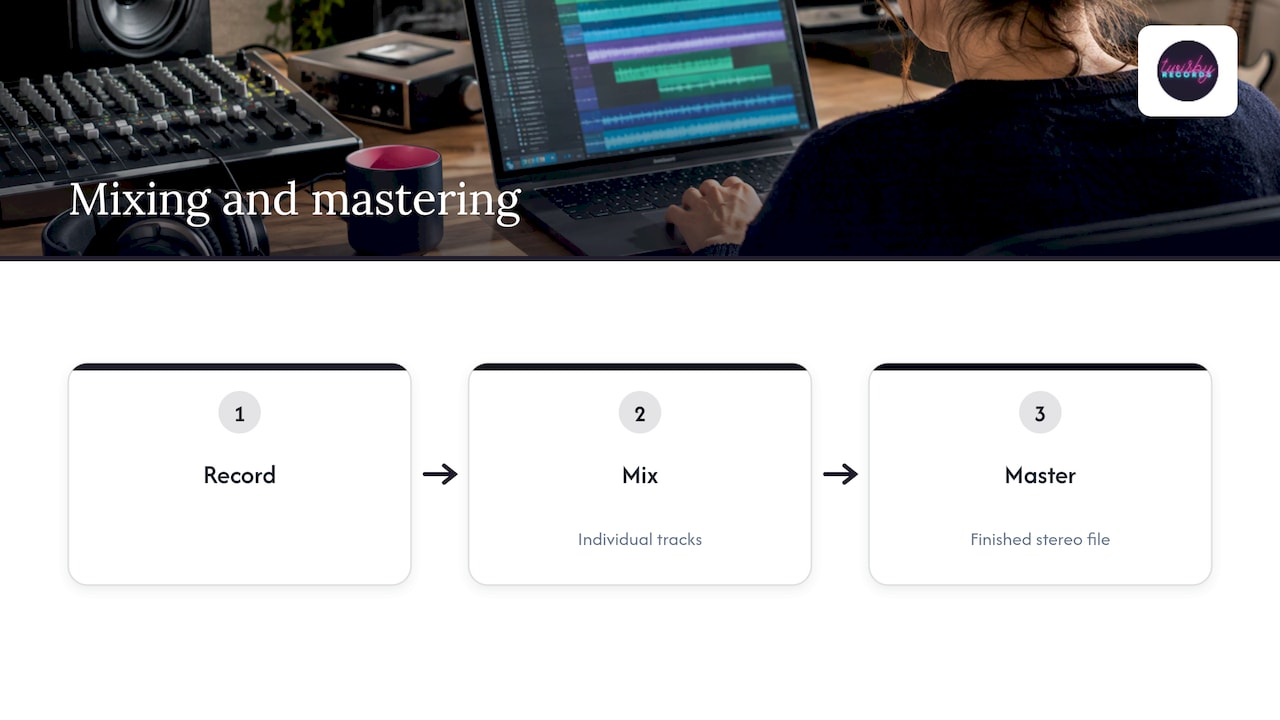
Our mastering service is $50 per track, and our work carries Apple Digital Masters certification, which matters if you want your release delivered to Apple Music in high quality. If you send us a song for mixing, you can keep both steps with the same engineers.
Realistic expectations: what a mixer can and cannot do
Mixing is not magic. In a Tape Op interview on working with a mix engineer, the engineer explains that the job is to work with the material provided, further define and balance a well-tracked project, and get the best presentation out of what is there. The same interview makes the point that a mixer should not be expected to transform a haphazard recording into a completely different high-end production.
Here is what that means for your session:
A mixer can: balance your parts, fix tonal clashes, tighten dynamics, add depth and width, and make the song translate to earbuds, car speakers and club systems.
A mixer should not be expected to: write new parts, replace a performance that was never right, or make a rushed vocal take sound like a different singer.
The better your recording, the more the engineer can spend on the creative decisions rather than on repair. If a vocal take is the weak point, record it again before you send the session. We offer remote vocal production for exactly this stage, so you can get a stronger take without booking a studio across the country, and we occasionally partner on in-person recording in Pittsburgh. Our recording page has the details.
What to prepare before you hand off your session
The single biggest lever you control is preparation. Production Expert’s hand-off guide, published October 2026, recommends settling the arrangement and performances before you send files, so no new parts appear during the mix.
A solid hand-off looks like this:
- Lock the song. Arrangement, performances and tuning decisions are finished. Changing a verse after mixing starts means starting that work over.
- Clean the tracks. Remove stray clicks, pops, edit bumps and edits without crossfades.
- Label everything. “Lead Vox,” “Vox Dbl L,” “Kick In” beat “Audio 14.”
- Ask about format. Confirm what file type the engineer wants and whether to send tracks dry or with your effects printed.
- Send a rough mix. It shows what you have been hearing and where the song’s energy is supposed to go.
- Add references and notes. Two or three songs you like, plus a sentence on what you like about each, and anything you want changed from your rough.
If you are exporting from your own session, our guides on how to export stems for mixing and sending 24-bit stems walk through the technical side. If you want to save time before you send, the eight mix prep steps work in any DAW, which is the software you record in.
Why references help more than adjectives
Words like “open,” “warm” or “punchy” mean different things to different people. Engineers interviewed by HighNote recommend an early conversation about sonic vision and references, and asking questions when a description is ambiguous rather than assuming both sides mean the same thing. A reference track plus a timestamp (“the low end at 0:45 in this song”) removes the guesswork.
How the process works, step by step
The details differ from engineer to engineer, but a professional mix project follows a recognizable path.
1. Scope and quote
You describe the song or songs, the track count and your goals. The engineer replies with a price and timeline. Mixing is quoted per project at Twisby, so you request a mix quote rather than choosing from a fixed menu.
2. File transfer
You send your prepared session or stems, the rough mix and references. Using one agreed channel for this, such as a shared folder and one email thread, keeps files from getting lost.
3. First mix
The engineer builds the balance, makes tonal and dynamic decisions and sends a first version. Listen several times, on different speakers, before you write back. Your first reaction on the first play is often about novelty, not quality.
4. Feedback and revisions
You send notes, the engineer adjusts and sends the next version. This loop continues until the mix is right.
5. Approval and delivery
You confirm the final mix explicitly, and the engineer delivers the agreed files. Then the song goes on to mastering.
How to give feedback that gets results
Revision rounds go quickly when the notes are clear. The sources agree on a few habits:
- One person, one document. Tape Op’s interviewed engineer recommends a single consolidated email or document for each round, instead of conflicting notes from several people. Geoff Swan, in an interview with Unstoppable Recording Machine, makes the same case for a lead point of contact who reconciles opinions before they reach the engineer. If your band has four members, decide who sends the notes.
- Start with the three biggest issues. Production Expert suggests prioritizing the three largest problems on the first pass and saving finer details for later rounds.
- Use timestamps or lyric references. “The second chorus needs the vocal louder at 2:14” is something an engineer can act on. “Make it more exciting” is not.
- Describe what you want to hear. Say “the snare should cut through the guitars” rather than “change the EQ on the snare.” You pick the result, the engineer picks the tool.
- Say when you approve. A clear “this is final” avoids confusion about whether another round is coming.
A worked example: you receive the first mix and notice the vocal is buried in the last chorus, the bass feels thin and the intro drums are too loud. That is three notes, each with a timestamp. Send those, listen to the next version, then deal with the smaller points. Compare that with ten scattered notes sent by four people over three days, some contradicting each other. The first path gets you a finished mix faster.
What to confirm in writing before work begins
Most disputes in mixing come from assumptions, not bad faith. Open Music Business’s guide to working with mix engineers lists the points to agree on in advance:
| Item | What to confirm |
|---|---|
| Scope | Which songs and which services are included |
| Supplied files | What you will send and in what format |
| First mix date | When you will hear the first version |
| Feedback method | How you will send notes and to whom |
| Revisions | What counts as one revision and how many are included |
| Payment | The schedule and what is due up front |
| Final files | Which formats you receive |
| Alternate versions | Instrumental, clean, TV or a cappella versions, if you need them |
| Stems or session | Whether they are included and what software or plug-ins they depend on |
The stems point catches many artists. Stems are grouped submixes of your song, such as all drums as one file. They are not automatically included, and the same guide cautions you to check whether delivery is stereo only or includes extra versions. If you plan to license the song for sync or want a live backing track, ask for instrumentals and stems up front.
Spelling out fees, usage and delivery terms in writing is normal across creative industries. The way SAG-AFTRA commercial usage fees are laid out for advertising work shows how much clarity about scope and payment helps everyone.
How long a mix takes
Plan in days, not hours. Mike Senior of Sound On Sound writes in a Q&A on how long to spend on a mix that a pure mixing job should not take more than a couple of days, while large chart-targeted productions can need two or three. Projects that include editing and fixing tracking-stage problems typically run three to five days.
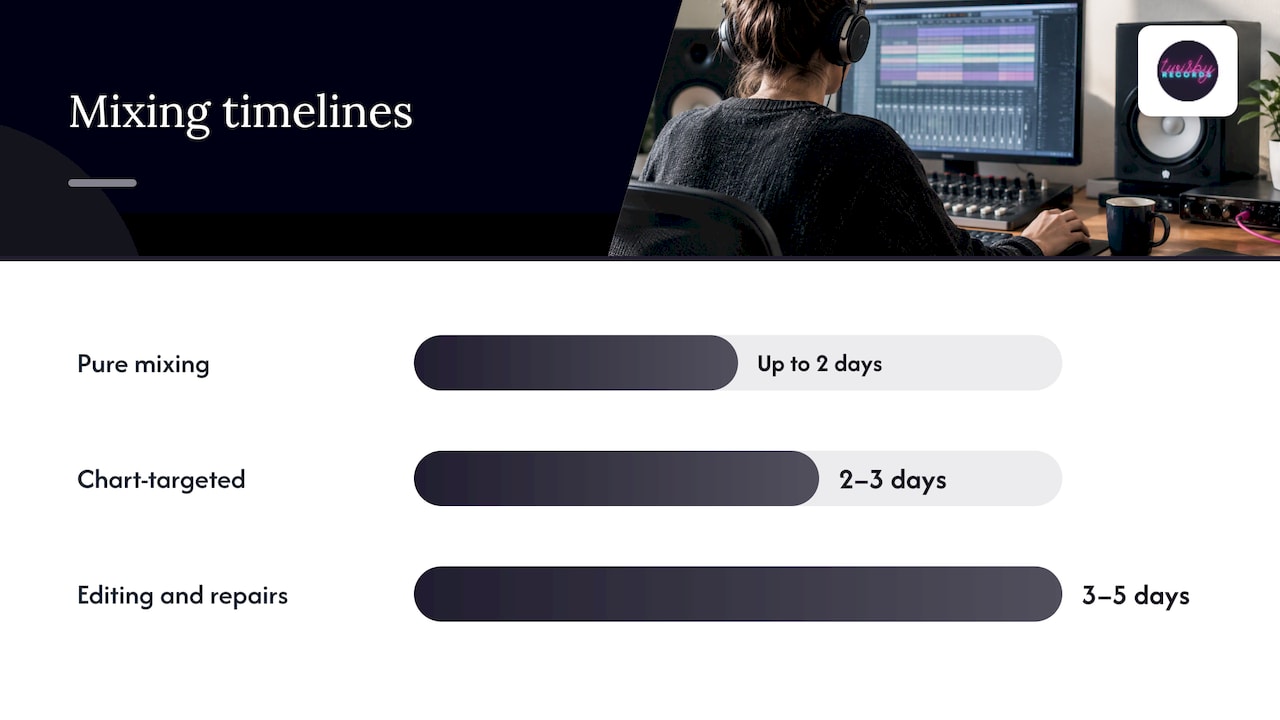
He also explains why the range is so wide: the engineer turns the supplied recordings into a finished product, and every tracking-stage miss, such as untuned vocals, missing doubles, worn drum heads or the wrong guitar tone, costs time to work around. Poorly prepared sessions take far longer.
Three things move your timeline:
- Track count and complexity. A sparse acoustic song moves faster than a 60-track production.
- Session condition. Clean, labeled, edited files save the engineer time. Raw files with noise and untidy edits add setup and repair work.
- Feedback speed. The clock stops while the engineer waits for your notes.
Quick turnaround and creative collaboration are what our clients tend to mention in their testimonials. Ask for a timeline in your quote and plan your release date around it, with a few extra days for revisions and mastering.
What mixing costs
Mixing prices vary widely with the engineer’s experience, the track count and the work required. Because those factors differ for every song, we quote mixing per project instead of publishing a flat rate. Mastering is a fixed $50 per track. Send us the song details through the mix quote page and you will see the figure for your project before anything starts.
What to ask yourself when comparing quotes: what is included (revisions, stems, alternate versions), when the first mix arrives and who is actually doing the work. Our guides on how to hire a mixing engineer and how to choose the right one go deeper on this.
Our perspective
Most of the frustration artists feel about mixing comes from an expectation gap, not from the engineer’s skill. The artist expects a transformation. The engineer expects a well-prepared session and clear direction. Close that gap and the whole process gets easier.
That is why our work is personal. Every song is mixed by an experienced engineer using real analog gear, with a focus on creative collaboration, quick turnaround and support after delivery. We do not run songs through an off-the-shelf or AI-driven chain. Independent artists have a specific sound and a specific audience, and the mix should reflect both.
We keep the pipeline in one place for a reason. Mixing, mastering with Apple Digital Masters certification, remote vocal production and, when you are ready, advertising for your release all connect. The mixer who knows what you want your song to do can set up the master. The same team can then help the release reach listeners through targeted campaigns.
Our advice: prepare well, give clear notes, and pick a partner who talks to you before they touch a fader.
Kreg
Taking the next step with Twisby Records
If your song is recorded and the arrangement is locked, you are ready to start. Tell us about the track, and we will quote the mix and walk you through the steps above. When the mix is approved, the same engineers can master it for $50, and when you are ready to release, we run Facebook and Instagram ad campaigns for music releases, with audience research, custom landing pages and reporting. Standard advertising packages are $25 per month plus 20% of ad spend, with a one-time $99 onboarding fee. Details are on our advertising page.

Start with the mixing service page or go straight to the quote form.
FAQ
Does a mix engineer fix a bad recording?
A mixer can improve balance, tone and dynamics, but the job is to present what you recorded in its best light. Per the Tape Op interview, they should not be expected to turn a haphazard recording into a different, high-end production. If a performance is weak, re-record it before mixing.
Do I need a mix and a master?
Yes, they are two different steps. Mixing balances individual tracks, and mastering polishes the finished stereo file and prepares it for distribution. Doing both on a release gives the song its best chance of sounding consistent everywhere.
How many revisions should I expect?
That depends on the agreement, so define it before you pay. Ask what counts as one revision and how many are included. You will get faster results by sending one consolidated set of prioritized notes per round rather than many small requests.
Will I get stems or the session file?
Not automatically. Open Music Business advises confirming whether you receive stems or a native session, and what software or plug-ins it depends on. Ask for instrumentals or other alternate versions at the start if you will need them.
How long will my first mix take?
Expect days rather than hours. Sound On Sound’s Mike Senior puts a pure mixing job at a couple of days, with repair-heavy projects running three to five. Clean, labeled files and quick feedback shorten the whole process.
Sources
- Working With a Mix Engineer, Tape Op #158
- How To Work With A Mix Engineer: The Art Of The Hand-Off, Production Expert
- What is the difference between mixing and mastering?, iZotope
- Expert mix engineers give their advice on building strong partnerships with artists, HighNote
- Geoff Swan: Mixing for Pop’s Biggest Artists, Unstoppable Recording Machine
- Working With Mix Engineers, Open Music Business
- Q. How long should I spend on a mix?, Sound On Sound
- SAG-AFTRA Commercial Usage Fees: 2026-27 Rates Explained