


Re-record a vocal when the problem is in the performance (flat emotion, unclear words, a drifting feel) or baked into the recording itself (clipping, a bad room, printed effects). Keep the take when the problem is pitch or timing on a few notes, because those are fixable in editing and mixing. Before you decide, work out which kind of problem you have. Many artists burn out their voice on endless retakes when the real culprit was mic position or input gain. If you send us a take and are not sure, our mixing and mastering engineers can tell you which side of the line it falls on.
TL;DR
- Re-record when the delivery is tentative, a key word is unclear, the feel keeps drifting, or the take is clipped or has effects printed on it.
- Keep and fix a take when only a few notes are off-pitch or a few entrances are early or late.
- Fix mic distance, gain and monitoring before you sing again. A new take cannot cure a production problem.
- Stop at three to four hours of singing in a day. A tired voice makes worse takes, not better ones.
- Record dry (no reverb or delay printed in) so one flawed effect never forces a full redo.
Table of Contents
- First ask: is it the performance or the recording?
- Signs you should re-record
- When to keep the take and fix it instead
- Protect your voice so the next take is the good one
- Record dry so one mistake never forces a redo
- Matching the sound when you re-record on another day
- When you cannot tell: get an engineer’s ear
- Work with Twisby on your vocal
- Our perspective
- FAQ
- Sources
First ask: is it the performance or the recording?
Every re-record decision starts with one question: is the problem in what I sang, or in how it was captured? Performance problems are inconsistency, uncertainty and a lack of intention. Production problems are mic position, gain staging and monitoring. A simple test: if moving the mic or lowering the gain makes the problem vanish, it was never the performance.
This matters because a new take only helps with the first kind. If your vocal sounds boxy because you were sitting two inches from a bare wall, a fifth take in the same spot will sound boxy too, and your voice will be tired when you finally fix the setup. Stop, diagnose, adjust, then record.
A practical way to do it:
- Listen back the next day if you can. In the moment you are listening to yourself, not to the song.
- Write down the exact spot and the problem in plain words, such as “late entrance in the second chorus” or “the word ‘leave’ is mushy.”
- If you cannot name a moment or say what it stops the line from doing, keep the take for a first mix.
- If you do re-record, describe the fix in one sentence first, such as “warmer, closer, less push.” Each new take should have a target.
Signs you should re-record
The delivery never arrives
If the lyric is unclear, the emotion is flat, or the line feels tentative in every take, record it again. Editing can lock in a performance whose musical intention is already obvious. It cannot add intention that was never sung. As one producer-focused guide puts it, there is no plugin for “the performance doesn’t say what you mean.” Stitching one strong line out of several mediocre fragments also tends to take longer than one more focused pass.
A critical word is lost
A diction problem inside a full mix is often a mix or arrangement fix. A diction problem when the vocal is exposed, such as an intro or a stripped-back verse, calls for a new take. Breath problems and delivery problems fall in the same bucket, according to one analysis of how engineers judge a take.
The feel drifts the whole way through
Human singers do not land perfectly on the grid. The same analysis notes that a sung take sitting on the grid more than roughly 70% of the time is unusual, and above 85% is very hard to reach without editing. So do not chase perfection. A few late or early entries can be nudged. A feel that drifts from start to finish is a re-record, ideally against a click you can hear clearly in your headphones.
The take is clipped
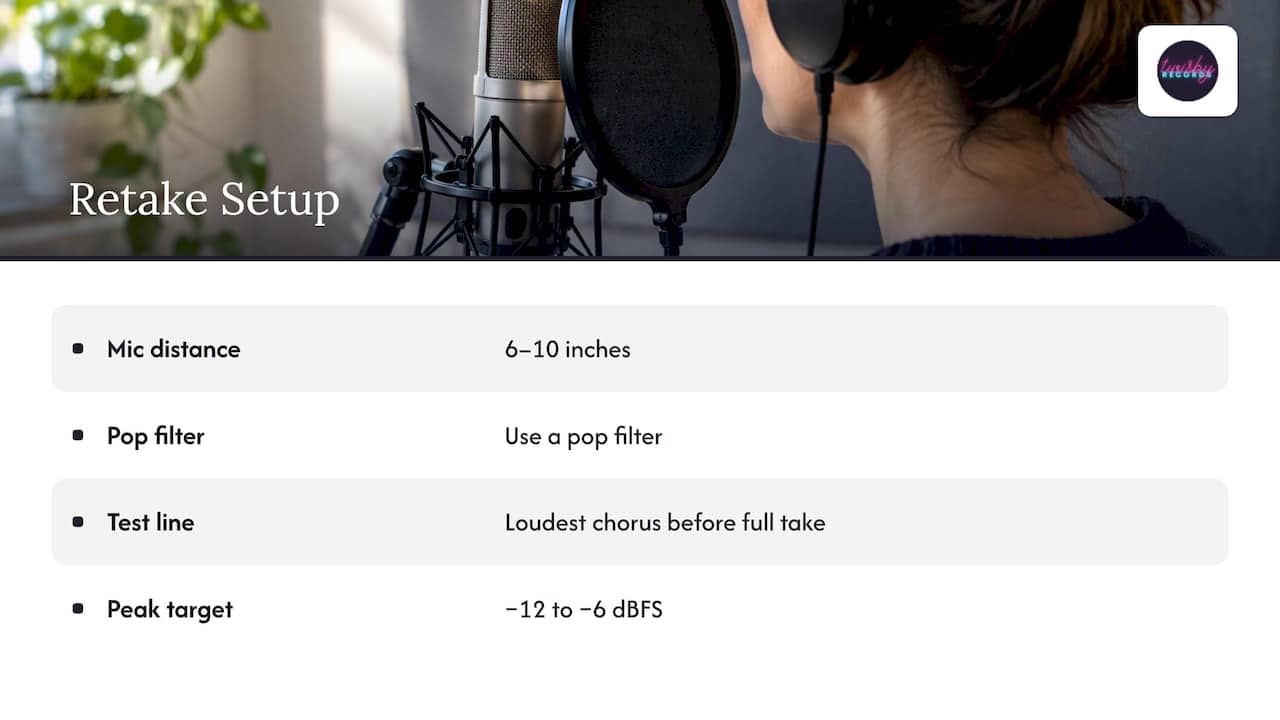
Flat-topped peaks or harsh distortion on loud notes mean the input was too hot. Once a vocal has clipped, you cannot mix it back to clean. A vocal problem guide recommends re-recording about 6 to 10 inches from the mic, with a pop filter, and with input gain set so loud notes peak around -12 to -6 dBFS (decibels relative to digital full scale, the point where digital audio clips). Test your loudest chorus line before you commit to a full take, because a quiet verse cannot tell you whether a shouted chorus will stay clean.
The room or the effects are stuck in the audio
A vocal recorded in an untreated room and peaking at 0 dBFS cannot be mixed into a clean sound. Printed reverb or delay cannot be removed later either. These are the cases where the honest fix is a new recording, after you fix the room and the settings.
When to keep the take and fix it instead
Re-recording is not always the answer, and a second performance will differ from the first in weight and pace. If the first take had the right feeling, protect it. A slightly pitchy take with the right emotion often beats a technically flawless one with none.
| Problem | Usually | Why |
|---|---|---|
| A few off-pitch notes | Keep and tune or punch in | Pitch is the most editable thing about a vocal |
| A few early or late entries | Keep and nudge | Small timing moves are routine editing |
| Consistent timing drift | Re-record against a click | The feel itself is off |
| Unclear words in a busy mix | Keep, fix in arrangement or mix | Context often hides it |
| Unclear words in an exposed spot | Re-record that phrase | Nothing hides it |
| Flat or tentative delivery | Re-record | Editing cannot add emotion |
| Clipping | Fix gain, then re-record | Distortion is permanent |
| Reverb or delay printed in | Re-record dry | Effects cannot be undone |
If tuning is the plan, how you capture the vocal affects how clean the result sounds. Our guide on preparing vocals for tuning covers that, and vocal pocketing shows how tight timing can be built without killing the feel.
When you do comp (build one vocal from several takes), preserve the best pass as a safe copy before you try an alternative, and give every extra take a purpose: a stronger emotional read, punchier consonants, or tighter rhythm.
Protect your voice so the next take is the good one
Most bad re-records come from a tired singer. Voices, especially untrained ones, tire quickly, and Sound on Sound’s vocal recording guide suggests aiming for five or six takes rather than dozens. It also suggests punching in on the weak phrase instead of singing the whole song again, and recording the hardest high notes or biggest choruses early, before the voice fades.
Some limits worth planning around:
- Berklee Online advises sleeping well for at least two nights before a session, not talking too much or rehearsing heavily two days before, and not booking more than three to four hours of vocal recording in a day. After about three hours the voice is fatigued and takes waste time and money.
- iZotope’s comping guide suggests one full take first as a warm-up and template, then three to four takes of each section. Far more than that risks fatigue and takes with little variation between them.
- Warm up, but do not overdo it. Recording cold gives stiff first takes, and an over-warmed voice tires fast.
- For a section you have repeated more than twice, rehearse it at low volume and save your full voice for the takes that count.
A stronger voice also records better take after take. If you want a routine for building one, these exercises to train your voice are a solid place to start.
A common trap: if you keep singing into an uncorrected production problem, you create real vocal fatigue on top of it. Then you cannot tell the original flaw from the tiredness. Fix the setup first.
For a full walk-through of a session, see our guides to recording vocals like a pro and our session prep checklist.
Record dry so one mistake never forces a redo
The cheapest way to avoid a re-record is to avoid printing effects. If reverb or delay is baked into a take and either the effect or the lyric turns out wrong, the whole line has to be sung again. Produce Like A Pro advises recording dry unless there is a specific creative reason not to. Printed tails get chopped when you edit breaths and comp, and it is easier to EQ a full-frequency vocal later than to restore frequencies you cut at the start. Keep EQ on the way in light, perhaps just a high-pass filter.
You can still hear reverb or compression in your headphones so the performance feels good. Just capture the clean signal underneath. If an effect is truly part of the performance, print it, but record a clean safety take too.
Matching the sound when you re-record on another day
If you need to replace a line days later, the new take must sit next to the old one. Use the same mic, the same position and distance, the same preamp and gain, and the same room if you can. Keep levels close from day to day so the takes edit together. Note your settings at the end of every session, including the distance from the mic and the input gain. Our home vocal recording guide shows how to get stems ready for mixing, and vocal mic selection helps you pick a mic you will keep using across sessions.
If you are replacing a line to layer harmonies or doubles, the same matching rule applies. See how to record vocal doubles that sound natural and how to layer vocals.
When you cannot tell: get an engineer’s ear
The hardest part of this decision is hearing your own take objectively. You know the lyrics, you remember the feeling you meant, and you fill in what the take does not deliver. That is why a second pair of ears pays off before you spend a week redoing something that was mixable, or mix something that needed one more pass.
Our engineers work with independent and DIY artists on exactly this. Our remote vocal production approach is built for artists who record from home and need their stems ready for mixing. When you are ready, mixing is where your best takes turn into a finished vocal, and mastering is a $50 one-off service that finishes the track for release. Our work carries Apple Digital Masters certification. For artists near Pittsburgh, we occasionally partner on in-person recording.
Our guide to mixing vocals shows what happens after the takes are chosen.
Work with Twisby on your vocal
If you have a take you are unsure about, we handle personalized mixing and mastering with real analog gear, experienced engineers and fast turnaround, with creative collaboration at every step. Mastering is $50 one-off. Mixing has no published price, so you request a quote. Once the song is finished, our advertising packages put it in front of listeners with targeted Facebook and Instagram campaigns.

See all of our services, or start with mixing.
Our perspective
After more than 35 years in audio, the pattern is the same. Artists re-record too much of what was fine and too little of what was not. They sing a fifteenth take of a line that was good at take three, and they leave a flat chorus alone because the pitch is clean.
We listen for the intention first. If a take says what the artist means, we keep it and build around it. That is why every project we take on is personalized, not a template or an automated process. A real engineer hears the difference between a note that needs tuning and a line that needs another pass, and says so before you burn out your voice.
Our rule of thumb for artists: protect the first great performance, fix the setup before you sing again, and bring a second opinion in early. Our mixing and mastering, with real analog gear and Apple Digital Masters certification, is designed to make the takes you keep sound finished.
Kreg
FAQ
How many takes should I do before I decide to re-record?
No single number fits every song, but a useful range is a full warm-up take, then three to four takes of each section. If you are well past that with no improvement, the issue is probably the setup or a tired voice, not the performance. Rest, then listen again before you sing more.
Is it better to punch in a line or re-record the whole song?
Punching in on the weak phrase is usually better. It protects the good parts and spares your voice. Match your mic distance and gain to the original take so the punch-in blends. Re-record the whole song only when the overall feel or energy is off.
Can mixing fix a bad vocal take?
Mixing can fix pitch and timing on individual notes and balance a vocal in the track. It cannot fix clipping, printed effects or a performance that lacks emotion. Those need a new take.
How long should a vocal session last?
Aim for no more than three to four hours of singing in a day. After about three hours most voices are fatigued, and takes get worse. Several shorter sessions across different days beat one long one.
Sources
- Pitch, Timing, Diction: How Pros Judge a Vocal Take
- Vocal Problem Finder
- Recording Vocals, Sound on Sound
- Vocal Recording: 10 Tips for a Successful Studio Session, Berklee Online
- 8 Tips for Perfect Vocal Comping, iZotope
- Recording Vocals: Tips from the Pros, Produce Like A Pro