

Facebook interest targeting for music works, but only when you treat it like a lab experiment instead of a guess. Run a small interest-based ad set against a broad-control ad set for at least a week, keep the creative strong, and let the numbers pick the winner. Start there: build one interest ad set today and pair it with a broad one before you touch anything else.
TL;DR:
- Running small interest-based ad sets against broad controls for at least a week helps identify genuine audience response, with interests serving as entry points rather than the main focus.
- Specific interests such as genre tags, comparable artists, festivals, publications, and lifestyle tags tend to perform better than generic interests, especially when combined into testable stacks.
- Testing interest stacks with modest budgets of $10 to $50 daily over a week provides clearer insights, and scaling winners gradually prevents resetting the learning phase.
- Creative quality and hook strength are more critical than interest targeting; video ads optimized for mobile viewing and testing different formats often yield quicker results.
- Focus on metrics like reach, CPM, CTR, and conversion rates to diagnose issues, shifting tactics from audience widening to creative improvements if early results underperform.
Table of Contents
- What Facebook Interest Targeting for Music Actually Is
- Interest Categories and Copy-Ready Examples for Musicians
- How to Build Interest Stacks That Are Actually Testable
- A Realistic Testing Plan and Budget Cadence
- Creative That Makes Interest Targeting Worth Running
- Metrics That Tell You What to Fix Next
- Fixing the Most Common Interest-Targeting Mistakes
- How Twisby Records Runs an Interest Test for a New Release
- What the Data Actually Tells Musicians to Prioritize
- Get a Managed Interest Test Without Doing It Alone
- Sources
- FAQ
What Facebook Interest Targeting for Music Actually Is
Meta builds interest profiles from what people like, watch, and click. Pages a user follows, posts they linger on, ads they tap, even off-platform behavior tracked through the Meta Pixel, all feed into a giant inference engine that decides someone is “into” indie folk or “into” festival culture. You don’t write these interests from scratch. You search for them inside Detailed Targeting at the ad-set level, and Meta shows you a list of matching interest names with rough audience sizes.
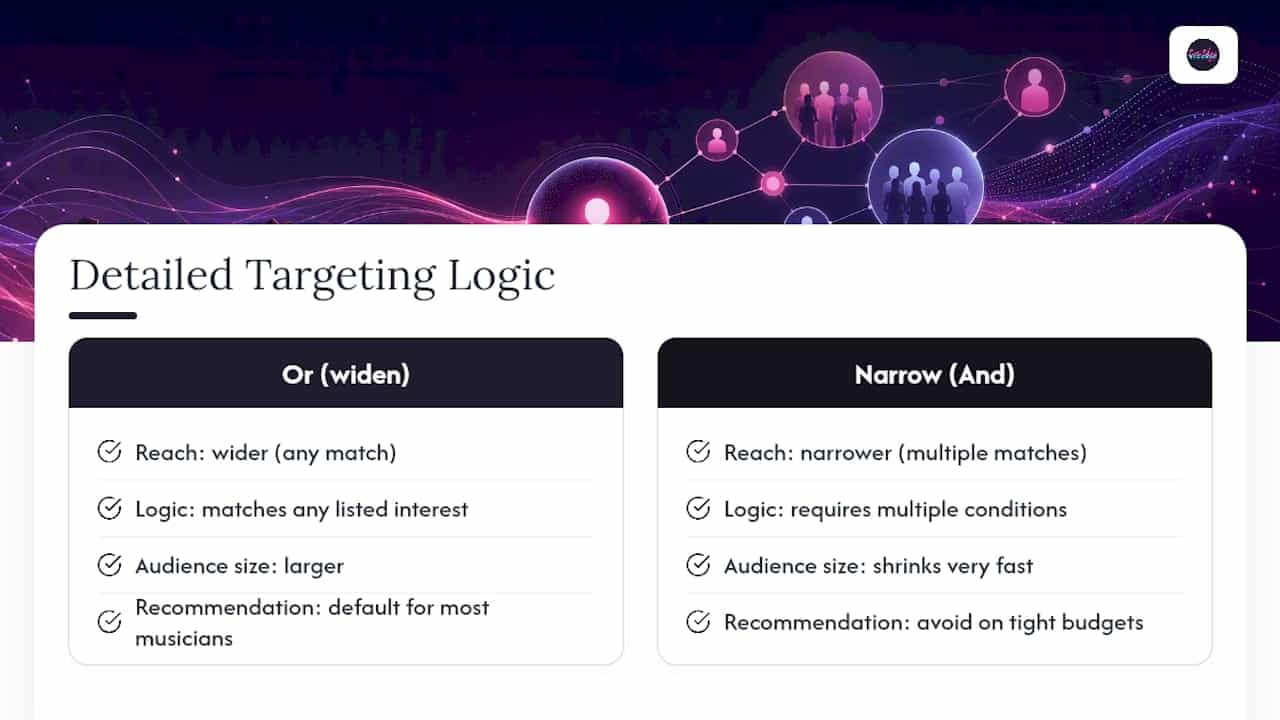
Inside Detailed Targeting, you choose between “Or” logic, which widens your reach to anyone matching any listed interest, and “Narrow Further,” which uses “And” logic to only show ads to people who match multiple conditions at once. Most musicians should default to “Or” logic. Stacking “And” conditions shrinks an audience so fast that Meta struggles to exit the learning phase, the period where the algorithm is still figuring out who converts.
Interests earn their keep on tight budgets, when you need a defined starting point instead of Advantage+ audience’s algorithmic guesswork. Once you have real purchase or stream data flowing through the Pixel, lookalike audiences built from that data usually outperform interest guessing. Interests are your entry ramp, not your destination.
Interest Categories and Copy-Ready Examples for Musicians
Detailed Targeting rewards specificity, and music fans sort themselves into recognizable buckets. Here’s where to start hunting for interest names that actually exist in the dropdown.
- Genre interests: broad labels like “Indie folk music” or “Alternative country” work for early discovery, but narrower genre tags (bedroom pop, synthwave, outlaw country) tend to hold more engaged, self-identified fans.
- Comparable artists: pick one or two acts that sound like you, not the artist you wish you sounded like. Targeting mid-tier or genre-adjacent acts beats targeting global superstars, whose fanbases are too massive and diluted to isolate anyone who’d actually click on an unknown name.
- Festivals and venues: interests tied to specific festivals, local venues, or touring package names work well for release announcements and show promotion, especially in a hyper-local radius.
- Publications and playlists: outlets like Pitchfork, Consequence, or genre-specific blogs, plus curated playlist brands, surface listeners who actively seek out new music instead of passively streaming what autoplay gives them.
- Instruments, roles, and lifestyle tags: “Acoustic guitar,” “Vinyl record collecting,” “DJing,” or “Live music” catch fans by behavior and gear ownership rather than genre alone.
Some interest names never surface in the standard dropdown search. Third-party interest explorer tools query Meta’s Marketing API directly and return hidden interest names along with live audience-size estimates, which is worth a look before you assume your niche has no matching interest at all.
How to Build Interest Stacks That Are Actually Testable
An interest stack is just a small, deliberate combination of interests grouped into one ad set, built so you can tell later which combination pulled its weight. Don’t dump ten interests into one set and call it targeting. Build two to four separate ad sets, each with its own testable logic.
- Ad set one: comparable Artist A plus your core genre, joined with “Or” logic.
- Ad set two: comparable Artist B plus a relevant festival or touring package.
- Ad set three: a music publication or playlist brand plus an instrument or lifestyle interest.
- Ad set four (optional): your broad control, no interests at all, for comparison.
Audience size matters more than most beginners realize. A 1 to 10 million person band works for most $10 to $200 a day budgets, giving Meta enough people to optimize delivery without spreading your dollars across users who will never care. Reserve “And” logic, which narrows two interests down to only their overlap, for very large budgets or hyper-local shows where you genuinely need that precision.
Exclude your existing fans, email subscribers, and past ticket buyers from every cold interest set. Mixing warm and cold audiences muddies your read on whether the interest itself is working, and retargeting is a separate phase that comes after cold testing proves out.
Pro Tip: Save each winning stack as a saved audience with a plain-language name (like “Artist A + Genre” or “Festival + Publication”) so you can find and relaunch it in seconds during your next release cycle instead of rebuilding it from memory.
A Realistic Testing Plan and Budget Cadence
Treat every campaign as a scientist would: one variable, one control, enough time to get a real read. Run your interest ad sets next to a broad-control ad set from day one, and follow up with a lookalike audience once you have enough Pixel data to build one.
- Give every test at least a week before judging results. Shorter windows can be skewed by Meta’s learning phase and normal fluctuations.
- Budget $10 to $50 per day per ad set for a DIY test. That’s enough spend to generate a meaningful sample without draining a release budget in three days.
- Compare interest performance against your broad control directly. Broad targeting frequently wins at higher budgets, so don’t assume the fancy interest stack is automatically smarter.
- Scale a winner by increasing budget 20 to 30% every few days rather than doubling it overnight, which can reset the learning phase.
- Kill or rework any ad set that’s spent through its test budget without a single meaningful click or landing-page engagement.
Meta’s own delivery models keep evolving how they represent and weight interests, so a stack that crushed it last spring might quietly underperform by fall. Revisit and re-test even your proven winners every few months.
Creative That Makes Interest Targeting Worth Running
None of this targeting work matters if the ad itself doesn’t earn attention in the first three seconds. Vertical video, shot for 9:16 and built for Reels and Stories placements, consistently outperforms static images for music promotion. Open with your strongest hook, whether that’s the catchiest four bars of the chorus, a striking lyric on screen, or a live clip with real crowd energy. Caption everything. Most viewers watch on mute.
Test creative variants against each other inside the same targeting setup before you touch your interest stacks again: a song snippet against a lyric-video hook against a raw live clip. Creative changes typically move performance faster than tiny targeting tweaks, so if results stall, fix the ad before you fix the audience.
Match your call to action to the funnel stage. Early awareness ads should ask for a follow or a stream. Once someone’s engaged, shift the ask toward tickets or merch, where the real revenue lives.
Metrics That Tell You What to Fix Next
Every metric points at a different layer of the funnel, and reading them in isolation is how musicians waste ad spend chasing the wrong fix.
At the top, watch reach, CPM, and video watch rate. A high CPM with a healthy watch rate usually means the audience is fine but expensive; a low watch rate means the hook failed regardless of who saw it. In the middle, CTR and cost per landing-page engagement tell you whether the ad’s promise matches what people expect to find when they click. Lower in the funnel, cost per stream, follow, or ticket click reveals whether the whole chain, from ad to landing page to platform, actually converts interest into action.
If CPM is high, suspect the audience or the bid. If CTR is weak, suspect the creative. If clicks arrive but nothing converts, check the landing page before touching anything else.
Fixing the Most Common Interest-Targeting Mistakes
High CPM paired with a weak watch rate usually means your audience is too narrow or your hook is flat. Widen the interest stack, switch to “Or” logic, or swap the first three seconds of the video before doing anything more drastic. Poor CTR despite decent reach often traces back to creative fatigue or a mismatch between the ad’s promise and the interest audience you’re chasing.
Always confirm your Pixel is firing and events are recording correctly before blaming targeting for a conversion problem. Exclude existing fans from every cold test, since they’ll inflate engagement numbers without proving the interest works on strangers. If interests keep underperforming after two or three honest test cycles, move to a custom audience built from your own data, or bring in outside help.
One more caveat worth remembering: not every user has music-related page likes to draw from, so interest data thins out for some segments, and no interest list will ever be perfectly complete.
How Twisby Records Runs an Interest Test for a New Release
A representative Twisby Records test for an indie single release looks close to what’s outlined above, run at a managed scale. A typical stack pairs two comparable artists with a relevant genre tag and a regional festival interest, split into three or four ad sets alongside a broad control, with $15 to $40 a day per set over a 10 to 14 day measurement window.
Twisby tracks watch rate and CTR early, then shifts focus to cost per stream and cost per landing engagement once enough data accumulates to make a real call. Sets that clear the cost-per-engagement threshold get scaled; sets that don’t, get killed before they burn more budget. With more than 35 years of combined audio experience and Apple Digital Masters certification behind the mastering side of the business, the same disciplined, test-first approach carries over into how campaigns get managed.
What the Data Actually Tells Musicians to Prioritize
Most advice about Facebook interests for music treats targeting like the whole game. It isn’t. The research on musical preference and Facebook Likes confirms that likes correlate meaningfully with taste, which is genuinely useful, but that correlation only pays off when the creative in front of that audience earns a look. I’d argue most independent musicians over-invest in interest research and under-invest in the first three seconds of their video.
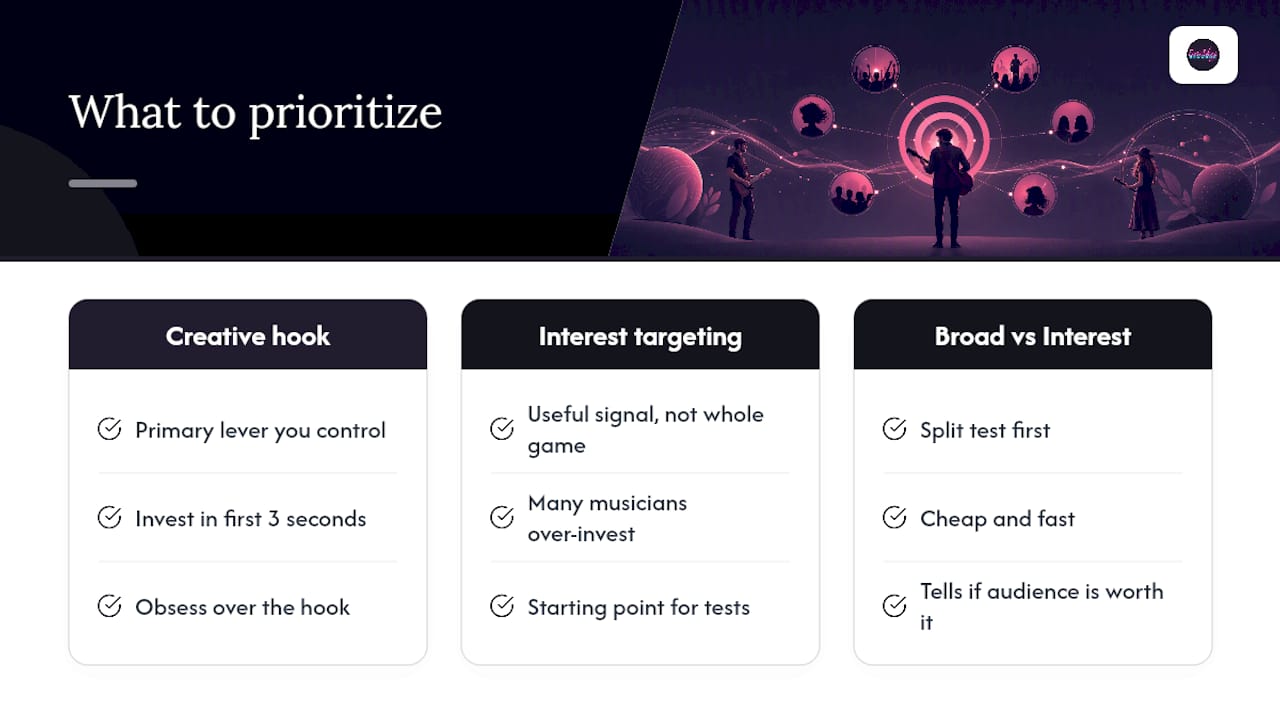
The conventional wisdom says “find the perfect audience.” The better instinct is “find a decent audience, then obsess over the hook.” Meta’s own push toward automated, AI-driven delivery only strengthens that case: as the platform gets better at finding people algorithmically, the ad itself becomes the lever you actually control. Interest stacks matter, but they’re a starting point for a controlled test, not a magic key.
Prioritize the broad-versus-interest split test before anything fancier. It’s cheap, it’s fast, and it tells you honestly whether your hand-picked audience is worth the extra setup time.
— Kreg
Get a Managed Interest Test Without Doing It Alone
Running your own broad-versus-interest split test is the right move, but doing it every release cycle, on top of writing songs and playing shows, wears thin fast. Twisby Records runs that entire process for you, audience research, interest-stack building, creative rotation, and reporting, so you get the discipline of a tested campaign without spending your week inside Ads Manager.
The Standard Packages start at $25 a month plus a 20% adspend fee, with a one-time $99 onboarding fee to set up audience research and your campaign structure from scratch. If your release also needs a professional finish before it goes anywhere near an ad, mastering runs $50 flat per track, done by engineers who work with real analog gear rather than automated presets. Request a mix quote or reach out about advertising to get a release-ready campaign built around a test plan instead of a guess.
Sources
Meta’s own interest-targeting documentation covers the mechanics of Detailed Targeting and audience-size guidance in more depth than any third-party summary. Research from Stanford’s Graduate School of Business backs the link between Facebook Likes and musical taste, and Meta’s engineering team explains how interest representations shift over time. For hidden interest names, an API-based interest finder fills gaps the dropdown search misses.
- Interest targeting (Adadvisor)
- Exploring hierarchical interest representation for Meta ads (Meta engineering)
- Musical preferences predict personality (Stanford GSB)
- Facebook Interest Finder | Eachspy
FAQ
How Can I Promote My Music on Facebook?
Post consistently with short vertical video, run a small paid test pairing an interest-based ad set against a broad-control ad set, and point every ad toward one clear action, whether that’s a stream, a follow, or a ticket link.
What Should I Put on a Facebook Post With Music?
Lead with your strongest hook in the first few seconds, caption the video since most people watch muted, and pair the clip with a direct, single call to action rather than several competing asks.
Do I Have to Say I Don’t Own the Rights to This Music on Facebook?
If you’re posting a cover, remix, or sample, disclose that you don’t hold full rights, since undisclosed use of others’ music can trigger copyright claims or restrict your post’s reach regardless of ad spend.
What Music Attracts Customers on Ads?
There’s no universal genre that converts best. What works is a specific interest stack tied to your actual sound, paired with creative that hooks attention in the first three seconds, tested against a broad audience to confirm the targeting adds real lift.
How Much Does Facebook Ad Management Cost Through Twisby Records?
Twisby Records’ Standard Packages run $25 a month plus a 20% monthly adspend fee, with a one-time $99 onboarding fee; Premium Packages charge 20% of monthly adspend with no separate flat fee.