

Frequency capping limits how many times the same listener sees your ad before you stop showing it to them. Spotify Ad Studio defaults to several impressions per day per listener, while Google Ads lets you set caps manually or hand control to its algorithm. The rule for music campaigns is simple: keep caps low for broad discovery, and raise them for retargeting people who have already streamed or engaged. Check your platform’s default first, then run a small test before committing real budget.
TL;DR:
- Most campaigns should start with a frequency cap of 2 to 4 impressions per week for awareness and 4 to 8 for retargeting, based on industry benchmarks.
- Spotify’s default is five impressions per day per listener, but lowering it can help stretch budgets and improve audience targeting.
- Manual caps are useful when working with tight budgets or specific delivery goals, while automatic optimization suits less experienced advertisers.
- Testing audience segmentation with different caps over at least one week reveals fatigue signals like declining engagement or rising costs.
- Creative rotation and sequencing allow higher frequency caps without causing ad fatigue, especially when fresh content is introduced every 3 to 5 exposures.
Table of Contents
- What Is Frequency Capping and How Does It Work?
- What Are the Default Frequency Caps on Major Ad Platforms?
- How Do You Set Caps by Campaign Goal and Funnel Stage?
- What Frequency Cap Benchmarks Work for Independent Artists?
- How Should You Test and Measure Your Frequency Caps?
- How Does Creative Rotation Affect Your Ideal Frequency Cap?
- A Practitioner’s View on Starter Plans and Proof Points
- Get Your Frequency Cap Testing Done for You
- Sources
- FAQ
What Is Frequency Capping and How Does It Work?
A frequency cap tells the ad platform “stop showing this ad to this person after X times.” That’s the whole concept. But the mechanics behind it get more nuanced once you start setting them for a real music campaign, and the terminology varies by platform.
Four terms come up constantly, and independent artists often mix them up:
- Impression cap limits total ad deliveries to one listener, regardless of whether they noticed it.
- View cap counts only when the ad was actually visible or watched past a threshold, which matters more for video promos than audio spots.
- Time capping restricts how many times someone sees an ad within a set window, like “no more than three times per day.”
- Dayparting controls when ads run at all, useful if your audience streams heavily in the evening and you don’t want to burn budget on 6 a.m. impressions nobody hears.
Caps get set at different levels depending on the platform. Some let you cap at the campaign level (everything under one umbrella shares a limit), others at the ad set or ad group level, and a few even let you cap individual creatives so no single clip gets overplayed while a fresher one sits idle.
Counting isn’t perfect, either. Google Ads only counts viewable impressions toward Display caps, meaning an ad that loaded but never appeared on screen doesn’t count against the listener. Identity tracking adds another wrinkle: caps rely on cookies, device IDs, or logged-in profiles, and a listener who switches from their phone to a laptop can look like two separate people to the ad system, quietly doubling their real exposure.
What Are the Default Frequency Caps on Major Ad Platforms?
Every platform ships with its own defaults, and knowing them before launch saves you from second-guessing your first campaign.
Spotify Ad Studio defaults to five impressions per day per listener. You can override that with custom ranges: daily caps from 1 to 5, weekly from 1 to 35, and monthly from 1 to 50, according to Spotify’s help center. Setting the cap too low, though, can actually hurt you. Spotify’s own guidance warns that very tight caps reduce the likelihood of full budget delivery, since the algorithm has fewer opportunities to serve your ad to a limited pool of eligible listeners.
Quick reference: Spotify’s default is 5 impressions per listener per day. Most artists running discovery campaigns end up dialing that back to 2 or 3 per day once they see early engagement data.
Google Ads handles Display and Video differently. Video campaign caps apply at the campaign level, and for Display, only viewable impressions count. You can let Google’s algorithm optimize automatically or set a manual limit, which matters if you’re running a YouTube pre-roll pushing a new single.
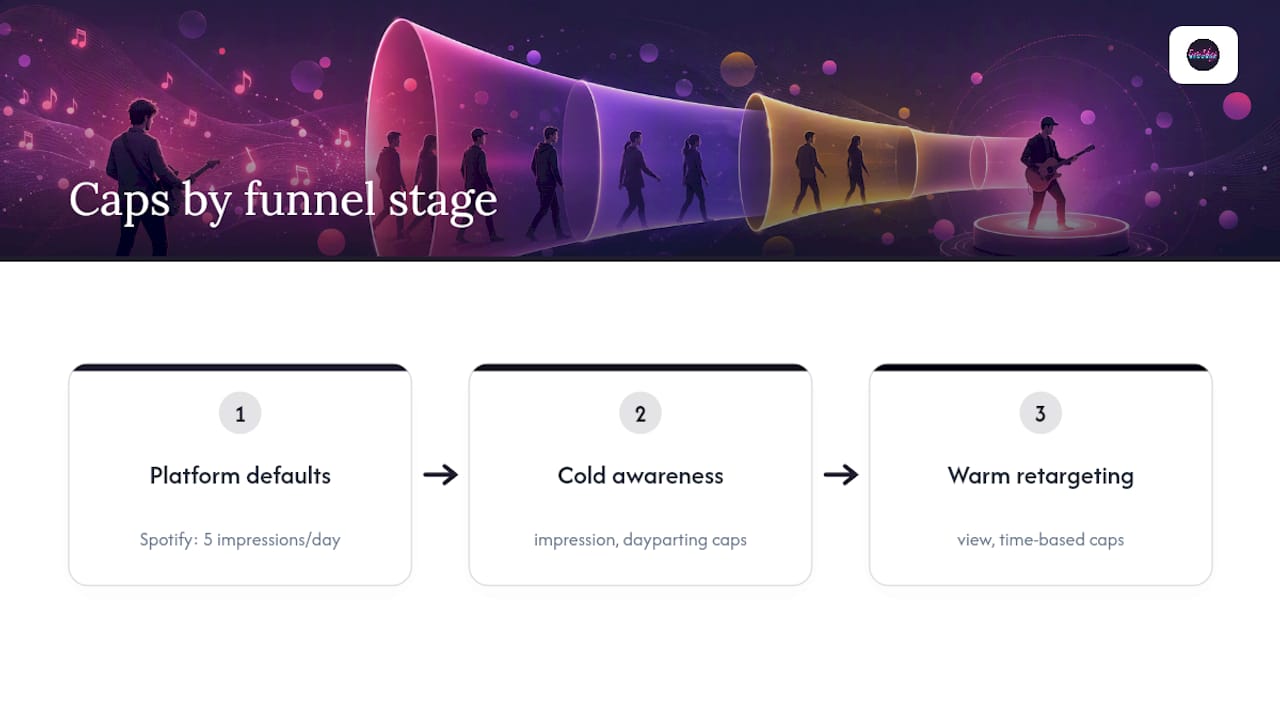
Amazon DSP documentation breaks caps into the same core types (impression, view, time, dayparting) and recommends tailoring each to where the listener sits in the funnel, according to Amazon’s frequency capping guide. A cold-audience awareness push and a retargeting sequence for people who already visited your artist page shouldn’t share the same limit.
Firebase and AdMob, used mostly for app-based music placements, don’t offer a simple slider. Instead, they lean on experimentation tools, which we’ll get into later. Meta placements (Facebook and Instagram retargeting) behave more like Google’s Display network: caps apply per ad set, and Meta’s own optimization tends to spread delivery to avoid obvious overexposure, though it’s far from foolproof on small budgets.
How Do You Set Caps by Campaign Goal and Funnel Stage?
The single biggest mistake independent artists make is applying one frequency cap to an entire campaign, regardless of who’s seeing the ad. A cold stranger scrolling past your track for the first time needs a different exposure schedule than someone who already saved two of your songs.
Here’s a workable framework by objective:
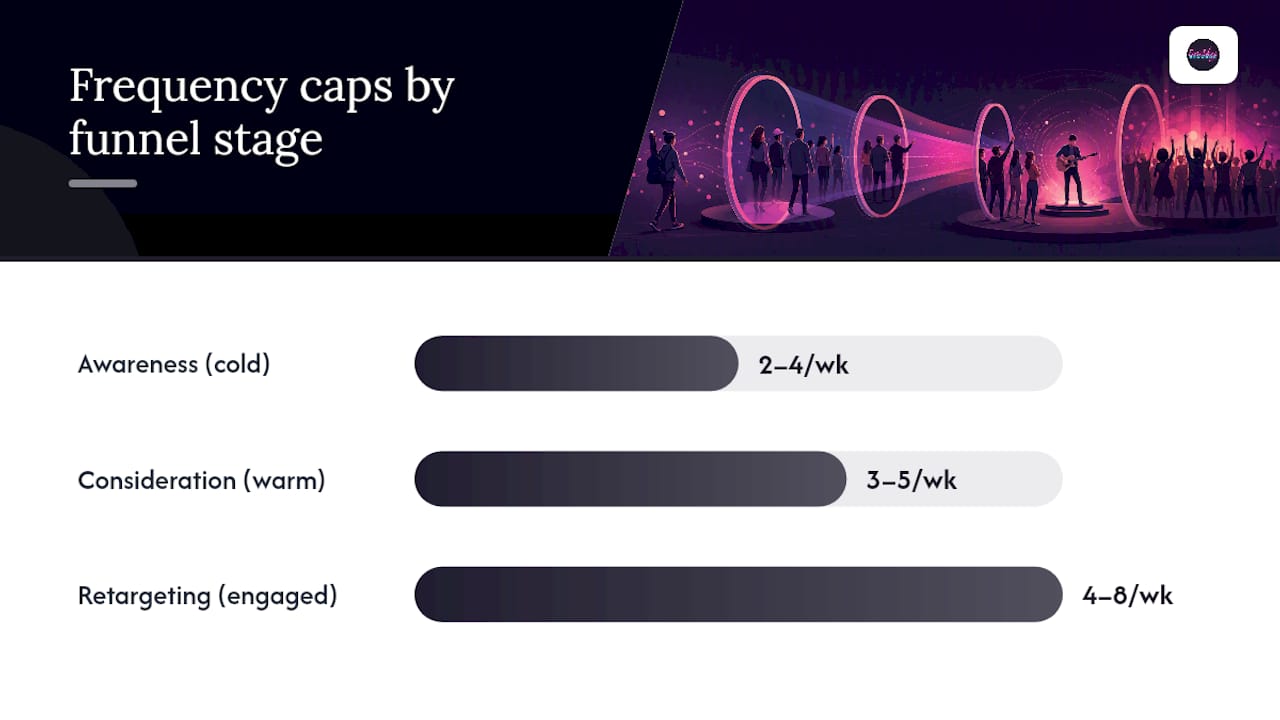
- Awareness (cold audience, top of funnel): Cap around 2 to 4 exposures per week. You’re introducing the song, not convincing anyone of anything yet, and overexposing strangers just burns budget on people who were never going to convert.
- Consideration (people who clicked or watched partway): Move to 3 to 5 per week. They’ve shown some interest, so a bit more repetition helps the hook sink in.
- Retargeting (engaged listeners, warm audience): Push to 4 to 8 per week. These are people who streamed, saved, or visited your landing page. They already know the song exists, so the goal shifts from introduction to conversion.
Segment your audiences before you touch the cap slider. Build separate ad sets for cold reach, warm engagers, and past streamers, and set each one independently rather than letting a single blended audience absorb one blanket frequency.
When should you let the algorithm decide instead of setting a manual number? Google’s own guidance suggests automatic optimization works well when you lack the time or data to manage caps by hand. Manual caps make more sense when you’re working with a hard budget constraint or a specific delivery goal, like making sure a $150 test spreads across a full week instead of dumping on day one.
Pro Tip: Run your playlist-promo campaign and your YouTube video promotion as two entirely separate line items, even if they’re pushing the same single. Video and audio placements earn attention differently, and forcing them under one shared cap usually shortchanges whichever platform performs better.
What Frequency Cap Benchmarks Work for Independent Artists?
Industry benchmarks put awareness campaigns at 2 to 4 exposures per week and performance or retargeting campaigns at 3 to 7 per week, with fatigue commonly setting in past seven exposures, according to Starti’s ad frequency management guide. Those numbers align closely with what music marketers report in practice, and they give you a sane starting range instead of guessing blind.
Budget matters here too. Test plans with modest budgets are common for artists validating a new single before committing more, based on strategies for combining Spotify and YouTube ad promotion. The goal at that budget isn’t mass reach. It’s learning whether your creative and targeting actually connect before scaling spend.
| Campaign stage | Frequency benchmark | Primary metric to watch |
|---|---|---|
| Awareness (cold) | 2 to 4 per week | Save rate, click-through rate |
| Consideration | 3 to 5 per week | Playlist adds, repeat plays |
| Retargeting (warm) | 4 to 8 per week | Cost per engaged listener, follower growth |
Raw stream counts are the wrong scoreboard. Saves, playlist adds, repeat listens, and follower growth tell you whether the exposure is actually landing, while stream counts alone can be inflated by autoplay or algorithmic placement that has nothing to do with your ad. If frequency climbs but those quality signals stay flat, the problem usually isn’t the cap. It’s the creative or the audience match, a pattern noted in Acast’s frequency capping guidance. More exposure won’t rescue a track that isn’t resonating with the people seeing it.
How Should You Test and Measure Your Frequency Caps?
Guessing your way to the right cap wastes money. Structured testing gets you there faster, and it doesn’t require an enterprise budget.
- Split your audience. Run two nearly identical ad sets, one with a lower cap (say, 2 per week) and one with a higher cap (5 per week), keeping creative and targeting otherwise identical.
- Give it real time. A week is usually the minimum to see meaningful separation, since fewer days won’t produce enough impressions per person to reveal a trend.
- Watch one primary metric. Pick cost per engaged listener or save rate as your decision metric, not a blend of five different numbers that pull in different directions.
- Use Firebase and AdMob for app placements. Firebase’s A/B testing tools let you run controlled frequency experiments inside apps and tie results directly to revenue and engagement data, which is harder to isolate on web-only campaigns.
Watch for fatigue signals as your test runs: a dropping click-through rate, a climbing cost per engaged listener, or a falling save and follow rate all point to the same conclusion. You’ve hit the ceiling for that audience.
Fatigue commonly appears once exposure passes 7 impressions per week, a threshold worth treating as a hard ceiling rather than a suggestion.
Once you find a cap that holds up, scale the budget behind it and rotate in fresh creative before fatigue creeps back in.
How Does Creative Rotation Affect Your Ideal Frequency Cap?
A higher frequency cap only works if you’re not showing the exact same fifteen-second clip every single time. Rotate creative roughly every 3 to 5 exposures, pairing short attention-grabbing hooks with longer video assets for the platforms that support them.
Sequencing matters as much as rotation:
- Lead with discovery creative, something visually or sonically arresting that stops the scroll.
- Follow with engagement creative that builds context, like a lyric snippet or behind-the-scenes clip.
- Close with a conversion-focused CTA, directing straight to the stream or save action.
Short-form ideas like quick one-sentence hooks work well as that first-touch discovery asset, especially on video placements where attention spans are short. This kind of sequencing also changes your optimal cap. A single static ad wears out fast at 6 exposures a week, but three rotating creatives sequenced properly can sustain a higher cap without triggering fatigue, because each exposure feels like new information rather than a repeat.
A Practitioner’s View on Starter Plans and Proof Points
Most independent artists overthink the cap number and underthink the proof points that actually validate it. Typically, starter tiers include a test plan built to validate a single creative and audience combination, and a multi-platform plan that layers Spotify discovery with YouTube retargeting once the first test proves out.
The cap matters less than what you measure against it. We track saves, playlist adds, and repeat plays as the real signal of whether a frequency setting is working, not raw impression counts. A campaign that hits its cap and still shows rising engagement is doing its job. One that hits the cap and stalls on saves needs a creative change, not a higher number.
With over 35 years of combined audio experience and Apple Digital Masters certification behind the work, Twisby’s approach treats frequency as one lever among several. It only pays off when the mix, the master, and the creative are already pulling their weight.
— Kreg
Get Your Frequency Cap Testing Done for You
Testing frequency caps by hand across Spotify, Google, and Meta takes hours most independent artists don’t have between releases. Twisby Records runs that testing for you: managed ad campaigns, audience segmentation by funnel stage, creative rotation planning, and weekly reporting that tells you which cap is actually converting, not just delivering.
A typical engagement starts with a small A/B test to find your baseline cap and creative fit, then scales into a multi-platform plan once the numbers hold up. Pricing runs through the Standard Packages at $25 per month plus a 20% adspend fee, or the Premium Packages at 20% of adspend per month for artists ready to run larger campaigns, both with a one-time $99 onboarding fee to get audience research and landing pages built. If your creative needs a boost before you scale spend, pairing that campaign with professional mastering at $50 per track ensures the ad is pointing listeners toward a release that sounds ready for it. Visit the advertising services page to request a quote and get your first test running.
Sources
- Custom frequency cap in Spotify Ad Studio
- Use frequency capping – Google Ads Help
- What is frequency capping? Examples and best practices
- The Best Ad Strategy for Music Promotion in 2026 (Spotify + YouTube Combined)
FAQ
What Is a Good Frequency Cap for Music Ads?
A good starting range is 2 to 4 exposures per week for awareness campaigns and 4 to 8 per week for retargeting warm audiences, based on industry benchmarks from Starti’s ad frequency guide. The right number for your campaign depends on how listeners respond, so treat these as a starting point and adjust based on save and engagement rates.
Why Am I Getting Several Ads After Every Song on Spotify?
Spotify Ad Studio defaults to five impressions per listener per day, which can feel repetitive if you’re a heavy listener during a campaign’s active window. Advertisers can lower that default with custom frequency caps, but many campaigns run at or near the default because tighter caps can limit how much budget the ad actually delivers.
What Is the Purpose of Frequency Capping in Meta Ads?
Frequency capping in Meta ads prevents the same person from seeing your ad too many times within a set period, which protects budget from being wasted on an audience that’s already tuned out. It works similarly to Google’s Display capping, applying limits at the ad set level and factoring into Meta’s own delivery optimization.
What Is Frequency Capping in Google Ads?
Frequency capping in Google Ads limits how often the same user sees your Display or Video ad, with video caps applied at the campaign level. Google counts only viewable impressions toward Display caps, and you can choose automatic optimization or set a manual limit depending on how much control you want over delivery.
How Much Does Twisby Records Charge to Manage Ad Frequency Testing?
Twisby Records’ Standard Packages run $25 per month plus a 20% adspend fee, while Premium Packages charge 20% of adspend per month, both detailed on the advertising services page. A one-time $99 onboarding fee covers initial audience research and landing page setup for new clients.