


To record a vocal double, you sing the same part a second time over your finished lead vocal, matching its pitch, timing, and phrasing as closely as you can. Then you blend the two takes so they sound like one bigger voice instead of two singers fighting. The recording is the easy part. Matching the lead, editing the double tight, and setting its level and pan are what separate a pro-sounding chorus from a smeared one.
Below is the process we use and teach independent artists, step by step.
TL;DR
- Finish your lead vocal first (comping, edits, tuning), then record the double against that final version.
- Match consonants, vowel lengths, and phrasing. Small pitch and timing differences are good. Sloppy consonants are not.
- Mix the double well below the lead and pan it to suit the song. A copied track with a delay is a fast fix, not a replacement for a real take.
- Double selectively. Choruses and key words benefit most, and contrast between sections is what makes a double feel big.
Table of Contents
- What a vocal double actually is
- When to double, and when to leave it alone
- Prep before you hit record
- How to record the double, step by step
- Edit the double so it sounds tight
- Panning and level: where the double sits
- Real double, copied track, or effect?
- Fixing a double that sounds messy
- Our perspective: double less, and double with intention
- Getting help with your doubles
- FAQ
- Sources
What a vocal double actually is
Stanford’s CCRMA describes vocal doubling as a studio technique where the same part is sung twice by the same person, in unison, effectively “a chorus of two.” That is the whole idea. You are not adding a harmony or a new melody. You are layering a second performance of the same line.
The reason it works is human imperfection. No one sings the same phrase identically twice. Reverb’s Craig Anderton points out that the unavoidable small timing and pitch differences between two performances create depth and interest, though the doubled vocal can end up less focused than a single one. Your job is to keep the depth and limit the loss of focus.
You will also see this called double tracking. Same thing: one singer, two (or sometimes more) takes of one line.
When to double, and when to leave it alone
Doubling everything is the most common mistake we hear in DIY mixes. If every line is thick, nothing feels thick. Doubles work through contrast: the listener hears a single, intimate verse, then a chorus that suddenly widens.
A practical map:
- Choruses: the default place for a full double. This is where you want the song to lift.
- Verses: keep single, or double lightly. A fully doubled verse can sound sloppy or dated, and you lose the room to build later.
- Key words and phrases: double the one word that carries the hook or the emotional turn.
- Bridges and outros: use doubles to build or to thin out, depending on the arc of the song.
A quick test: sing through the song and mark the three or four moments where you would physically push harder. Those are your double candidates.
Prep before you hit record
Recording a double against an unfinished lead is how you end up re-recording. iZotope’s guidance is to record double tracks after comping, editing, and tuning the lead, so the double matches the final version of the main performance rather than a draft.
Before you track:
- Lock the lead. Pick your best takes, comp them, fix timing issues, and tune. Print that as a single clean lead track.
- Print a rough mix to sing against. Headphones should have the lead present but not deafening. If you can only hear the lead, you will mimic it too stiffly.
- Keep the same mic, distance, and room. A double recorded in a different space or with different gain stops sounding like the same voice.
- Warm up again. If the double is recorded on a different day, your tone will drift. Do a few passes of the chorus before you commit.
- Mark the double sections. Decide in advance which lines get doubled so you do not waste energy on the whole song.
If you are still deciding how much of this to do yourself and how much to hand off, our breakdown of mixing costs for DIY artists shows how better prep lowers the bill.
How to record the double, step by step
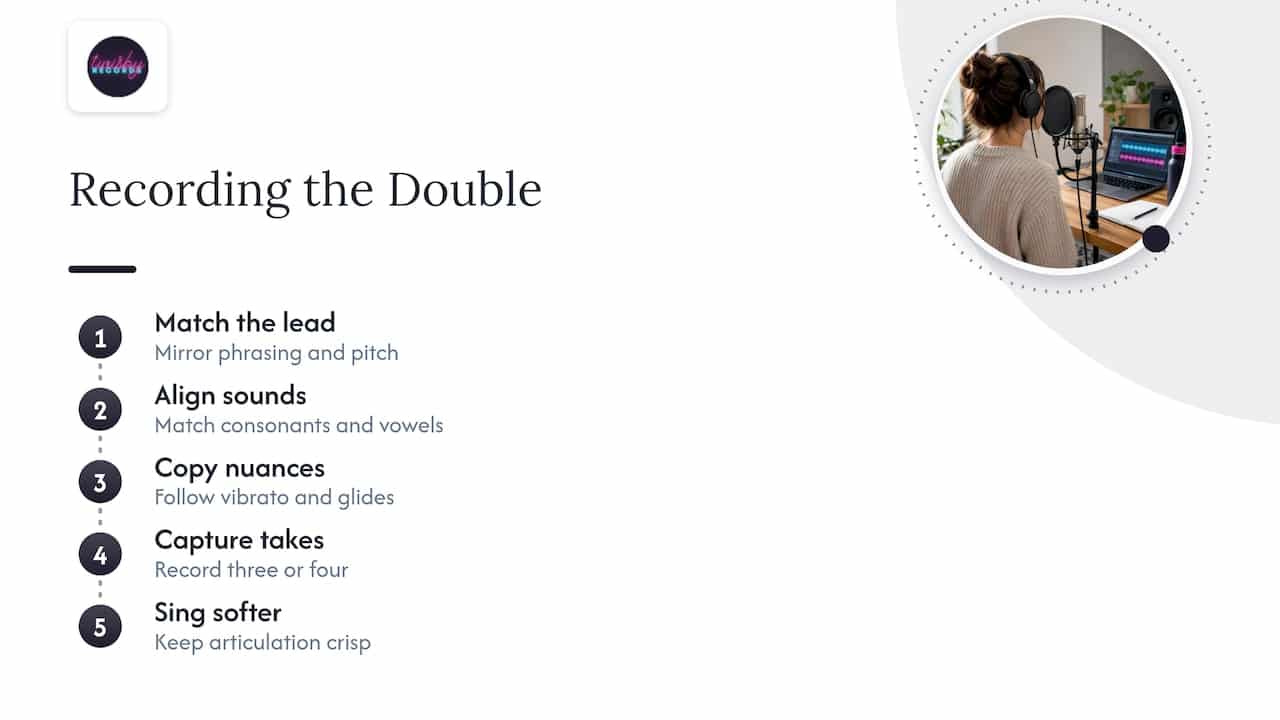
1. Sing it like the lead, not like a new performance
The goal is to match the original in phrasing and pitch. Listen to a phrase, then sing it right after, with the same intention and the same breath placement. Do not try to “improve” it on the double. Improvements are what make a double sound like a different person.
2. Focus on consonants and vowels
Timing of the starts and ends of words is what the ear catches first. Pay particular attention to hard consonants such as T, K, and P, to sibilants such as S, and to how long you hold each vowel. If the lead holds “love” for a beat and a half, hold it for exactly that. Mismatched endings are the number one reason a double sounds messy.
3. Match the vibrato and glides
If the lead slides into a note, slide into it. If the lead has a straight tone on a held note, resist adding vibrato. Stylistic habits like scoops and fall-offs should be copied, not reinvented.
4. Record more than one pass
Capture three or four takes of each doubled section. You will pick the tightest one, and sometimes you will comp the best words from several. Keep the energy consistent. A whispery double under a belted lead will not blend.
5. Sing a little softer, but not timid
Doubles usually sit below the lead in the mix, so you do not need to push as hard. Staying relaxed also tends to keep pitch steadier. Just keep the articulation crisp, because soft singing with mushy consonants is hard to fix.
Edit the double so it sounds tight
This is where most of the polish comes from. Sound On Sound’s approach to editing doubled vocals is to align the starts and ends of notes and the hard consonants, using cuts, small moves, crossfades, and careful time-stretching only when necessary.
A workable routine:
- Zoom in on each phrase with the lead and double stacked.
- Move the double so the first consonant of each word lines up with the lead.
- Check the word endings. Trim or crossfade so the double does not hang on after the lead stops.
- Remove breaths from the double. Two sets of inhales stacked together sound distracting.
- Use a de-esser on the double so its sibilance does not pile on top of the lead’s. iZotope recommends removing breaths and de-essing double-tracked vocals to avoid clashing with the lead.
Do not edit to a grid. You are aligning to a human performance, and a few milliseconds of looseness is what keeps the effect alive. If you edit everything to perfect sync, you end up with something that behaves like a single voice again, which is exactly what you were trying to avoid.
Panning and level: where the double sits
There is no single right answer, but there are two reliable starting points.
Wide: keep the lead in the center and pan two double takes hard left and right. This gives a big, stereo chorus. It is a common approach in modern pop and rock, and it is the one described in Soundfly’s guide to mixing leads against a background chorus.
Subtle: Reverb’s guidance is that doubled vocals are commonly mixed roughly 3 to 10 dB below the lead, and can either be centered for a thicker, chorus-like effect or panned modestly, around 30% left and right, for more space.
How to choose:
| Goal | Double level | Pan | Good for |
|---|---|---|---|
| Thicker lead, same focus | Lower end of the range, barely noticeable | Center | Intimate songs, verses |
| Spacious, polished chorus | Moderate | About 30% L/R | Pop, singer-songwriter choruses |
| Big, wide hook | Moderate, check the lead stays dominant | Hard L/R | Rock, pop-punk, anthemic hooks |
Tips to keep it clean:
- Solo the double and the lead together, then mute the double. If you only notice it when it disappears, the level is right.
- Check in mono. Doubles that are too wide or too close in level can make the lead feel weaker on a phone speaker.
- If the double sounds boomy or sibilant, apply a gentle high-pass filter and a de-esser to it only, not to the lead.
Real double, copied track, or effect?
You have probably seen tutorials that duplicate the lead, shift it a few milliseconds, and call it a double. Here is the honest picture.
A real second take sounds the most natural. BMI’s overview notes that real takes carry small, unique performance variations, while artificial methods try to emulate that randomness.
A duplicated file is not a double. Yamaha’s Mike Levine notes that an identical copy panned opposite is effectively a louder mono signal unless you change the timing or pitch. Real sung doubles have more impact than a simple duplicate.
Delay and pitch-shift tricks are fast fixes. They are fine for demos, for a single word, or when you cannot re-sing the part. They tend to sound like one voice pretending to be two, and listeners pick up on that over a whole chorus.
Automated doubling tools can generate a synthetic second voice from your lead. They can be useful for sketches. For a release you plan to promote, our view is that a real take is what you want in the chorus, with any effect used as seasoning rather than the foundation.
When you have a decent real double and just want it tighter, timing-alignment software that follows your lead’s phrasing (rather than a grid) can save hours. Treat it as an assistant for the edit, not a replacement for the performance.
Fixing a double that sounds messy
If the double sounds off, diagnose before you re-sing.
| Symptom | Likely cause | Fix |
|---|---|---|
| Smeared, “swimmy” chorus | Consonants or word endings not aligned | Edit starts and ends; crossfade tails |
| Sharp or flat shimmer | Double drifted in pitch from the lead | Re-sing that phrase, or tune lightly to match the lead |
| Harsh “sss” in the chorus | Sibilance stacked | De-ess the double; lower its high end |
| Lead feels weak | Double too loud | Pull the double down toward the lower end of the 3 to 10 dB range |
| Sounds fake or thin | Copied track or heavy effect | Record a real take for the chorus |
| Breathy clutter | Both takes include breaths | Delete breaths on the double |
If a phrase keeps fighting you after four or five passes, stop. Fatigue creates drift. Come back after a break and re-sing just that line.
Also resist the urge to tune the double harder than the lead. Both should land in the same spot, and the lead sets the reference. Small natural differences are what make the layer sound human.
Our perspective: double less, and double with intention
We have mixed and mastered for independent artists for over 35 years, and the pattern we see in DIY sessions is consistent. Artists record a lot of doubles, then fix the problem with plugins, then wonder why the chorus still feels flat.
Our advice is simpler. Treat the double as an arrangement decision first and a recording task second. Pick the moments that deserve extra weight, record them with care against a finished lead, and let everything else breathe. When doubles are placed on purpose, the mix needs less processing, and the song hits harder in mastering.
We also prefer working with real performances and real gear over off-the-shelf shortcuts. A well-matched double carries a small amount of human variation that no template reproduces, and that is the part listeners feel without being able to name it. If you are sending us stems, tell us which lines are meant to be doubled and which are not. It saves a round of revisions and keeps your intent intact.
— Kreg
Getting help with your doubles
If you have recorded your lead and doubles but the stack still will not sit right, we can take it from there. Our mixing service covers editing and balancing vocal layers, and when you do not have a good space to record, we offer remote vocal production and recording. Once the mix is approved, mastering is $50 per track. Mixing is quoted per project, so send us the song and we will give you a number.
If you plan to release on streaming platforms, it also helps to know how to get Apple Digital Masters status, which we are certified to deliver.
FAQ
What is a double in vocals?
It is a second recording of the same vocal line by the same singer, layered with the first. Stanford’s CCRMA describes it as a studio technique in which the part is sung twice in unison. The two takes differ slightly, which gives the sound extra width and texture.
Can I just copy my lead vocal and offset it?
You can, but it will not sound like two performances. An identical copy panned to the other side behaves like a louder single voice unless timing or pitch changes. It works as a quick fix for a word or a demo. For a chorus you care about, record a real second take.
How loud should the vocal double be?
Quieter than the lead. Reverb’s guidance puts doubles roughly 3 to 10 dB below the lead. Start toward the lower end of that range, then raise it only until you can feel the thickness without hearing the double as a separate voice.
Should I double the whole song?
Usually not. Doubling choruses, hooks, and key words gives the listener contrast. If every section is doubled, the song loses its sense of lift, and a fully doubled verse can sound sloppy or dated.
Do I need to tune the double?
Tune the lead first, then record the double against it. If the double drifts on a few notes, correct only those so it sits with the lead, and leave small natural differences alone.
Sources
- Doubling Simulation, Stanford CCRMA
- Double-Tracking, Harmonizing, and Layering, Reverb
- What Is Double Tracking?, iZotope
- Synchronised Singing, Sound On Sound
- A Guide to Mixing Lead Vocals Against a Background Chorus, Soundfly
- Double Tracking Explained, BMI
- Recording and Mixing Background Vocals, Yamaha Hub