
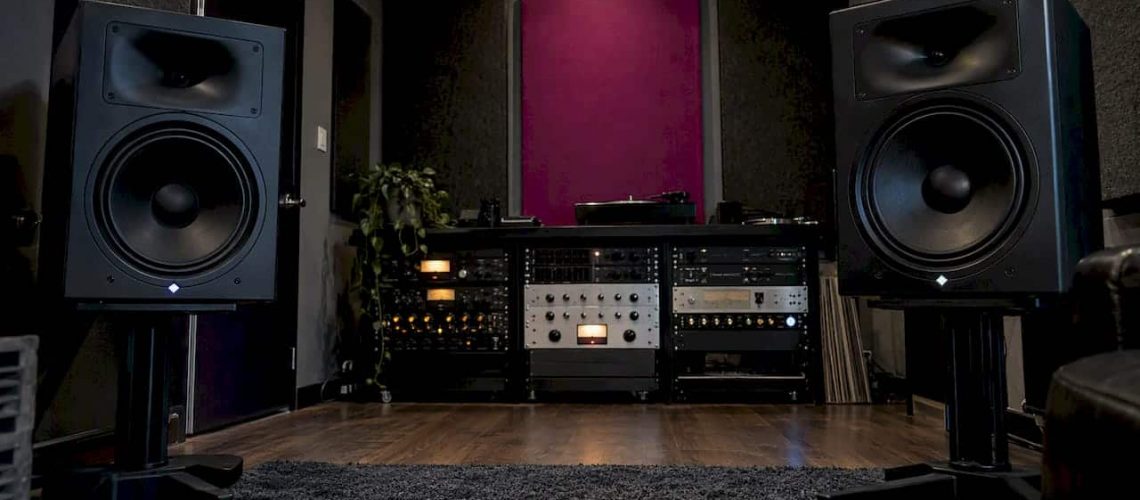

Hip hop mastering comes down to three jobs: keep the low end solid and centered, keep the vocal clearly on top, and bring the track to a competitive level without crushing the drums. Get the mix right first, leave real headroom, and master with a few simple tools instead of a long chain. This guide walks you through each step, from preparing your files to checking the final master on the platforms where your listeners will hear it.
I’ve worked on independent records for a long time, and the same problems show up again and again: muddy 808s, vocals that fight the beat, and masters pushed so hard the snare loses its knock. Let’s walk through how to avoid all three.
TL;DR
- Mastering is the last step before release. It balances the whole track, makes it consistent across speakers and platforms, and does not fix a bad mix.
- Send a mix with the master fader at unity and no limiter added just for loudness, with real headroom. Our headroom guide suggests peaks between -6 and -3 dBFS.
- Keep the vocal front and center, keep the lows centered and mono, and protect kick and snare transients.
- Spotify normalizes to -14 LUFS, so chasing extra loudness mostly costs you dynamics. Leave about 1 dB of true peak headroom.
- If you want a second set of ears, our mastering is $50 per track.
Table of Contents
- What mastering does for a hip hop track
- Prepare your mix before you master
- Balancing 808s, kicks and low end
- Keeping vocals on top
- Drums, punch and compression
- Loudness targets for streaming
- Samples, vintage sound and warmth
- Using references and home-studio tools
- Our perspective on mastering hip hop
- Get your hip hop track mastered
- FAQ
- Sources
What mastering does for a hip hop track
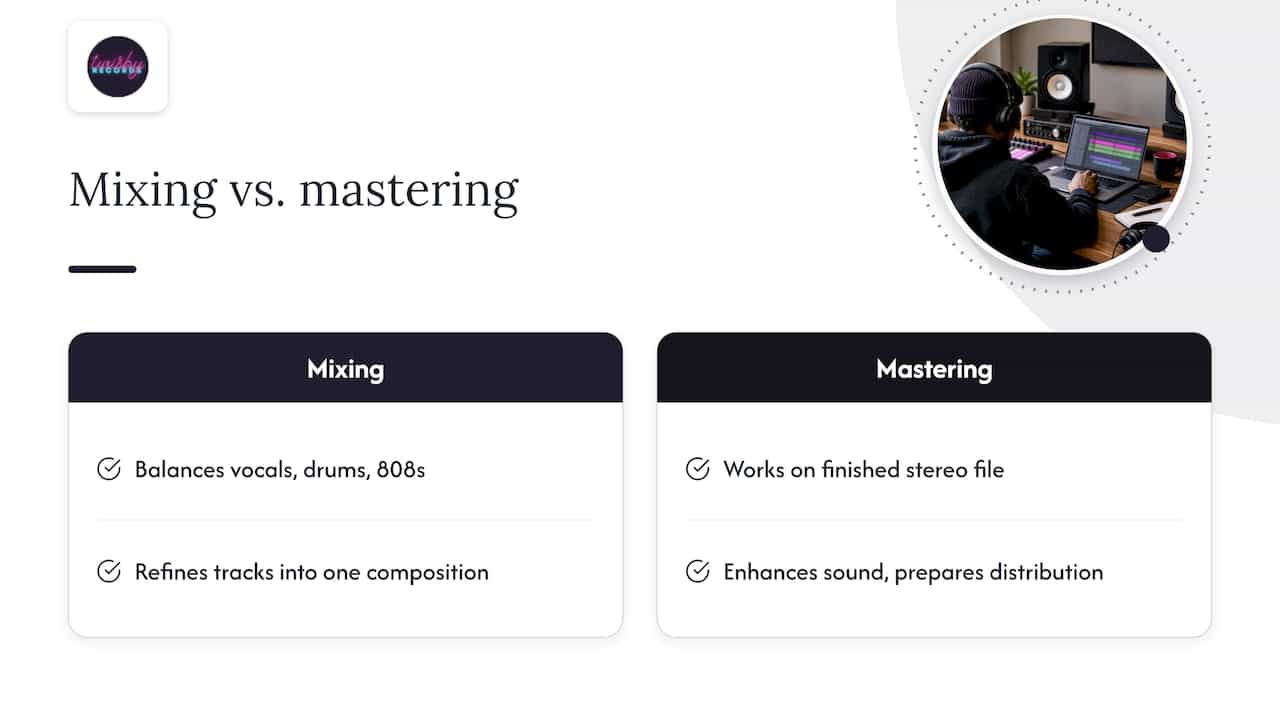
Mixing balances the individual layers: vocals, drums, 808s, samples, ad-libs. Mastering works on the finished stereo file. One explanation of the difference puts it this way: a mix refines the individual tracks into one composition, while mastering enhances the overall sound and prepares it for distribution.
That means mastering is about subtle moves. A dB of EQ here, some gentle compression there, a limiter to set the final level. If you find yourself needing to turn the vocal up 4 dB, that is a mixing fix, and you should go back to the mix.
It is also not just a volume boost. Spotify describes mastering as being more about balance among recordings, tone and volume than loudness alone. On a full project, mastering also makes songs feel like they belong together, which matters when your tracks sit next to each other on a playlist or an EP.
Hip hop has its own priorities. A Grammy-nominated engineer cited in this introduction to mastering hip hop and pop notes that both genres put vocal clarity first, but hip hop leans on low-end presence while pop leans on higher-octave clarity. That is the whole game in one sentence: big low end, clear voice.
A mastering engineer also brings something you cannot: a fresh ear. Engineer Chris Athens has pointed out that well-designed mastering rooms make mixes easier to judge than the compromised rooms most mixes are made in. After forty hours on a beat, your ears have stopped being reliable.
Prepare your mix before you master
Most mastering problems start in the bounce. Fix these before anything else.
- Leave the master fader at unity. If the mix is too hot, pull down the individual channel faders with a VCA or group instead of turning down the master.
- Remove loudness-only processing. Take off any limiter or maximizer on the master bus that is only there to make the mix louder. Keep processing that is part of the sound of the mix, such as a bus compressor that glues the drums. This guide on what to send and what to bypass draws the same line.
- Bounce full resolution. Send WAV files at the session’s bit depth and sample rate. Lossless formats like WAV, FLAC or AIFF are fine; never send an MP3.
- Leave headroom. Aim for peaks well below 0 dBFS. We cover the numbers in Headroom for Mastering.
- Check in mono. Collapse the mix to mono and listen for anything that disappears. That is a phase problem, and it will show up on phone speakers and club systems alike.
- Name your references. Pick two or three released tracks you love and note what you like about each: the weight of the low end, the brightness of the vocal, the width of the hook.
If you are still working on the mix itself, prepping your song for mixing is the earlier step that makes everything downstream easier.
Balancing 808s, kicks and low end
Low end is where hip hop masters succeed or fail. The usual guidance is to keep the low frequencies centered. Soundfly’s introduction says lower frequencies should typically sit in the center of the stereo field. A common rule of thumb is to keep everything under roughly 120 Hz in mono, which keeps the 808 and kick solid on any system and is also what you need if the record goes to vinyl (see mastering for vinyl).
Here is a practical way to work through it:
- Find the clash. The kick and 808 share the same space. If the low end sounds smeared, one of them is too loud or they are fighting in phase. That is usually a mix fix. Our seven tips for mixing low end go through it.
- Use a gentle low shelf or a narrow cut, not big boosts. A 1 to 2 dB move at the right frequency is usually enough. If you need 6 dB, the mix needs work.
- Check the sub on small speakers. If you cannot hear the 808 on earbuds, the harmonics are missing, not the sub. Adding a little saturation in the mix brings it out.
- Mind your room. Untreated rooms exaggerate or hide bass. Adding bass trap acoustic panels in corners is one of the most effective upgrades for judging low end, because it tames the buildup that makes you cut bass that was fine.
Mid-side tools help here, too. Narrowing the sides below your low cutoff while keeping the highs wide gives you a tight bottom and an open top. Our article on mid-side processing shows five ways to use it without making the track sound hollow.
Keeping vocals on top
In rap, the vocal is the song. Listeners follow the words, so if the voice is buried or harsh, nothing else matters.
The approach for the master is simple. Keep the lead vocal clearly on top and in the middle, with the low frequencies in the mid channel. A few things to check:
- Is the vocal consistent from verse to hook? If it jumps in level, fix it in the mix with automation. Mastering compression cannot do that cleanly.
- Is there harshness around 3 to 6 kHz? Over-bright vocals get tiring fast once the master is louder. A small dynamic EQ cut works better than a static one if the harshness only happens on certain words.
- Are the ad-libs and doubles sitting behind the lead? They add width, but they should not pull attention from the main line.
- Is the sibilance under control? Limiting emphasizes “s” sounds. Fix them before the limiter, not after.
Searches like “mastering hip hop vocals” usually point to a vocal chain. Strictly, vocal processing belongs in the mix: tuning, compression, de-essing, reverb and delay. By mastering time, you are judging how the finished vocal sits against the beat and making small adjustments to the whole file. If you need the vocal itself to be better, our team handles remote vocal production and mixing.
Drums, punch and compression
Hip hop lives on its transients. Kicks and snares dictate the rhythm, and a compressor can control those transients. The goal is to hold loudness steady without flattening the knock.
A basic mastering chain for a hip hop track looks like this:
- Corrective EQ. Clean up low mud, any resonances, and harshness.
- Gentle bus compression. Low ratio (about 1.5:1 to 2:1), slow attack so the transient passes through, 1 to 2 dB of gain reduction at most.
- Optional clipper or soft clipper. Used to shave the highest drum peaks so the limiter works less. A clipper before the limiter is a common way to do this.
- Multiband compression (only if needed). Useful when the low end pumps against the vocal. Keep it subtle.
- Limiter. Set the final level and the true peak ceiling.
Keep the chain short. A handy discipline is to reach for three or four tools at most and ask whether each one is doing something you can actually hear. If you bypass a plugin and cannot tell, take it out.
For taming peaks while keeping rhythmic impact, parallel compression is a classic trick. A walkthrough of New York compression explains how to set it up and blend it so the drums gain density without losing their attack. In a master, you would use much smaller amounts than in a mix.
If you want to go deeper on this, our mix bus processing guide has practical settings you can start from.
Loudness targets for streaming
This is where many artists overdo it. Streaming services adjust playback volume, so a master that is 4 dB louder than another does not play louder; it gets turned down.
Spotify adjusts tracks to -14 dB LUFS according to the ITU 1770 standard. Loud masters get turned down, and softer masters are turned up. The platform also leaves 1 dB of headroom for lossy encodings, and Premium listeners can pick a Loud setting at -11 LUFS, where a limiter is applied to prevent clipping. Spotify, and YouTube too, target -14 LUFS integrated, although the same source cautions that sound quality and balance matter more than hitting a number.
The practical lessons for hip hop:
- You do not need to slam it. A hip hop master at -9 LUFS will be turned down on Spotify, and it will have less punch than one at -12 or -13 that keeps its drum transients. Waves puts it this way: an excessively loud master does not create a louder playback experience for the listener.
- Leave true peak headroom. For lossy streaming, at least 1 dB of true peak headroom is a good rule of thumb. Intersample peaks can cause distortion during conversion, and true peak limiting helps prevent it.
- Measure, do not guess. Use a loudness meter that shows integrated LUFS, short-term LUFS and true peak.
Our article on mixing for streaming at -14 LUFS shows how to keep your punch at that level, and mastering for Spotify covers the platform in detail.
Apple Music and Apple Digital Masters
Apple has its own program for high-quality masters. Apple recommends 24-bit sources and the highest-resolution master file possible, so its encoders can work most efficiently and preserve the dynamic range of the master. In practice, that means: master at 24-bit, do not upsample a low-quality file, and do not hard clip the final file. Our post on Apple Music loudness goes through what that means for listeners and musicians. Twisby Records holds Apple Digital Masters certification, so we know the delivery requirements well.
Samples, vintage sound and warmth
If your beat is built on 70s soul samples or dusty loops, the master should protect that character instead of polishing it away. Over-brightening a sampled record is the fastest way to make it sound fake.
One approach engineers use is converting the digital master to analog temporarily to apply tube or tape saturation. Yamaha’s explanation notes this can add warmth and reduce harshness, qualities associated with vintage sound. If you are working in the box, a saturation plugin used lightly can get you part of the way there.
Tips for vintage-style hip hop:
- Use less high-frequency boost than you would on a modern trap record.
- Let the dynamics breathe. Vintage records were not mastered to modern loudness.
- Keep the sample’s noise and texture. Do not use broadband noise reduction on the whole master.
- Compare against a reference from the era you want, level-matched to your master.
Using references and home-studio tools
A reference track is your reality check. Pick songs in your style that you love how they sound, then name them with notes about what you like in each. Here is how to use them well:
- Match the loudness of the reference to your master. Louder always sounds better, so level matching is the only fair comparison.
- Compare the low end first, then the vocal level, then the high end.
- Switch quickly, back and forth, and trust your first impression.
- Check on three systems: headphones, a phone speaker and a car.
Common home mastering mistakes:
- Mastering in the same session as the mix, with the same tired ears.
- Boosting the lows to make the track “big” and ending up with a limiter that pumps on every kick.
- Stacking multiple limiters to reach a loudness target.
- Skipping mono checks.
- Sending a mix that already peaks at 0 dBFS.
For a general walkthrough of the process from start to finish, see how to master a song.
Our perspective on mastering hip hop
We have been doing this for over 35 years, and what separates a good hip hop master from an average one is rarely a plugin. It is a decision about what matters in the record. Usually it is the voice and the low end, and everything else supports them.
We built Twisby Records around personalized work for independent artists. Every record gets an engineer who listens to it, talks to you about what you want, and uses real analog gear along with digital tools. We are not running your track through a preset or an automated service. A preset cannot tell that your 808 is tuned slightly flat to the key, or that the snare should hit harder in the second verse.
Our mastering is also Apple Digital Masters certified work, which matters when your music is going to Apple Music. We think artists get the best results when mixing and mastering come from people who talk to each other, so we encourage you to send your mix, your references and notes about the sound you are after. We would rather spend an extra email getting it right than guess.
— Kreg
Get your hip hop track mastered
If you have a mix you are happy with and want it to translate everywhere, our mastering service is $50 per track, with personalized attention and fast turnaround. Send your references, tell us what you want the track to feel like, and we will handle the rest.

If the mix itself still needs work, see our mixing service or request a mix quote. Once the record is ready, our advertising services can help you reach listeners with targeted Facebook and Instagram campaigns.
FAQ
Can I master hip hop at home?
Yes, and many artists do. Use a short chain of EQ, light compression and a limiter, check against level-matched references, and listen on several systems. The harder part is judgment: a fresh set of ears, ideally in a well-treated room, catches what you stopped hearing during the mix.
How loud should a hip hop master be?
There is no required number. Spotify normalizes to -14 LUFS, so louder masters are turned down. Many engineers aim in a range that keeps the drums punchy while leaving at least 1 dB of true peak headroom, and judge by ear against references.
What should I send to the mastering engineer?
Send a full-resolution WAV at your session’s bit depth and sample rate, with the master fader at unity and no loudness-only limiter. Include your reference tracks and a short note about what you want. If the track has a vocal-heavy hook, mention it.
Is mastering the same as mixing?
No. Mixing balances individual elements like vocals, drums and 808s. Mastering works on the finished stereo track, making small adjustments to tone and level and preparing it for distribution. If a problem lives in one instrument, it belongs in the mix.
Sources
- Mixing and Mastering: Next Steps in Music Production
- What to Know About Mastering, Spotify for Artists
- An Introduction to Mastering Hip-Hop and Pop Music
- Chris Athens Breaks Down Mastering, Part 1
- 10 Tips to Prepare a Hip Hop Track for Mastering
- Mix for Mastering: What to Send and What to Bypass
- Preparing for Mastering: What Files and Levels Do I Need
- How to Prepare Your Mix for Mastering
- Hip Hop Mastering: How to Master Rap and Trap
- Loudness normalization on Spotify
- Your Audio Mastering Questions, Answered
- How to master for streaming platforms
- Apple Digital Masters 2.4.1
- What’s the Difference Between Recording, Mixing and Mastering