

A cold audience is made up of people who have never heard of you. Cold audience music ads are how an independent artist reaches them: paid ads on Facebook and Instagram built to introduce one song to strangers who are likely to love it. They work when three things line up: a tight audience, a 10-second hook that earns the listen, and tracking that shows whether those listeners stayed. That is the routine we build for artists in our advertising service, and this guide walks through it so you know what good looks like.
TL;DR
- Cold means strangers. Warm means people who already follow, stream or visit your pages. Each needs different targeting and different creative.
- Start cold campaigns with a broad, simple audience: location, age and a few genre or similar-artist interests. Over-narrow audiences starve Meta’s algorithm.
- Lead with the strongest seconds of the song. A stranger has no reason to care about your name yet.
- Judge results by saves, playlist adds and returning listeners, not by cheap clicks.
- Plan on $5 to $10 a day per test for useful data, and run tests long enough to read them.
Table of Contents
- What a cold audience is, and why it needs its own ads
- Build the cold audience: keep it simple
- Creative: win a stranger in 10 seconds
- Set up the campaign
- Budget: what a test costs
- Read the results: fans, not clicks
- Common mistakes with cold audiences
- Where we come in
- FAQ
- Sources
What a cold audience is, and why it needs its own ads
Think of three temperatures. Cold listeners have never heard your name. Warm listeners know you: they follow you, engage with your posts, visited your site or interacted with earlier campaigns. Hot listeners are your diehards who buy, share and show up.
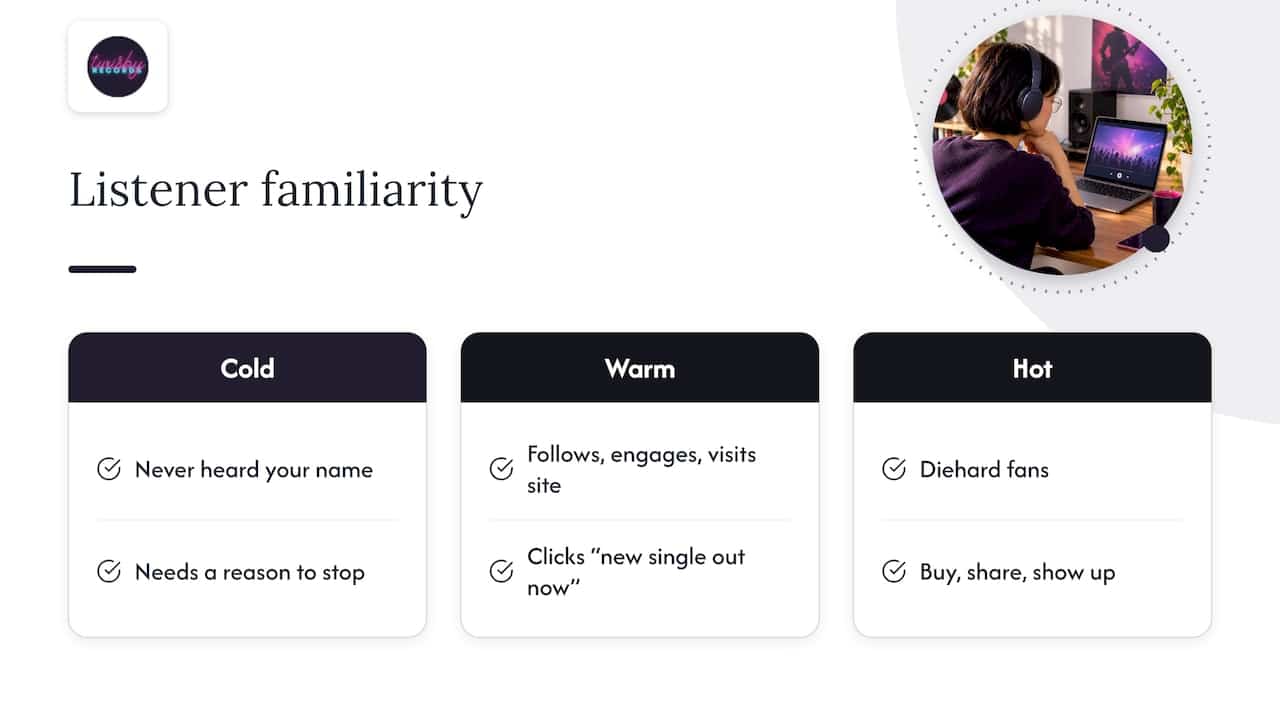
The split matters because the same ad cannot do both jobs. A cold U.S. listener who has never heard an artist’s name may need a stronger lyrical hook or entirely different creative than a familiar audience. A warm fan will happily click “new single out now.” A stranger scrolling past needs a reason to stop in the first second.
That is also why a “buy my music” call to action rarely works on strangers. You are not asking them to buy. You are asking them to listen once.
Cold ads are not the only thing moving people from stranger to fan. Playlist placements, press, short videos and word of mouth all build familiarity, and a stranger who meets you in several places is far more likely to press play. How paid ads work alongside PR, playlist exposure and organic reach is worth understanding before you set a budget, because ads speed that process up rather than replace it.
Build the cold audience: keep it simple
Most first campaigns fail on targeting, and usually because the audience is too clever. Here is the approach we recommend.
Start with location and age
Pick the countries where you want listeners. For most independent artists that means the U.S. plus a few other English-speaking markets, or a region that matches your touring plans. Add an age range that fits your genre, then stop. Every extra layer shrinks the pool, and starting too narrow limits Meta’s algorithm.
Add genre and similar-artist interests
Interest targeting lets you reach people who follow artists, genres or cultural touchpoints close to your sound. Hypebot’s guide gives the example of using a festival such as Warped Tour as a signal for alternative rock. Choose artists who are close to you in sound and large enough to appear as interests in Meta’s menu. Avoid the very biggest names in your genre: their fans are numerous but rarely discover small acts through an ad.
Our audience recipes for $50 tests lay out how we group interests so each test answers one question.
Use lookalikes once you have a seed
A lookalike audience asks Meta to find people who resemble a group you already have: email subscribers, site visitors or engaged fans. Hypebot says a custom audience needs at least 100 emails to seed a lookalike, with 500 or more recommended. That makes lookalikes a second-stage tool: your first cold campaigns collect the data, and the lookalikes come later. We cover the process in our guide to 1% lookalikes for musicians.
A starting recipe
- One campaign, one song.
- Two or three ad sets, each with a different audience: for example, a genre interest, a group of similar artists, and a broad audience with only age and location set.
- The same two or three videos in every ad set, so the audience is the only thing that changes.
- Let them run, then keep the audience that earns the best listener behavior.
Changing one variable at a time is what makes a test readable.
Creative: win a stranger in 10 seconds
In a cold campaign, the video does more targeting work than any setting. The listener does not know you, so the ad has to hand them the song’s best moment before they scroll.
What tends to work:
- Open on the strongest hook. Skip the intro. Cut straight to the chorus, the drop or the line people remember.
- Vertical video, short. Ten to fifteen seconds is plenty for a first listen.
- Your name on screen. Strangers need something to search for later.
- A visual that fits the genre. A performance clip, a lyric moment or a scene that matches the song’s mood.
- Copy that places the song. Name the feeling or the moment the song is about, or the kind of listener it suits.
The creative has to represent the music honestly. Creative that misrepresents the music attracts people who like ads rather than fans, and those people click and leave. A thumbnail that promises a pop banger in front of a folk ballad will give you cheap clicks and no saves.
If you have a Facebook and an Instagram placement, adapt the same clip for both. Our how-to for Instagram music ads covers formats and placements in detail.
Set up the campaign
Meta lets you choose the goal of a campaign, and that choice shapes who sees your ad. Hypebot lists three objectives for musicians:
| Objective | What it optimizes for | When it fits |
|---|---|---|
| Traffic | Clicks to a Spotify profile or smart link | Simple first tests |
| Engagement | Likes, comments, shares | Building social proof on a video |
| Conversions | A tracked action, which requires the Meta Pixel | Optimizing toward real listener behavior |
The Meta Pixel is a small piece of tracking code that tells Meta what people do after they click. Conversions campaigns are only as good as that tracking. If the pixel or the event is misconfigured, Meta optimizes toward the wrong people. Our guides to tracking music ad conversions and verifying Spotify conversion tracking in 20 minutes walk through the checks.
Where you send the click matters too. A custom landing page with a clear play button and your streaming links keeps the path short, and it gives you data on every visitor. Building these pages and wiring the tracking is part of what we do for advertising clients.
Budget: what a test costs
You do not need a large budget, but you do need enough to learn something. Hypebot notes a campaign can technically run on $1 a day, but recommends $5 to $10 a day to gather useful insights. A music marketing podcast reached the same range: the lower end for a campaign is $5 to $10 a day.
A worked example. Three ad sets at $5 a day for a week is $105. That buys you three audience readings on one song. If one ad set produces clearly better saves and playlist adds, you have a winner to scale. If none does, the problem is probably the creative, and you change that before spending more.
What counts as a good cost per result changes with genre, season and market, so we keep our own numbers in the music ads benchmarks guide and the guide to optimizing music ad campaigns.
Read the results: fans, not clicks
A conversion that Meta records is not the same as a listener who stays. The same recorded conversion can hide a listener who bounces after seconds or one who saves, follows and returns. That is why the cheapest result is not always the best one.
The podcast above gives a striking example: two campaigns with 500 and 1,000 conversions produced 1,100 versus 3,500 streams and 250 versus 600 saves. More conversions did not automatically mean more fans, so the quality of the audience and the tracking mattered as much as the count.
Watch these signals:
- Saves and playlist adds per listener reached.
- Repeat listening, meaning the same people coming back.
- Follower growth on the streaming profile.
- Cost per engaged listener, not only cost per click.
Spotify’s own documentation shows what a good reading looks like. In its display campaigns, results track listener behavior for 14 days after someone sees the campaign, and it reports an intent rate: the share of converted listeners who saved a track or added it to a playlist. Spotify’s research links that behavior to a 2.5x increase in artist streaming six months later. The takeaway for any cold campaign is to optimize toward saves and returning listeners, not raw volume.
After a test, make one decision per audience: keep, change the creative, or cut. Then feed the winner into a warm campaign and a lookalike. That is how a cold test turns into a growing fan base.
Common mistakes with cold audiences
- Selling to strangers. Ask for a listen, not a purchase.
- Stacking interests. Five layers of targeting mean a tiny audience and a higher cost.
- Changing three things at once. You cannot tell what worked.
- Stopping tests too early. One day of data is noise.
- Ignoring tracking. Without it, Meta optimizes blind.
- Skipping the music. A weak mix or master wastes every ad dollar. The listener hears your song for the first time inside the ad, so how it sounds is part of the creative.
What we have learned about cold audiences
Most artists come to us worried about the ad settings. The settings matter, but the first thing a cold listener does is hear your record, and that decides everything after it. A polished mix and master make the ten-second hook land, and a clean hook makes every audience test cheaper to read.
That is why we work on the whole path. Our engineers mix and master with real analog gear and carry Apple Digital Masters certification, and our advertising service handles audience research, Facebook and Instagram campaigns, custom landing pages, reporting and optimization. The sound and the campaign are built to support each other, and the work is personal: we collaborate with each artist rather than hand over a template.
If you are releasing independent music, treat the first campaign as research. You are learning who your listeners are. Done well, a $50 test tells you more about your audience than a month of guessing.
Kreg
Where we come in
If you want a cold campaign set up and run for you, our advertising service covers audience research, targeted Facebook and Instagram campaigns for your release, a custom landing page, reporting and optimization for streaming growth. Standard Packages are $25 per month, with a 20% fee on ad spend, and there is a one-time onboarding fee of $99. Premium Packages are priced at 20% per month per ad spend.
If the song itself is not ready, start there. Mastering is $50 per track, and our mixing is quoted per project, so the first ten seconds a stranger hears are the best version of your record.
FAQ
What is the difference between cold and warm audiences in music ads?
Cold audiences are people who have never heard of you. Warm audiences are existing fans, social engagers, website visitors and people who interacted with earlier campaigns. Cold ads introduce the music, so they lead with a hook. Warm ads can announce a release to people already listening.
How much should I spend on cold audience music ads?
Plan on $5 to $10 a day per test. A $1 a day campaign is possible but gives little data. A week of two or three small ad sets is usually enough to see which audience reacts.
Should I use interests or lookalikes for a cold audience?
Start with interests: genre, similar artists and location. Lookalikes need a seed audience, and Hypebot says at least 100 emails, with 500 or more recommended. Once your first campaigns have gathered that data, lookalikes are a strong next test.
How do I know if cold ads reach likely fans?
Look past clicks to saves, playlist adds and returning listeners. Spotify tracks listener behavior for 14 days after someone sees a campaign, and those save and playlist signals show intent better than click counts.
Sources
- Guide to Meta Ads to Market Music on Facebook and Instagram, Hypebot
- How Meta Ads Actually Help Grow Spotify Streams, TC Workshops
- How Musicians Should Run Meta Ads in 2026, One More Time podcast
- Tracking display campaign results, Spotify for Artists
- Social Media Brand Discovery: A Guide for Marketers