


TL;DR:
- Growing Spotify streams depends on genuine listener engagement signals like saves, completion rates, and playlist adds. Fake streams harm this system, while consistent releases and optimized profiles promote organic growth. Building real engagement and avoiding shortcuts leads to sustainable success on the platform.
Increasing Spotify streams is defined as driving the listener behaviors that Spotify’s algorithm reads as genuine engagement signals, not simply inflating a play count. Since 2024, tracks need 1,000 annual streams to earn any royalties at all. About 87% of tracks never reach that floor, which means most independent releases earn nothing. The artists who break through treat streams as a behavioral metric, not a vanity number. Save rate, completion rate, and repeat listens are the real currency. Understanding those signals is the first step toward building real, lasting growth on the platform.
How to increase Spotify streams: what the algorithm actually measures
Spotify does not reward the most popular song in a vacuum. The algorithm tracks save rate, completion rate, and playlist adds as its core signals for deciding which tracks to push further. Each of those signals tells Spotify something specific about listener intent.
Here is what each signal means in practice:
- Save rate: When a listener saves your track to their library, Spotify reads that as strong approval. A high save rate tells the algorithm your music is worth recommending to similar listeners.
- Completion rate: Listeners who play your track all the way through send a positive signal. Skipping before 30 seconds is treated as a rejection and reduces your track’s visibility in algorithmic playlists.
- Playlist adds: When users add your track to their own playlists, it triggers downstream discovery for their followers. Editorial and algorithmic playlist adds follow from strong organic engagement, not the other way around.
- Repeat listens and profile visits: A listener who returns to your track or browses your full profile reinforces the positive signal already sent.
- Pre-saves: A pre-save campaign concentrates saves and replays in the first 24–72 hours after release. Pre-saves trigger Release Radar exposure and give your track the early momentum the algorithm needs to take notice.
Pro Tip: Build your pre-save campaign at least two weeks before release day. Give your audience enough time to act, and your track lands in more libraries the moment it goes live.
One thing to be clear about: fake streams destroy this system. Bot traffic and fake plays produce low completion rates, which signals disengagement and shrinks your organic reach. The short-term number means nothing if the algorithm learns your audience does not actually listen.
How does your Spotify profile affect stream growth?

Your Spotify for Artists profile is the first thing a new listener sees after clicking your name. A fully updated profile signals seriousness and measurably increases save rates and listener engagement. Treat it like a landing page, not an afterthought.
The key profile elements to complete:
- Artist photo: Use a high-quality, current image. Blurry or outdated photos reduce credibility and click-through rates.
- Artist bio: Write a bio that tells your story in plain language. Mention your genre, your influences, and what makes your music worth a listener’s time.
- Canvas videos: Short looping visuals attached to your tracks increase the chance a listener shares your song on social media, which sends external traffic back to Spotify.
- Artist Pick: Pin your newest release or a track you want to push. New visitors see it first.
- Genre and mood metadata: Accurate metadata gives Spotify’s recommendation engines the context they need to place your music in front of the right listeners. Incorrect or missing metadata means the algorithm cannot categorize you properly.
- Verification: Claim your verified checkmark through Spotify for Artists. It builds trust and unlocks the analytics tools you need to track what is working.
Keeping your profile updated with each release is not optional. Every new photo, bio update, or Canvas video tells the algorithm you are active and worth promoting.
What promotion strategies actually grow Spotify listeners?
Organic growth on Spotify depends on building a funnel that converts social media attention into saves and repeat plays. Here is a practical sequence that works for independent artists:
- Build a pre-save funnel. Use a smart link tool to collect pre-saves before release day. Share the link across every platform you use, and give followers a clear reason to act, such as exclusive early access or a behind-the-scenes preview.
- Drive traffic from social platforms. Traffic from TikTok, Instagram, and email campaigns that converts to saves and repeat plays amplifies algorithmic reach. A post that gets views but no saves does almost nothing for your Spotify growth. Craft your content to push people toward saving the track, not just watching a clip. You can also read about social media strategy shifts that affect how artists funnel listeners to streaming platforms.
- Pitch to editorial playlists. Submit your track through Spotify for Artists at least seven days before release. Be specific about genre, mood, and the story behind the song. Editorial placements reward tracks that already show strong engagement, so treat this as a supplement to organic work, not a replacement.
- Reach out to user playlist curators. Independent curators in your genre can add your track to playlists with real, engaged subscribers. A single well-placed user playlist add can trigger a chain of algorithmic recommendations.
- Collaborate with other artists. Features and co-releases expose you to an established audience that already trusts the artist you work with. Cross-promotion between two artists with overlapping audiences is one of the most efficient ways to grow monthly listeners.
- Pursue DJ support in your genre. In electronic music and related genres, DJ support and promo cascades generate the highest quality external demand signal for Spotify’s algorithm. When a DJ plays your track to a live audience, listeners search for it on Spotify and save it. That organic search and save behavior is exactly what the algorithm rewards.
Pro Tip: Segment your audience by platform before you run paid social ads. A cold audience that has never heard your music will skip your track fast, which hurts your completion rate. Warm up new listeners with content before asking them to stream.
| Promotion method | Primary signal generated | Best timing |
|---|---|---|
| Pre-save campaign | Early saves, Release Radar trigger | 2–4 weeks before release |
| Social smart link funnel | Saves, repeat plays | Release week and beyond |
| Editorial playlist pitch | Algorithmic boost, new discovery | 7+ days before release |
| User playlist outreach | Playlist adds, downstream discovery | Release week onward |
| Artist collaborations | New audience saves, profile visits | Ongoing |
| DJ and radio promo | Organic search, saves from live exposure | Ongoing in niche genres |
How do you keep streams growing after release day?
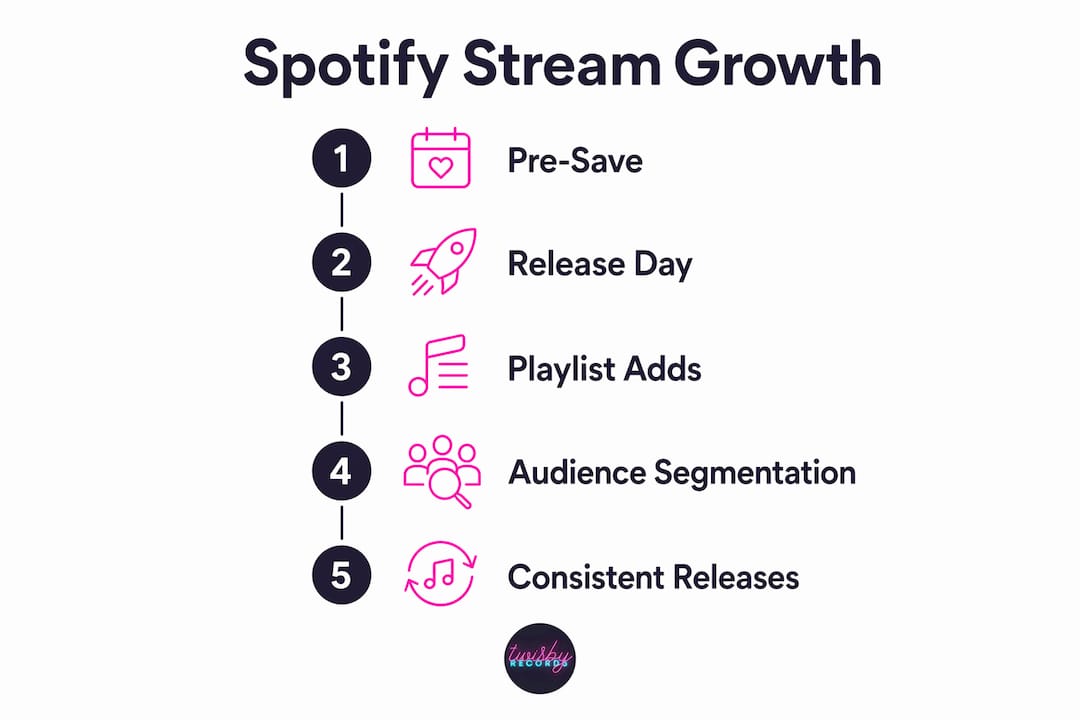
Release day is the start of a campaign, not the end of one. Releasing new music every 4–6 weeks maintains algorithmic momentum by giving Spotify fresh signals and keeping you visible in Release Radar for your existing followers. Artists who release once a year and go quiet lose monthly listeners fast.
Strategies that sustain growth over time:
- Monitor Spotify for Artists analytics weekly. Track your save rate, listener demographics, and which playlists are sending traffic. Double down on what is working and cut what is not.
- Create short-form content around every release. Behind-the-scenes clips, lyric breakdowns, and process videos give listeners a reason to engage with your music beyond a single stream. Deeper connection leads to repeat listens. A solid content creation strategy makes this repeatable rather than exhausting.
- Build a traffic loop. Sustained growth depends on stacking repeatable promotional inputs like releases, collaborations, and playlist outreach. No single spike sustains a career. Stack multiple inputs so your monthly listener count never depends on one source.
- Guide listeners to your catalog. Use your Artist Pick and playlist features to direct new listeners to older tracks. A listener who discovers three of your songs in one session is far more valuable than one who streams a single track once.
- Balance quality with frequency. Releasing often matters, but releasing music that listeners skip in the first 30 seconds cancels out the benefit. Quality completion rates compound over time.
A small group of engaged listeners who save and replay your tracks contributes far more to algorithmic growth than thousands of passive plays. Build for depth of engagement, not width of reach.
What mistakes kill Spotify stream growth?
Most independent artists stall not because their music is bad, but because they make avoidable mistakes that damage algorithmic trust.
- Buying fake streams. This is the fastest way to destroy your algorithmic standing. Fake plays produce terrible completion rates, and Spotify’s system notices. Your track gets buried, and in serious cases, your account can be removed from the platform entirely.
- Treating editorial playlists as a strategy. Editorial playlists are a reward for strong organic performance. Waiting for a playlist to save your release instead of building real engagement is a losing approach.
- Running paid ads to cold audiences too early. Paying to send listeners who have never heard of you directly to a Spotify link almost always produces high skip rates. That skip data feeds back into the algorithm and reduces your reach.
- Ignoring your analytics. If you do not check your save rate and completion rate after each release, you cannot identify what is working. Blind promotion wastes time and money.
- Inconsistent release patterns. Going months without a release causes your monthly listener count to drop sharply. The algorithm needs fresh signals to keep recommending you.
- Neglecting your existing fans. Your current listeners are your most reliable source of saves and repeat plays. Engage them through email, social media, and live events before chasing new audiences.
Shortcuts in music promotion do not just fail to work. They actively make things worse. Every fake stream, every cold ad click that turns into a skip, every ignored fan is a signal to Spotify that your music is not worth recommending. The artists who grow consistently are the ones who treat every listener interaction as something worth earning.
Key Takeaways
Sustainable Spotify growth comes from earning genuine listener engagement signals, specifically saves, completion rates, and repeat listens, rather than chasing raw stream counts.
| Point | Details |
|---|---|
| Algorithm signals matter most | Save rate, completion rate, and playlist adds drive algorithmic promotion more than total stream count. |
| Profile completeness drives saves | A fully updated Spotify for Artists profile with photos, bio, and Canvas videos measurably increases engagement. |
| Pre-save campaigns create momentum | Concentrated saves in the first 24–72 hours after release trigger Release Radar and early algorithmic pickup. |
| Consistent releases sustain growth | Releasing every 4–6 weeks keeps monthly listeners active and gives Spotify fresh signals to work with. |
| Fake streams cause real damage | Bot traffic produces low completion rates, which shrinks organic reach and risks account removal. |
What I’ve learned after years of watching indie artists grow on Spotify
I have worked with independent artists long enough to see the same pattern repeat. An artist releases a strong track, buys a few thousand streams to make the numbers look better, and then wonders why nothing happens. The algorithm saw through it immediately.
The artists who actually grow are the ones who obsess over save rate and completion rate, not total plays. I have seen tracks with modest stream counts outperform viral moments because a tight, engaged audience kept saving and replaying them. That behavior compounds. Spotify’s recommendation engines, including Radio, Discover Weekly, Release Radar, and Autoplay, all share the same core logic. They respond to the same behavioral signals. One genuinely engaged listener is worth more than fifty passive ones.
The other thing I tell every artist I work with: your niche is not a limitation. A small, passionate community of listeners in a specific genre generates the kind of save and replay behavior that the algorithm treats as gold. Stop trying to appeal to everyone and start building something real for the people who already connect with your sound. That focus is what turns a modest release into a catalog that keeps growing long after the release week is over.
— Kreg
How Twisbyrecords supports your Spotify growth strategy
Independent artists have the strategies. What they often lack is the execution support to make those strategies work at a professional level.

Twisbyrecords brings over 35 years of experience and Apple Digital Masters certification to every project. The team works directly with DIY artists on mixing, mastering, and advertising campaigns designed to drive the kind of listener engagement that Spotify’s algorithm rewards. From smart link funnel support to targeted advertising that reaches warm audiences, the advertising and promotion services at Twisbyrecords are built around the same principles covered in this article. If you want professional support that aligns with real growth strategies, explore the full range of artist services available and see what fits your current release plan.
FAQ
What listener behaviors does Spotify’s algorithm reward most?
Spotify’s algorithm prioritizes save rate, completion rate, and playlist adds as its core engagement signals. Tracks that listeners save and play all the way through receive the most algorithmic promotion.
How many streams does a track need to earn royalties on Spotify?
Since 2024, tracks must reach 1,000 streams annually to qualify for royalty payments. About 87% of tracks never reach that threshold, earning zero revenue.
Does buying streams help grow your Spotify presence?
Buying streams actively harms your growth. Fake plays produce low completion rates, which signals disengagement to the algorithm and reduces your track’s visibility in organic and algorithmic playlists.
How often should independent artists release music on Spotify?
Releasing new music every 4–6 weeks maintains algorithmic momentum and keeps you visible in Release Radar for your existing followers. Longer gaps cause monthly listener counts to drop.
What is the best way to get on Spotify editorial playlists?
Submit your track through Spotify for Artists at least seven days before release with accurate genre and mood metadata. Editorial placements follow strong organic engagement, so building real listener signals before pitching improves your chances significantly.