

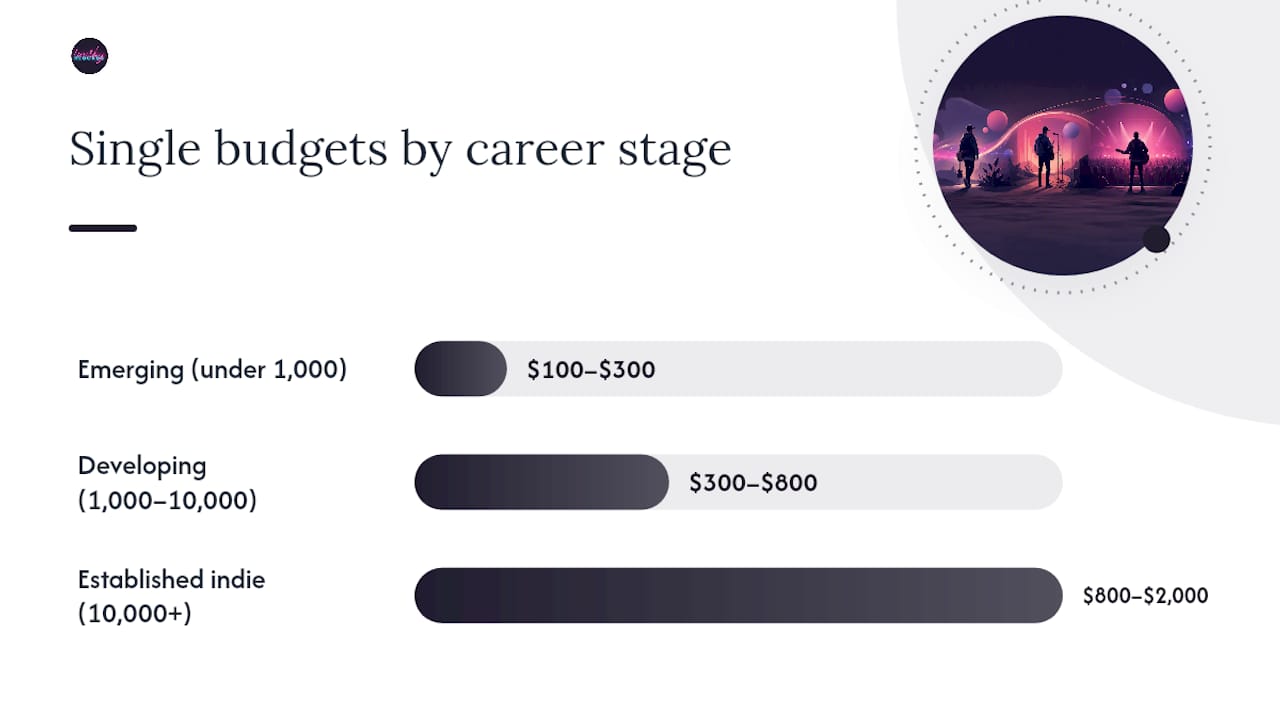
Your music ad budget depends on where you are in your career. Emerging artists with under 1,000 monthly listeners should plan to spend $100–$300 per single release on paid promotion. Developing artists (1,000–10,000 monthly listeners) typically need $300–$800 per single and $500–$1,500 for an EP. Established independent artists can run effective campaigns at a substantially larger budget per release, depending on goals and channels.
That split works as a first draft for a single release and can be adjusted once you see which channel performs.
Your immediate action: set aside $100–$150 and run a 7-day Meta or TikTok campaign targeting a cold audience with one creative variant. That is your baseline test. Do not spend more until you have data.
Quick-reference ranges by career stage and release type:
- Emerging (under 1k monthly listeners): Single $100–$300 | EP $200–$500 | Album $300–$700
- Developing (1k–10k monthly listeners): Single $300–$800 | EP $500–$1,500 | Album $800–$2,500
- Established independent (10k+ monthly listeners): Single $800–$2,000 | EP $1,500–$4,000 | Album $2,500–$7,000+
Key Takeaways
Independent artists who set a clear goal, match spend to career stage, and test before scaling will get more from every dollar in their music ad budget than those who pick a number arbitrarily.
| Point | Details |
|---|---|
| Minimum effective spend | Budget at least $100 per release; below that, ad platforms lack enough data to optimize. |
| Start with a test split | Allocate 40% Meta, 25% TikTok, 20% playlist/smart links, 15% contingency for a first campaign. |
| Scale with signals | Only increase budget after 5+ days of stable cost-per-result; raise by 20–30% at a time. |
| Measure beyond royalties | Track CPL and email list growth; subscriber lifetime value often exceeds streaming royalty returns. |
| Twisbyrecords managed campaigns | Twisbyrecords structures campaigns by goal, stage, and channel split, with custom landing pages and regular reporting. |
Table of Contents
- What does a music ad budget actually pay for?
- How do you match your spend to your actual goal?
- What are the practical budget ranges by career stage?
- How should you split your ad budget across channels?
- What should you expect from each ad channel?
- Why do very small budgets often fail?
- What do benchmarks and ROI actually look like?
- When should you increase your ad budget?
- How Twisbyrecords sets and measures release ad budgets
- What running indie campaigns actually taught me
- Twisbyrecords handles the budget, creative, and execution for you
- Sources
- FAQ
What does a music ad budget actually pay for?
Most artists conflate “release budget” with “ad budget,” and that confusion leads to underfunded campaigns. A release budget splits into four buckets: production, visuals, distribution/registration, and marketing. Your music ad budget lives entirely inside that marketing bucket. Here is what it actually covers:
- Paid social ads (Meta, TikTok, YouTube): The cost of running campaigns on ad platforms. You pay per impression (CPM), per click (CPC), or per video view (CPV). This is the largest line item for most artists.
- Spotify Ads / DSP ad buys: Direct ad placements on streaming platforms, including Spotify Ads Studio. Separate from organic playlist pitching.
- Playlist pitching fees: Some third-party playlist promotion services charge per submission or per placement. Costs vary widely, from $20 for a single submission to $200+ for curated outreach packages.
- PR outreach: Press releases, blog placements, and media pitching. Independent PR campaigns typically run $300–$1,500 per release cycle, though some artists handle this themselves at near-zero cost.
- Influencer fees: Paying creators on TikTok, YouTube, or Instagram to feature your track. Micro-influencer rates (10k–100k followers) often range from $50 to $500 per post, though rates vary significantly by niche and engagement.
- Smart links and landing pages: Tools like Feature.fm, Linktree alternatives, or custom pre-save pages. Monthly subscriptions typically run $10–$30, or you pay per campaign. These convert ad traffic into saves, follows, and email signups.
- Tracking and reporting tools: Pixel setup, UTM parameters, and analytics dashboards. Many artists use free tools like Google Analytics or Meta’s native reporting, but some invest in third-party attribution platforms.
What does NOT belong in your music ad budget: distribution fees (DistroKid, TuneCore), mixing and mastering costs, studio time, and music video production. Those are production and distribution expenses. Mixing and mastering belong in the production bucket, not the marketing one. Keeping these separate matters because it prevents you from accidentally raiding your ad spend to cover production overruns.
How do you match your spend to your actual goal?
Picking a dollar figure without a goal is the fastest way to waste money. Before you set a budget number, decide what you are actually trying to accomplish with this release. The goal determines the channel, the channel determines the minimum spend, and the minimum spend determines whether your budget is realistic.
Here is a simple framework:
- Goal: streams and saves → Primary KPI: cost per stream (CPS) or cost per save. Best channels: Meta ads driving to a smart link, Spotify Ads. Target CPS: roughly $0.01–$0.05 for a well-targeted campaign. A $200 Meta campaign can realistically generate 4,000–20,000 streams if the creative connects.
- Goal: followers and email signups → Primary KPI: cost per lead (CPL). Best channels: Meta lead ads, TikTok with a link-in-bio landing page. Target CPL: $0.50–$3.00 for music audiences. A $150 campaign can yield 50–300 new email subscribers, depending on your niche and creative quality.
- Goal: ticket or merch sales → Primary KPI: cost per acquisition (CPA). Best channels: Meta retargeting (warm audiences who already engaged with your music), Google Ads for branded searches. CPA for merch typically runs $5–$25 depending on price point and audience warmth.
- Goal: playlist adds and editorial consideration → Best channel: direct Spotify for Artists editorial pitching (free, but requires planning 7+ days before release) plus paid playlist outreach services. Budget $50–$200 for third-party pitching services per release.
Decision rules worth knowing:
- If you have fewer than 500 monthly listeners, prioritize followers and email over raw streams. A small, engaged list compounds faster than a one-time stream spike.
- If you are releasing an album, PR and playlist pitching often deliver better long-tail value than pure paid ads, because editorial placements keep working after the campaign ends.
- If you are promoting a live show, retargeting your existing listeners with ticket ads on Meta almost always outperforms cold-audience campaigns.
What are the practical budget ranges by career stage?
The numbers below are grounded in practitioner guidance for independent artists. They assume you are running paid social ads as the primary channel, with some allocation to playlist pitching and smart links.
| Career Stage | Monthly Listeners | Single Budget | EP Budget | Album Budget | Primary Goal | Min. Test Spend |
|---|---|---|---|---|---|---|
| Emerging | Under 1,000 | $100–$300 | $200–$500 | $300–$700 | Followers, saves | $100 |
| Developing | 1,000–10,000 | $300–$800 | $500–$1,500 | $800–$2,500 | Streams, email list | $150 |
| Established indie | 10,000+ | $800–$2,000 | $1,500–$4,000 | $2,500–$7,000+ | Streams, ticket/merch | $200 |
Most independent artists should expect to spend roughly $100–$500 per release on paid promotion, and anything below $100 rarely generates enough data to make decisions from. That $100 floor is not a suggestion; it is a functional minimum for running a test that tells you something useful.
For a developing artist releasing a single, a realistic line-item budget might look like this:
- Meta/Instagram ads: $200
- TikTok ads: $100
- Playlist pitching service: $75
- Smart link tool (Feature.fm or similar): $15
- Contingency/testing reserve: $60
- Total: $450
That is a lean but functional campaign. It gives you enough data on two paid channels, a shot at playlist placement, and a proper landing page to capture email signups. Social ad campaigns for a meaningful music release typically run $200–$800, split across two or three platforms with retargeting built in.
Pro Tip: Use a music marketing budget calculator to plug in your release type, artist tier, and target channels. These tools combine benchmark assumptions like cost-per-stream and expected campaign duration to give you a starting estimate before you commit any money.
How should you split your ad budget across channels?
Two allocation templates cover most situations for independent artists. The first is a conservative test split for artists who have not run paid campaigns before. The second is a scale-up split for artists who have validated at least one channel.
Conservative test split (first campaign or new release)
Use this when you have no prior campaign data and need to learn before committing larger spend.
- Meta (Facebook/Instagram) ads: 50% — The most mature targeting infrastructure for music. Start here.
- TikTok ads: 25% — Higher organic amplification potential, but requires strong short-form creative.
- Playlist pitching / smart links: 15% — Allocate to a reputable pitching service and a landing page tool.
- Testing reserve: 10% — Hold this back for a second creative variant or a new audience segment mid-campaign.
Dollar example at $300 total: Meta $150, TikTok $75, Playlist/smart links $45, Testing reserve $30.
Scale-up split (after validating a channel)
Once you know which channel delivers the best cost-per-result, shift weight toward it.
- Winning channel: 60% — Pour the majority into what is working.
- Second channel: 20% — Keep a presence on the secondary platform to avoid audience fatigue on the primary.
- Retargeting: 10% — Retarget people who clicked or watched but did not convert. This is often the highest-ROI slice of the budget.
- Testing reserve: 10% — Never stop testing new creatives, even when a campaign is performing well.
A 4-week test plan
- Week 1: Launch one creative variant on Meta and one on TikTok. Set daily budgets at roughly 1/7 of your weekly allocation. Do not touch targeting or creative during this week.
- Week 2: Review CPM, CTR, and cost-per-result. Kill the underperforming creative. Shift budget to the winner. Launch one new creative variant.
- Week 3: If the winning creative is stable (cost-per-result has not increased by more than 20%), increase the daily budget by 20–30%. Add a retargeting audience.
- Week 4: Evaluate total cost-per-result against your KPI target. Decide whether to extend, pause, or shift budget to a new channel.
Pro Tip: Reserve 20–30% of your marketing budget for testing new creatives and new audience segments. Use the rest on proven channels once tests validate performance. Artists who skip this step end up running the same creative until it burns out, then wonder why results dropped.
What should you expect from each ad channel?
Meta (Facebook and Instagram)
Meta remains the most reliable paid channel for independent artists because of its audience depth and targeting precision. You can run campaigns for as little as $5/day, but a meaningful test needs at least $100–$300 to generate enough data. For Instagram ads for music, Reels placements tend to outperform static image ads for music discovery.
- Typical CPM: $8–$20 for music audiences in the US
- Typical CPC: $0.30–$1.50 depending on creative and audience
- What $100 buys: roughly 5,000–12,000 impressions or 65–330 link clicks
- Best formats: Reels (video), Stories (short-form), and carousel for merch
TikTok Ads
TikTok’s self-serve ad platform (TikTok Ads Manager) requires a higher daily minimum than Meta for some campaign types. The organic amplification effect is real: a well-performing paid post can earn additional organic reach beyond the paid impressions. Creative quality matters more here than on any other platform. A low-production video that feels native to TikTok will outperform a polished ad that looks like an ad.
- Typical CPM: $10–$30 for music content in the US
- Minimum daily budget: $20/day for campaign-level budgets on some formats
- What $100 buys: roughly 3,000–10,000 impressions
- Best formats: In-Feed Ads using native-style video, 15–30 seconds
YouTube Ads
YouTube pre-roll (skippable TrueView in-stream) charges on a cost-per-view (CPV) basis. You only pay when someone watches at least 30 seconds or interacts with the ad. This makes it efficient for music videos where the first 30 seconds are strong enough to hold attention.
- Typical CPV: $0.01–$0.05 for music content
- What $100 buys: roughly 2,000–10,000 completed views
- Best use case: Promoting a music video or lyric video to a warm audience
Spotify Ads
Spotify Ads Studio lets you run audio and video ads directly on the platform. Spotify’s campaign forecasting tools let you set realistic minimums and expected reach before you commit spend. The minimum campaign budget on Spotify Ads Studio is $250. That is a higher floor than Meta or TikTok, so it is better suited for developing and established artists rather than emerging ones running their first test.
- Minimum campaign budget: $250
- Best use case: Reaching active Spotify listeners with an audio ad driving to your artist profile or a specific track
- Targeting: Genre, playlist type, listener behavior, and demographic filters
Playlist pitching
Organic editorial pitching through Spotify for Artists is free and should always be your first step before spending money. Pitching your music to Spotify playlists at least 7 days before release gives the editorial team time to consider your track. Paid third-party playlist pitching services range from $20 for a basic submission to $200+ for curated outreach. The value compounds: a playlist placement drives saves and followers that persist long after the campaign ends.
PR outreach
Independent PR campaigns typically cost $300–$1,500 per release cycle when working with a freelance publicist. DIY PR (submitting to blogs, music journalists, and local press yourself) costs mostly time. PR is better suited for EP and album releases than singles, because the story needs enough material to justify a feature.
Stat callout: Social ad campaigns for a meaningful music release typically run $200–$800, split across two or three platforms with retargeting. TikTok self-serve formats can require higher daily minimums than Meta, making it a better fit once you have validated creative.
Why do very small budgets often fail?
Spending $20 or $30 on a music ad campaign is not a test. It is a donation to the platform. Here is why: every major ad platform (Meta, TikTok, Google) uses a machine-learning algorithm to optimize delivery. That algorithm needs a minimum volume of results (clicks, views, conversions) before it can identify who responds best to your ad. Until it reaches that threshold, it is essentially guessing.
On Meta, the algorithm typically needs 50 conversion events within a 7-day window to exit the “learning phase.” At a CPL of $1.50, that requires $75 in spend just to give the algorithm enough data to start optimizing. Spend less than that, and you are paying for random delivery with no optimization benefit.
Minimum thresholds that actually matter:
- $50: Absolute floor for a learning-phase test. Expect noisy data and no optimization.
- $100–$200: The range where meaningful optimization begins on Meta and TikTok. You will see enough impressions and clicks to identify which creative and audience performs better.
- $250: Minimum campaign budget for Spotify Ads Studio.
- $500+: Where you start getting statistically reliable data across two channels simultaneously.
Stat callout: A $100 Meta campaign targeting a US music audience typically delivers 5,000–12,000 impressions and 65–330 link clicks. That is enough data to compare two creative variants and identify a winner, but not enough to declare a campaign successful or failed.
Pro Tip: Run every test for at least 5–7 days before drawing conclusions. Campaigns launched on a Monday behave differently than those launched on a Friday. A full week smooths out day-of-week variance and gives the algorithm time to find its footing.
- Avoid pausing and restarting campaigns mid-test. Every pause resets the learning phase.
- Do not change creative, targeting, or budget during the first 5 days. Changes restart the learning clock.
- If a campaign spends its full budget in 2 days, your daily budget is too high relative to your audience size. Narrow the audience or lower the daily cap.
What do benchmarks and ROI actually look like?
Streaming royalties will not pay back your ad spend at early stages. That is not a flaw in the strategy; it is the nature of audience building. The RIAA’s documentation on streaming economics reinforces that promotion at early stages is an investment in long-term audience value, not a short-term revenue play. Understanding that framing changes how you measure success.
Here is what $100 and $1,000 realistically buy across channels:
These are ballpark ranges, not guarantees. Creative quality, genre, targeting precision, and landing page conversion rate all affect the final numbers. A music marketing budget calculator can help you model specific scenarios using benchmark cost-per-stream and CPL assumptions before you commit.
How to calculate long-term value beyond royalties:
- Estimate your email CPL from the campaign (total spend ÷ new email signups).
- Multiply new email subscribers by your average revenue per subscriber over 12 months (merch, tickets, crowdfunding). Even $5–$10 per subscriber per year changes the math significantly.
- Compare that lifetime value against your CPL. If CPL is $1.50 and lifetime value is $8, the campaign has a positive return even if streaming royalties are negligible.
- Track playlist adds separately. A playlist placement that drives 500 saves has compounding value because those listeners will hear future releases automatically.
The honest caveat: most emerging artists will not see a direct financial return on their first few campaigns. The return is audience size, email list growth, and streaming profile credibility, all of which make future campaigns cheaper and more effective.
When should you increase your ad budget?
Scaling too early is as damaging as spending too little. Doubling a budget on a campaign that has not stabilized usually increases cost-per-result rather than improving it. Here are the signals that tell you scaling is safe:
- Stable cost-per-result over 5+ consecutive days. If your CPL or cost-per-stream has not increased by more than 10–15% day-over-day for five days, the campaign has found its footing.
- CTR above 1% on Meta or TikTok. A click-through rate below 1% usually means the creative or audience needs work before you add more budget.
- Playlist conversion to followers is positive. If your playlist pitching spend is generating saves that convert to profile followers, that channel is worth more investment.
- Email signups per $100 spent are consistent. Consistency matters more than the absolute number. Erratic CPL means the audience or creative is unstable.
Step-by-step scale plan:
- Confirm stable performance over 5–7 days using the signals above.
- Increase daily budget by 20–30%, not more. Larger jumps force the algorithm back into the learning phase.
- Monitor for 5–7 days after the increase. If cost-per-result rises more than 20%, pause the increase and revert to the previous budget level.
- If performance holds, repeat the 20–30% increase after another 5–7 days.
- When you hit audience saturation (frequency above 3–4 on Meta, declining CTR), introduce a new creative variant or expand the audience before increasing budget further.
Risk controls:
- Set a campaign-level spending cap so a runaway algorithm cannot overspend your weekly budget.
- Never scale two variables simultaneously (budget and creative, or budget and audience). Change one thing at a time.
- Keep a monitoring log: date, daily spend, impressions, clicks, cost-per-result. A simple spreadsheet is enough.
How Twisbyrecords sets and measures release ad budgets
The approach Twisbyrecords uses with independent artists reflects the same framework outlined in this guide, applied with 35+ years of experience and the precision that comes from running hundreds of campaigns across genres.
A typical managed campaign at Twisbyrecords is structured around these components:
- Campaign goal alignment: Before any budget is set, the goal is defined. Streams, followers, email signups, and ticket sales each require a different channel mix and a different KPI target.
- Budget setting by stage: For an emerging artist releasing a single, a starting budget of $200–$400 is typical, split between Meta (Facebook and Instagram) and playlist pitching. For a developing artist with an EP, $600–$1,200 is a more realistic range, adding TikTok and a retargeting layer.
- Channel split: Meta (Facebook and Instagram) ads are the primary channel in most campaigns because of targeting depth. TikTok is added when the artist has short-form video content ready. Spotify Ads are considered for artists with $250+ available for a single platform.
- Creative and landing pages: Twisbyrecords builds custom landing pages for each release, which means ad traffic lands on a page designed to convert clicks into email signups and pre-saves rather than sending listeners to a generic streaming profile.
- Reporting cadence: Clients receive regular reporting on CPM, CTR, cost-per-result, and playlist adds. The reporting is tied to the original goal, so you always know whether the campaign is moving the right needle.
- Apple Digital Masters certification: All audio delivered through Twisbyrecords meets Apple Digital Masters standards, which means the music being promoted is already optimized for the platforms where the ads are driving listeners.
What this changes for clients: A managed campaign removes the guesswork from budget allocation, creative testing, and optimization. Artists who run their own campaigns often spend the first $150–$200 learning what not to do. A managed approach compresses that learning curve significantly.
For artists considering whether to run campaigns independently or with managed support, comparing agency vs. DIY approaches is worth the time before committing a release budget.
What running indie campaigns actually taught me
The most persistent mistake I see independent artists make is treating their first ad campaign as a launch rather than a test. They spend their entire budget in the first week, get mediocre results because the creative was not right, and conclude that paid ads do not work for them. That conclusion is wrong, but it is understandable.
What actually works is treating the first $100–$200 as tuition. You are buying data, not streams. The streams come later, once you know which creative resonates, which audience converts, and which platform gives you the best cost-per-result for your genre. Artists who approach it that way tend to see their cost-per-stream drop significantly by their third or fourth campaign, because they are not starting from zero each time.
There is also a psychological shift worth making. Paid promotion is not a shortcut to revenue. At early stages, it is audience construction. Every email subscriber you add, every playlist follower you earn, every listener who saves your track is a compounding asset. The RIAA’s streaming economics data makes clear that royalties alone will not justify ad spend at small scale. But a growing, engaged audience will. That reframe changes how you measure success and, more practically, how you decide when a campaign is worth continuing.
The other thing I have seen consistently: artists who split their budget between content creation and paid promotion outperform those who put everything into ads. Splitting release budgets across content creation and paid promotion, with roughly 30–40% toward content and 20–30% toward ads, keeps creative supply from becoming a bottleneck. You cannot run a 4-week ad campaign on one piece of creative. The algorithm will exhaust it in days.
At Twisbyrecords, the campaigns that perform best are the ones where the artist came in with a clear goal, realistic expectations, and enough creative assets to rotate. The budget almost always matters less than those three things.
Twisbyrecords handles the budget, creative, and execution for you
Running a paid campaign for your music release means managing ad accounts, writing copy, building landing pages, testing creatives, reading analytics, and adjusting spend, all while trying to finish the next record. Most independent artists do not have time to do all of that well, and the cost of doing it poorly is a wasted budget and a missed release window.
Twisbyrecords offers fully managed advertising campaigns built specifically for independent and DIY artists. The service covers audience research, ad creative, custom landing page setup, campaign launch, and ongoing optimization, with reporting tied to the goals that actually matter for your career stage. There is no one-size-fits-all package: every campaign is scoped to your release type, budget, and target audience. With Apple Digital Masters certification and over 35 years of experience in the music industry, Twisbyrecords brings both the technical and marketing sides of a release under one roof.
If you are ready to stop guessing at allocation and start running campaigns that are built to perform, see what a managed ad campaign looks like and get a quote for your next release.
Sources
These are the primary resources worth bookmarking when planning your music promotion budget:
- Music Marketing Ad Budgets: How Much to Spend | Orphiq
- Music Promotion Costs in 2026: Real Prices for Every Channel
- How to Build a Music Release Budget | Velveteen
- Music Marketing Budget Calculator | Release Planner | AMW®
- Campaign forecasting and budgeting — Spotify for Artists
How to use these sources together: Start with the AMW calculator to get a rough estimate, cross-check CPM and CPC ranges against Promoly’s cost guide, then use Spotify’s forecasting tool to validate your streaming-specific expectations. That three-step cross-check takes 20 minutes and prevents the most common budgeting mistakes.
FAQ
How much should an independent artist spend on music ads?
Most independent artists should budget $100–$500 per release for paid promotion. Emerging artists can start at $100–$300 for a single; developing artists typically need $300–$800 to run a meaningful multi-channel campaign.
What is the 70/20/10 rule for a marketing budget?
For music promotion, this means putting the majority on your best-performing platform (often Meta), a portion on a newer channel like TikTok, and a small slice on something untested like a new playlist service or influencer partnership.
Is $20 a day enough for music ads?
It depends on the platform and objective. Google Ads notes that $20/day can run some campaigns, but effectiveness depends on campaign type and format. On Meta, $20/day is a starting point for awareness campaigns but is unlikely to generate enough conversion data for meaningful optimization. For a 7-day test, a total spend closer to the practical minimum required to generate meaningful data is recommended.
How much does Spotify pay per million streams?
Spotify’s per-stream rate varies by country, listener subscription type, and other factors, but industry estimates typically place it in the range of $3,000–$5,000 per million streams. This reinforces why early-stage ad campaigns should be measured by audience growth and lifetime value rather than royalty payback.
What is the minimum test budget for a music ad campaign?
$100 is the practical floor for a test that generates usable data. Below that, ad platform algorithms do not have enough conversion volume to optimize delivery, and the results are too noisy to draw conclusions from. A 7-day test at $15–$20/day on Meta or TikTok is the standard starting point recommended by music marketing practitioners.