

Spotify’s algorithmic playlists are personalized collections, like Discover Weekly, Release Radar, Radio, and Daily Mix built from a listener’s individual taste profile rather than human editorial picks alone. The single highest-leverage move you can make is engineering strong, high-quality engagement in the first 48 to 72 hours after release while pitching your track through Spotify for Artists ahead of launch. Everything else is tactics in service of that window.
TL;DR:
- Prioritize building strong engagement within the first 48 to 72 hours after release by prompting saves, full listens, and profile visits.
- Optimize metadata, submit your pitch early, and run targeted ads to maximize the quality of traffic during the critical launch window.
- Understand that listener context, device type, and individual taste profiles significantly influence playlist placement and performance.
- Avoid artificial streaming tactics, as Spotify’s system can detect manipulation, and focus instead on genuine fan-driven actions like saves and repeats.
- Consistently analyze Spotify for Artists data to refine your promotion strategy and bolster long-term playlist and algorithmic visibility.
Table of Contents
- How Spotify Algorithmic Playlists Actually Work
- Taste Profiles, Algotorial Curation, and What Feeds the Model
- The Signals That Actually Move the Needle
- Your 48 to 72 Hour Launch Checklist
- Reading Your Data to Improve the Next Release
- What the Research and Engineering Docs Actually Say
- Do Algorithmic Playlists Behave Differently Across Listeners?
- Myths About Spotify Algorithmic Playlists You Should Ignore
- Turning Spotify for Artists Data Into Your Next Release Plan
- Where Artists Should Actually Spend Their Energy
- How Twisby Records Turns This Checklist Into Results
- Sources
- FAQ
How Spotify Algorithmic Playlists Actually Work
Spotify builds personalized playlists from a listener’s taste profile, an ongoing record of what they search, play, skip, and save. Each playlist type serves a different job in a listener’s rotation, and knowing which one you’re chasing changes what you optimize for.
- Discover Weekly refreshes every Monday with tracks the listener has never heard, aimed at cold discovery for brand-new fans.
- Release Radar surfaces new music from artists a listener already follows or streams often, making your existing fan base its main audience.
- Daily Mix, Your Top Songs, and Radio extend a listening session after a listener already connects with your sound, rewarding songs that hold up over repeat plays.
- Autoplay, Smart Shuffle, and Prompted Playlist let listeners actively steer what comes next, including typing a mood or vibe request that pulls tracks into a generated queue.
Discover Weekly wins you strangers. Release Radar wins you superfans who already opted in. Treat them as two separate goals, not one.
Taste Profiles, Algotorial Curation, and What Feeds the Model
Spotify runs what its own engineers call an “algotorial” system: editors first build a candidate pool of quality tracks, and algorithms then reorder that pool differently for every listener based on their taste profile. Human curation decides who’s even in the running. Personalization decides who each listener actually sees.
The model itself weighs several inputs. Acoustic features like tempo, key, danceability, and energy help it match songs by sonic similarity, not just genre tags. Collaborative signals track which songs get streamed together by similar listeners. Contextual signals, including time of day, device type, and even day of the week, shift what gets surfaced during a commute versus a Saturday night. Academic work on reinforcement-learning approaches to playlist generation shows models trained on simulated listener behavior can optimize directly for satisfaction metrics like completion rate, and that gains in simulation translated into measurable engagement lifts in live testing. That’s the mechanism behind why your behavioral signals matter more than your genre tag.
The Signals That Actually Move the Needle
Spotify’s recommendation system rewards specific, measurable listener actions, and some carry far more weight than a raw stream count ever will.
- Saves and playlist adds: a listener adding your track to their library signals durable appreciation, not a passive listen.
- Completion rate versus skip rate: a track that gets skipped in the first 30 seconds tells the algorithm it missed, while full plays tell it to keep showing the song.
- Repeat listens: someone who replays a track within days is behaving like a developing fan, and that pattern gets noticed.
- Profile visits and follows: listeners who click through to your artist profile and follow you signal intent beyond a single song.
- Traffic quality over traffic volume: a burst of low-intent plays from a broad ad blast reads differently to the system than a smaller batch of plays that convert to saves and follows.
Pro Tip: A thousand plays from a cold, untargeted ad audience will almost always underperform three hundred plays from fans who save the track, because the system is scoring intent, not volume.
Your 48 to 72 Hour Launch Checklist
Everything before release day exists to prime this window. Everything after it exists to keep the signal from going cold.
- Confirm metadata and upload early. Get your track into Spotify for Artists with correct genre tags, credits, and artwork at least two to four weeks before release.
- Submit your Spotify for Artists pitch at least one week out. This is how you get considered for the editorial candidate pool that feeds the algotorial process, detailed in this playlist pitching guide.
- Run a pre-save and follower campaign in the two weeks leading up to launch, using a structured pre-save campaign approach to build a base of day-one listeners.
- On release day, run targeted, conversion-led ads on social and Spotify itself rather than broad reach campaigns, and prompt every listener toward a full listen and a save.
- Mobilize a small, organized fan group to add the track to their personal playlists. Research on fan collectives and algorithmic amplification shows this kind of legitimate, coordinated activity can meaningfully boost visibility without breaking any platform rule.
- Watch for low-quality traffic spikes that inflate plays without saves, since that pattern can flatten your momentum instead of building it.
- Review Spotify for Artists metrics within 24 to 48 hours and pivot ad creative or audience targeting immediately if completion rates lag.
Reading Your Data to Improve the Next Release
Spotify for Artists gives you the exact metrics that map to the signals above: saves, streams, completion rate, listener sources, playlist adds, and profile follows. The mistake most independent artists make is stopping at the stream count.
Cross-reference your ad platform’s conversion data against in-app engagement instead. A campaign that generated cheap clicks but low completion rates is a warning sign, not a win, and tools discussed in this guide to increasing Spotify streams walk through how to spot the gap. Run short A/B tests on ad creative or audience segments, two or three days is enough to see a direction, then reallocate spend toward whichever version produces more saves and completions per dollar, not more clicks.
What the Research and Engineering Docs Actually Say
Spotify’s own engineering team frames personalization as editors building a quality pool while algorithms handle per-listener ordering, a collaboration rather than a pure machine decision. Peer-reviewed work on simulation-based reinforcement learning for playlists backs up why completion and save behavior carry real weight in that ordering. Twisby Records has spent over 35 years mixing and mastering independent releases, holds Apple Digital Masters certification, and has built its advertising process around exactly the engagement signals this research points to.
Do Algorithmic Playlists Behave Differently Across Listeners?
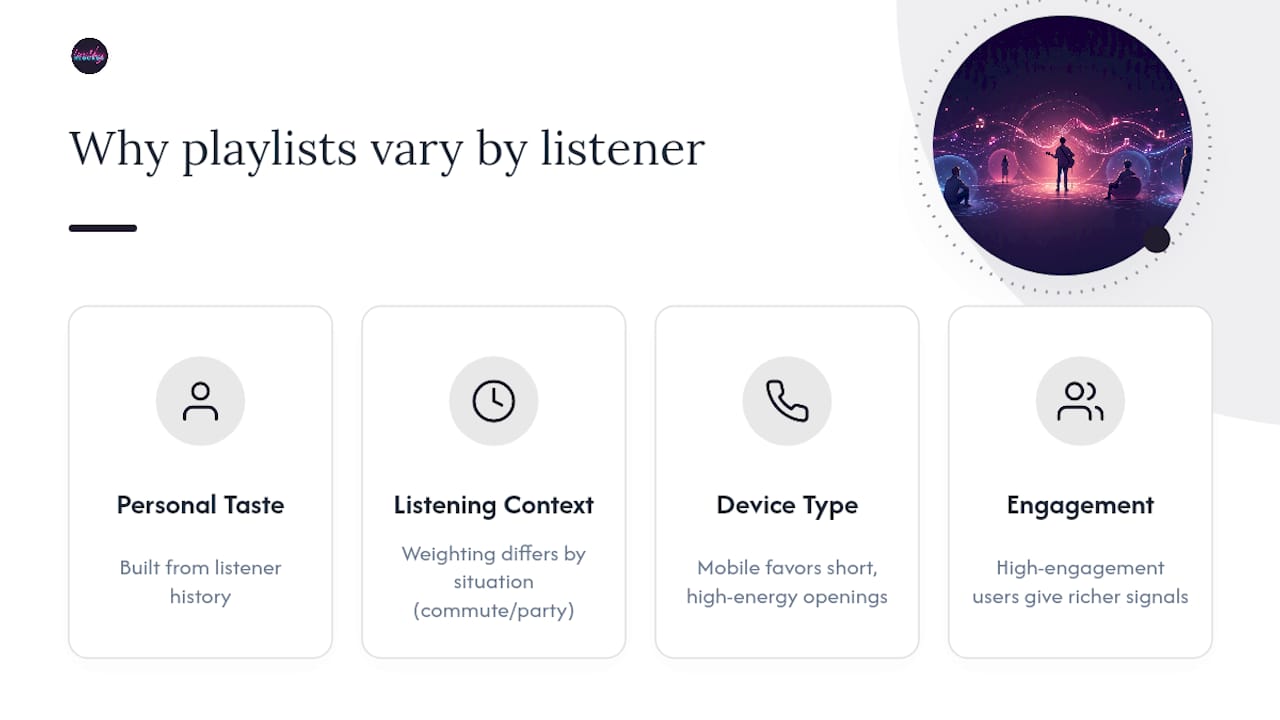
Yes, and this is where a lot of artists misjudge their own results. A track that performs beautifully in Discover Weekly for one demographic can barely register for another, because the taste profile driving each playlist is built from that individual’s own listening history, not a general popularity score.
Listening context matters as much as the listener. A commuter checking Spotify during a Monday drive gets different contextual weighting than a listener queuing up a Saturday-night mix, even if both have similar taste profiles otherwise. Mobile listening tends to favor shorter, higher-energy openings since skip decisions happen fast on a phone screen. Desktop and smart-speaker sessions, often used for background listening at home or work, tend to reward songs that hold attention over a longer stretch, since skips are less frequent in that context.
Age and genre habits shift the picture further. Younger, high-engagement listeners who follow many artists and build playlists constantly generate richer behavioral data, which can make the algorithm move faster on their Discover Weekly. Listeners with narrower, more repetitive habits, replaying the same fifty songs for months, give the system less room to introduce something new, so algorithmic playlists for that group can feel more conservative. None of this means one group is more valuable than another. It means the same track can look like a hit in one Discover Weekly rotation and a miss in another, and that variance is normal, not a sign your song failed.
Myths About Spotify Algorithmic Playlists You Should Ignore
The biggest myth is that playing your own song repeatedly, or asking a handful of friends to loop it, will trick the algorithm into promoting it. Spotify’s systems are built to detect artificial streaming patterns, and manipulated plays tend to get filtered out or flagged rather than rewarded.
A second common misconception: that buying ads directly guarantees playlist placement. Spotify’s Discovery Mode adds a commercial signal into the mix where it’s active, but the company is explicit that it doesn’t guarantee inclusion in any algorithmic playlist, and it can affect your royalty rate on the plays it influences.
A third myth worth killing: that algorithmic playlists are pure math with no human involvement. The algotorial process starts with editors curating a candidate pool before any personalization algorithm touches it, meaning a track that never makes that initial editorial cut has a much steeper climb, relying entirely on listener-driven signals to build momentum on its own.
Finally, plenty of artists assume one great release will permanently unlock algorithmic visibility. It doesn’t. Your taste-profile match resets and re-evaluates continuously based on ongoing listener behavior, so a strong Discover Weekly run this month doesn’t guarantee the same treatment for your next single unless the new release earns its own engagement.
Turning Spotify for Artists Data Into Your Next Release Plan
The artists who improve fastest treat their Spotify for Artists dashboard as a feedback loop, not a scoreboard. Look at where your listeners came from, algorithmic playlist, editorial playlist, search, or your own profile, and weight that against how long they stayed.

If most of your streams came from an algorithmic playlist but completion rate was weak, the issue is likely the track itself: the intro, the hook placement, or a mismatch between the song’s energy and the playlist’s context. If completion rate was strong but saves were low, the song is holding attention without converting listeners into fans, which usually points to a gap in your call-to-action or profile presentation rather than the mix itself, something a mastering review can sometimes catch. Compare listener source breakdowns release over release rather than judging any single song in isolation, since one outlier can be noise while a repeated pattern across three releases is a real signal about your sound or your promotion strategy.
Document what you tried each time, which ad creative ran, which audience you targeted, and what the pitch note said, so you can actually tell which lever moved the needle next time. A structured release strategy built around this kind of comparison will teach you more after three releases than any single viral moment will.
Where Artists Should Actually Spend Their Energy
Chasing a single viral stream spike is the wrong instinct. Consistent, targeted engagement across several releases builds the kind of taste-profile match that compounds, while one-off vanity plays disappear from the algorithm’s memory almost immediately. Document every campaign, ad audience, pitch note, release timing, so you know what to repeat. Iteration beats intuition here, every time.
— Kreg
How Twisby Records Turns This Checklist Into Results
You now know the mechanics. Executing all of it, metadata, pitching, pre-saves, conversion-led ads, and post-release analysis, inside a 72-hour window while also running your creative career is where most independent artists lose the thread. Twisby Records exists to run that operational load for you, so your release window gets managed attention instead of a rushed weekend.

The services map directly onto what this guide covers: targeted advertising campaigns built around conversion, not vanity clicks, mixing and mastering with Apple Digital Masters certification to make sure your track holds up on the first fifteen seconds that decide a skip or a save, and reporting that tracks the same saves, follows, and completion metrics detailed above. The outcome isn’t a guaranteed playlist slot. No honest service promises that. It’s higher-quality listens and measurable engagement that actually feed your taste-profile match over time. If you have a release date on the calendar, get a quote on advertising support before you lock your pitch window, since timing that campaign against your Spotify for Artists submission is where most of the value sits.
Sources
- Types of Spotify playlists (Spotify Support)
- Humans + Machines: A Look Behind the Playlists Powered by Spotify’s Algotorial Technology (Spotify Engineering)
- Simulation-based RL approaches for playlist generation (ACM paper, 2023)
- Prompted Playlists – Spotify newsroom
FAQ
How many Spotify streams do you need to make $10,000?
There’s no single official rate since payouts vary by listener location, subscription type, and label deal, but independent estimates commonly cite roughly a large number of streams to earn significant revenue. Focus on save and completion rates instead of chasing a raw stream target, since those are what actually drive algorithmic placement and repeat listening.
What is the 1,000 true fans rule on Spotify?
The concept, popularized outside Spotify itself, argues that a dedicated base of genuinely engaged fans who consistently stream, save, and follow can sustain an independent artist better than a much larger pool of passive listeners. It lines up directly with why Release Radar and repeat-listen signals matter more than one-off viral spikes.
Can artists still create AI-influenced playlists on Spotify?
Yes. Features like Prompted Playlist let listeners describe a mood or vibe in their own words, and Spotify’s algorithm generates a personalized queue from that prompt, which is a listener-facing tool rather than something an artist submits directly.
What is the 30-second rule on Spotify?
Spotify counts a stream as monetizable once a listener plays a track for at least 30 seconds, which is why early skips within that window hurt a song’s standing far more than a skip after a minute. Structuring your intro to hold attention past that mark is one of the most direct ways to protect your completion rate.
Does Spotify guarantee playlist placement if I run ads?
No. Paid features like Discovery Mode add a commercial signal that can influence recommendations where active, but Spotify is explicit that no paid option guarantees inclusion in any algorithmic or editorial playlist.