
The fastest route to discovery on Instagram right now is Reels built to earn shares and saves, paired with a business profile optimized for the follow-through. Instagram remains one of the largest global social networks by user count, which means the audience is there. What changes outcomes is whether your content gets passed along privately and whether your profile converts that attention into a follow, a click, or a stream. Watch shares, saves, and reach first. Everything else follows from those three numbers.
TL;DR:
- Set up a business or creator profile with searchable genre terms, a current release or ticket link, and Highlights covering new music, shows, and press.
- Batch two Reels, three Stories, and one carousel weekly; use Insights to choose posting times, since audience activity matters more than general timing advice.
- Open each Reel with a hook in the first one to three seconds, add subtitles and a location tag, and favor one or two specific hashtags.
- Test one creative variable across Reels for two weeks, then use Insights to compare shares, saves, reach, and retention before deciding what to keep.
- Phone shot rehearsal clips can outperform polished videos for discovery, so film authentic moments rather than saving every strong performance for a polished production.
Table of Contents
- How to set up and optimize your Instagram for discovery and conversion
- Which Instagram formats to use and a recommended content mix for musicians
- Practical post ideas and Reel creative patterns that drive shares and saves
- A tactical Reel production and optimization checklist musicians can reuse
- Realistic posting cadence, best days/times, and batching tips for musicians
- Tactics to convert viewers into followers and active fans through real interactions
- How to write captions and pick hashtags that act as discovery signals
- Which metrics to prioritize and how to run simple tests to improve discovery
- How Twisby Records applies these tactics in real campaigns
- A practitioner’s honest take on Instagram growth timelines
- Get help turning organic traction into finished releases and managed campaigns
- FAQ
- Sources
How to set up and optimize your Instagram for discovery and conversion
Before a single Reel goes up, your profile needs to be ready to catch the people it attracts. A great video that lands on a half-finished profile is a wasted opportunity.
Start by switching to a business or creator account if you haven’t already. This unlocks Insights (the analytics we lean on throughout this guide), contact buttons, and the ability to run ads later if you want to scale something that’s already working organically.
Your bio is prime real estate, and it should work like a search listing, not a diary entry. Include your genre or sound in plain words (think “dream-pop duo” or “Nashville singer-songwriter”), and close with a direct call to action pointing to your newest release or your mailing list.
A few setup details matter more than they seem:
- Match your display name and handle to how fans search for you on Spotify or Apple Music, so a fan who finds you on one platform can find you on the other.
- Use a profile photo that’s instantly recognizable at thumbnail size: a clear face shot or a simple, high-contrast logo.
- Build Highlights for “New Music,” “Shows,” and “Press” so a first-time visitor can self-serve the basics in under ten seconds.
- Set your link-in-bio tool to lead with your current priority, whether that’s a pre-save link or a ticket page, and swap it the moment that priority changes.
For the link itself, a basic Linktree-style page works, but many artists find a dedicated landing page converts better because it can be built around a single action instead of a grid of equal-weight buttons.
Pro Tip: Rewrite your bio every time you have a new single or show. A stale bio quietly tells visitors you’re inactive, even if your Reels say otherwise.
Which Instagram formats to use and a recommended content mix for musicians
Each format on Instagram does a different job, and treating them all the same is one of the more common mistakes we see independent artists make.
- Reels are your discovery engine. They get shown to non-followers first, so this is where new fans find you.
- Stories build the relationship once someone’s already following you, and they’re where casual viewers turn into DM conversations.
- Live sessions reward your most invested fans with depth: a writing session, a Q&A, a stripped-down performance.
- Carousels work as save-bait: lyric sheets, behind-the-scenes photo dumps, or step-by-step gear breakdowns people want to revisit.
- Feed posts (single images) are best for evergreen moments: album art, press photos, tour announcements that don’t need the motion of a Reel.
A sustainable weekly mix for most independent musicians looks like two Reels, three Stories, one carousel, and an occasional Live when you have something worth going deep on. That’s realistic for someone writing, recording, and gigging, not just posting.
One thing worth internalizing early: raw, phone-shot clips often outperform highly produced videos for discovery, by a meaningful margin in recent tests. A rehearsal room clip filmed on your phone, lit by whatever’s in the room, frequently beats a polished music video clip for reach. Save the cinematic footage for YouTube or your website. On Instagram, authenticity is the format.
Practical post ideas and Reel creative patterns that drive shares and saves
The goal of every Reel is to make someone want to send it to a friend or save it for later. That single filter should guide your content planning more than any trend chart.
Ideas that consistently earn shares and saves:
- Behind-the-scenes moments: a half-finished take, a studio mistake, the fifteenth take of a vocal line.
- Quick lessons or riff breakdowns: teach a four-bar hook or a chord voicing people can try themselves. This is textbook save-bait.
- Relatable rehearsal chaos: a dropped pick, a dead battery, a bandmate laughing mid-take. This is what gets tagged and sent to friends.
- Lyric breakdowns: unpack what a line actually means, especially if it’s personal or ambiguous.
- Micro-performances: fifteen seconds of your strongest hook, nothing else.
The framing matters as much as the idea itself. A Reel built to trigger a private share needs a recognizable “musician moment” (something any player or singer would instantly relate to), a short punchline or musical tag that lands fast, and a subtle nudge toward sharing. Content designed to be shared privately or saved for later sees a real lift in distribution, so bake that intent into the concept, not just the caption.
CTAs that work without sounding desperate: “Tag the bandmate who does this every rehearsal,” “Save this for your next practice session,” or “Send this to someone who needs to hear it today.” Specific and situational beats generic every time.
Pro Tip: If a Reel idea only works as a caption instruction (“like if you agree”), it’s not strong enough on its own. The visual or the moment should carry the share, not the request.
A tactical Reel production and optimization checklist musicians can reuse
Every Reel benefits from the same short list of checks before you hit publish.
- Hook in the first 1 to 3 seconds. Reels are tested against non-followers first, and a weak opening can get a video cut from further distribution early. Start with motion, a surprising cue, or the hook of the song itself.
- Add subtitles. Many people watch with sound off, especially on the first scroll past.
- Geo-tag your location. Posts with a location tag see a real boost in reach, which matters most for show announcements and city-specific content.
- Use one or two targeted hashtags. Genre-specific and highly relevant beats a wall of generic tags.
- Put your caption keyword in the first two lines, since that’s what shows before “more.”
- Choose and test your thumbnail. A still frame with your face or instrument in focus usually outperforms a blurry mid-motion frame.
- Favor original audio when it’s your own music. It reinforces your sound as the thing people are discovering.
Shares and saves now carry more weight than likes in how widely a Reel gets distributed, according to 2026 algorithm analysis. If early retention and shares are strong in the first few hours, let the Reel run. If they’re flat, that’s your signal to adjust the hook or the concept next time rather than reposting the same idea.
Realistic posting cadence, best days/times, and batching tips for musicians
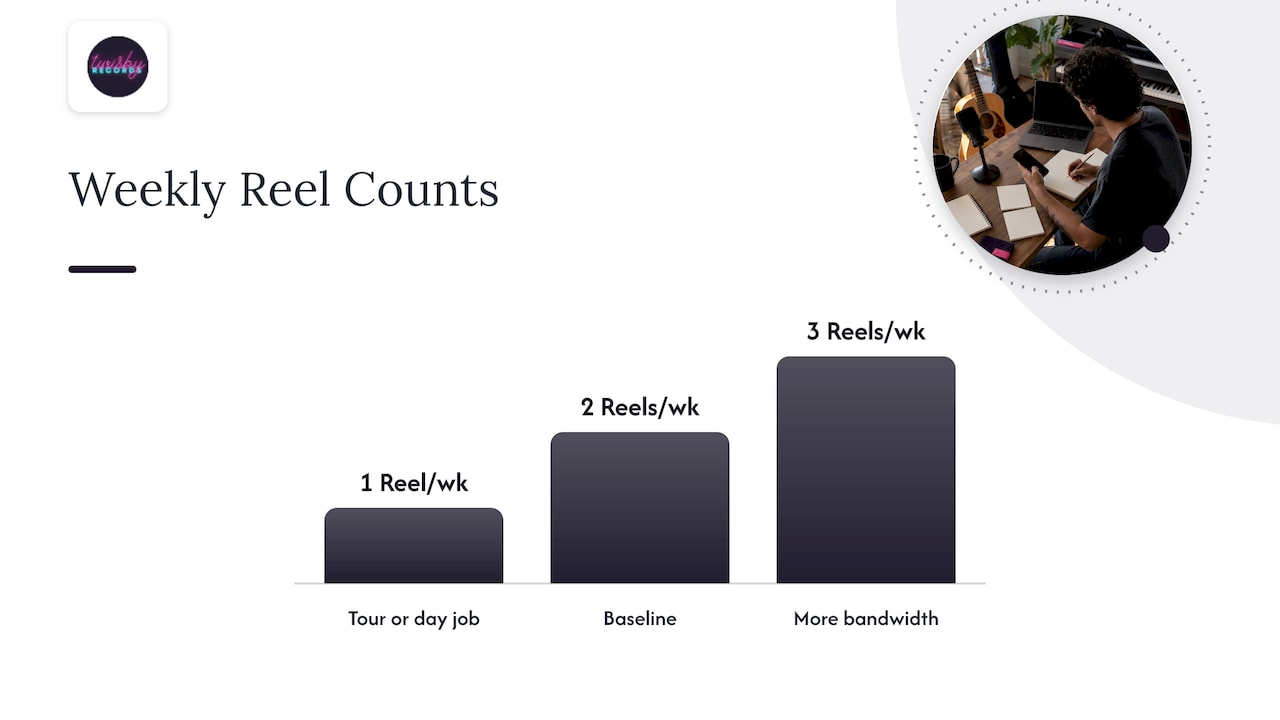
Consistency beats intensity. A manageable baseline is two Reels, three Stories, one carousel, and an occasional Live each week. If you have more bandwidth, add a third Reel; if you’re stretched thin around a tour or a day job, drop to one Reel and keep the Stories steady, since Stories take less effort and still maintain the relationship.
There’s no universal “best time” that holds for every artist, your own audience’s habits matter more than general advice. Use Instagram Insights to check when your followers are actually active, then schedule around that window instead of guessing.
Batching is what makes this sustainable:
- Set aside one session a week to film three or four Reels at once, using the same setup and lighting.
- Edit in a single sitting using CapCut or Instagram’s native editor, keeping cuts simple and subtitles consistent.
- Schedule posts in advance through Meta Business Suite so publishing doesn’t depend on remembering at the right moment.
- Keep a running list of ideas in your phone’s notes app so batching day starts with options instead of a blank page.
This rhythm keeps your presence steady without turning Instagram into a second job on top of writing and performing.
Tactics to convert viewers into followers and active fans through real interactions
Growth that lasts comes from relationships, not just reach. Community-building and consistent presence tend to matter more for musicians than hard selling, and organic engagement is what eventually drives ticket and merch sales.
A few moves that build real relational signals:
- Use Story replies and polls to start conversations, then move promising ones into DMs where the connection deepens.
- End a Reel with a specific question that nudges people toward replying or sending it to a friend, rather than a vague “thoughts?”
- Repost fan content (a cover, a concert video, a story mention) with credit, since this doubles as social proof for new visitors.
- Pitch a duet-style Reel or cross-post to another artist in your scene with a clear, specific creative ask (a shared chorus, a trade of verses) rather than a vague “let’s collab.”
Collaboration works best when you come with a concrete idea already attached. “Want to trade sixteen bars on this beat and each post our half?” gets a faster yes than “we should collab sometime.”
Pro Tip: Reply to every comment within the first hour when you can. Early replies signal an active post to the algorithm and often pull in more comments from people who see the conversation already happening.
How to write captions and pick hashtags that act as discovery signals
Captions now do more classification work than hashtags, and treating them as an afterthought leaves discovery on the table.
Lead with your genre, mood, or instrumentation in the first line, something like “Indie pop chorus, lo-fi production, recorded in a bedroom.” That tells both Instagram and a scrolling stranger exactly what they’re about to hear before they even hit play.
Keep hashtags minimal. Discovery benefits from one or two highly relevant hashtags rather than a dense cloud of generic ones. A folk artist is better served by #folkmusic or #singersongwriter than by stacking ten loosely related tags.
- Pair a genre tag with a mood or use-case tag: #bedroompop plus #latenightdrive, for example.
- Skip tags with millions of posts already attached, since specificity helps you surface in the right feeds.
- Test two or three combinations over a month and watch which one correlates with stronger reach in Insights.
On length, captions around 100 to 149 words, written as statements rather than questions, are currently outperforming shorter or question-led captions for retention and engagement. Close with a direct, specific CTA: “Save this riff for your next practice” reads as useful, not pushy.
Which metrics to prioritize and how to run simple tests to improve discovery
Follower count is a lagging indicator. The numbers that tell you what’s actually working are shares, saves, reach, accounts reached, and retention on your Reels.
- Set a hypothesis. Pick one variable to test, like your hook style or caption length.
- Run it for two weeks, posting your normal cadence but isolating that one variable across each Reel.
- Define success before you start: for example, a 20 percent lift in saves compared with your prior month’s average.
- Review Insights at the end of the window and decide whether to keep, adjust, or drop the variable.
- Boost selectively. When an organic Reel already shows strong shares and retention, a small amount of ad spend behind it, through a structured ad campaign, can extend its reach without risking budget on something unproven.
This keeps experimentation structured instead of reactive, and it protects your time from chasing every new trend.
How Twisby Records applies these tactics in real campaigns
We’ve spent more than 35 years working with independent artists on the production and promotion side, and that experience shapes how we think about organic and paid strategy together. Our work reflects a commitment to high technical standards aligned with the quality those same Reels are ultimately trying to drive streams toward.
In practice, this means we watch for Reels that are already earning strong shares and saves organically, then help artists decide whether that momentum is worth backing with a small, targeted ad campaign.
- Our comparison of YouTube Ads versus Facebook Ads for musicians helps artists decide where paid spend goes furthest once organic content proves itself.
A practitioner’s honest take on Instagram growth timelines
Here’s what we’d tell a friend starting this today: run the two-week Reel test before you judge whether any of this works. Track shares and saves daily, not just at the end of the window, so you can see momentum building or stalling in real time.
Set your expectations in the right place. Audience growth on Instagram and growth in actual streams don’t always move at the same speed, a Reel can go wide without every viewer converting to a listener right away. That’s normal, not a failure of the strategy.
Give the content time to find its shape before you change course, and trust the shares-and-saves signal over your gut feeling about which Reel “felt” good to make.
— Kreg
Get help turning organic traction into finished releases and managed campaigns
If a Reel starts pulling strong shares and saves, the next bottleneck is usually the release behind it: is the mix polished enough to hold that attention once someone taps through to listen? We offer mixing, mastering, and advertising built specifically for that handoff.
- Mastering, starting at $50 per release, gets your track ready for streaming at the quality your new listeners expect.
- Mixing, with pricing available on request through our mixing and mastering services, handles the production work before mastering begins.
- Advertising support, through our Standard and Premium ad packages, can extend the reach of a Reel that’s already proving itself organically, with a one-time $99 onboarding fee to get a campaign set up correctly from the start.
A strong Reel earns the attention. A well-mastered release and a well-targeted campaign make sure that attention turns into actual listeners. Request a mix quote when you’re ready to move from testing content to backing a release.
FAQ
What is the 5-3-1 rule on Instagram?
The 5-3-1 rule is a content-mix guideline suggesting you engage with five posts from others, comment on three, and share one piece of your own content daily to balance community engagement with self-promotion. It’s a general framework rather than an Instagram-stated policy, and musicians can adapt the ratio to fit their own posting capacity.
What is the 3-2-1 rule on Instagram?
The 3-2-1 rule is a content-planning approach where creators post three pieces of value-driven content, two relationship-building posts, and one promotional post within a given cycle. Like the 5-3-1 rule, it’s a popular creator heuristic rather than an official Instagram guideline, useful mainly as a starting template.
What is the 4-1-1 rule on Instagram?
The 4-1-1 rule suggests that for every one promotional post, you should share four pieces of valuable or entertaining content and one piece of relationship-focused content, such as a repost or shoutout. The ratio keeps a feed from feeling like a constant sales pitch, which aligns with guidance that organic engagement and community-building outperform hard selling for musicians specifically.
What is the 80/20 rule on Instagram?
The common advice recommends that most of your content focus on entertaining, educating, or connecting with your audience, while a smaller portion directly promotes your music or merch. For independent musicians, that might mean behind-the-scenes clips and lessons making up the bulk of posts, with release announcements and show promotion as the smaller remainder.
How often should musicians post on Instagram?
A sustainable baseline is two Reels, three Stories, and one carousel per week, adjusted up or down based on your schedule. Consistency over several weeks matters more than any single post, since shares and saves compound as your content reaches new audiences.
Sources
- Cracking the Instagram algorithm: a 2026 guide for musicians
- How to… Plan your social media strategy as a musician | ISM
- Global social networks ranked by number of users – Statista