


Submit your pitch at least 7 days before release, but treat 14 days as your real target.
Pick one focus track with a clear playlist lane, and write a 500-character pitch that names the sound, gives editors a reason to care right now, and states exactly where the song fits. Everything else, tags, promo proof, timing, is just execution around that core move.
TL;DR:
- Pitch your song at least 14 days before release to allow time for metadata correction and to maximize chances of editorial playlist consideration.
- Use a clear, genre-specific 500-character pitch structure focusing on the sound, timely relevance, and precise playlist or listener fit.
- Ensure all metadata, artwork, and collaborator credits are accurate, and have promo assets ready to support early momentum.
- Accurate tags for genre, mood, and location improve routing and increase the likelihood of matching the right playlists.
- Submit early in the week, ideally avoiding the final 48 hours before release, and monitor playlist additions in your Spotify analytics post-release.
Table of Contents
- Spotify Editorial Pitch Tips: The Step-by-Step Workflow
- How to Write the 500-Character Pitch
- Which Tags and Metadata Actually Matter?
- What Promotion and Proof Points Should You Include?
- Common Mistakes and Your Pre-Submit Checklist
- How Twisbyrecords Builds Pitch-Ready Releases
- How to Follow Up on a Submitted Pitch
- What Editorial Teams Actually Do With Your Pitch
- Best Times and Days to Submit Your Pitch
- My 7 to 14-Day Pitch Workflow
- Sources
- FAQ
Spotify Editorial Pitch Tips: The Step-by-Step Workflow
Editorial pitching lives inside Spotify for Artists, and the process only works if your timeline is right. Spotify’s own guidance requires that you deliver music and submit a pitch at least 7 days before release to be considered for editorial playlists and to route the track into followers’ Release Radar. That’s the floor, not the target.
Best practice pushes further out. Delivering to your distributor 2 to 4 weeks ahead gives you room to fix metadata errors, confirm the release shows up correctly, and still hit the pitch window with a polished submission, according to timing guidance from Orphiq. A practical calendar looks like this:
- 21 to 28 days out: deliver the release to your distributor. This is the single most common bottleneck, since distributor processing time varies and a delay here can push you past the 7-day minimum by accident.
- 14 days out: log into Spotify for Artists and confirm the release appears under “Upcoming.” If it’s not there, your pitch window hasn’t opened yet.
- 10 to 7 days out: finalize your pitch text, lock your tags, and have promo assets ready to go. Treat 7 days as an emergency deadline, not a plan.
- Release day: your first-72-hour push begins the moment the track is live.
Inside Spotify for Artists, the pitch form sits on the release’s detail page once it appears as upcoming. You’ll select your one focus track, per Spotify’s own pitching rules, which allow only one unreleased song per release project to be pitched. Team members with Admin or Editor access can submit or edit the pitch, so if you work with a manager or label partner, confirm who has that access before the window closes. Editor-level collaborators can typically fill out and submit the form; Viewer access won’t cut it.
Before you hit submit, run through a few quick checks:
- Does your metadata (title, featured artists, genre) match what’s on your distributor’s delivery?
- Have you checked the loudness and clarity of the first 30 seconds, since that’s what editors hear first?
- Is your artwork finalized and free of text errors?
- Are all collaborator and producer credits accurate and complete?
Miss any of these and your pitch can look sloppy even when the song itself is strong.
How to Write the 500-Character Pitch
Spotify caps your pitch at 500 characters, roughly 80 to 90 words. That constraint is the whole game. The most effective pitches follow a three-part structure identified in Artist: a sonic descriptor, a credible proof point or context line, and an explicit statement of playlist or listener fit.
Start with what the song sounds like, using language that mirrors real playlist titles rather than generic mood words, as shown in this playlist example. “Late-night indie acoustic” tells an editor more than “chill vibes” ever will, because it matches how playlists are actually named and searched. Follow that with one line of context, why this song matters now, whether that’s a collaboration, a milestone, or a regional moment. Close with where it belongs: a specific playlist lane or listener use case, like “ideal for a wind-down or study playlist.”
Ambient/deep-focus example:
“Instrumental ambient track built on slow analog synth swells and field-recorded rain. Third release in a concept series exploring insomnia and late-night thought. Fits deep-focus, sleep, or ambient study playlists alongside artists in that lane.”
Alt-pop with a collaborator example:
“Alt-pop duet blending airy falsetto verses with a driving synth-pop chorus. Featuring [Collaborator Name], whose past feature drove steady playlist adds. A hooky, radio-ready fit for alt-pop or new-music-friday-adjacent playlists.”
Hip-hop with regional traction example:
“Boom-bap hip-hop with live horn samples and a conversational flow. Building steady local traction with over 15,000 monthly listeners concentrated in the Midwest. A strong fit for regional hip-hop and boom-bap revival playlists.”
Notice what each template does: it names a micro-genre, drops one verifiable detail, and states a playlist lane in plain, searchable language. That’s the format editors and Spotify’s internal discovery tools are built to parse quickly, per artist.tools’ pitch analysis.
To fit inside 500 characters without gutting the message, work through this checklist:
- Cut every adjective that doesn’t describe a sound (delete “amazing,” “incredible,” “powerful”).
- Replace long band or project histories with one relevant proof point.
- Swap full sentences for fragments where meaning survives (“Built on slow synth swells” beats “This song was built on top of slow synth swells”).
- Read the final draft against actual playlist titles in Spotify search to confirm your language matches how the platform’s own naming works, a technique that reduces mismatch between how you describe a song and how editors classify it.
Pro Tip: Before you submit, type your genre and mood words into the Spotify search bar and see what playlists come up. If your pitch language doesn’t overlap with real playlist titles, editors and internal tools have nothing to match it to.
For more full-length pitch examples and phrasing you can adapt directly, Twisbyrecords’ guide to Spotify playlist pitching walks through several complete submissions line by line.
Which Tags and Metadata Actually Matter?
Genre and mood tags aren’t decoration. Spotify’s editorial teams and internal discovery systems use them to route your pitch, and accurate tags paired with a concise, context-rich pitch improve how quickly and correctly a song gets prioritized.
Here’s how to think through each category:
- Primary vs. secondary genre: Use a secondary genre only when it’s genuinely audible in the track. A folk song with light electronic texture can carry both tags. A straight pop song with one synth pad probably shouldn’t claim “electronic” just for reach.
- Mood and instrumentation: Base these on what’s dominant in the first 30 seconds, since that’s the window editors actually hear. If the hook is guitar-driven but the verse opens with piano, tag for the hook.
- Culture and location: Only apply these when they’re real and specific, like a regional sound scene or a language-specific audience. A vague “global” or “worldwide” tag tells editors nothing useful.
- Avoid aspirational tags. Labeling a bedroom-pop track “alt-rock” because you hope to reach that audience does the opposite of what you want; it signals a mismatch and can get your pitch skipped entirely.
Berklee Online’s guidance on pitching to Spotify playlists treats metadata accuracy as one of the two or three biggest levers you control, right alongside timing. Get the tags honest and specific, and the pitch does half its own work before an editor even reads your sentence.
What Promotion and Proof Points Should You Include?
Editors read hundreds of pitches a week, and a single line of credible traction can separate yours from the pile. What counts as credible? Saves, a steady week-over-week listener climb, playlist adds from real curators, local or regional buzz, or a press mention or sync placement, according to Orphiq’s pitching research.
What doesn’t count, and can actually hurt you, is anything vague or inflated. Don’t claim your track is “going viral” without a number behind it, and never reference bot-driven stream spikes as a proof point. Editors have seen every version of that trick, and it reads as a red flag rather than momentum.
Regional traction over vague virality. A pitch that states “steady growth to 15,000 monthly listeners, concentrated in the Midwest” carries more weight than “blowing up right now,” because it’s specific and verifiable in one glance.
For the first 72 hours after release, a few tactics build the kind of real traction worth mentioning in a future pitch or a follow-up release:
- Push the release directly to your existing fan base through email or social stories, not just a single feed post.
- Create short-form clips built around the song’s hook, timed to the same 30-second window editors will hear.
- Ask any collaborator to post and link directly to the release, since cross-posting from a second account multiplies reach fast.
If you’re building this traction as part of a paid push, Twisbyrecords’ 48 to 72-hour launch guide covers the mechanics of activating algorithmic playlists in that early window. When it’s time to compress all of that into your actual pitch, one line is enough: “Steady release-week growth across [region/platform], supported by [collaborator/press mention].” That’s it. Editors don’t need your whole promo plan, just proof it exists.
Common Mistakes and Your Pre-Submit Checklist
Most rejected or ignored pitches fail for the same handful of reasons, and nearly all of them are avoidable.
- Pitching too late. Missing the 7-day minimum, or worse, cutting it that close, leaves zero room for error.
- Writing vague adjectives. “Amazing,” “unique,” and “powerful” tell an editor nothing about the sound.
- Choosing the wrong or aspirational genre tags. This misroutes your pitch before a human even reads it.
- Writing a biography instead of a pitch. Your band’s history isn’t what editors need in 500 characters; the song’s fit is.
Red flags that get a pitch skipped fast include mismatched tags, inflated claims with no proof behind them, and pitches that never actually state which playlist or listener use case the song fits.
| Pre-submit item | Confirmed? |
|---|---|
| Distributor delivery complete, 7+ days out (ideally 14+) | ☐ |
| Pitch text is 500 characters or fewer | ☐ |
| Genre, mood, and location tags verified against the actual mix | ☐ |
| Team member has Admin or Editor access to submit | ☐ |
| Promo assets (clips, posts, artwork) ready for release day | ☐ |
| First-72-hour plan defined and assigned to someone | ☐ |
Run through that list every time, even on your tenth release. The mistakes that sink pitches are rarely creative; they’re logistical.
How Twisbyrecords Builds Pitch-Ready Releases
A pitch only sounds credible if the track behind it holds up under a fast, critical first listen, which is exactly what editors give it. At Twisbyrecords, that starts in the mix: identifying which track in a batch has the clearest single-sentence pitch angle, then tightening the first 30 seconds specifically, since that’s the window an editor actually hears before moving on.
A few ways the studio side maps directly onto pitch readiness:
- Focus track selection during mixing. Selecting the pitched track based on its clearest playlist lane helps improve pitch readiness.
- Ensuring technical quality holds up on Spotify’s playback chain so the sonic descriptor in your pitch matches what editors actually hear.
- Ad creative built for the first 72 hours. Short-form assets and targeted campaigns are designed to generate the kind of real, regional traction worth naming in a pitch, rather than vanity numbers.
Client testimonials and author credentials help explain why this workflow holds up release after release. If you’re weighing whether your mix is truly pitch-ready, Twisbyrecords’ advertising services are built to carry that first-72-hour push once the pitch is submitted.
How to Follow Up on a Submitted Pitch
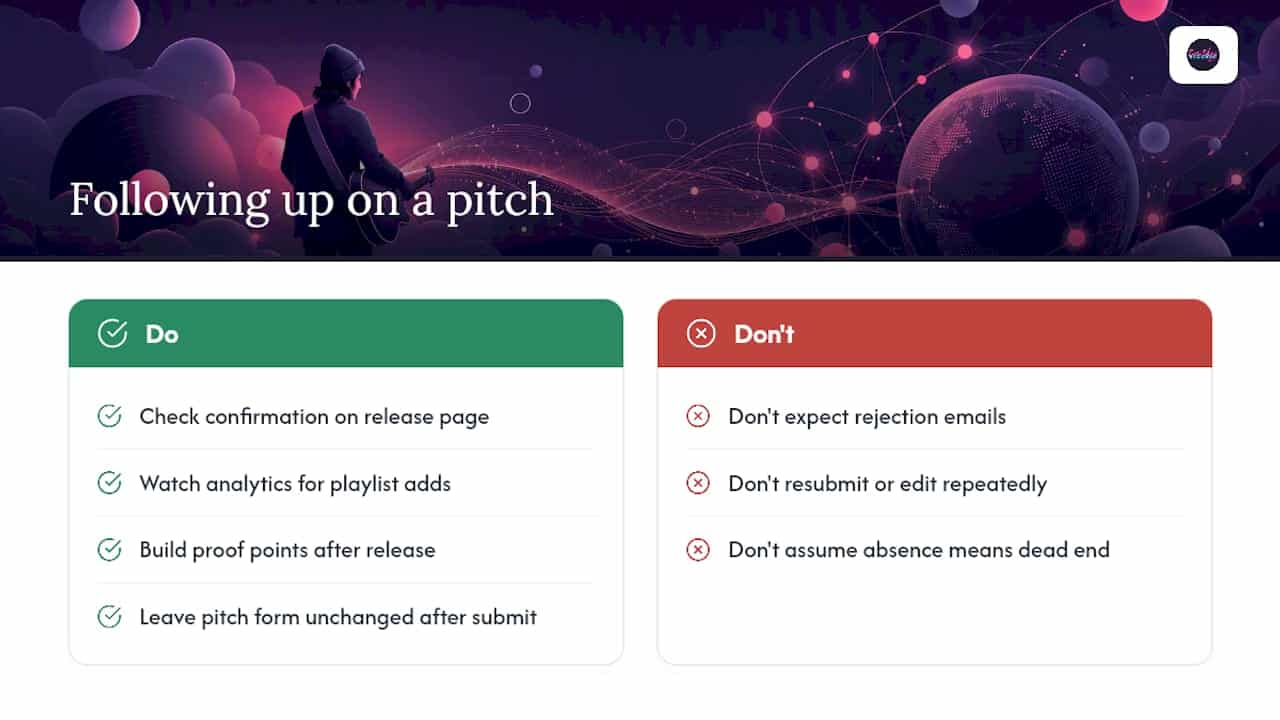
Once you submit, Spotify for Artists gives you limited but useful visibility. Check the release’s detail page under the pitching section; if your submission went through, you’ll see a confirmation there rather than a separate email notification in most cases. There’s no public “under review” or “rejected” status bar, which frustrates a lot of artists expecting a clear yes or no.
The honest answer is that editorial placement is binary and mostly silent: either the song shows up on an editorial playlist, or it doesn’t, and Spotify does not send a rejection notice explaining why. What you can track is what happens around the pitch. Watch your Spotify for Artists analytics in the days after release for any playlist adds appearing under “Playlists,” including editorial ones, which will show up by name if you land one.
Don’t resubmit or edit the pitch repeatedly hoping to trigger a second review; the form is meant to be filled out once per release and left alone. If the track doesn’t land on an editorial playlist, that’s not a dead end. Spotify’s own guidance notes that submitting the pitch still feeds the track into Spotify’s systems and helps route it to followers’ Release Radar, even without an editorial placement. That’s real distribution value on its own. Use the weeks after release to build the exact proof points, saves, steady growth, real playlist adds, that make your next pitch stronger.
What Editorial Teams Actually Do With Your Pitch
Spotify’s editors are curators managing specific playlists, and your pitch is one input among many they use to decide what fits. They’re not reading your whole artist story; they’re scanning for a fast, honest match between your tags, your pitch language, and the playlist’s actual identity.
That’s why specificity beats persuasion. An editor managing a late-night acoustic playlist isn’t swayed by claims of greatness; they’re looking for a track that sonically belongs next to what’s already on the list. Your job in 500 characters is to make that fit obvious, not to convince them the song is good in the abstract.
It’s worth being direct about the odds: editorial placement is competitive and pitching never guarantees a spot, per Spotify’s own pitching page. Editors are working through enormous volume, and even a strong pitch on a strong song can miss. That’s not a reason to skip the process; it’s a reason to treat every pitch as one data point in Spotify’s broader recommendation systems, since algorithmic playlists and Release Radar routing benefit from a clean, accurate pitch regardless of whether an editorial slot opens up.
Think of the editorial team less as gatekeepers you’re begging and more as curators doing quick pattern matching. The clearer your pattern, sound, context, fit, the faster they can say yes.
Best Times and Days to Submit Your Pitch
Timing your submission around the calendar matters less than timing it around your release date, but a few practical patterns help. Submitting early in the week, Monday through Wednesday, gives Spotify’s teams more processing runway before the following Friday’s new-release cycle, when the platform is handling the heaviest volume of incoming pitches and playlist updates.
Avoid submitting the pitch itself in the final 48 hours before your absolute deadline. Even though 7 days is the technical minimum, cutting it that close leaves no margin if your distributor delivery is delayed or your metadata needs a last-minute fix. Aim to have the pitch finalized and submitted by the 10 to 14-day mark, which lines up with the practical calendar covered earlier in this guide.
There’s no confirmed evidence that a specific hour of the day changes your odds, so don’t overthink submitting at 9 a.m. versus 4 p.m. What matters far more is submitting once, correctly, with your metadata locked and your tags verified, rather than submitting fast and fixing details afterward. A rushed Thursday-night pitch racing the 7-day cutoff will almost always underperform a calm submission finished a week and a half out.
My 7 to 14-Day Pitch Workflow
Here’s the exact sequence I’d run in the two weeks before any release. Day 14: confirm distributor delivery is locked and the release shows as “Upcoming” in Spotify for Artists. Day 12: pick your one focus track and write a first draft of the 500-character pitch using the sound, context, fit structure. Day 10: test that draft against real playlist titles and Spotify search suggestions, then rewrite anything that doesn’t match how the platform actually names playlists.
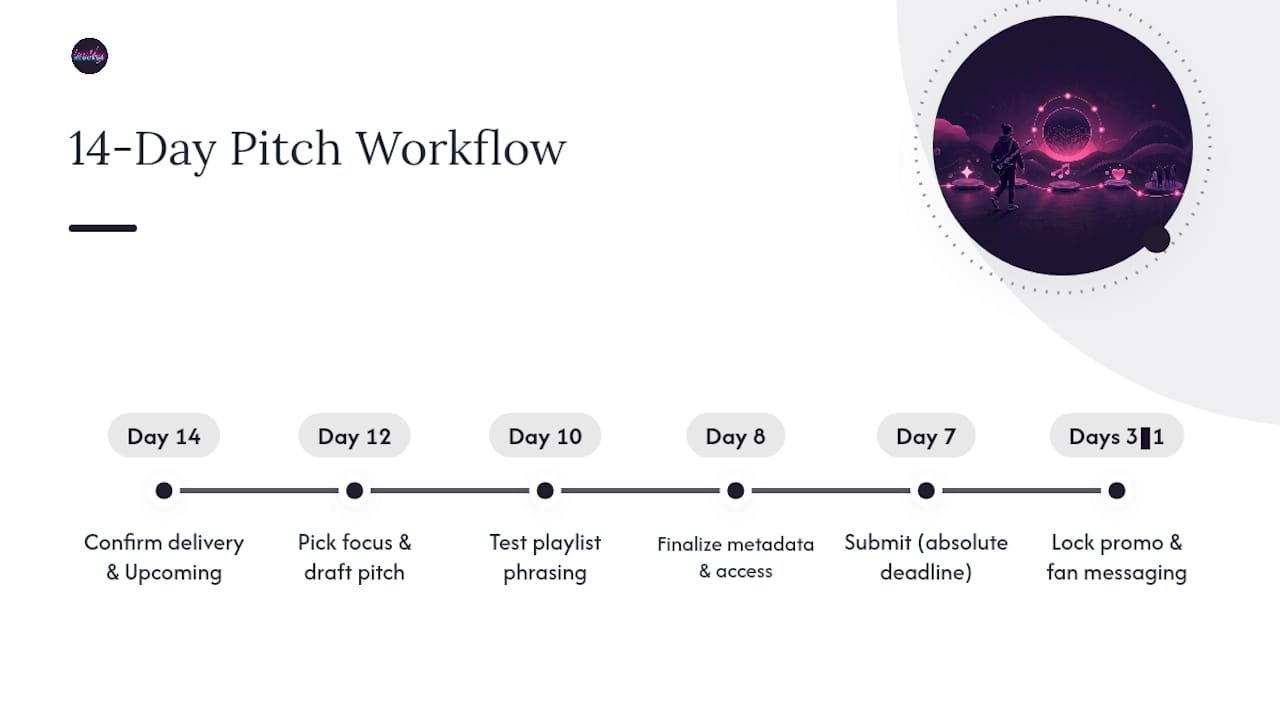
Day 8: finalize tags, genre, mood, instrumentation, and confirm every team member’s access level. Day 7 (absolute deadline): submit if you haven’t already. Day 3 to 1: lock promo assets, short-form clips, collaborator posts, and your fan push messaging. Release day: execute the 72-hour plan immediately, don’t wait to see how the first few hours go.
Pro Tip: Read your finished pitch out loud next to three real playlist titles in your genre. If it doesn’t sound like it belongs in that sentence, an editor won’t hear it that way either.
Getting your studio work, metadata, and pitch language aligned before that 7-day deadline is where a lot of independent releases fall apart, not from a weak song, but from a rushed submission. If you want a second set of ears on the mix, the metadata, or the promo push before your next release window closes, Twisbyrecords’ advertising services are built to carry the first-72-hour push once your pitch is in.
— Kreg
Sources
- Pitching music and videos to Spotify playlist editors — Spotify Support
- Artist
- Spotify for Artists playlist pitching — Orphiq
- How to get your music on Spotify playlists — Berklee Online
FAQ
What Is the Spotify 1000 Rule?
The “1000 rule” isn’t an official Spotify policy; it’s an informal benchmark some artists use, suggesting a song needs roughly 1,000 engaged listeners or saves early on to signal real momentum. Spotify itself doesn’t publish a specific listener threshold tied to editorial consideration.
Is It Worth Pitching to Spotify Playlists?
Yes. Even when editorial placement doesn’t happen, submitting your pitch still helps route the track into your followers’ Release Radar and feeds Spotify’s broader discovery systems, so there’s a real benefit even without a playlist slot.
How Far in Advance Should You Pitch to Spotify?
Submit at least 7 days before release, but aim for 14 days as a safer target, and deliver to your distributor 2 to 4 weeks out to leave room for fixes.
How Do You Know if Spotify Accepted Your Pitch?
Spotify doesn’t send a rejection notice or explicit “accepted” status. Check your release’s pitching section in Spotify for Artists for submission confirmation, then watch your playlist analytics after release to see if an editorial playlist add appears.