


If your mix is already balanced and final, send a stereo file and skip the extra cost. If you’re unsure about your low end, your vocal sits wrong in the verses but right in the chorus, or you need masters for streaming plus vinyl plus a radio edit, prepare stems instead. Stereo mastering is faster and less expensive. Stem mastering costs more and requires more time, but it gives you control a stereo file can’t offer. Twisby Records holds Apple Digital Masters certification and works both routes daily.
TL;DR:
- Stem mastering offers greater flexibility to rebalance specific groups like bass or vocals, but requires meticulous export and costs more than stereo mastering.
- Stereo mastering is faster and less expensive, suitable for mixes that are already finalized and do not need structural adjustments.
- Proper file preparation, such as matching sample rates, leaving headroom, and avoiding limiters on stems, is crucial to prevent delays and additional fees.
- Stem sessions typically take longer and cost more because they involve evaluating several grouped stereo files rather than a single mix.
- In most cases, trusted mixes can be mastered from stereo files, while complex or unresolved mixes benefit from targeted stem adjustments.
Table of Contents
- Stem Mastering vs Stereo Mastering: The Quick Comparison
- What Happens During Stereo Mastering
- How Stem Mastering Actually Works
- When to Choose Stereo vs Stems: A Decision Guide
- Preparing Your Files and Export Checklist
- What Stem Mastering Can and Can’t Fix
- The Bottom Line on Choosing Your Method
- How We Decide Between Stems and Stereo at Twisby Records
- Ready to Master Your Track the Right Way
- Sources
- FAQ
Stem Mastering vs Stereo Mastering: The Quick Comparison
Stereo mastering processes one finished two-track file. Stem mastering works from grouped submixes, usually drums, bass, vocals, and instruments, exported as separate stereo files that sum back into your mix. That’s the entire technical distinction, and it drives everything else: cost, turnaround, and how much an engineer can actually change.
Here’s how the two stack up on what matters to you:
- Control and flexibility: Stereo locks in your mix balance as final; stems let the engineer rebalance groups (more kick, less vocal reverb, tighter low end) before applying master processing.
- Cost and turnaround: Stereo mastering is typically the faster, less expensive option, since stem mastering usually costs more and takes longer because it demands more session time and surgical decisions.
- Preparation complexity: Stereo needs one clean file; stems need matched start points, full tails, and careful export discipline across every group.
- Best for: Stereo suits a mix you already trust. Stems suit a mix that’s close but not quite settled, or one that needs multiple final formats.
If you can’t decide, ask yourself one question: would you change anything about the balance if you could? If the answer is no, stereo saves you money.
What Happens During Stereo Mastering
Stereo mastering takes your finished two-track mixdown and polishes it. The engineer isn’t rebalancing your kick against your bass. They’re shaping the whole picture: tonal correction with EQ, dynamic control with compression, width adjustments through stereo imaging, and final loudness targeting with a limiter, tuned for wherever the track is headed, whether that’s Spotify, Apple Music, or vinyl. Mastering for Spotify has its own loudness quirks worth understanding before you export anything.
Your file needs to meet a few basic specs:
- WAV or AIFF format, 24-bit or higher.
- Sample rate matching your session (typically 44.1kHz or 48kHz).
- Roughly -3 dB of headroom below 0, so the engineer has room to work without clipping.
- A reference bounce of your mix, so the engineer knows what you were aiming for.
Pro Tip: Send the mix you’re proudest of as your reference, not a rough draft. Engineers master toward your intent, and an outdated reference sends them chasing the wrong sound.
The trade-off for this simplicity is speed. Stereo sessions generally start at a lower cost and are completed more quickly than stem work, largely because there’s nothing to rebalance. The engineer is refining, not rebuilding.
How Stem Mastering Actually Works
Stems aren’t the same thing as multitracks, and mixing these two up is one of the most common (and most expensive) mistakes independent artists make. Multitracks are your raw individual files: every vocal take, every guitar layer, every drum mic, unmixed. Stems are grouped submixes, drums as one stereo file, bass as another, vocals as another, already balanced internally and ready to combine. Understanding that distinction before you export saves you a confused email exchange with your engineer later.
What stems actually let an engineer do:
- Push the kick and bass relationship without touching anything else.
- Pull vocal presence up in a chorus without re-EQing the whole mix.
- Correct low-end imaging issues that a single stereo file locks in place.
- Build separate masters for streaming, vinyl cutting, or a radio edit from the same source.
The logistics matter as much as the concept. Every stem needs to start at the exact same timecode, include full reverb and delay tails so nothing gets clipped off, and export without any master bus limiter riding on top. That last point trips people up constantly: if you print stems with a brick-wall limiter already baked in, the engineer loses the headroom they need to actually do stem-level work. Expect stem sessions to run longer and cost more than stereo, simply because there’s more to evaluate.
When to Choose Stereo vs Stems: A Decision Guide
Neither method is inherently better. They solve different problems, and picking wrong wastes money in either direction.
- Choose stereo mastering when your mix is genuinely finished, your budget is tight, and you need a fast turnaround. This covers most polished, well-mixed tracks. Stereo remains the industry standard specifically because it respects the balance decisions the mix engineer already made.
- Choose stem mastering when the arrangement is complex, the low end feels unresolved, the vocal sits inconsistently across sections, or you need masters for multiple formats from one session.
- Choose neither, and go back to remixing, when the problems are structural: timing issues, frequency clashes baked into the arrangement, or a vocal that’s simply recorded wrong. No amount of stem-level polish fixes a performance or arrangement problem.
That third scenario is where independent artists lose money. They pay for stem mastering hoping it will rescue a mix, when what they actually need is a mix engineer, not a mastering one.
Preparing Your Files and Export Checklist
Getting this right the first time avoids delays and, often, avoids extra fees. Whether you’re sending stereo or stems, follow this sequence:
- Bounce your reference mix first, the one you’re happiest with, at full length.
- Confirm every stem or stereo file uses the same sample rate and at least 24-bit depth.
- Leave approximately -3 dB of peak headroom across every file.
- Bypass any master bus limiter before exporting, especially for stems.
- Verify every stem starts at the same timecode and includes full tails, not truncated reverb or delay decay.
A few naming and grouping habits make the engineer’s job faster:
- Group stems logically: drums, bass, vocals, instruments, FX, rather than dozens of individual tracks.
- Name files clearly (“SongTitle_Drums.wav”) so nothing gets mixed up in transit.
- Include a tempo map if your track has tempo changes.
- Attach a short note flagging anything you’re unsure about, a section that feels too loud, a vocal that might need presence.
The most common technical error is a mismatch: stems that don’t line up at the same starting point, missing tails, or a limiter accidentally left on the master bus. Exact export requirements are well documented across the industry, and following them the first time is far cheaper than a second round of fixes. If you want a fuller walkthrough, Twisby Records’ export guide covers this step by step.
What Stem Mastering Can and Can’t Fix
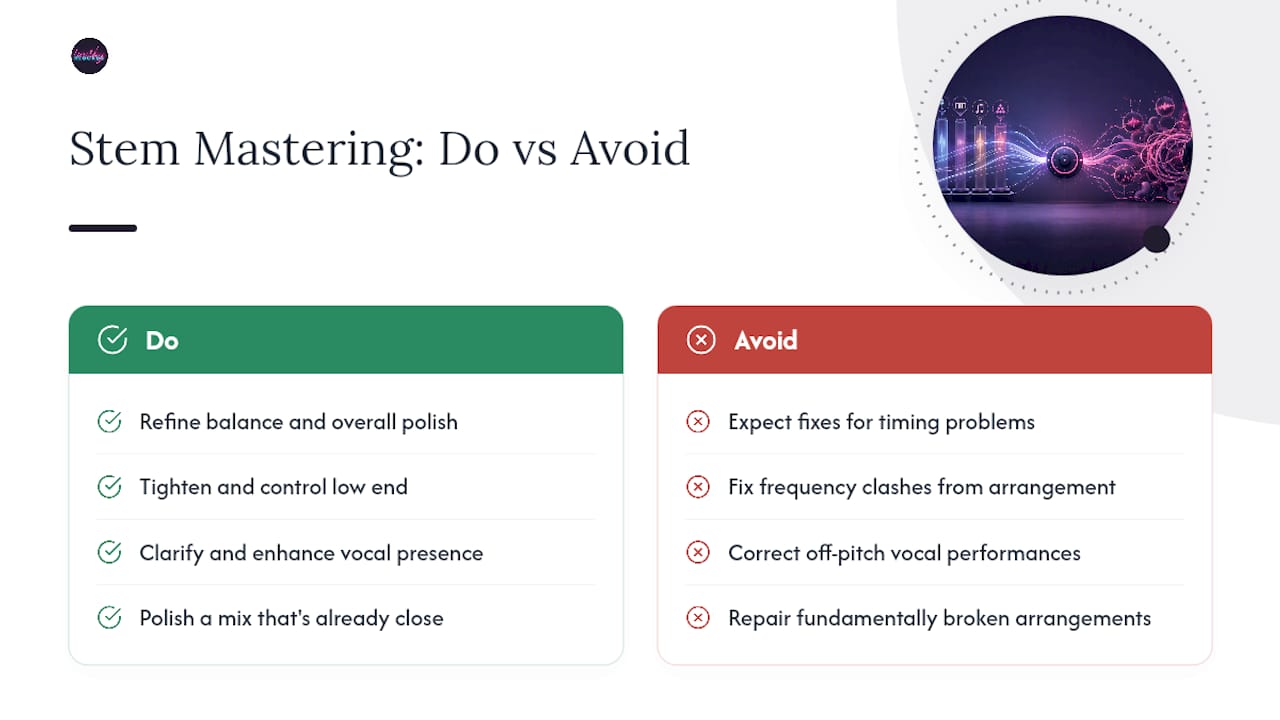
Stem mastering polishes. It doesn’t rebuild. That distinction gets lost constantly in artist forums, where stems get pitched as a cure-all for mixes that never quite came together.
Stem mastering is not a fix-it service for a bad mix. It gives an engineer flexibility to refine a mix that’s close, adjusting balance, tightening low end, clarifying a vocal. It cannot repair a fundamentally broken arrangement or a performance that was tracked wrong.
That’s the honest version of what stem mastering is designed to do, and it’s worth sitting with before you spend money on it. Timing problems, frequency clashes baked into the arrangement, or a vocal recorded off-pitch aren’t things a mastering engineer touches at the stem level. Those need a remix, sometimes a re-record.
Where they don’t help: a song where the drums were tracked out of time, or where three instruments were arranged in the same frequency range from the start. If your mix has that second kind of problem, talk to a mixing engineer before you talk to a mastering one.
The Bottom Line on Choosing Your Method
If your mix is finished and you trust the balance, send stereo and save the money for advertising or your next release. If something feels unresolved, or you need multiple final formats, prepare stems using the export checklist above and be upfront with your engineer about what’s bothering you. When you reach out, mention your genre, your deadline, and specifically what you’re unsure about; that context lets an engineer recommend the right method before you’ve paid for the wrong one. A full mastering walkthrough is worth a read if you’re prepping your first submission.

How We Decide Between Stems and Stereo at Twisby Records
Every project starts with a listen, not a form. We’re checking whether the balance already works, whether the low end feels resolved, and whether there’s a vocal moment that needs targeted attention rather than a full remix. That listen tells us more than any questionnaire could.
Most polished, well-arranged mixes get mastered from stereo. It’s faster, it costs less, and it respects the choices already made in the mix. We recommend stems only when we hear a specific, fixable issue: a kick and bass fighting for space, a vocal that needs presence in one section without disturbing another. Over 35 years and with Apple Digital Masters certification behind our masters, we’ve learned that recommending the cheaper, faster route when it’s genuinely the right one builds more trust than upselling stem work nobody needed.
If you’re not sure which route fits your track, send a mix and a note about what’s bothering you. That’s usually enough to tell.
— Kreg
Ready to Master Your Track the Right Way
Twisby Records handles both routes covered in this guide, stereo mastering for finished mixes and stem mastering when your balance needs targeted work, so you’re not stuck choosing blind or paying for more session time than your track actually needs.

Every engagement starts the same way: send your files (stereo or stems, we’ll tell you which fits), get a straightforward turnaround estimate, and receive your finished masters as Apple Digital Masters certified deliverables, ready for streaming without a second round of guesswork. If you’re also thinking about how the release reaches listeners once it’s mastered, our advertising services handle the Facebook and Instagram campaign side, so the polish you paid for actually gets heard. Submit your mix and a short note about what you’re unsure of, and we’ll tell you the right method before you spend a dollar on the wrong one.
Sources
- Stems and multitracks — iZotope community blog
- Stem mastering: go beyond conventional stereo mastering — SonicScoop
- Stem mastering vs stereo mastering: what’s the difference? — BorisFX
- Asmr
FAQ
Should a mastered track be mono or stereo?
Nearly all commercial masters are delivered in stereo; mono is reserved for specific broadcast or club sound-system requirements, not standard streaming releases.
Do most DJs use stems?
Many DJs and remixers work with stems for live mixing and edits, but that’s a separate use case from mastering stems, which are grouped submixes prepared specifically for final polish, not performance.
Is Dr. Dre a mastering engineer?
No. Dr. Dre is primarily known as a producer and mixer, not a mastering engineer; mastering is typically handled by a specialized engineer working after the mix and production stages are complete.
What is the rule for stems in music?
The core rule is consistency: every stem must share the same start point, include full tails, and export without a master bus limiter so the stems sum back to the original mix cleanly.
How do I know if I need stem mastering instead of stereo?
If your mix balance already feels finished, stereo is faster and cheaper; if you need targeted adjustments to vocal presence, low end, or multiple final formats, stems give your engineer that control.