


Mastering revisions are targeted refinements applied to a finished stereo master, not fixes to the underlying mix. In a typical independent workflow, you should expect typically one or two focused revision passes before delivery. That ceiling is not arbitrary. Industry engineers consistently recommend limiting free rounds to one or two to keep scope focused and protect timelines for both sides.
Here is what a normal revision looks like:
- What’s included: tonal balance adjustments, stereo field width, overall density, gentle transient shaping, and limiter curve tailoring
- Common policy norm: one to two free revisions bundled in the project fee, with additional rounds billed separately
- Single most important tip: level-match the returned master to your reference before you judge anything. A louder version always sounds better, and that perception will send you chasing a problem that does not exist.
Twisbyrecords operates within these same norms, backed by Apple Digital Masters certification and over 35 years of engineering experience.
Key Takeaways
Mastering revisions are master-stage refinements only. One to two focused rounds, with level-matched listening and prioritized notes, is the most effective path to a finished track.
| Point | Details |
|---|---|
| Level-match before judging | Always match loudness to your reference before evaluating any returned master. |
| Limit revision rounds | One to two free rounds is the industry norm; additional passes are typically billed separately. |
| Prioritize your notes | List your top two concerns per round to keep requests specific and speed approvals. |
| Label every version | Use clear file names (MixV2, MasterV1) so both sides always know which file is current. |
| Twisbyrecords | Offers structured mastering revisions with Apple Digital Masters certification and clear turnaround windows. |
Table of Contents
- What actually counts as a mastering revision?
- What do typical revision policies look like?
- How do you request a revision that actually gets results?
- What files and naming conventions do engineers expect?
- When does a revision become billable?
- Copy-paste revision request templates and checklists
- What does the full revision workflow look like, step by step?
- How do you know when a revision is actually finished?
- Why a clear revision policy protects everyone
- Twisbyrecords handles mastering revisions with a clear policy and fast turnaround
- Sources
- FAQ
What actually counts as a mastering revision?
A mastering revision addresses problems that live at the master stage. If the issue originates in the mix, sending a revision request will not fix it, and you will burn a free round on something the engineer cannot solve without a new mix file.
Belongs in the master:
- Top-end harshness or dullness across the full mix
- Stereo field too narrow or too wide
- Overall density or punch (limiting and compression curve)
- Sibilance control across the full program
- Loudness target adjustment (LUFS integrated level)
Does not belong in the master:
- One instrument is too loud or too quiet relative to others
- The lead vocal needs to sit differently in the arrangement
- A re-recorded or replaced vocal take
- Any change that requires opening individual tracks
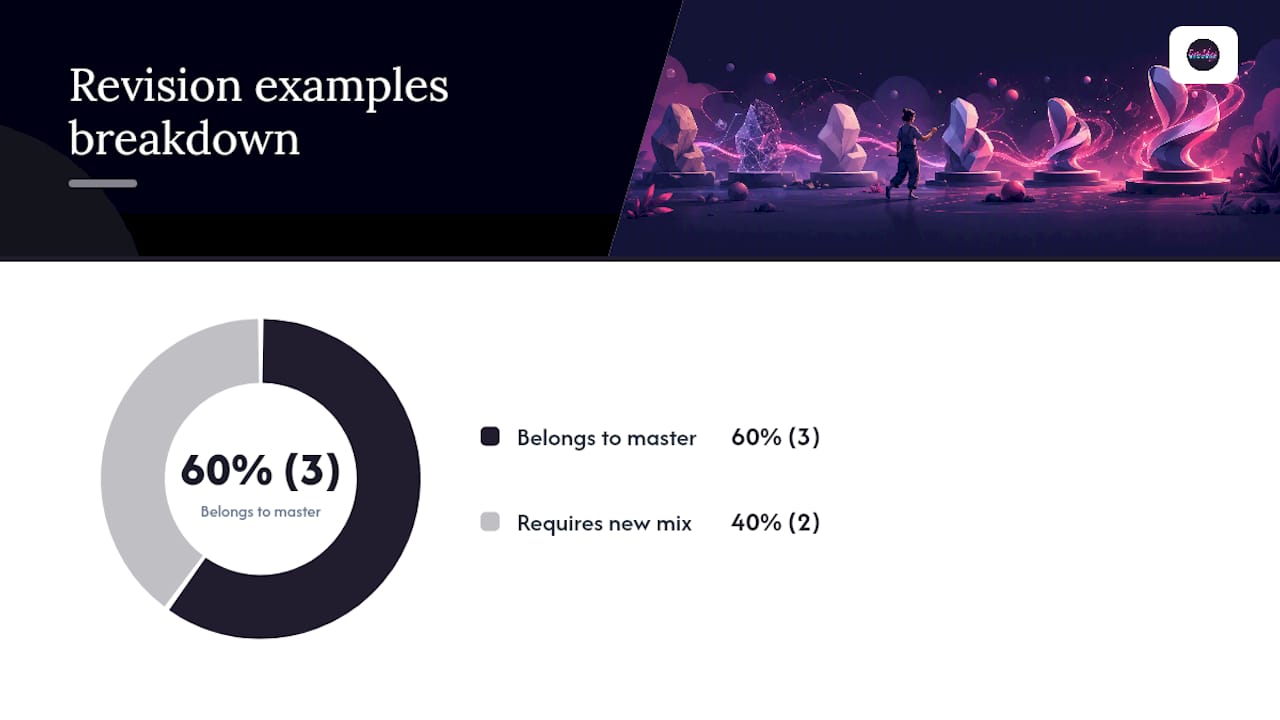
A quick reference:
| Requested change | Belongs to master? | Why |
|---|---|---|
| “The whole mix feels too bright” | Yes | Full-program EQ is a master-stage tool |
| “The snare is too loud” | No | Requires adjusting a single mix element |
| “It needs more punch overall” | Yes | Limiting and transient shaping apply at master stage |
| “The chorus vocal is buried” | No | Vocal level is a mix balance issue |
| “Widen the stereo image slightly” | Yes | Stereo processing lives in the master chain |
When you supply a new mix file after the first master is delivered, that triggers a new master pass, not a revision. Label it clearly so both sides understand the versioning.
Pro Tip: Before sending any revision request, ask yourself: “Does this problem exist on every instrument, or just one?” If it’s just one, you need a new mix, not a new master.
What do typical revision policies look like?
Experienced engineers and forum summaries commonly recommend limiting free mastering revisions to a small, focused number of rounds to avoid indefinite, subjective correction cycles. Here is how those norms translate into real policy structures.
Common pricing models:
- Bundled revisions: one or two free rounds included in the flat project fee; additional rounds billed per pass
- Per-revision fee: each round after the first is charged at a fixed rate (typically $25–$75 per pass for singles, depending on the engineer)
- Hourly billing: less common for mastering, but used for complex album projects where revision scope is unpredictable
- Rush fees: 24-hour or same-day turnaround typically carries a surcharge of 25–50% above the base rate
Triggers for additional charges:
- A new mix file supplied after the original master is delivered
- A major tonal direction change that effectively restarts the session
- Requests that require processing individual channels (which belong in the mix)
- Revisions requested outside the agreed window (e.g., 30 days after delivery)
Sample policy language you can copy:
These lines belong on your invoice, service page, or project agreement before work begins.
How do you request a revision that actually gets results?
Structured revision notes with specific, audible observations avoid the open-ended revision trap and speed final approvals. Here is the checklist to follow before you send anything.
Step-by-step revision request process:
- Level-match first. Use a gain plug-in or your DAW’s clip gain to match the returned master to your reference at the same perceived loudness before you listen critically.
- Identify the section. Note the timestamp where the problem is most audible (e.g., “0:42 into the chorus”).
- Describe what you hear, not what you want done. Write “the high end feels harsh on cymbals” rather than “add a high-shelf cut at 10k.”
- State the desired outcome. “I’d like the top end to feel smoother without losing air” gives the engineer direction without prescribing a specific tool.
- Attach a reference track. Name it, note the timestamp of the quality you want, and confirm you’ve level-matched it to the master.
- Prioritize. List your top two concerns first. Asking clients to prioritize their top two items per revision cuts subjective requests and improves outcome speed.
Do / don’t quick reference:
- Do describe audible problems in plain language
- Do check on at least three playback systems before writing notes (headphones, car, phone speaker)
- Do include a reference track with a specific timestamp
- Don’t name specific plug-ins or processing chains
- Don’t send emotional or vague language (“it just doesn’t feel right”)
- Don’t bundle mix-level problems into a mastering revision request
On stems: supply a full stereo rough mix for reference. Only send stems or a new mix file if the engineer specifically requests them, or if you have confirmed the issue lives in the mix.
What files and naming conventions do engineers expect?
Friction at the file-delivery stage wastes revision rounds. Send the right files with clear names and the engineer can focus on the audio, not on tracking down which version is current.
Required files for a mastering revision:
- The original stereo mix WAV or AIFF (24-bit, 44.1 kHz minimum; 48 kHz or higher if that is your session rate)
- The previously delivered master file, labeled clearly
- A reference track (commercial release at a similar loudness target)
- DAW session stems only if the engineer requests them for a specific fix
File naming example:
ArtistName_SongTitle_MixV2_STEREO_24b48k.wav
ArtistName_SongTitle_MasterV1_REVISION_REQUEST.wav
ArtistName_SongTitle_Reference_ArtistName_SongTitle.wav
On loudness targets: LUFS (Loudness Units Full Scale) is the standard metric for measuring integrated loudness. Most streaming platforms normalize playback, so the goal is a master that sounds intentional and controlled at the engineer’s target, not one that is simply as loud as possible. Level-match your reference to the master using a free metering plug-in like Youlean Loudness Meter before comparing. Never judge loudness by ear alone.
Version control: label every new mix with a version number (MixV1, MixV2) and every new master separately (MasterV1, MasterV2). A new mix always generates a new master version, not a revision. Clear labels prevent the most common source of confusion in revision workflows.
When does a revision become billable?
The line between a free revision and a billable new pass is clearer than most clients expect. A practical, repeatable approach to revision notes and limit-based policies avoids open-ended correction cycles and protects both the client’s budget and the engineer’s time.
Common billable triggers:
- A new mix file supplied after the original master is delivered
- A request that changes the fundamental tonal direction (not a refinement, a restart)
- Any request that requires processing individual channels or instruments
- Revisions submitted outside the agreed window
- More rounds than the bundled number in the original agreement
Sample language for reopening scope:
Client to engineer: “I know this is outside the original scope. Can we discuss whether this is a new pass or a new project?”
Engineer to client: “The changes you’re describing require a new mix. Once you send the updated file, I’ll treat it as a new master pass at the standard rate.”
Avoiding scope creep from the start:
- Put revision limits in writing before the project begins
- Ask clients to submit a single consolidated revision note (not a drip of individual emails)
- Agree on a revision window (e.g., 14 or 30 days post-delivery)
- Require prioritization: two items per round maximum
Copy-paste revision request templates and checklists
Use these templates as starting points. Adapt the brackets to your project details.
Minimal template (single focused change)
Prioritized template (two to three items with timestamps)
Comprehensive template (full pass with labeled sections)
Engineer action checklist:
- Confirm level-match between the new request and the previous master
- Read all notes before opening the session; identify which are master-stage and which are not
- Implement changes in priority order
- Render an A/B export (original master vs. revised master at matched levels)
- Log changes in a session notes file (date, version, what changed)
- Deliver with a short note summarizing what was adjusted
Client listening checklist before sending a revision request:
- Level-match the master to your reference (non-negotiable)
- Listen on at least three systems: studio monitors or headphones, car speakers, phone speaker
- Write down specific timestamps and audible descriptions, not emotional reactions
- Check mono compatibility (collapse to mono and confirm nothing disappears)
- Sleep on it. Spaced revisits catch translation issues that a single listening session misses, and you will hear things differently after 24 hours.
Pro Tip: Treat each listening pass as an active test. Before checking the master again, write down from memory what you heard last time. Retrieval practice and distributed review reliably improve what you retain and notice — the same principle that makes spaced study effective applies directly to critical listening.
What does the full revision workflow look like, step by step?
A shared five-step workflow removes ambiguity about who does what and when approval is final.
-
Submit the master (Client). Deliver the stereo mix WAV, reference track, and any written notes. Expected turnaround to first master: 24–72 hours for singles, 5–10 business days for albums.
-
Listen and level-match (Client). Check on multiple systems over at least 24 hours before writing revision notes. Approval at this step means “I have listened critically and have specific notes” or “I approve as delivered.”
-
Engineer implements the revision (Engineer). Works from the prioritized notes, addresses only master-stage items, and logs all changes. Turnaround for a revision pass: typically 24–48 hours.
-
Client verifies (Client). Level-match the revised master to the previous version and the reference. Confirm each noted item was addressed. Approval at this step means “the revision matches the brief.”
-
Final delivery (Engineer). Delivers the approved master in all required formats (WAV, MP3, DDP for album). Closes the revision window. Any further changes are a new billable pass.
For albums, batch approvals by side or by sequence group rather than track by track can enhance the experience as detailed in Corporate Event Entertainment Ideas That Drive Engagement. Sequencing decisions affect the mastering of adjacent tracks, so approving the full sequence before requesting revisions saves rounds. If you are planning a release around a specific date, build revision time into your music release strategy before you book the mastering session.
How do you know when a revision is actually finished?
A revision is finished when the returned master matches the brief you submitted, not when it sounds perfect in isolation. These checks confirm it.
A/B listening checklist:
- Level-match the revised master to the previous version (same LUFS)
- Compare on headphones, monitors, and a consumer speaker
- Check mono: collapse to mono and confirm the low end and vocals hold
- Confirm the specific items from your revision request are addressed
Measurable verification items to request:
- Integrated LUFS reading (ask the engineer to confirm the target)
- True-peak limit (confirm it does not exceed the agreed ceiling)
- Phase correlation check (no significant phase cancellation in mono)
Small vs. large corrections:
A micro-tweak is a top-end comfort adjustment, a slight limiter release change, or a minor stereo width shift. These are true revisions. A macro change, such as a fundamental rebalance of low-end energy or a complete tonal direction shift, almost always means the mix needs to change first. Evidence-based review methods recommend structured, varied listening passes rather than passive re-checking to catch the difference between a master-stage fix and a mix problem before you send the request.

| Correction type | Example | Belongs in master? |
|---|---|---|
| Micro-tweak | Top-end feels slightly harsh | Yes |
| Micro-tweak | Limiter pumping slightly in chorus | Yes |
| Macro change | Bass and kick need rebalancing | No — new mix needed |
| Macro change | Vocal sits too low in the whole track | No — new mix needed |
Why a clear revision policy protects everyone
A transparent revision policy is not a defensive legal document. It is the single most respectful thing you can put in front of a client before work begins.
Every ambiguous revision request I have seen come through a session shares the same root cause: no one defined what a revision was before the project started. The client assumed “unlimited tweaks until it’s right.” The engineer assumed “two focused passes.” Both were reasonable assumptions. Neither was written down.
The templates and checklists in this guide exist to close that gap. When a client knows upfront that a revision means “master-stage changes only, two rounds included, new mix triggers a new pass,” they write better notes. They listen more carefully. They prioritize. The result is a faster approval cycle and a better-sounding master, because the engineer is not chasing a moving target.
Apple Digital Masters certification, like the kind Twisbyrecords holds, requires that every delivered file meets a defined technical standard. That discipline starts with the revision process, not at the export stage. A clear policy is what makes that standard achievable on every project.
Twisbyrecords handles mastering revisions with a clear policy and fast turnaround
Independent artists deserve to know exactly what they are getting before a session starts. Twisbyrecords includes structured revision rounds in every mastering project, with Apple Digital Masters certification on every delivered file and a turnaround built for independent release schedules.

If you have a track ready for mastering or you want to talk through your revision workflow before booking, the Twisbyrecords services page has everything you need to get started. You can also explore release promotion support if you want managed streaming growth alongside your mastered release. Reach out and let’s get your track finished the right way.
Sources
- How Many Revisions Is Normal—and How To Use Them Wisely | Fresh Chopped Beats
- Avoid The #1 Mastering Mistake (How Revisions SHOULD Work.) — SonicScoop
- How to Revise Effectively — Science-Backed Guide | StudyVector
- Exams and Revision Top Tips
FAQ
What are mastering revisions?
Mastering revisions are targeted adjustments to a finished stereo master, covering tonal balance, loudness, stereo field, and limiting. They do not include changes to individual instruments or mix elements.
How many free mastering revisions should I expect?
One to two free rounds is the standard industry norm. Experienced engineers recommend this limit to keep scope focused and prevent indefinite subjective changes.
What should I include in a revision request?
Include a timestamp, a plain-language description of what you hear, your desired outcome, and a level-matched reference track. Prioritize your top two concerns and avoid naming specific plug-ins or processing tools.
When does a revision become a new billable pass?
Supplying a new mix file, requesting changes that affect individual channels, or exceeding the agreed number of free rounds all trigger a new billable pass rather than a free revision.
How do I know when a revision is finished?
A revision is finished when the returned master addresses each item in your written request, confirmed by level-matched A/B listening on at least three playback systems, including a mono check.