


A stereo single typically delivers within a few days from a clean final mix. A small EP runs several working days. A full album, with cohesion passes, sequencing, and DDP export, usually takes around a week or more. Those numbers hold when your files are ready and your revision notes are clear. The single biggest thing that blows a timeline? Submitting a mix that still needs fixing.
Here’s what you can do right now to hit the lower end of every range:
- Send your final stereo mix at the correct level (typically peaking around -1 dBFS or lower, no clipping)
- Include 1–2 reference tracks with a note on what you like about them
- Specify your delivery formats upfront (streaming, CD, vinyl, or all three)
- Define your revision window before the session starts
The distinction between active processing time and total calendar delivery time is where most artists get confused. An engineer might spend 30–60 minutes actively working your track, per iZotope’s guidance on mixing and mastering timelines, but QC passes, format exports, and metadata tagging push that to 24–48 hours on the calendar. Plan for calendar time, not bench time.
Table of Contents
- How mastering turnaround time actually breaks down by project size
- What actually moves your timeline faster or slower
- A step-by-step time map of the mastering workflow
- How to shorten your mastering turnaround before you even book
- What mastering service SLAs actually mean and what rush options cost
- How price tiers connect to turnaround speed and what you actually get
- Stereo mastering vs. stem mastering: which one fits your deadline?
- Ready-to-use booking timeline templates for singles, EPs, and albums
- How Twisbyrecords handles turnaround in the real world
- Key Takeaways
- The part of turnaround nobody talks about honestly
- Twisbyrecords can meet your release deadline
- Useful sources
- FAQ
How mastering turnaround time actually breaks down by project size
Active processing time and calendar delivery time are two different clocks, and conflating them is how release dates get missed.
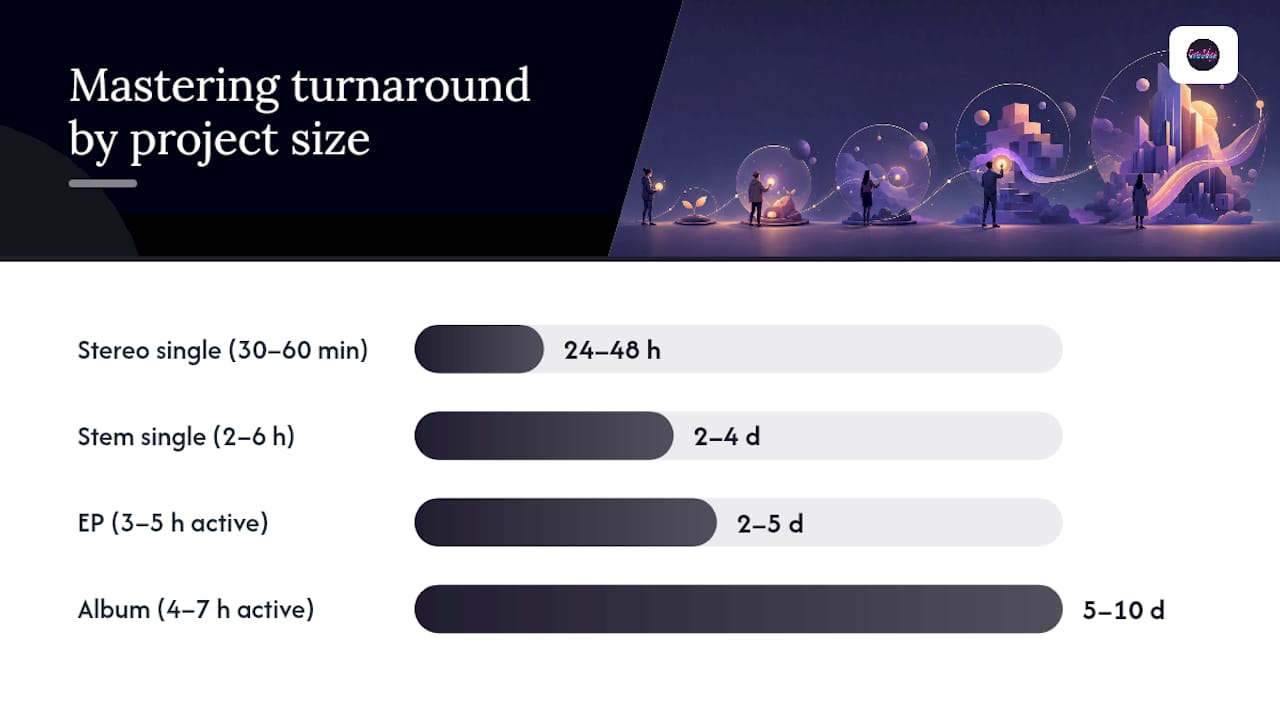
For a stereo single, iZotope estimates active mastering at roughly 30–60 minutes for a well-prepared mix. Add QC listening, loudness exports, and metadata, and total delivery lands at 24–48 hours. If you also need alternate masters (radio edit, instrumental, Apple Digital Masters–compliant version), budget an additional 1–3 hours of active time and potentially another calendar day.
Stem mastering a single is a different animal. Organizing stems, checking phase relationships, and processing individual elements can take 2–6 hours of active work, sometimes more if the stems arrive unlabeled or misaligned. That translates to 2–4 calendar days for a single stem session.
For a 3–5 track EP, most engineers complete active processing in one focused session of 3–5 hours, then spend additional time on sequencing and level matching across tracks. Expect 2–5 working days total. A 10–12 track album is where the calendar really stretches. Sound on Sound forum data puts active album mastering at 4–7 hours for the processing passes alone, with assembly, cohesion listening, DDP creation, and QC adding meaningful time on top. A realistic album window is 5–10 working days.
Format requirements add more time the more complex your deliverables are. Different formats such as streaming only, CD, or vinyl prep each require additional processing and calendar time. Planning for all your desired formats upfront helps avoid delays.
What actually moves your timeline faster or slower
Not all mastering projects are equal, and the variables below are what separate a 24-hour delivery from a 10-day one.
Mix readiness is the single largest factor. A mix that arrives with clipped peaks, phase cancellation, or excessive low-end buildup forces the engineer to either work around the problems (adding time) or send it back (adding days). Sound on Sound notes that a significant portion of mixing time is actually spent correcting tracking and recording issues, and those problems don’t disappear at the mastering stage. A clean mix is the fastest path to a fast master.
Stereo vs. stem mastering is the second biggest variable. Stereo processing is faster by design. Stem sessions require the engineer to manage multiple elements, check inter-stem phase relationships, and often apply different processing chains per stem group. That doubles or triples active time compared to a stereo session.
Number of formats compounds with project size. Every additional format (DDP, vinyl, alternate masters) adds active work and QC time. Requesting all formats at booking, rather than adding them mid-project, prevents timeline disruption.
Client responsiveness during revisions is underestimated. If an engineer sends a revision and waits 48 hours for your feedback, that’s 48 hours added to your calendar, regardless of how fast the processing was.
Engineer workload and scheduling matters too. Most professional engineers work a queue, and your project starts when your payment and approved files clear, not when you first reach out.
Pro Tip: Before you submit your mix, run a quick check for clipped peaks (any sample at 0 dBFS), phase issues on the mono sum, and excessive noise floor. These three problems are the most common reasons a mastering session runs long or gets sent back. The Twisby Records guide on how to master a song walks through exactly what a clean submission looks like.
A step-by-step time map of the mastering workflow
Here’s how a professional mastering session actually breaks down, step by step, with realistic time estimates for each stage.
- Diagnosis and chain setup: — 10–20 minutes. Processing decisions are made, reference tracks are loaded, and the initial chain is built. Tools like iZotope Ozone’s Master Assistant can produce a reliable starting point in under 10 minutes for straightforward material.
| Mastering Step | Active Time (per track) | Calendar Buffer |
|---|---|---|
| Critical listen | 5–15 min | None |
| Diagnosis / chain setup | 10–20 min | None |
| Active processing | 20–45 min | None |
| Cohesion pass (albums) | 15–30 min | None |
| Format exports | 15–45 min total | +0–1 day |
| Metadata / DDP | 20–60 min total | +0–1 day |
| QC pass | 10–20 min | +0–1 day |
Before calling a master done, run this quick check: Does the loudness match your target platform’s spec? Does it translate on earbuds, speakers, and a mono phone speaker? Are there any clicks, pops, or encoding artifacts in the exported file? LordReverb recommends stopping if active adjustments exceed roughly 4–5 times the track’s runtime, as that’s usually a signal the mix needs attention, not more mastering.
How to shorten your mastering turnaround before you even book
The fastest mastering sessions are the ones where the engineer spends zero time asking questions or fixing prep problems. Here’s the checklist that gets you there.
- Export your final stereo mix — at 24-bit or 32-bit float, at your session’s native sample rate. Don’t convert or dither before sending.
- State your loudness target. Streaming platforms like Spotify normalize to around -14 LUFS integrated. CD masters typically run louder. Vinyl has its own constraints. Tell your engineer which format is primary. The Twisby Records guide on mastering for Spotify covers platform-specific targets in detail.
Pro Tip: Consolidate all your feedback into a single message per revision round. “The low end is too heavy around 80 Hz, and the vocal feels slightly buried in the chorus” is one revision. Sending those as two separate emails at different times creates two separate revision cycles and doubles your wait time.
What mastering service SLAs actually mean and what rush options cost
Reading a service page’s turnaround promise requires knowing what the language actually means.
“Up to X working days” means the engineer has that many business days from the moment the clock starts, not from when you first inquire. The clock typically starts when two conditions are met: payment is received and your approved final files are uploaded. A Monday inquiry with files delivered Wednesday means the turnaround window opens Wednesday.
Business days exclude weekends and holidays. A “5 business day” turnaround that starts on a Thursday delivers the following Thursday at the earliest, not the following Tuesday.
Common SLA elements to look for:
- Quoted turnaround window (e.g., “up to 5 working days”)
- When the clock starts (payment + files, or files alone)
- Number of revisions included and response time per revision
- Format deliverables included in the base price
- Rush availability and how to request it
On revisions: most professional services include 1–3 rounds of revisions. A revision is typically defined as adjustments within the original creative scope. Requesting a completely different sound direction, adding new tracks, or changing the format list mid-project usually constitutes scope change and may reset the timeline.
A realistic rush policy looks like this: expedited delivery (24–48 hours for a single, 2–3 days for an EP) is available at an additional fee, with the understanding that the engineer prioritizes your project above the existing queue. Rush does not mean lower quality, but it does mean less scheduling flexibility for revisions. If you need a rush master, have your files and feedback ready to go immediately.
How price tiers connect to turnaround speed and what you actually get
Faster turnaround usually costs more, but the relationship isn’t always linear. Here’s how the tiers typically stack up.
Standard tier covers stereo mastering with a quoted turnaround of 3–5 working days, 1–2 revisions, and streaming-format delivery. This is the right choice when your release date is flexible and your mix is clean.
Priority tier typically shortens the window to 1–3 working days, includes more revision rounds, and often adds format options like DDP or Apple Digital Masters. The price premium for priority service varies by engineer and project scope.
Express or rush tier targets 24–48 hours for singles and 2–3 days for EPs. Expect a surcharge for expedited placement in the queue. The tradeoff is a compressed revision window: there’s simply less calendar time to go back and forth.
Before booking any tier, ask these questions to uncover hidden time costs:
- Are stems supported, and is there an additional charge?
- Is DDP creation included, or is it an add-on?
- How many revisions are included, and what’s the typical response time per round?
- Does the quoted turnaround include all requested formats, or just the primary?
For a deeper look at how different service levels compare, the Twisby Records roundup of online mastering agencies breaks down what to expect at each tier.
Stereo mastering vs. stem mastering: which one fits your deadline?
The choice between stereo and stem mastering isn’t just sonic. It’s a scheduling decision.
Mastering is a faster, more objective discipline than mixing, and stereo mastering keeps it that way. The engineer works with your final two-channel mix, making tonal, dynamic, and loudness decisions at the macro level. Active processing runs 30–60 minutes per track for a well-prepared stereo file.

Stem mastering gives the engineer more surgical control: separate stems (drums, bass, vocals, instruments) allow element-level adjustments that stereo processing can’t make. The tradeoff is time. Active stem sessions run 2–6 hours per track, and that’s assuming the stems arrive organized, phase-aligned, and properly labeled.
Choose stereo mastering when:
- Your mix is final and you’re happy with the balance
- Your deadline is tight (48 hours or less for a single)
- You need a straightforward loudness and tonal polish
Choose stem mastering when:
- The mix has balance issues that can’t be fixed in the stereo domain (e.g., the kick is too loud relative to everything else)
- You want element-level dynamic control (vocal de-essing without touching the mix bus)
- You have the time: budget at least 2–4 calendar days for a single stem session
If you’re unsure whether your mix needs stems, the Twisby Records post on whether mastering can fix a bad mix is a direct answer to that question.
Ready-to-use booking timeline templates for singles, EPs, and albums
Copy these into your release calendar and adjust for your specific engineer’s SLA.
Standard single: Files + payment submitted → 48–72 hours delivery → 24-hour revision window → final files delivered by day 4–5.
Standard EP (3–5 tracks): Files + payment submitted → 3–5 working days delivery → 48-hour revision window → final files by day 6–8.
Standard album (8–12 tracks): Files + payment submitted → 7–10 working days delivery → 48–72 hour revision window → final files by day 10–14.
| Package | Turnaround | Revisions Included | Deliverables |
|---|---|---|---|
| Standard | 3–5 working days | 1–2 rounds | Streaming WAV, MP3 |
| Priority | 1–3 working days | 2–3 rounds | Streaming WAV, MP3, Apple Digital Masters |
| Express / Rush | 24–48 hours (single) | 1 round | Streaming WAV; additional formats on request |
Rush templates compress the revision window significantly. For an express single, plan to review and respond within 12 hours of receiving the master. For a rush EP, 24 hours per revision round is the realistic maximum. After you receive your final masters, platforms like Payhip let you sell audio files directly to fans while your streaming distribution is processing.
How Twisbyrecords handles turnaround in the real world
Twisbyrecords brings over 35 years of experience and Apple Digital Masters certification to every project, which means the format-specific QC that adds days at less experienced studios is already built into the standard workflow.
Two representative examples of how turnaround works in practice:
Single, stereo, clean mix: An independent artist submits a final stereo mix with a reference track and a note specifying streaming delivery and a -14 LUFS target. The master is completed and delivered within 24–48 hours, including a streaming-optimized WAV and an Apple Digital Masters–compliant file.
10-track album, full package: An artist submits all tracks with consistent headroom, a track order, and a request for DDP and streaming masters. Twisbyrecords completes the cohesion pass, sequencing, DDP authoring, and QC within 7 working days. The artist receives streaming WAVs, a DDP image for CD replication, and Apple Digital Masters files.
What makes these timelines hold: the artist submitted final mixes (not work-in-progress files), included a reference, specified all deliverables at booking, and responded to the revision within 24 hours. Every one of those steps is within your control.
To hit a quoted turnaround, send Twisbyrecords:
- Final stereo mix (or organized stems) at 24-bit or higher, no master bus limiting
- 1–2 reference tracks with brief notes
- Your complete deliverable list (streaming, CD, vinyl, Apple Digital Masters)
- Your release date and any hard deadline
Key Takeaways
Mastering turnaround time ranges from 24 hours for a clean stereo single to 10 working days for a full album with multi-format delivery, and mix readiness is the single factor most within your control.
| Point | Details |
|---|---|
| Stereo single timeline | Expect 24–48 hours from clean files; stem singles run 2–4 calendar days. |
| EP and album windows | A 3–5 track EP takes 2–5 working days; a 10–12 track album runs 5–10 working days including QC. |
| Mix readiness is the key variable | Clipped peaks, phase issues, or an unfinished mix can add days to any project. |
| Format requests add time | DDP, vinyl prep, and Apple Digital Masters each add active hours; request all formats at booking. |
| Twisbyrecords delivers | With Apple Digital Masters certification and 35+ years of experience, Twisbyrecords handles singles to full albums within quoted SLA windows. |
The part of turnaround nobody talks about honestly
Speed in mastering is real, but it’s not the whole story. The industry tends to advertise the fastest possible scenario: clean mix, stereo only, one format, no revisions. That’s not most projects.
What I’ve seen consistently is that the artists who hit their deadlines aren’t the ones who booked the fastest service tier. They’re the ones who submitted clean files, knew what they wanted, and responded to revisions quickly. A 5-day standard turnaround with a prepared artist beats a 48-hour rush with three rounds of “can you make it warmer?” every time.
There’s also a quality boundary worth naming. When a project arrives with a mix that genuinely needs stem mastering to be competitive, the honest answer is to say so, even if it pushes the timeline. Rushing a stereo master on a mix with a buried vocal or a muddy low end doesn’t serve the artist. The calendar pressure is real, but the record lasts longer than the deadline.
If you’re planning a release, build the mastering window into your schedule before you announce a date, not after. Two weeks of buffer between “files submitted” and “release day” is not excessive. It’s professional.
Twisbyrecords can meet your release deadline
Independent artists who come to Twisbyrecords with a clear deadline and prepared files get a quoted turnaround they can build a release plan around. With Apple Digital Masters certification, DDP capability, and 35+ years of engineering experience, the full range of deliverables is covered in a single booking.

Standard mastering projects deliver within 3–5 working days. Rush options are available for singles and EPs when your deadline is tight. To get an expedited quote, reach out through the Twisbyrecords services page and include your release date in the inquiry.
When you book, attach your final stereo mix (or stems), 1–2 reference tracks, your complete format list, and your release date. That’s everything needed to lock in a turnaround window. If you’re also planning a release campaign, the advertising services can be coordinated alongside mastering so your promotional timeline and your audio delivery land at the same time.
Useful sources
The timing guidance in this article draws from the following sources:
- How long does it take to mix and master a song? – iZotope
- What is the difference between mixing and mastering? – iZotope Community
- When Is Your Master Done: 5 Signs to Stop? – LordReverb
- Q. How long should I spend on a mix? – Sound On Sound
- How long to master an album? – SOS Forum
- How To Master A Song: A Musician’s Practical Guide – Twisby Records
- Services – Twisby Records
FAQ
How long does mastering a single track usually take?
Active mastering for a well-prepared stereo single runs 30–60 minutes, but total delivery including QC, exports, and metadata typically takes 24–48 hours on the calendar.
Does stem mastering always take longer than stereo mastering?
Yes. Stem sessions run 2–6 hours of active processing compared to 30–90 minutes for stereo, which adds 1–3 calendar days to a single project’s delivery window.
How long does it take to get genuinely skilled at mastering?
Developing reliable mastering judgment typically takes years of consistent practice and critical listening, though tools like iZotope Ozone’s Master Assistant can accelerate the learning curve by providing a calibrated starting point quickly.
What’s the fastest realistic turnaround for a full album?
With clean stereo mixes, a single format (streaming), and prompt revision responses, a 10–12 track album can be completed in as few as 5 working days, though 7–10 working days is the more typical professional window when DDP and multi-format delivery are included.
What’s the single best thing I can do to speed up my mastering turnaround?
Submit a final mix with no clipping, no master bus limiting, and a clear note on your target format and loudness. Mix readiness is the variable that most consistently separates fast deliveries from delayed ones.