

If you have under 1,000 monthly listeners, start with $50–$150 per release to test creative and audience combinations. At 1,000 to 10,000 listeners, plan $200–$500 to build retargeting audiences and pitch playlists. Past 10,000, budget $500 to $2,000 or more for multi-touch funnels and professional support.
Pro Tip: Before you spend a dollar, pick one platform and run a $50–$150 test for 3 to 7 days. Track click-through rate, cost per view, and save rate. That single test tells you more than a week of guessing.
Key Takeaways
A music ads budget only works when it’s matched to your career stage, tested in small increments before scaling, and measured against save rate and cost-per-result thresholds rather than raw spend.
| Point | Details |
|---|---|
| Match budget to stage | Spend $50–$150 under 1,000 listeners, $200–$500 at 1k–10k, and $500–$2,000+ past 10k monthly listeners. |
| — | Put 60% toward acquisition, 25% toward retargeting, and 15% toward creative, with a testing reserve set aside. |
| Test before you scale | Run 2–4 creative variations and hold spend steady for 5–7 days before doubling budget. |
| Track save rate closely | Save rate signals algorithmic playlist potential more reliably than raw play counts. |
| Consider Twisbyrecords past $500/month | Twisbyrecords pairs personalized ad campaigns with Apple Digital Masters certified mixing and mastering for artists ready to scale. |
Table of Contents
- Music Ads Budget by Career Stage
- What Music Advertising Actually Costs on Each Platform
- How to Test, Measure, and Scale an Ad Campaign
- Sample Budgets: What $50, $100, $500, and $2,000 Actually Buys
- Timing Your Music Ads Budget Around the Calendar
- Genre Changes How You Should Allocate Ad Spend
- When Managing Your Own Ad Budget Stops Making Sense
- The Mistakes That Quietly Drain a Music Ads Budget
- Ready to Put a Real Budget Behind Your Next Release?
- Sources
- FAQ
Music Ads Budget by Career Stage
Most independent artists get this backward. They set a budget first, then figure out what to do with it. Flip that. Your career stage should determine both how much you spend and what you spend it on.
Starter (under 1,000 monthly listeners). You’re not ready for scale. You’re ready to learn. Spend $50–$150 per release, almost entirely on creative and audience testing. Skip retargeting entirely at this stage. You don’t have enough traffic yet to build a meaningful retargeting pool. Your priority order: validate your creative organically first (post it, see if people engage before you pay to push it), then run small paid tests, then submit to playlists using whatever signal you’ve gathered.
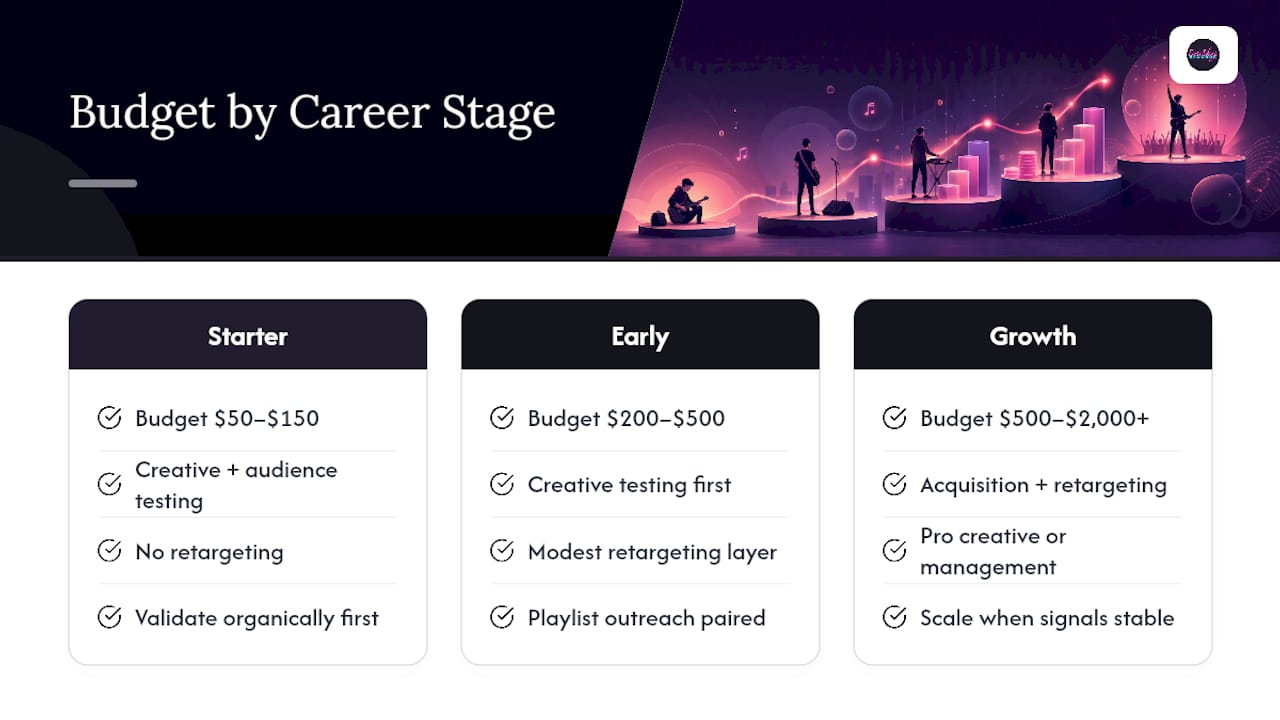
Early traction (1,000 to 10,000 monthly listeners). Now you have data worth acting on. Budget $200–$500 per release. This is where retargeting starts to earn its keep, because you finally have enough website or profile visitors to build an audience worth remarketing to. Split your spend: creative testing first, then playlist outreach paired with a modest retargeting layer, then a small reserve for whatever’s working best.
Growth (10,000+ monthly listeners). You’ve earned the right to run a real funnel. Budget $500 to $2,000 or more per release, spread across acquisition, retargeting, and possibly professional creative or campaign management. According to Orphiq’s staged budget framework, most independent artists should spend $100 to $500 per release on paid promotion overall. Anything under $50 rarely teaches you anything useful because the sample size is too small to trust.
Watch for scaling signals before you increase spend at any stage: a cost-per-view or click-through rate that stays consistent for at least five to seven days, a save rate that’s climbing release over release, and playlist submissions converting into actual adds. If those three things aren’t holding steady, more budget just amplifies the same mediocre results.
What Music Advertising Actually Costs on Each Platform
Costs vary wildly by platform, and the number that looks cheapest on paper isn’t always the one that gets you the best listener.
Meta (Facebook and Instagram). This is where most artists start, and for good reason. It has the deepest audience targeting and the most mature ad tools for music promotion. The real cost per stream on Meta ads for independent artists typically runs $0.05 to $0.45, and MusicPulse’s analysis found many first-time advertisers land around $0.38 per stream while experienced media buyers get it down to $0.08–$0.12. That gap is almost entirely about targeting skill and creative quality, not luck.
- Meta rewards specific, well-targeted creative over broad “music fans” campaigns.
- Weakness: costs climb fast if your targeting stays generic.
YouTube. Bumper ads (6 seconds, unskippable) and in-stream ads (skippable after 5 seconds) both work for music promotion. CPV commonly falls between $0.01 and $0.05, and a well-targeted $500 campaign can deliver 10,000 to 50,000 views depending on how tight your targeting is and how strong your creative hooks the first three seconds.
TikTok. Spark Ads (boosting an existing organic post) usually outperform fully managed creative built from scratch, because they carry social proof from real engagement. Ad-group minimums typically start around $20 per day. TikTok often reports lower CPMs than Meta in broader industry benchmarks, according to Ctrl+Reach’s 2026 ad performance data, which makes it a solid low-cost testing ground if your audience skews younger.
Spotify Ad Studio. Audio ads here work differently. Listeners hear your ad, not just see it, which means the ad itself can literally be a preview of your song. Minimum campaign spend sits around $250, and targeting leans on genres, mood, and listening context rather than demographics alone.
The biggest cost lever across every platform is geography. U.S. CPMs run higher than most international markets because U.S. audiences carry more advertiser competition and higher purchasing power.
How to Test, Measure, and Scale an Ad Campaign
Ad spend without a measurement plan is just donating money to a platform. Here’s the sequence that keeps waste low:
- Validate creative organically first. Post it to your own following before you pay a cent. If it flops with people who already like you, paying to show it to strangers won’t fix that.
- Run 2–4 ad variations at once. Test different hooks, thumbnails, or captions, but isolate one variable at a time. Changing the audience and the creative simultaneously tells you nothing about which one moved the needle.
- Respect platform minimums. Meta can technically run at $5–$10 a day, but you need $50–$150 total to get a readable signal. TikTok ad groups need roughly $20 a day minimum. Spotify Ad Studio requires a $250 minimum campaign spend, according to Orphiq’s campaign guidance.
- Set your KPI thresholds before you launch. A healthy click-through rate for music ads generally sits above 1%, cost-per-click in the $0.30–$0.80 range depending on platform, and save rate is arguably the most important number you’ll track, since Spotify’s own guidance to artists ties higher save rates directly to better odds of algorithmic playlist placement.
- Apply the stop/scale rule. Only double your budget once a metric holds steady for 5 to 7 consecutive days. Cut a campaign the moment cost per result rises more than 20% from where it started.
Pro Tip: Choose one optimization event before launch, whether that’s a Spotify save, a link click, or a landing page visit, and build your entire measurement plan around that single event. Trying to track five metrics at once is how artists end up scaling the wrong campaign.
Sample Budgets: What $50, $100, $500, and $2,000 Actually Buys
Percentages mean nothing until you see them spent. Here’s what each budget tier looks like in practice.
- $50 (entry test): One platform, two creatives, a 3 to 5 day run. Expect a few thousand impressions, a modest handful of clicks, and enough signal to know whether your creative resonates. This is pure learning money, not a growth campaign.
- $100 (small push): Split across two platforms, such as Meta and TikTok, or two audience segments on one platform. Enough volume to start a basic retargeting pool if your landing page tracking is set up correctly.
- $500 (meaningful push): Test three to four audience segments, seed a retargeting campaign, set aside a slice for playlist pitching outreach, and keep a small reserve for producing a second round of creative once you see what’s working. This is the range Orphiq’s benchmarks point to as where paid ads start coordinating meaningfully with playlist outreach and PR.
- $2,000 (coordinated rollout): A genuine multi-touch funnel. Acquisition ads on Meta and YouTube, a retargeting layer for anyone who’s engaged, professionally produced creative, a slice for PR or playlist pitching, and a defined reporting window to judge the whole thing at the end. This is also the range where hiring outside help starts paying for itself.
Your landing page setup matters more at the $500 and $2,000 tiers, since a generic bio link can’t track conversions the way a dedicated page can.
Timing Your Music Ads Budget Around the Calendar
When you spend matters almost as much as how much you spend. U.S. advertising costs across every platform climb in the fourth quarter, from roughly October through December, as retail and holiday advertisers flood the auction and drive up CPMs industry-wide. If your release timeline is flexible, that’s the window to avoid for a first-time test campaign, since you’ll pay more for the same reach.
Release timing also interacts with your testing plan. Running your creative validation and small-budget tests two to three weeks before a release, rather than on release day itself, gives you time to fix a weak hook or swap out an underperforming audience before the money that matters most goes out the door. Save your bigger spend, whether that’s the $500 or $2,000 tier, for launch week and the two weeks after, when algorithmic attention on new releases is naturally higher across Spotify and TikTok alike.
Summer months (June through August) often see lower competition and softer CPMs on Meta and YouTube, since fewer big-budget advertisers are active. That makes summer a reasonable window for testing new creative cheaply, even if you’re saving your actual release for the fall.
Genre Changes How You Should Allocate Ad Spend
A genre’s typical listener behavior should shape where your dollars go, not just your overall budget size.
Pop and hip-hop tend to perform well on TikTok and Instagram Reels, where short, hook-forward creative matches how the platforms are consumed. Front-load spend toward acquisition and creative testing here, since these genres often see faster save-rate feedback.
Indie, folk, and singer-songwriter genres frequently do better on Meta and YouTube, where longer-form storytelling and behind-the-song content resonate with an audience that engages more slowly but with more loyalty. Retargeting carries more weight for these genres, since converting a casual listener into a save often takes a second or third touch.
Electronic and dance music often performs strongest on Spotify Ad Studio and YouTube, where the audio-first or visual-heavy format suits the genre’s production values. Genre-specific targeting on Spotify, using mood and listening-context categories, tends to outperform broad demographic targeting here.
Whatever your genre, resist the instinct to target “music fans” broadly. Narrower, genre-specific targeting consistently produces better cost-per-result across every platform in Ctrl+Reach’s benchmark data, which also shows Meta commanding the largest overall share of music ad spend while TikTok often posts cheaper CPMs in aggregate.
When Managing Your Own Ad Budget Stops Making Sense
There’s a point where DIY testing turns into a second job. If you’re spending more than five hours a week managing campaigns, or your budget has grown past $500 a month consistently, the math starts favoring outside help. Managed services also solve a problem DIY often can’t: connecting your ad strategy to your actual audio quality, since a track that’s mixed for streaming platforms performs differently in a 15-second ad clip than a full-length listen.
That’s the gap Twisbyrecords was built to close. With more than 35 years of combined experience and Apple Digital Masters certification, Twisbyrecords pairs personalized advertising campaigns with the mixing and mastering work that makes your creative worth advertising in the first place. Rather than handing you a generic template, the team builds campaign architecture, audience research, and creative iteration around your specific release and genre.
Before reaching out to any managed service, gather your recent metrics (CTR, save rate, cost per result), a clear goal for the next release, your available creative assets, and a realistic monthly budget. That preparation alone will make any conversation with a service like Twisbyrecords’ advertising team far more productive.
— Kreg
The Mistakes That Quietly Drain a Music Ads Budget
Most wasted ad spend traces back to one of three habits.
- Advertising before validating creative. If a clip hasn’t earned organic engagement, paying to push it further usually just buys you a worse version of the same silence.
- Targeting “music fans” as a category. It’s too broad to be useful. Genre, mood, and behavioral targeting consistently outperform generic interest targeting.
- Skipping measurement setup. No defined conversion event means you can’t tell a good campaign from a lucky one.
- Overspending on one unproven channel. Put your whole budget into a single platform before it’s proven, and a bad week there sinks your entire release.
- Not budgeting for creative production. Every dollar in ad spend needs decent creative behind it, or you’re just paying to show people something that doesn’t convert.
If you spot a red flag mid-campaign, a cost per result climbing past your threshold, a stalled save rate, act fast: kill the underperforming ad set, shift that reserve budget toward whatever’s working, and tighten your targeting rather than widening it.
Ready to Put a Real Budget Behind Your Next Release?
Running your own tests teaches you a lot, but there’s a ceiling to what a solo artist juggling a day job can manage alongside campaign optimization. Twisbyrecords gives independent musicians a faster path past that ceiling: a team that builds your ad campaigns and refines your mix and master, so the track behind the ad is actually built to convert on the platform running it.
Twisbyrecords works from the same career-stage thinking laid out in this guide, but replaces your guesswork with campaign architecture built around your genre, audience, and goals. That means personalized targeting instead of generic “music fans” campaigns, audio production tuned for how Meta, YouTube, and Spotify actually play a 15-second clip, and reporting that tells you exactly what your spend earned. If you’re at the point where a $500 or $2,000 monthly budget feels within reach but the time to manage it isn’t, check out Twisbyrecords’ advertising services and get a plan built around your next release.
Sources
- Music Marketing Ad Budgets: How Much to Spend
- YouTube Ads Cost for Musicians: 2026 Pricing
- The Real Cost Per Stream on Meta Ads
- The 2026 Ad Performance Blueprint for the Music Industry
FAQ
How Much Does a 30 Second Radio Ad Cost?
Radio ad costs vary widely by market and station size, often ranging from under $100 in small local markets to several thousand dollars on major stations. For most independent musicians, digital platforms like Meta, YouTube, and Spotify Ad Studio offer far more targeting precision per dollar spent.
How Many Spotify Plays Does It Take to Make $1,000?
Spotify payouts vary by market and account type, but independent artists commonly need hundreds of thousands of streams to reach $1,000 in royalties. That’s why cost per stream from paid ads, often $0.05 to $0.45 on Meta, needs to be weighed against long-term streaming revenue rather than treated as a direct payback.
Is $20 a Day Good for Google Ads?
$20 a day can work as a learning budget on platforms with similar minimums, like TikTok’s ad-group threshold, but it’s rarely enough to generate a reliable signal in a single day. Stretch it across a 3 to 7 day test window instead of judging it day by day.
What Is the 70/20/10 Rule for Marketing Budget?
The 70/20/10 rule allocates 70% of budget to proven tactics, 20% to newer approaches showing promise, and 10% to experimental ideas. Independent musicians can adapt a similar principle by keeping the bulk of spend on tested creative and audiences while reserving a smaller slice for new platforms or formats.
Should I Hire Twisbyrecords or Manage My Own Music Ads Budget?
If your monthly ad spend is consistently under $500 and you have time to test creative yourself, DIY makes sense. Once you’re spending more than that or need audio production paired with campaign strategy, Twisbyrecords’ advertising services become a cost-effective alternative to managing everything alone.