


For most consumer product and music launches, Thursday delivers the best mix of reach and cost efficiency. Weekend releases outperform for entertainment and impulse-buy categories. Early-week launches win when you’re chasing press cycles or B2B buyers. Two things change the math fast: which channel you’re running on, and whether you’re optimizing for awareness or direct response.
Before you touch your ad account, lock in these three moves:
- Run a full creative QA pass 48 hours out, checking every asset against platform specs.
- Set pacing rules so your budget doesn’t burn out before your first weekend.
- Define your baseline KPIs (CPC, CPA, conversion rate) so you can judge the first 48 to 72 hours against something real.
Key Takeaways
Release-day ad performance depends more on matching timing to audience behavior and campaign objective than on chasing a single universal “best day.”
| Point | Details |
|---|---|
| Thursday leads for most launches | Higher attention with lower competition than Friday, but check your own category data. |
| Weekends win for entertainment | Impulse-buy and entertainment products perform better when buyers have leisure time. |
| Channels need separate timing | Social, search, streaming, and programmatic each favor different hours and days. |
| The 90-day window matters most | Full-funnel campaigns reach sales goals faster on average than standard approaches. |
| Twisby Records builds this into a checklist | Creative QA, pre-save alignment, and 48 to 72 hour reporting turn timing theory into a repeatable process. |
Table of Contents
- When to Schedule Release Day Ads for Maximum Impact
- Why Does Ad Performance Vary by Day of the Week?
- How Does Timing Change by Ad Channel?
- What Should You Run Before, During, and After Launch?
- How Do You Test Which Day Works Best for You?
- How Twisby Records Applies Release-Day Timing
- What This Guide Actually Tells You to Prioritize
- Get Your Release Timed and Managed the Right Way
- Sources
- FAQ
When to Schedule Release Day Ads for Maximum Impact
Thursday earns its reputation because it sits at the intersection of high attention and lower competition. People are mentally shifting toward weekend plans but haven’t checked out of work mode yet, so search and social behavior both stay active.
Here’s how the calendar actually breaks down:
- Thursday: broad consumer launches, apps, e-commerce products. Attention is high, ad inventory hasn’t spiked yet.
- Friday: music releases specifically, because of the industry-standard global release day tied to playlist refresh cycles.
- Saturday or Sunday: entertainment, gaming, local events, anything with an impulse-buy trigger. People have leisure time and disposable attention.
- Monday or Tuesday: B2B products, SaaS tools, anything timed to align with a press embargo or industry news cycle.
Pro Tip: Don’t default to Thursday just because it’s the “safe” answer. If your product is impulse-driven entertainment, a Saturday launch can outperform Thursday by a wide margin because your buyer isn’t at a desk.
The quick heuristic: match the day to buyer behavior, not to convention. If your audience makes decisions during downtime, launch during their downtime.
Why Does Ad Performance Vary by Day of the Week?
Auction dynamics and human behavior both shift across a seven-day cycle, and they don’t always move in the same direction.
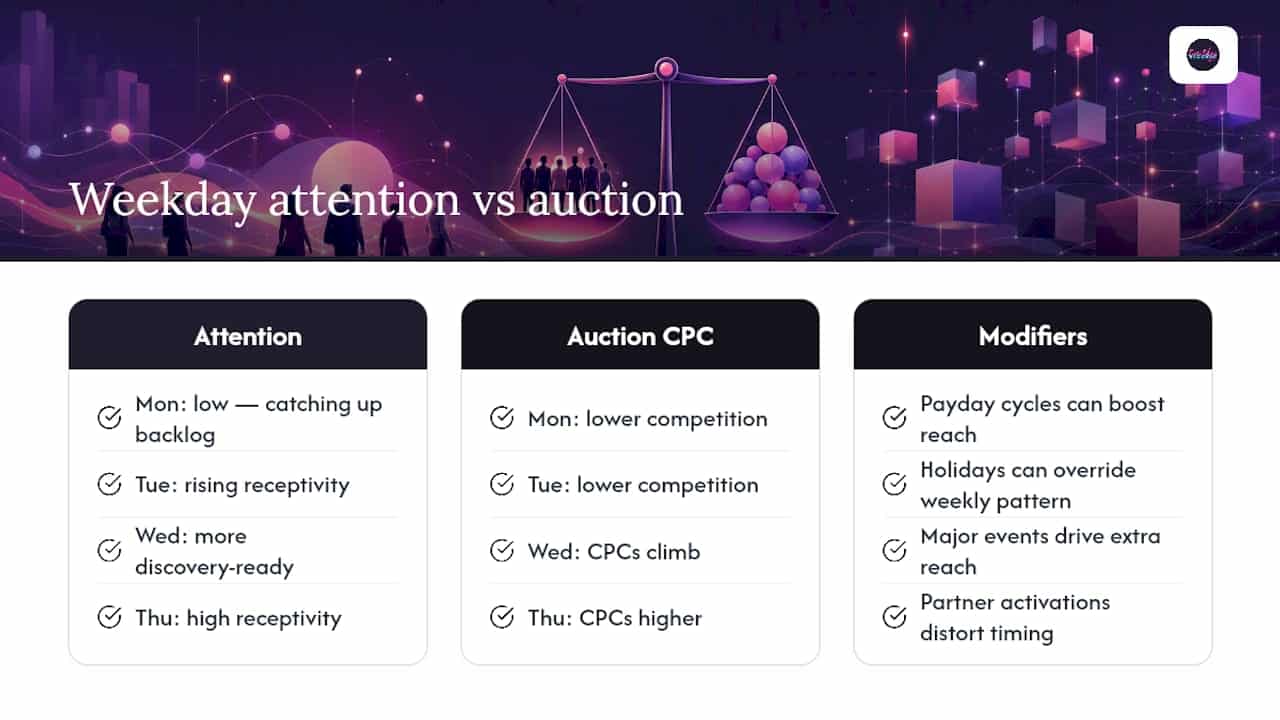
Attention follows a predictable arc. Early-week users are catching up on backlog; by Thursday and Friday, they’re more receptive to discovery content because the urgent work is handled. Weekend behavior flips entirely toward leisure browsing, which favors entertainment and impulse categories over utility products.
Auction pressure moves opposite to what you’d expect. Advertisers who avoid Monday and Tuesday competition often see CPCs climb on Wednesday through Friday as more brands pile into the same inventory. That means your “best” attention day can also be your most expensive one, so your cost-per-result doesn’t always track your reach.
Payday cycles, holidays, and event calendars distort all of this. A launch that lands the same week as a major cultural event, like the record-setting promotional push behind “Spider-Man: Brand New Day,” can override normal weekly patterns entirely, because coordinated partner activations generate reach that has nothing to do with which day of the week it is.
Check your platform’s first-party reporting (Meta Ads Manager, Google Ads, Amazon Ads console) for day-of-week breakdowns in your own category before assuming any general rule applies to you.
How Does Timing Change by Ad Channel?
Release-day timing isn’t one decision. It’s four or five separate decisions, one per channel, and they don’t always point the same direction.
- Social platforms. Meta and TikTok reward early-morning and evening posting windows on release day itself. Use the first six hours for reach-building creative, then shift budget toward conversion-optimized ads once engagement signals settle. Music marketers should read our guide on Instagram ads for music for release-day creative cadence specifics.
- Search. Paid search volume for a new product name spikes hardest on the actual release day and the day after, as people search for reviews and “where to buy.” Weekday search CPCs run higher than weekend CPCs in most categories because more advertisers compete during business hours.
- Streaming, audio, and CTV. For music, Friday remains the global playlisting standard, as explained in Why Artists Release Music at Midnight: Playlists, Charts, and Buzz, and pitching playlist editors before your pre-save deadline matters more than the ad spend itself. For video and audio ad placements, push your highest-reach spots in the first 48 hours, when algorithmic discovery mechanisms are most likely to surface new content.
- Programmatic and display. Day-parting protects you from CPM spikes. Cap delivery during peak competitive hours and let pacing algorithms spread spend across lower-cost windows, which preserves reach without blowing your budget in the first six hours.
Choosing between formats also matters: our comparison of YouTube ads versus Facebook ads for musicians breaks down which format suits which release-day goal.
What Should You Run Before, During, and After Launch?
Release day isn’t an isolated event. It’s the midpoint of a sequence, and the sequence matters more than the single day you pick.
Pre-launch (one to four weeks out): Build awareness with teaser ads and drive pre-saves or sign-ups. Keep the preview window tight, roughly one week of heavy visibility works better than a month-long tease, because longer preview windows risk audience fatigue before you’ve even launched. If you’re running a music release, our Spotify pre-save campaign guide covers lead times in detail.

Release day: Coordinate paid social, search, email, and your landing page so all four fire in the same window. A visitor who clicks an ad but lands on a mismatched page loses momentum instantly.
Post-launch (30 to 90 days): Shift budget toward remarketing, review collection, and conversion optimization. This is also where the 90-day window matters most: brands using Amazon Ads’ New Product Campaigns reach a 1,000-unit sales goal faster on average for full-funnel campaigns compared to standard campaigns, because the full-funnel structure spans video, audio, display, and shopping placements instead of front-loading everything into day one.

Pro Tip: Budget pacing should mirror this arc: spend heaviest in the first 72 hours, then taper into a sustained 90-day tail rather than one big burst that fizzles by week two.
How Do You Test Which Day Works Best for You?
Skip the guesswork and run a structured test before committing your full budget to any single day.
- Keep creative constant, vary the day. Run comparable audiences with identical ad creative across two or three candidate launch days, ideally as parallel microtests rather than sequential ones.
- Track the right KPIs. Watch CPC, CPA, conversion rate, and, for music releases, early stream or listen-through rate as a leading indicator of playlist traction.
- Set a minimum budget threshold. Small test budgets produce noisy results in the first 48 hours. Extend inconclusive tests toward the full 90-day window before drawing conclusions, especially if your category has long consideration cycles.
- Iterate. Shift day-parting or creative based on what the data shows, then scale spend behind the winning combination.
How Twisby Records Applies Release-Day Timing
We run every release through a repeatable checklist rather than guessing at a good day: creative readiness checks, platform-specific placements, a live landing page, pre-save alignment, and a 48 to 72 hour reporting cadence to catch problems before they become expensive.
That process is built on more than 35 years in audio production and Apple Digital Masters certification, alongside hands-on experience running targeted Instagram and Facebook campaigns for independent artists. For synchronizing pre-save momentum with paid social, our music release strategy guide walks through the full sequencing model.
- Pre-launch: teaser creative and pre-save push, one to two weeks out
- Release day: coordinated paid social plus landing page plus streaming push
- Post-launch: remarketing and optimization through the 90-day window
| Checklist Item | What It Does |
|---|---|
| Creative QA | Confirms every asset meets platform specs before spend goes live |
| Pre-save alignment | Syncs paid ads with playlist pitching for day-one streaming momentum |
| 48 to 72 hour reporting | Catches pacing or targeting issues before budget is wasted |
Ready to see it applied to your release? Check the advertising services page for details.
What This Guide Actually Tells You to Prioritize
The research here points to an uncomfortable truth for anyone hunting a single magic release day: sequencing beats day selection almost every time. A mediocre Thursday launch backed by a tight pre-launch teaser and a disciplined 90-day post-launch push will outperform a “perfect” Friday launch with no follow-through.
Most advertisers overinvest in picking the day and underinvest in what happens after it. That’s backward. The Deadline coverage of the Spider-Man campaign makes this obvious at scale, coordinated partner activations mattered more than any weekday advantage. You don’t need a $309 million budget to apply the same lesson: coordination beats calendar.
If you take one thing from this guide, let it be this. Stop treating release day as an event and start treating it as the midpoint of a sequence you control. Test your day, yes, but spend twice as much energy on what you run the week before and the ninety days after.
— Kreg
Get Your Release Timed and Managed the Right Way
Twisby Records is the alternative to guessing your own release-day timing, or hiring a generalist agency that treats music the same as any other product launch. We build the pre-save alignment, creative QA, and 48 to 72 hour reporting cadence into every campaign we run, so you’re not testing timing theory alone with a limited ad budget.

If you’ve read this far, you already know timing alone won’t save a weak launch. What moves the needle is the sequence: pre-launch teasers, a coordinated release day across paid social and streaming, and a 90-day post-launch push that actually gets tracked. That’s the exact workflow we run for independent artists, backed by over 35 years in production and Apple Digital Masters certification. Check out our advertising services page to see how we’d structure your release, or browse our resource links for more on distribution and promotional tie-ins. Request a quote and get your release day scheduled with a plan behind it, not a guess.
Sources
- How to create your new product launch strategy | Amazon Ads blog
- ‘Spider-Man: Brand New Day’ $309M promo campaign is a Hollywood record | Deadline
FAQ
What Day Should I Launch Release Day Ads?
Thursday works best for most consumer launches, Friday for music releases tied to global playlist refresh cycles, and weekends for entertainment or impulse-buy products.
Do People Really See Thousands of Ads a Day?
Estimates on daily ad exposure vary widely and no single figure is verified across sources, but the consistent point across marketing research is that attention is scarce and timing your ad to a moment of genuine relevance matters more than raw volume.
What Makes a Release Day Ad Campaign Successful?
Coordinated timing across creative, landing pages, and paid channels matters more than the specific day chosen; the Spider-Man: Brand New Day campaign showed how partner activations can generate reach that overrides normal weekly patterns.
How Long Should a Release Day Campaign Run?
Plan for a 90-day window rather than a single-day push. Brands using full-funnel campaigns reach sales goals roughly 39% faster than those relying on shorter bursts.
Can Twisby Records Manage My Release Day Ads?
Yes. Twisby Records builds pre-save alignment, creative QA, and platform-specific placements into a repeatable checklist for independent artists launching new music.