


A solid music release strategy is a timed, coordinated plan that moves your music from finished file to active listener, not just an upload and a prayer. The difference between 100 streams and 10,000 streams is rarely the song. It’s the plan behind it.
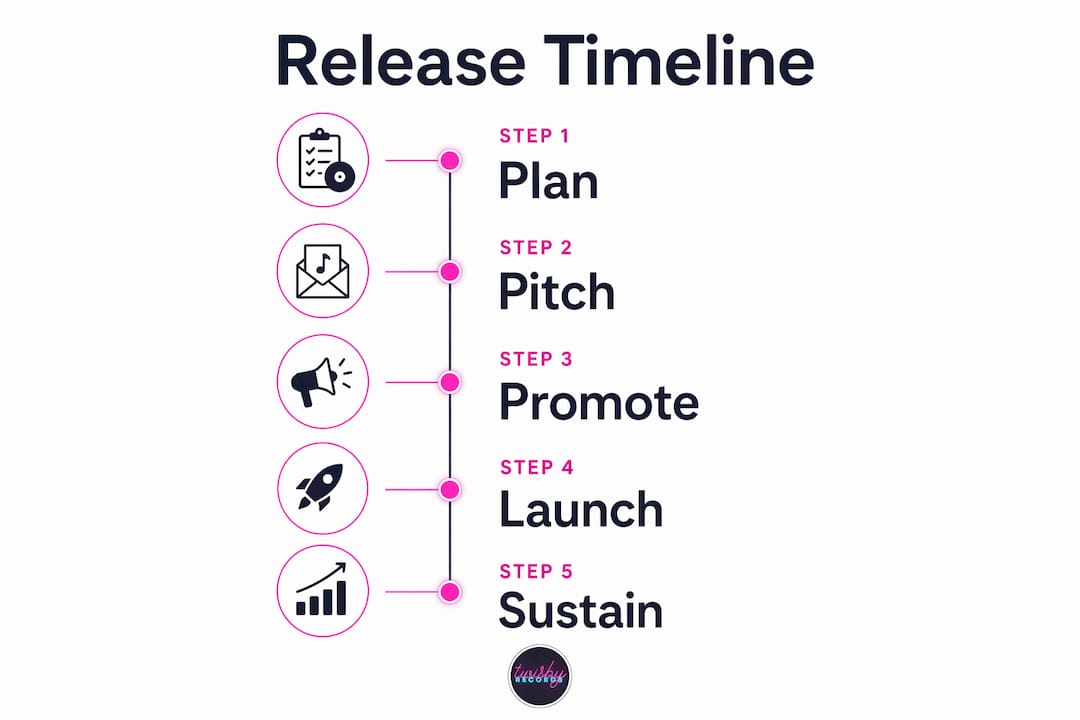
Here’s what an effective release covers in 2026:
- Choose a release date with at least 4–8 weeks of lead time
- Set measurable goals tied to streams, saves, and playlist placements
- Prepare all assets: master, cover art, social graphics, Spotify Canvas
- Submit your distributor upload and pitch Spotify editorial early
- Run a pre-save campaign and build your smart link
- Execute a coordinated launch week across social, email, and ads
- Sustain momentum for 4+ weeks post-release with secondary content
Platforms like Bandcamp and SoundCloud serve as essential tools for sharing private links with press and curators before your track goes live everywhere, providing a professional way to pitch without exposing your release early.
What’s the best way to choose a release date and set goals?
Friday is the only day that matters for most independent artists. Release Radar updates on Fridays, editorial playlists refresh on Fridays, and listener habits cluster around end-of-week listening. Releasing on any other day means skipping those windows entirely.
Work backward from your chosen Friday. You need at least 5–7 business days for distributor processing, plus 14 days minimum for Spotify editorial pitching. That math alone gets you to four weeks. Six to eight weeks gives you real breathing room.

Before you lock the date, check for conflicts: major holidays, genre-defining album drops, or personal schedule gaps that would kill your ability to promote consistently.
Goals need to be specific. “More streams” is not a goal. “500 pre-saves before release day” is. Tie your targets to pre-save counts, save rate, playlist placements, and follower growth. Pre-save counts are the strongest early signal you can actually control and measure before the track goes live.
How to prepare your assets and pitch playlists before release day
Your track needs to be fully mixed and mastered before any promotion begins. A great rollout cannot rescue a poorly mixed song. Get your mastering done right before you set a date.
Once the master is locked, build your full asset package:
- Final WAV master and any clean or instrumental versions
- Cover art at 3000x3000px, plus cropped versions for social
- Spotify Canvas (a 3–8 second looping visual)
- Short video teasers (15–30 seconds) for Reels and TikTok
- Smart link set to pre-save mode, switching to “out now” on release day
Submit your editorial pitch through Spotify for Artists at least two weeks before release, ideally three. Include genre, mood, instruments, and the story behind the song. Missing this window is the one mistake you cannot fix after the fact.
For independent curators, send personalized pitches with a private SoundCloud or Bandcamp link, never an attachment. Most independent curators take 7–14 days to review, so start that outreach at the three-week mark. Accuracy in your metadata matters here too: wrong ISRC codes or misformatted artist names cause delays that eat into your pitching window.

Pro Tip: Batch all your social content in one session at the three-week mark. Film 8–12 short clips, create your graphics, and schedule them. Release week should be execution, not scrambling.
How to execute your launch week marketing and advertising
Launch week is where preparation pays off. Your goal is a concentrated burst of saves, streams, and shares in the first 48 hours, because that window is when Spotify’s algorithm is most actively evaluating your track.
Post across every platform on release day, but vary the format. An Instagram Reel, a TikTok video, a YouTube Shorts clip, and a Facebook post all reach different slices of your audience. Don’t post once and disappear. Come back with the story behind the song, a lyric highlight, a thank-you to early listeners.
Go live on release day. Instagram Live and TikTok Live sessions get algorithmic priority and create a shared moment with fans that a static post never can.
Send a personal message to your 20–50 closest supporters. Not a mass text. Individual messages. That initial burst of real engagement from people who genuinely care matters more to the algorithm than passive plays from cold audiences.
On the ad side, targeted Meta campaigns starting on release day, even at $5–$10 per day, amplify your organic reach. Target listeners of similar artists in your genre. Testing different video hooks and visuals during pre-release lets you put your budget behind what’s already proven to resonate.
What should you do after release to keep momentum going?
Most releases die in weeks two through four because artists go quiet. That’s exactly when staying active has the most leverage.
Release secondary content to give fans new reasons to share your smart link:
- Acoustic version or live performance clip
- Lyric video
- Behind-the-scenes of the recording session
- Remix or alternate mix
Share streaming milestones publicly. Hit 1,000 streams? Got added to a playlist? Post it. Milestones create social proof and re-energize your existing fans to share again.
Post-release is also the right time to pitch independent curators. They respond better once you have real listener data, specifically save rate and stream count, to show them. A pitch backed by evidence outperforms a speculative pre-release ask every time.
Update your electronic press kit and artist profile with release highlights. Then run a post-release review: which content drove the most streams, which platform converted best, what your save rate looked like. Document it. Your next release should take 30 minutes to plan, not three hours.
Expert insights from over 35 years in music production and promotion
A release is not a day. It’s a supply chain. The track is the product, and the strategy is how it reaches the shelf. Most independent artists spend months on the music and one day on the promotion. That’s backwards. The 72-hour window after release is when Spotify weighs save rate and completion rate more than raw stream count. Those signals determine whether the algorithm extends your reach or lets the track quietly fade. Everything in the pre-release phase exists to prime an audience that will generate that signal burst on day one.
The waterfall release approach compounds this effect across an entire project. You release singles one at a time, each added to a growing EP or album. When a fan plays the new track, the previous ones play next automatically. Streams stack rather than scatter, and each release cycle gives you a fresh promotional reason without diluting listener attention.
Pre-saves convert directly into Day 1 streams, which feed Release Radar and signal algorithmic interest before any editorial team has weighed in. That’s why pre-save count is the most actionable metric to prioritize in your single release plan.
At Twisbyrecords, we’ve spent over 35 years helping independent artists navigate exactly this. The artists who build real traction treat every release as part of a repeatable marketing rhythm, not a one-off event. Virality is not the goal. Consistency is. For a deeper look at how this plays out in practice, the Twisbyrecords podcast covers release strategy, promotion, and the business of being an independent artist.
How much does a music release actually cost?
Budget varies widely depending on how much you handle yourself, but here’s a realistic breakdown for an independent single release:
- Mixing and mastering: This is non-negotiable. A poorly mixed track undermines every other investment. Professional mixing and mastering services range based on project scope.
- Distribution: Most major distributors charge an annual fee or per-release fee. Budget this first since nothing else can happen without it.
- Cover art and visual assets: A professional designer for cover art and social graphics is worth the spend. Budget accordingly for your market.
- Paid advertising: Even a modest Meta ad budget of $5–$10 per day during release week makes a measurable difference. A full campaign over two to three weeks can run $150–$300 for an independent artist.
- Playlist and press submission tools: Services that connect you to curators and blogs carry per-submission or subscription fees.
A well-planned release with a modest budget consistently outperforms a disorganized one with a large one. Prioritize the master and the distribution setup first. Everything else scales from there.
How collaborations and partnerships expand your reach
Collaborations are one of the fastest ways to reach listeners who don’t know you yet. When you feature another artist or appear on their track, you get direct access to their audience on release day, not through an algorithm, but through a personal recommendation.
For an album launch strategy, plan collaborations early. A featured artist needs to be credited in your metadata correctly, and their promotional involvement needs to be agreed upon before you upload to your distributor. Misformatted featured artist credits are one of the most common causes of distribution delays.
Beyond artist features, look at creator partnerships. Short-form video creators who match your sound can post using your audio on release day, giving you reach that paid ads can’t replicate at the same cost. Brief them two to three weeks out so their content lands with real timing. For independent artists building their catalog, original beats and strong creative foundations make these partnerships more attractive to collaborators.
Cross-promotion with artists in adjacent genres also works well. A joint playlist, a shared social post, or a co-headlined live event gives both artists a reason to promote and both audiences a reason to listen.
Ready to release with confidence?
Twisbyrecords works with independent artists at every stage of the release process, from getting your mix and master right to running targeted advertising campaigns that actually move the needle. With Apple Digital Masters certification and over 35 years of experience, we know what a release needs to break through. See what we offer and let’s build your next release the right way.
Key Takeaways
A successful music release strategy requires a structured timeline starting 6–8 weeks out, with coordinated pitching, asset preparation, and post-release engagement to compound streaming momentum.
| Point | Details |
|---|---|
| Lead time is non-negotiable | Plan at least 4–8 weeks ahead to cover distributor processing and Spotify editorial pitching. |
| Friday releases win algorithmically | Release Radar and editorial playlists refresh on Fridays, giving Friday drops a built-in discovery advantage. |
| Pre-saves drive Day 1 streams | Pre-save counts are the strongest early signal; they convert directly into streams that trigger algorithmic boosts. |
| The 72-hour window decides reach | Spotify weighs save rate and completion rate in the first 72 hours to determine broader playlist placement. |
| Post-release consistency beats one-day spikes | Sustained content and curator outreach in weeks 2–4 compound momentum rather than letting it fade. |
FAQ
How far in advance should I plan a music release?
At least 4–8 weeks for a single, and 10–12 weeks for an album. This covers distributor processing, Spotify editorial pitching, and content creation without rushing any phase.
When should I pitch Spotify editorial?
Submit your pitch at least two weeks before your release date, ideally three. Pitching later risks exclusion from Release Radar and curated playlists entirely.
What’s a waterfall release strategy?
A waterfall release means dropping singles one at a time, each added to a growing EP or album. Streams compound across the catalog because each new track leads listeners to the previous ones automatically.
Should I pitch independent curators before or after release?
Post-release pitching works better for independent curators. Real listener data, including save rate and stream count, makes your pitch far more persuasive than a pre-release ask with no evidence behind it.
How do I sustain momentum after release week?
Release secondary content like acoustic versions or lyric videos, share streaming milestones publicly, and keep at least one piece of content active per week for the first four to eight weeks after release.