

Optimize your music ads by chasing downstream listener actions, not clicks. Before you spend a dollar, confirm your landing path loads fast on mobile and your tracking actually fires. Kreg at Twisby Records has watched artists burn budgets on ads that looked great in the dashboard and did nothing for real streams, and the fix almost always starts with what happens after the click, not the ad itself.
TL;DR:
- Most wasted ad spend results from setup issues, not creative faults, making thorough landing page, tracking, and disclosure checks essential before launching.
- Choose a single, clear objective per campaign stage—pre-release focuses on pre-saves and email signups, while post-release targets streams and playlist adds.
- Test one high-signal creative hypothesis at a time, such as different hooks or visual moments, and measure their impact over enough data collection before making changes.
- Use consistent attribution windows, like 14 days, for cross-platform comparison of downstream actions such as saves and streams to ensure accurate performance evaluation.
- Start testing with a moderate daily budget, set predefined stop points, and scale winners gradually, ensuring tracking works correctly before spending on creative development.
Table of Contents
- What Belongs on Your Pre-Launch Checklist?
- How Do You Choose the Right Campaign Objective?
- What Should You Actually Test in Your Creative?
- Meta or Spotify: Where Should Your Ads Actually Run?
- Why Does Your Landing Page Matter More Than Your Ad?
- Which Metrics Actually Prove a Campaign Is Working?
- How Small Should You Start, and When Do You Scale?
- What I Tell Every Artist Before They Spend a Dollar
- Let Twisby Records Handle the Setup Friction
- Sources
- FAQ
What Belongs on Your Pre-Launch Checklist?
Most wasted ad spend traces back to a setup problem, not a creative problem. Before launch, walk through this list:
- Landing destination: A smart link or release page that loads fast on mobile and points to one clear action.
- Tracking: A working Meta Pixel and Conversion API event tied to your smart-link click, tested end to end before spending.
- Creative: At least three vertical clips with distinct hooks and readable captions (many viewers watch muted).
- Objective: One primary goal and a written budget stop point, decided in advance, not mid-campaign.
- Disclosure plan: If you’re paying a creator or influencer to post about your release, you need a clear, visible disclosure that meets FTC guidance.
Skip any one of these and you’re optimizing blind.
How Do You Choose the Right Campaign Objective?
Pick one objective per release stage, and don’t ask an ad to do two jobs. Pre-release, the goal is pre-saves or email signups. Post-release, it’s streams, follows, or playlist adds. Mixing asks in a single campaign confuses the platform’s learning phase and slows down results for both goals.
Once you’ve picked the objective, the KPIs follow naturally: smart-link conversions, saves, follows, playlist adds, or email signups, depending on the stage. Spotify Ad Studio reports on downstream actions like music page visits and saves specifically so artists stop treating clicks as the finish line.
When you compare results across platforms, use the same attribution window every time. Spotify’s own Marquee research measured listening within 14 days of a click, and matching that window across Meta and Spotify campaigns keeps your comparisons honest instead of misleading.
An ad conversion rate (ACR) benchmark of 90 to 98 percent across client campaigns has been observed, meaning the vast majority of ad-driven clicks that reach a properly built landing page complete the intended action. Treat that range as a heuristic for what a healthy funnel looks like, not a guarantee for your release.
What Should You Actually Test in Your Creative?
Test one hypothesis at a time. If you change the hook, the opening bars, the caption, and the visual concept all in the same test, you’ll have a result with no explanation attached.
Here’s a simple sequence for indie budgets:
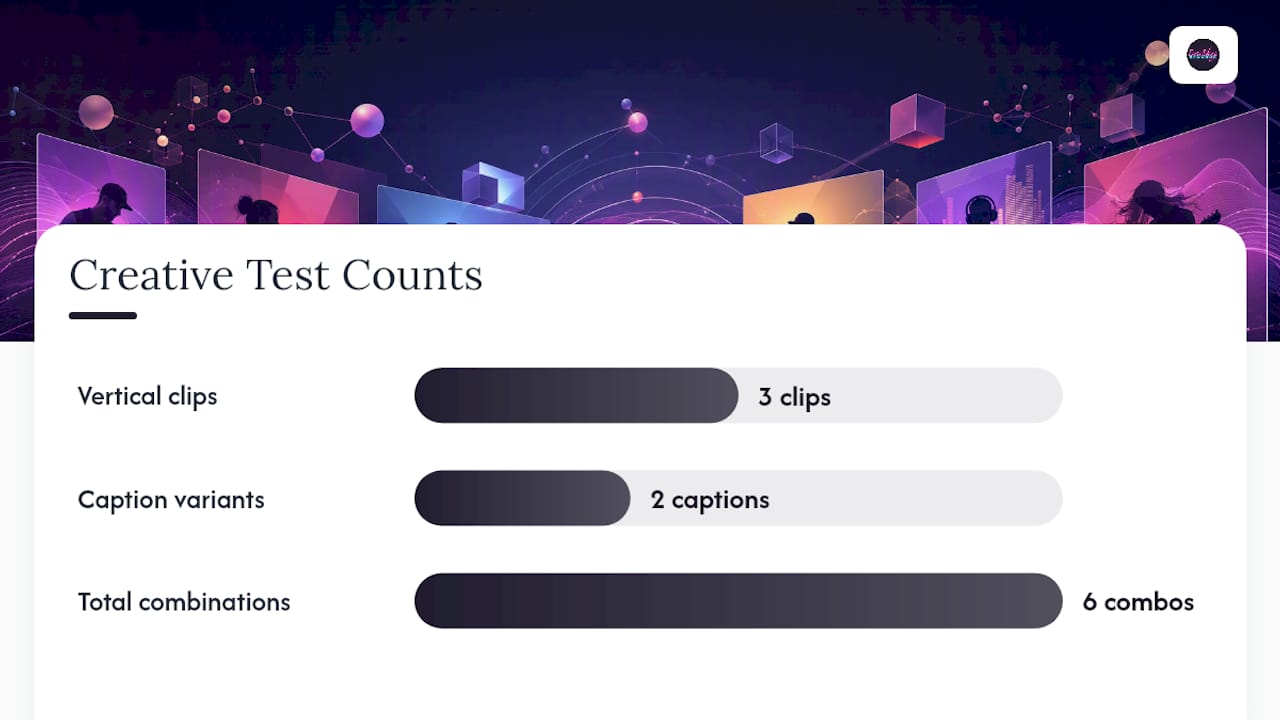
- Start with three vertical clips, each leading with a different hook (a lyric, a visual moment, a fan reaction).
- Pair each clip with two caption or headline variants, so you’re testing message alongside visual.
- Use dynamic creative within one ad set if your platform supports it, or duplicate ad sets for a cleaner, controlled comparison.
- Let each variant collect enough data to separate signal from noise before you cut anything.
- Kill the weakest hook first, then move to caption testing with the surviving clip.
High-signal tests change something a listener would notice and remember, like swapping the opening line of the chorus for the bridge. Low-signal tests, like nudging a button color or a caption’s punctuation, rarely teach you anything worth the ad spend. Research on music in advertising backs this up: emotional resonance and memorable audio drive recall far more than small cosmetic tweaks.
Pro Tip: Write down your hypothesis before launching each test. “Hook A outperforms Hook B because it starts with a lyric, not an instrumental,” gives you something to actually confirm or reject.
For more creative variations worth testing, our music ad creative ideas guide has real examples that convert.
Meta or Spotify: Where Should Your Ads Actually Run?
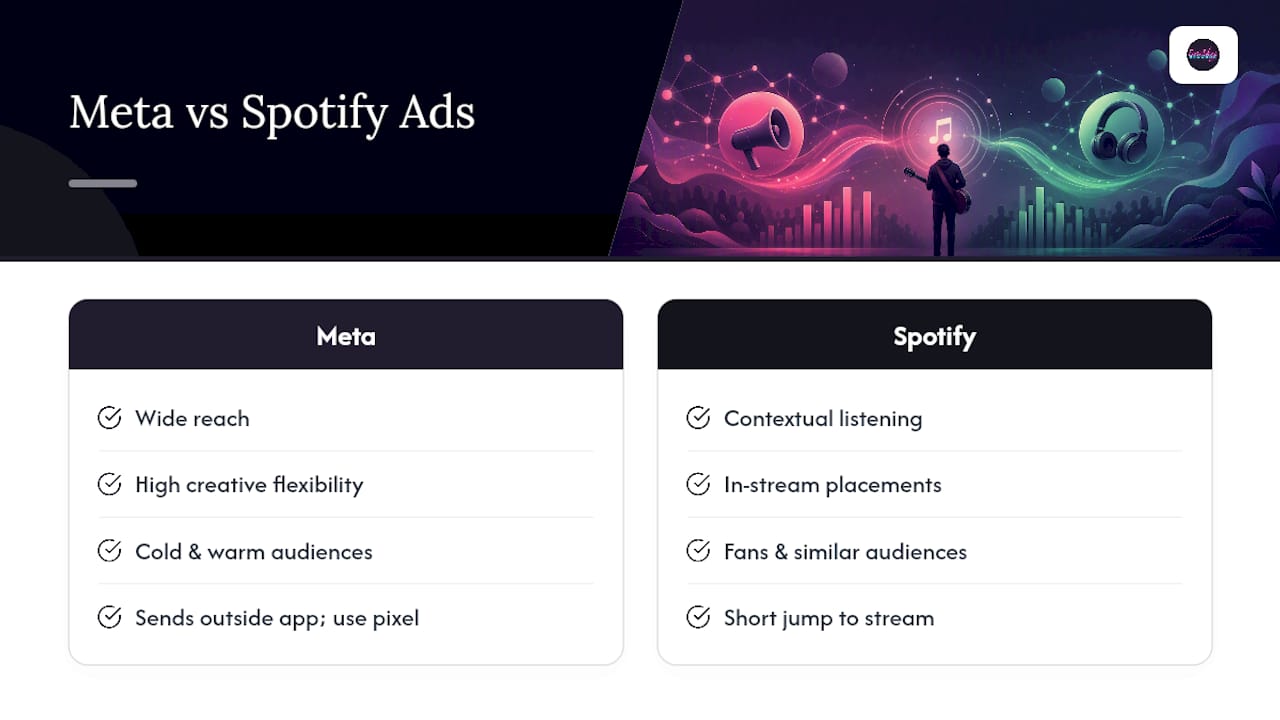
Spotify’s advantage is context. Listeners are already inside a listening environment, so the jump from ad to stream is short. Tools like Ad Studio, Campaign Kit, and Marquee put your release directly in front of fans and similar-artist audiences, though availability varies by market, so check your Spotify for Artists account before planning spend.
Meta’s advantage is reach and creative flexibility. You can build cold and warm audiences by age, genre affinity, and past engagement, and Reels tends to outperform static Feed placements for music content right now. The catch is that Meta sends listeners outside a music app entirely, so a smart link paired with a working pixel is what turns a click into a measurable conversion instead of a guess.
Start narrow with a defined genre and age bucket, then broaden only after you’ve confirmed which segment actually converts. Narrowing too early on a small budget just starves your test of data. For platform-specific setup, see our Spotify conversion ads checklist and Instagram ads guide.
Why Does Your Landing Page Matter More Than Your Ad?
Your ad’s job is to earn the click. Your landing page’s job is to prove that click meant something, and that’s where most indie campaigns quietly fail.
A smart link beats a direct DSP link because it lets you track clicks at a single point before the listener splits across Spotify, Apple Music, or YouTube. That single tracking point is what practitioner guidance recommends for exactly this reason: you keep the session alive long enough to measure what happens next.
Before you spend real money, confirm:
- Meta Pixel and Conversion API are both firing on the smart-link click event.
- Server-side events are deduplicated with shared event IDs, since browser privacy settings and in-app browsers can silently drop client-side events.
- You’ve test-fired the event yourself and watched it register in Events Manager.
- Your smart link’s destinations map cleanly to the DSPs your audience actually uses.
Pro Tip: Send yourself a test click from a different phone, on cellular data, before launch. If the event doesn’t show up in your dashboard within a few minutes, don’t launch yet.
Our full pixel setup walkthrough covers this in about 30 minutes.
Which Metrics Actually Prove a Campaign Is Working?
A cheap cost-per-click can lie to you. What matters more is what happens after: saves, repeat streams, playlist adds, and whether your listeners cluster in cities where you can actually tour.
Spotify’s Marquee study found that Marquee delivered roughly 10 times more listeners per dollar than comparable social ads in that study, with even the lowest-performing release still seeing 5 times more, all measured within a 14-day listening window.
That’s a hypothesis worth testing on your own release, not an automatic guarantee. Compare your Spotify and Meta results using that same 14-day window, and lean on the Twisby ACR range of 90 to 98 percent as your rough target for a healthy landing page. If your numbers fall far short, check your tracking setup first. A broken pixel event looks identical to a bad ad, and most artists blame the wrong thing.
How Small Should You Start, and When Do You Scale?
Start at a moderate daily budget per test. That’s enough data to see a real signal without risking a significant portion of your budget on a hunch.
Set a stop point before you launch, written down, not decided emotionally three days in when the numbers look rough. When a variant wins clearly, scale it by 20 to 50 percent a day at most. Bigger jumps reset the algorithm’s learning phase and can tank performance you already earned.
Duplicate winning ad sets to refresh creative without disturbing a stable audience. Once a hook proves itself in paid testing, reuse it in organic posts and your next release cycle. That’s free value from money you already spent.
Broaden your market once a core audience is saturated, meaning frequency is climbing but conversions are flattening. End a campaign when a fresh creative swap and a full week of data still can’t beat your stop point. For a fuller budgeting framework, see our music ad budget guide.
What I Tell Every Artist Before They Spend a Dollar
The single habit I push hardest: run a pre-flight test with one objective before committing real budget. Fire the pixel event yourself, confirm it lands, then launch. Most disappointing campaigns aren’t creative failures. They’re tracking failures wearing a creative costume.
At Twisby, we sequence measurement before creative testing for exactly this reason. You can’t learn from a test you can’t see clearly.
— Kreg
Let Twisby Records Handle the Setup Friction
Twisby Records is the alternative to running your ad account alone, without the guesswork of building your own pixel and smart-link setup from scratch. Our Standard and Premium advertising packages handle campaign setup, tracking, reporting, and optimization so your ad spend goes toward listeners instead of trial and error.
The Standard Package runs $25 a month plus a 20 percent adspend fee, with a one-time $99 onboarding fee to get your tracking and smart links built correctly from day one. If your release needs a cleaner mix before it hits the ad account, our mastering service polishes the audio your ad creative will lean on. Ready to stop guessing whether your pixel is firing? Visit the advertising services page and get your campaign set up right the first time.
Sources
- Using Spotify Ad Studio, Artist Teams Can Now Measure the Impact Their Ad Campaigns Have on Streaming – Spotify for Artists
- Turn up your music marketing | Spotify Advertising
- FTC: Disclosures 101 for Social Media Influencers
- Meta Ads for Music: How to Run Campaigns That Convert | NotNoise
FAQ
What’s the Single Best Way to Optimize Music Ad Campaigns?
Optimize toward downstream listener actions like saves and playlist adds, not clicks. Confirm your tracking and landing page work correctly before you spend, since a broken pixel event makes even a great ad look like it failed.
How Much Should I Spend When Testing a New Ad?
Start at $5 to $10 a day per creative variant, with a written stop point decided before launch. Scale winners gradually, at 20 to 50 percent a day, to avoid resetting the platform’s learning phase.
Do I Need to Disclose Paid Influencer Posts for My Music?
Yes. The FTC requires clear and conspicuous disclosure whenever a creator receives payment or free products in exchange for promoting your release, and vague or buried disclosures don’t meet that standard.
What Attribution Window Should I Use to Compare Spotify and Meta Ads?
Use a consistent window, such as the 14-day listening window Spotify used in its Marquee study, across every platform you’re comparing. Mismatched windows make one channel look artificially stronger than it actually is.
How Much Does Twisby Records Charge for Managed Ad Campaigns?
The Standard Package runs $25 a month plus a 20 percent adspend fee, with a one-time $99 onboarding fee. The Premium Package charges 20 percent of monthly adspend, and both include setup, tracking, and reporting.
What’s a Good Benchmark for My Landing Page Conversion Rate?
Twisby Records tracks an ad conversion rate between 90 and 98 percent across client campaigns as a practical benchmark. Treat it as a target range to aim for, not a guarantee, since your actual results depend on your creative, audience, and tracking setup.