
The real cost per stream on paid ads is typically within a range for most independent artists, once you account for smart-link leakage and creative testing, according to Meta ad benchmarks from MusicPulse. Since Spotify pays fractions of a cent per stream, that math only works if you treat paid streams as a discovery investment, not a direct purchase. Test creative and track saves before you scale spend.
TL;DR:
- Cost per stream on paid ads generally ranges from $0.15 to $0.50, depending on platform and genre, with Meta and Spotify typically at the lower end.
- Creative testing, smart-link conversion rates, and campaign management significantly influence actual costs, often increasing the effective expense by nearly double.
- For campaigns, a $0.30 to $0.50 cost per conversion means an artist must generate approximately 60 to 100 streams per dollar spent to break even on royalties.
- Starting with Meta is recommended for budgets under $500, while Spotify Ads Manager becomes more cost-effective for larger budgets over $1,000.
- Monitoring saves, skip rate, and engagement metrics yields better insight into campaign success than raw cost per stream alone.
Table of Contents
- Cost Per Stream Ads: Benchmarks by Platform and Genre
- What Actually Drives Your Cost Per Stream
- The Hidden Costs That Inflate Your Real Cost Per Stream
- Budgeting and Break-Even Math for Ad Campaigns
- Which Ad Channel Should You Test First?
- How to Measure and Optimize Your Campaigns
- Twisby Records’ Practical Approach to Ad-Ready Music
- What I’d Tell Any Artist Before Spending a Dollar
- Get Managed Advertising Built Around Your Track’s Actual Sound
- Sources
- FAQ
Cost Per Stream Ads: Benchmarks by Platform and Genre
Every platform prices attention differently, and the gap between them determines whether your first campaign feels like a win or a waste. Meta remains the default starting point for most indie artists because its ad buying tools are mature and its targeting is granular. Spotify Ads Manager costs more per impression but delivers listeners already inside the app, which shortens the path from click to play.
A music ad planner from Tools4Music puts typical US CPMs at $10 to $18 on Meta, $15 to $25 on Spotify Ads, and a wider, less predictable band on TikTok and YouTube depending on format and bidding strategy. Translated into cost per stream, here’s how that generally shakes out:
| Platform | Typical US CPM | Estimated cost per stream |
|---|---|---|
| Meta (Facebook/Instagram) | $10–$18 | $0.15–$0.45 |
| Spotify Ads Manager | $15–$25 | $0.20–$0.50 |
| TikTok | Highly variable | $0.10–$0.40 |
| YouTube | Highly variable | $0.20–$0.50 |
Genre changes the math too. Pop and hip-hop tracks tend to see lower cost per stream because broad, algorithm-friendly audiences respond fast to short hooks. Indie, electronic, and Latin genres often run higher because their audiences are smaller or more geographically concentrated, which pushes CPMs up even when engagement is strong.
A few things to keep in mind before you treat any of these ranges as gospel:
- Sample sizes behind published benchmarks are usually small compared to platform-wide ad volume, so treat ranges as directional, not exact.
- Attribution gaps between ad platforms and Spotify mean the “cost per stream” you calculate is really an estimate built from clicks and assumed conversion rates, not a verified stream count.
- Streaming ad pricing overall has softened in some markets as more programmatic inventory came online, according to Business Insider’s reporting on streaming ad costs, so today’s numbers may not hold steady for long.
Twisby Records’ own benchmark data on ad conversion rates shows click-to-stream conversion rates between 90% and 98% when tracking is set up correctly, which gives you a sanity check against the estimates above.
What Actually Drives Your Cost Per Stream
Cost per click and cost per stream are not the same metric, and confusing them is the single most common budgeting mistake indie artists make. A click gets someone to a smart link. From there, they have to tap through to Spotify, wait for the app to load, and actually hit play. Every one of those steps loses people, so your real cost per stream is always higher than your cost per click implies.
Four levers explain most of the variance you’ll see between campaigns:
- Attribution gap: the drop-off between ad click, smart-link landing page, and actual Spotify play compounds fast, and platform pixels can’t see past the smart link.
- Geography: US audiences carry higher CPMs than most international markets, but Spotify’s Loud & Clear reporting confirms US and other developed-market streams also pay out more per play, so the trade often balances.
- Creative format: video generally outperforms static audio ads for cost per click, and hooks placed in the first three seconds tend to cut acquisition costs substantially.
- Audience targeting: narrow lookalike audiences convert at a higher rate but exhaust quickly, while broad targeting scales further but dilutes relevance.
Reality check: Spotify reported paying more than $11 billion to the music industry in 2025, yet per-stream payouts still vary widely by market, which means the same ad budget can produce very different royalty returns depending on where your listeners actually stream from.
The Hidden Costs That Inflate Your Real Cost Per Stream
The number you see in your ad dashboard is never the full story. Three costs sit underneath every campaign and quietly raise your true cost per stream:
- Creative production and testing. Budget roughly 10% to 15% of total ad spend for producing and iterating on video and audio creative, since the first version rarely performs best.
- Smart-link leakage. Not every click that lands on your smart link converts into a Spotify play. If your landing page converts at 60% and only 70% of those visitors actually hit play, a $0.20 cost per click quietly becomes closer to $0.48 in true cost per stream.
- Management time and the learning curve. Platforms need a minimum volume of conversions, generally in the range of 50 per week, before their algorithms optimize reliably. Campaigns that never hit that threshold stay expensive indefinitely.
Pro Tip: Multiply your raw cost per click by 1.8 to 2.2 to get a realistic “all-in” cost per stream estimate before you commit a full budget. It’s a rough rule, but it keeps you from underestimating what a campaign will actually cost.
Budgeting and Break-Even Math for Ad Campaigns
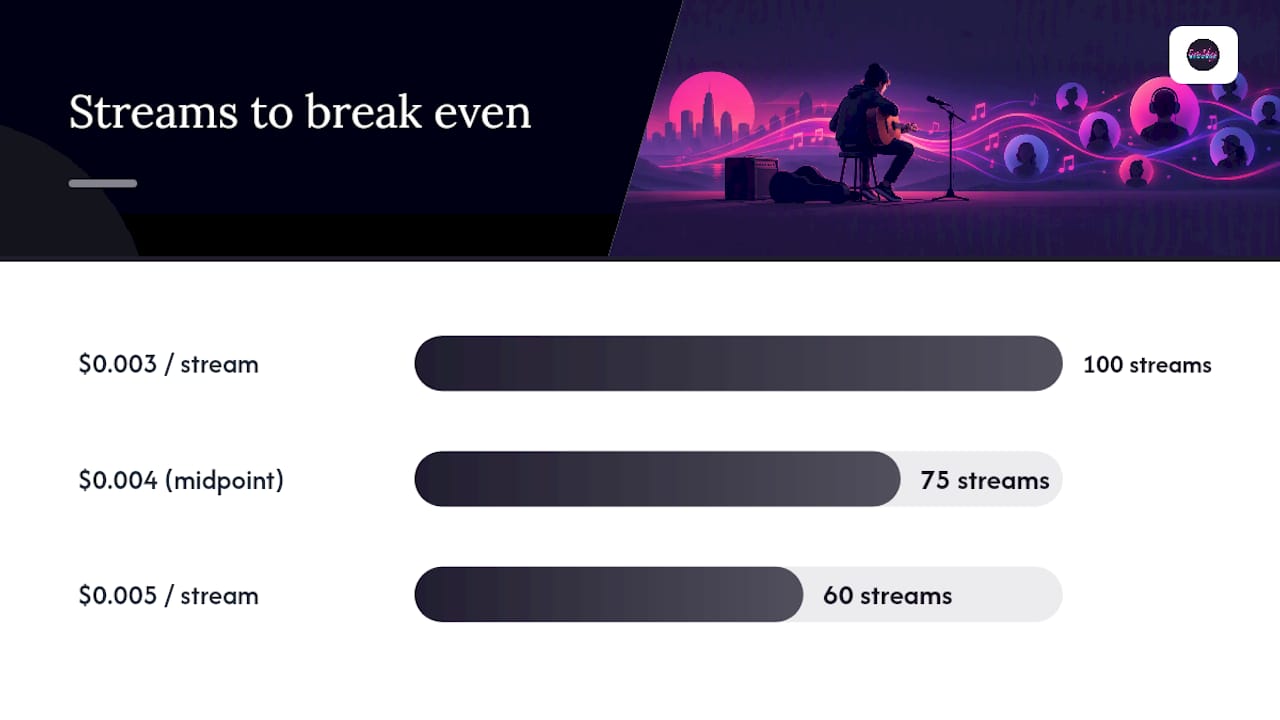
Here’s the formula that matters most: cost per conversion divided by per-stream payout tells you how many streams a single paid listener needs to generate before the campaign pays for itself in royalties. Using a conservative payout assumption of $0.003 to $0.005 per stream, as outlined in VLVTN’s break-even guide, a $0.30 cost per conversion means that listener needs to stream the track 60 to 100 times to break even purely on royalty revenue.
That math looks discouraging until you factor in saves and follows. A saved track tends to generate several times its initial play count over the following months as it resurfaces in algorithmic playlists, so treat saves as a multiplier on lifetime value, not just a vanity number.
Here’s how that plays out across three common starting budgets, assuming a $0.30 average cost per conversion:
| Budget | Estimated impressions | Estimated clicks | Estimated streams | Streams needed to break even |
|---|---|---|---|---|
| $100 | 6,000–9,000 | 150–250 | 100–180 | 60–100 |
| $500 | 30,000–45,000 | 750–1,200 | 500–900 | 300–500 |
| $1,000 | 60,000–90,000 | 1,500–2,400 | 1,000–1,800 | 600–1,000 |
Follow these steps to turn any target number of streams into a working budget:
- Decide your target: streams, saves, or new followers.
- Divide your target by your estimated conversion rate to find required clicks.
- Multiply required clicks by your expected cost per click to get total budget.
- Add 15% to 20% on top for creative testing and leakage.
Which Ad Channel Should You Test First?
Your budget size should decide your first channel more than your genre or personal preference. Under $500, Meta usually makes the most sense because its minimum viable test size is lower and its targeting tools are the most forgiving for a first-timer. Above $1,000, Spotify Ads Manager becomes worth testing because it captures listeners already inside a streaming mindset, which tends to produce a cleaner cost per stream even at a higher CPM.
- Choose Meta when you want broad reach, flexible creative formats, and the most mature ad tools for a first campaign.
- Choose Spotify Ads Manager when you want higher-intent listeners and don’t mind paying more per impression for it.
- Choose TikTok when your track has a clear hook that works as a 15-second clip and you’re chasing discovery over immediate streams.
- Choose YouTube when you have finished video content and want to build watch-time alongside stream counts.
If your goal is pure stream volume, start with Meta or TikTok. If your goal is saves and followers that compound over time, Spotify Ads Manager or a well-targeted Instagram campaign, detailed in Twisby’s guide to Instagram ads for music, tends to produce a better cost per meaningful outcome.
How to Measure and Optimize Your Campaigns
Cost per stream alone tells you almost nothing about whether a campaign is working. Saves, follows, and skip rate tell you far more, because those are the signals platforms actually reward with algorithmic placement.
- Install the Meta pixel and set up server-side events so you’re not relying on browser tracking alone. Twisby’s 30-minute pixel setup guide walks through the process.
- Verify your smart-link funnel end to end, confirming clicks actually register as Spotify plays using a tool like the conversion tracking framework Twisby recommends.
- Run a $50 A/B test between two creative versions before committing a full budget to either.
- Don’t judge results until you’ve hit at least 50 conversions per ad set. That’s the rough threshold most platforms need to exit the learning phase.
Pro Tip: Optimize for cost per save, not cost per stream. A campaign with a higher cost per stream but a strong save rate will almost always outperform a cheaper one that converts to nothing.
Twisby Records’ Practical Approach to Ad-Ready Music
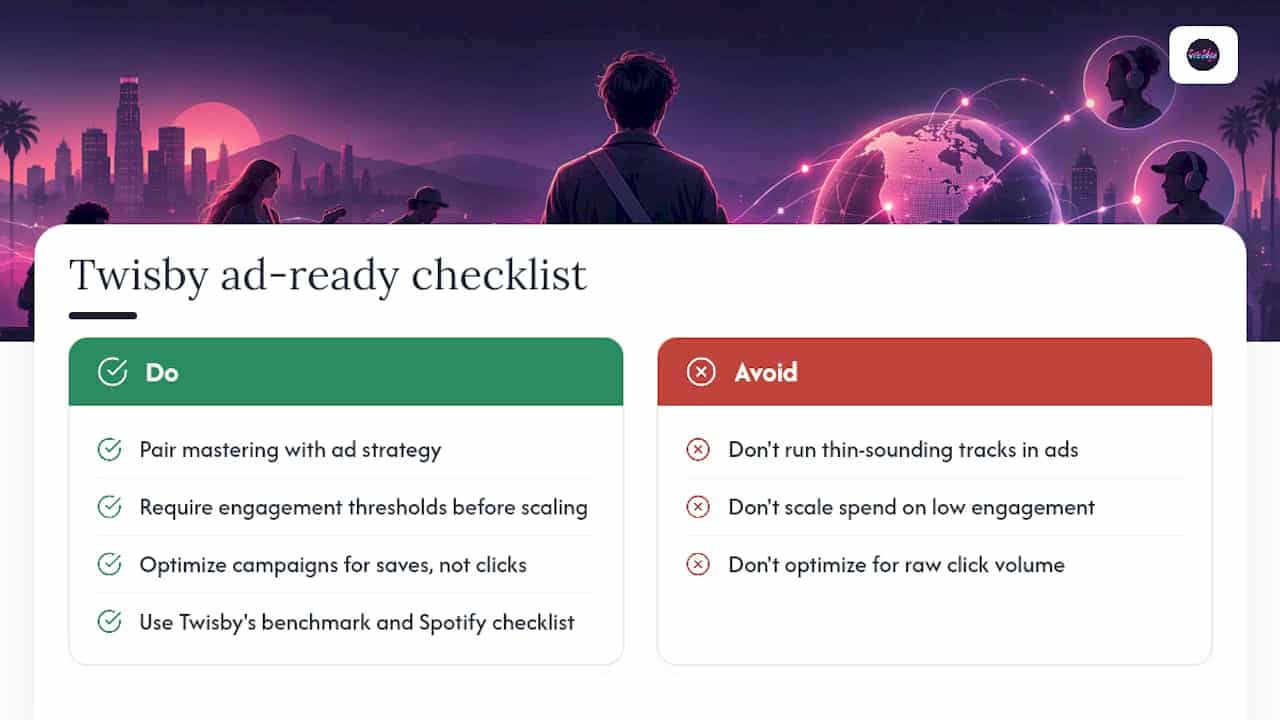
Twisby Records pairs mastering with ad strategy because a track that sounds thin loses listeners in the first three seconds of any ad, no matter how well it’s targeted. The team requires engagement thresholds before scaling spend and optimizes toward saves, not raw click volume. For readers who want a starting point, Twisby’s ad benchmark breakdown and Spotify conversion checklist are built for exactly this stage.
What I’d Tell Any Artist Before Spending a Dollar
Set up tracking before you spend a cent. Run small tests in month one. Never scale past engagement benchmarks just because the ad account lets you. Pair every paid dollar with an organic push, like the tactics in Twisby’s guide to growing Spotify streams.
— Kreg
Get Managed Advertising Built Around Your Track’s Actual Sound
Twisby Records is the alternative to running ads blind. Instead of testing creative in a vacuum, Twisby bundles mastering with managed advertising so your ad spend is working with a track that’s already polished enough to hold attention in the first three seconds.
The Standard Packages run $25 per month plus a 20% adspend fee, with a one-time $99 onboarding fee to get audience research, a custom landing page, and reporting set up correctly from day one. Premium Packages carry the same 20% adspend fee for artists who want more hands-on optimization. Every package is built around the same principle covered above: track saves and engagement first, scale spend second. If you’re ready to stop guessing at cost per stream and want a team tracking it for you, visit the advertising services page to get started.
Sources
- The Real Cost Per Stream on Meta Ads
- As Spotify Turns 20, the Most Global and Diverse Music Industry in History Has Taken Shape — Spotify
- Music Ad Planner | Compare TikTok, Meta, Spotify & YouTube Ad Costs | Tools 4 Music 2026
- Music Ad Break-Even Math: Cost Per Stream vs Spotify Payout | VLVTN
- How much streaming ads cost — Business Insider
FAQ
How Much Do Streaming Ads Cost?
Streaming ads for music promotion typically cost between $10 and $25 CPM depending on platform, translating to roughly $0.15 to $0.50 per stream once smart-link leakage is factored in. Meta tends to sit at the lower end of that range, while Spotify Ads Manager runs higher due to its higher-intent audience.
How Much Does Spotify Pay for $1,000,000 Streams?
Streams generate royalties based on per-stream payout rates that vary by market and other factors, so actual revenue depends on multiple variables including label splits and distributor fees.
How Much Does a 30-Second Ad on Hulu Cost?
Streaming and connected TV ad pricing has softened as more inventory has entered the market, with some formats seeing double-digit percentage declines according to Business Insider’s reporting. Exact 30-second CTV rates vary widely by targeting and season, so most independent musicians get more value testing Meta, Spotify Ads, or TikTok first.
Is $20 a Day Good for Music Ads?
A $20 daily budget is a reasonable starting point for testing creative on Meta or TikTok, since it can generate enough clicks within a week to gauge early cost per click. It’s usually too small to reach the 50 conversions per ad set most platforms need to fully optimize, so treat it as a testing budget rather than a scaling budget.
What Should Independent Artists Track Besides Cost Per Stream?
Save rate, skip rate, and cost per save matter more than raw cost per stream because they signal whether the algorithm will reward the track with organic placement. Twisby Records’ conversion tracking guide walks through setting this up correctly before spending a full budget.