


Use Spotify for Artists to submit one upcoming, unreleased song, ideally pitched 31–40 days before release for the highest acceptance rates, or at least 14–30 days in advance as a recommended window. Parallel targeted outreach to 10–20 well-matched independent curators also increases your odds of real listener growth.
Here’s what to do right now:
- Claim your Spotify for Artists (S4A) account if you haven’t already
- Upload your track through a distributor and set a public release date
- Choose one song to pitch per release cycle
- Fill in every pitch field (genre, mood, instrumentation, free-text)
- Submit at least 7 days before release; but for the best shot at editorial placement, aim to pitch 31–40 days before release, or at minimum 14–30 days ahead.
Timing matters more than most artists realize. Research shows that pitches submitted well in advance before release have substantially higher acceptance rates than last-minute submissions. That gap is not a coincidence.
One honest caveat: pitching does not guarantee placement. Editorial teams review a high volume of submissions and weigh track fit, momentum, and profile quality. Your job is to make the strongest possible case, then let the process work.
Table of Contents
- How do you submit a pitch inside Spotify for Artists?
- What should you write in each Spotify pitch field?
- What eligibility rules and timing windows do you need to know?
- How do you pitch third-party and independent playlist curators?
- How do you check playlist adds and what should you do next?
- Key Takeaways
- What most artists get wrong about playlist pitching
- Twisbyrecords helps you get release-ready before you pitch
- FAQ
- Useful sources and tools
How do you submit a pitch inside Spotify for Artists?
Only tracks uploaded through a distributor and set as an upcoming release appear in Spotify for Artists for pitching. Before you open the pitch form, run through this checklist:
- UPC and ISRC codes are present and correct
- Metadata is clean: track title, artist name, and album art match across all platforms
- Your S4A artist profile has an updated bio and a high-quality photo
- The release date is set and the track shows under “Upcoming” in S4A
Once those are confirmed, the submission flow is straightforward:
- Log into Spotify for Artists
- Go to Music and select Upcoming
- Click the track you want to pitch
- Select Pitch for Playlists
- Fill in every field: genre, subgenre, mood, instruments, cultural context, and the 500-character free-text pitch
- Submit and confirm
You can only pitch one song per release, and some fields cannot be edited after the track goes live. Submit early so you have time to review everything carefully.
“If you pitch an unreleased song at least 7 days before release, we’ll add it to your followers’ Release Radar playlists.” — Spotify for Artists official guidance
Pro Tip: Set your distributor release date as soon as the track is finished mastering. Distributors typically need 5–7 business days to deliver to Spotify, and the UPC needs to appear in S4A before you can access the pitch form. Build that buffer into your release timeline from day one.

What should you write in each Spotify pitch field?
Editors use your metadata and free-text pitch to route tracks to the right playlist team. Every field is a signal, not a formality.
Field-by-field breakdown:
- Genre/Subgenre: Be specific. “Indie Folk” beats “Alternative.” The more precise the genre, the more accurately editors can route your track.
- Mood/Style: Choose descriptors that match real playlist names. “Late Night Drive,” “Melancholic,” or “Uplifting” map directly to editorial categories.
- Instrumentation: List what’s actually in the track. Acoustic guitar, piano, and strings tell a different story than 808s and synthesizers.
- Cultural/Context Tags: Tour dates, sync opportunities, or a notable feature artist are worth mentioning here.
- 500-Character Pitch: This is your one shot at a human narrative. Be specific, be brief, and show you have a plan.
“The biggest mistake is treating playlisting as an administrative checkbox. Editors are humans and respond to concise narratives and alignment with editorial keywords.” — DIY Musician
Three pitch templates you can adapt:
Single release:
“‘[Track Name]’ is a melancholic indie folk track built around fingerpicked guitar and layered vocals. Fits playlists like ‘Sad Indie’ and ‘Acoustic Mornings.’ We’re running a pre-save campaign with a landing page and targeted Facebook ads launching release week.”
Video tie-in:
“‘[Track Name]’ has an official music video releasing simultaneously. Dark R&B, late-night mood, comparable to [Artist A] and [Artist B]. Pre-save campaign active; video pitched separately.”
Tour-linked release:
“‘[Track Name]’ drops the week our 12-city U.S. tour begins. Uptempo indie rock, fits ‘Road Trip’ and ‘Alt Workout’ contexts. Press coverage confirmed in [Publication].”
Dos and don’ts:
- Do align your free-text language with the mood and genre tags you selected
- Do mention your pre-save campaign or ad spend to show promotional intent
- Don’t use the 500 characters to recap your career bio
- Don’t name specific playlists you want to land on; describe the context instead
What eligibility rules and timing windows do you need to know?
Spotify’s rules are non-negotiable. Miss them and you lose the editorial window entirely.
Official minimums:
- The track must be unreleased at the time of pitching
- It must appear under “Upcoming” in Spotify for Artists
- Pitch at least 7 days before release for Release Radar eligibility
- Song and video pitches are separate; submit both for maximum consideration
Video eligibility specifics: The video must be an official music video or performance clip, delivered through your distributor or label. The same 7-day minimum applies. Label-only pitch restrictions may apply for certain editorial video placements; check with your distributor if you’re on an indie label.
Timing and acceptance data:
| Submission Lead Time | Acceptance Rate | Notes |
|---|---|---|
| 31–40 days before release | 18% | Highest rate; editors have review time |
| 14–30 days before release | Moderate | Recommended window for most artists |
| 7 days before release | Low | Meets minimum; limited editorial review |
| 1–3 days before release | 4% | Near-zero editorial consideration |
Eligibility checklist:
- Track is unreleased and set as upcoming
- Distributor delivery is confirmed
- UPC and ISRC are present
- Artist profile is complete with bio and photo
- Pitch submitted at least 7 days out (14–30 days strongly preferred)
Missed windows cannot be reopened. There is no appeal process for a track that went live before you pitched it.
How do you pitch third-party and independent playlist curators?
Independent-curator pitching is a relationship-based task, not a single-platform submission. It runs in parallel with your editorial pitch, not instead of it.
Finding the right curators:
- Search Spotify directly for playlists in your genre and note the curator’s profile name
- Reverse-engineer playlists that already feature artists at your listener level
- Search Instagram, YouTube, and Reddit communities for playlist curators in your niche
- Use music discovery tools and community platforms to identify active, engaged curators
Targeting checklist:
- Match playlist follower scale to your current monthly listeners; a 500-follower playlist is a better fit for a 1,000-monthly-listener artist than a 500,000-follower list
- Prioritize niche, engaged playlists over massive but loosely themed ones
- Confirm the playlist is still active (updated within the last 30 days)
Outreach templates:
Short email:
“Hi [Name], I’m [Artist], an indie [genre] artist based in [City]. My new track ‘[Title]’ releases [Date] and fits the vibe of your ‘[Playlist Name]’ playlist. Here’s a preview link: [URL]. I’m running a pre-save campaign and Facebook ads to drive listeners. Would love to be considered. Thanks.”

Short DM:
“Hey [Name], love ‘[Playlist Name].’ My track ‘[Title]’ drops [Date] and fits right between [Track A] and [Track B] on your list. Preview: [URL]. Worth a listen?”
Submission form copy:
“Track: ‘[Title]’ | Genre: [Genre] | Release: [Date] | Why it fits: [One sentence on playlist alignment] | Promo plan: pre-save campaign, targeted ads, [publication] coverage | Preview: [URL]”
Pro Tip: Log every outreach attempt in a simple spreadsheet with columns for playlist name, curator contact, follower count, date contacted, channel used, and response. This prevents you from accidentally contacting the same curator twice and helps you spot which channels convert best.
Follow-up timeline: Wait 7–10 days before a single polite follow-up. If there’s no response after that, move on. Curators receive dozens of pitches weekly.
On paid platforms: Services like SubmitHub and Groover offer a paid listen and written feedback window. Placement is never guaranteed, and any service that promises a specific playlist spot is a red flag. Use paid platforms for feedback and discovery, not as a placement guarantee.
How do you check playlist adds and what should you do next?
Inside Spotify for Artists, go to Music, select your track, and open the Audience tab. Look for the listener source breakdown, which shows how many streams came from editorial playlists, listener playlists, or other sources. Track saves and follower growth in the days following a playlist add; those numbers tell you whether the placement is converting listeners into fans.
Immediate next steps after a placement:
- Pin the track to your “This Is” playlist if you’re eligible
- Post a shoutout on Instagram and TikTok tagging the playlist or curator
- Send listeners to a landing page that captures email addresses
- Run a short targeted ad campaign to the playlist’s audience to amplify the momentum
- Thank the curator directly; a brief, genuine message builds the relationship for your next release
Basic outreach tracker columns:
| Playlist Name | Curator Contact | Follower Count | Date Contacted | Response | Add Date |
|---|---|---|---|---|---|
| [Playlist] | [Email/DM] | [#] | [Date] | [Yes/No/Pending] | [Date or —] |
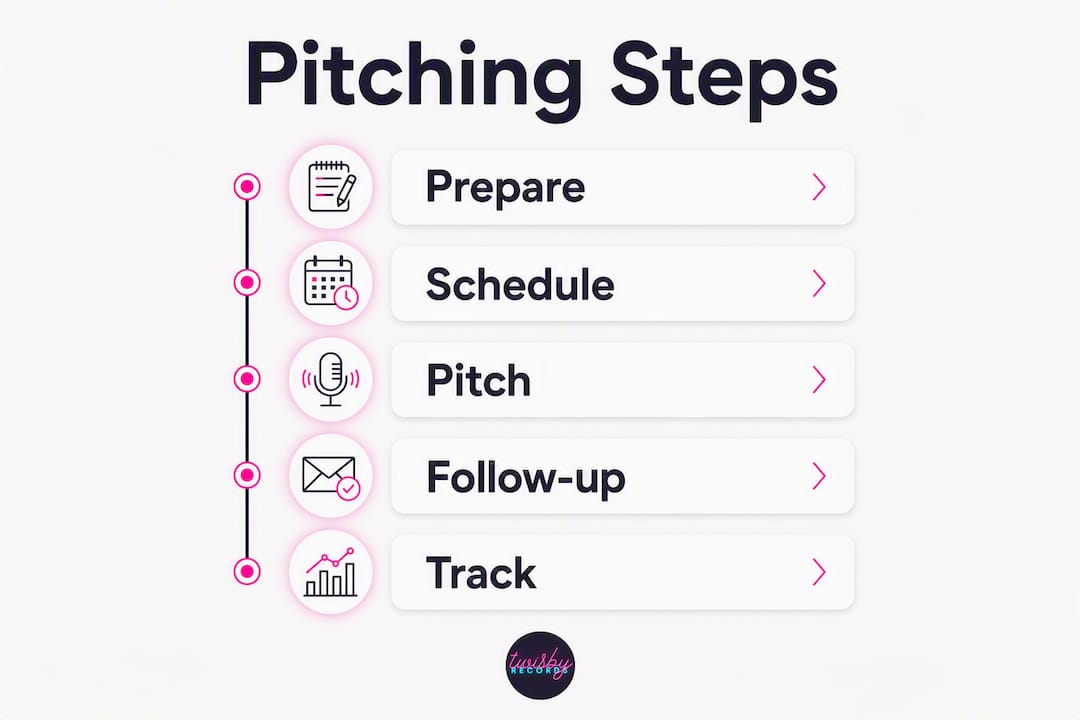
Keep this tracker updated after every release cycle. Over time, it becomes your most valuable promotion asset.
Key Takeaways
Effective Spotify playlist pitching requires submitting one unreleased track through Spotify for Artists ideally 31–40 days before release for an 18% acceptance rate, or at least 14–30 days in advance. Fill every pitch field with specific editorial language, and run parallel outreach to well-matched independent curators.
| Point | Details |
|---|---|
| Submit early | Pitches 31–40 days out achieve an 18% acceptance rate vs. 4% for last-minute submissions. |
| Fill every field | Genre, mood, instrumentation, and the 500-character pitch all route your track to the right editorial team. |
| Match curator scale | Target playlists whose follower count aligns with your current monthly listener base for better conversion. |
| Track everything | A simple outreach spreadsheet prevents duplicate contacts and reveals which channels produce results. |
| Twisbyrecords support | Twisbyrecords offers mastering, landing pages, and managed ad campaigns to strengthen your pitch and release momentum. |
What most artists get wrong about playlist pitching
Here’s the honest reality: most emerging artists treat playlist pitching as a lottery. Submit and hope. That mindset produces exactly the results you’d expect.
The artists who consistently land placements think about it differently. They treat each pitch as a business case. The editorial team at Spotify is deciding whether your track fits a specific listener experience. Your job is to make that decision easy. Specific genre tags, a mood that maps to a real playlist name, and a sentence about your promotional plan all reduce the editor’s risk. A complete, professional Spotify for Artists profile is part of that case; missing ISRCs or a blank bio signals that you’re not ready.
The independent curator side is where most artists leave the most opportunity on the table. Chasing 100,000-follower playlists when you have 800 monthly listeners is a waste of time and goodwill. A 2,000-follower niche playlist where every track gets real engagement will do more for your Spotify algorithm signals than a passive add to a massive list where listeners skip your track in three seconds. Skips hurt you. Saves help you.
One more thing: the promotional plan you mention in your pitch is not a formality. Editors and curators want to know you’re going to drive traffic to the track. A pre-save campaign, a landing page, and even a modest ad budget signal that you’re an active partner in building the audience, not someone waiting for a playlist to do all the work.
Plan early. Be specific. Track everything. Repeat it every release cycle.
Twisbyrecords helps you get release-ready before you pitch
Getting onto playlists starts well before you open the pitch form. Your track needs to sound competitive at streaming loudness standards, your metadata needs to be clean, and your promotional assets need to be ready on release day.
Twisbyrecords offers mastering built to Apple Digital Masters standards, metadata and ISRC checks, custom landing pages for pre-save campaigns, and fully managed Facebook and Instagram ad campaigns tied to your release date. You get a real promotional plan, not a template, with audience research, ad creative, and weekly reporting so you know exactly what’s working.
If you’re preparing a release and want professional help with audio quality, pre-save setup, or a managed ad campaign, see what Twisbyrecords offers and reach out with your release date, a WAV file, and your target playlists. We’ll take it from there.
FAQ
How early should you pitch to Spotify editorial playlists?
Spotify requires a minimum of 7 days before release, but pitches submitted 31–40 days out show an 18% acceptance rate compared to 4% for last-minute submissions. Whenever possible, pitch 31–40 days ahead; otherwise, aim for 14–30 days as your standard window.
Can you pitch a song that’s already been released?
No. Spotify for Artists only shows upcoming, unreleased tracks in the pitch queue. Once a track goes live, the editorial pitch window closes permanently.
Does pitching to Spotify guarantee playlist placement?
Pitching does not guarantee placement. Editorial teams review many submissions and weigh track fit, profile quality, and promotional momentum before making any decision.
How do you find independent playlist curators to contact?
Search Spotify for playlists in your genre, check curator profiles on Instagram and Reddit, and use music discovery platforms to identify active curators whose follower scale matches your current monthly listener count.
What’s the difference between editorial and independent playlist pitching?
Editorial pitches go through Spotify for Artists and are reviewed by Spotify’s internal team. Independent curator outreach is manual, done via email, DM, or submission forms, and targets user-generated playlists outside Spotify’s editorial system.
Useful sources and tools
Official Spotify guidance:
- Pitching music and videos to Spotify playlist editors — the primary source for eligibility rules, timing, and submission steps
- How to Get Your Music on Spotify Playlists — Berklee Online — academic-grade overview of the full playlisting process
Practical how-to guides:
- DIY Musician — How to pitch Spotify editorial playlists — field-level pitch guidance and editorial keyword strategy
- MusicTech — How to get playlisted on streaming services — promotional plan guidance for pitches
Curator discovery tools:
| Tool | What it does | Best for |
|---|---|---|
| ARTEEST | Curated music discovery community | Finding niche, engaged playlist curators |
| SubmitHub | Paid listen and feedback from curators | Getting written feedback and discovery |
| Groover | Paid curator outreach with response guarantee | Structured outreach with accountability |
| Spotify Search | Native playlist search by genre/mood | Free curator discovery and reverse-engineering |
Reminder: Use Spotify for Artists exclusively for editorial pitching. Third-party platforms and independent curator outreach are separate paths that run alongside it, not through it.