

TL;DR:
- Running music in Instagram ads requires verified sync and master licenses or an explicit license from a production library. Instagram’s Sound Collection does not automatically cover paid ads, and using unverified tracks risks muting or rejection during delivery. Proper licensing and embedding audio into final videos ensure legal compliance and campaign success.
You can run music in Instagram ads only when you hold commercial sync and master rights — or use a provider that explicitly grants them for paid placements. Instagram’s in-app Sound Collection does not automatically cover paid ads, and relying on it is one of the fastest ways to get your creative muted, rejected, or pulled mid-campaign.
Here’s what you need to have in place before you launch:
- Confirm your license covers paid ads. A sync license (from the publisher/composer) and a master license (from the record label or rights owner) are both required for most commercial tracks. Subscription production libraries like Epidemic Sound or per-track services like Foxi Music often bundle both, but you must verify the license explicitly includes “commercial advertising” or “paid social” use.
- Get it in writing. A verbal okay or a standard streaming license is not enough. You need a written license, a buyout receipt, or a license rider that names Meta/Instagram, the territory, and the campaign duration.
- Bake the audio into your final video file before uploading to Ads Manager. Do not rely on the platform to attach music after upload. Baked audio prevents automated swapping or muting during delivery.
- Store your documentation alongside your campaign assets. License PDFs, receipts, and license IDs belong in the same folder as your ad creative, not buried in an email thread.
The two authorities to know: Instagram Help’s Sound Collection guidance and standard US sync/master licensing practice, which governs every paid placement regardless of platform.
Table of Contents
- What does Instagram’s official guidance say about music in paid ads?
- Which licenses do you actually need for a paid Instagram placement?
- Where can you get music that’s safe for Instagram ads?
- How do you license a popular commercial song for an Instagram ad?
- How do you go from a cleared track to a live ad in Ads Manager?
- What kind of music actually improves ad performance?
- What are the most common music licensing mistakes in Instagram ads?
- How Twisbyrecords handles music licensing for ad campaigns
- Key Takeaways
- The part most marketers skip until it’s too late
- Useful sources and vendor links
- Twisbyrecords is the faster route to cleared, campaign-ready audio
- FAQ
What does Instagram’s official guidance say about music in paid ads?
Instagram and Meta draw a clear line between organic posts and paid placements when it comes to music rights. The Sound Collection, accessible inside the Instagram app, is licensed for personal and organic use. Once you attach a budget and run paid delivery, different rights are required — and Meta’s automated systems are built to enforce that distinction.
What that means in practice: Meta’s content ID and rights-management systems scan audio in ads. When the system detects a track that lacks verified commercial clearance, it can mute the audio automatically, reject the creative outright, or replace the sound with a generic track. None of those outcomes are recoverable mid-campaign without pausing spend and rebuilding the creative.
Ads Manager routes for adding music. Meta’s Creative Editor and Advantage+ creative tools do offer a music selection interface, but the tracks surfaced there are not guaranteed to cover all commercial ad uses across every territory. The safest route is always to upload your final video with audio already embedded. That way, the platform has no separate audio layer to flag or swap.
Distributing your own music to platform libraries. If you own the master on a track you want to use in ads, services like DistroKid’s Social Media Pack can deliver your release to Instagram’s music library. That makes it available for organic use, but you still need to confirm whether that delivery grants commercial ad rights or only personal/organic use. The two are not the same, and the distributor agreement is where that distinction lives.
Store your license documentation inside your campaign asset folders from day one. If Meta’s manual review team asks for proof of rights, you want a PDF ready, not a three-day search through your inbox.
Which licenses do you actually need for a paid Instagram placement?
Two rights must be cleared for any commercial track in a paid ad: the sync license and the master license. Understanding who controls each one tells you exactly who to call.
- Sync license: Granted by the music publisher or composer. It covers the right to synchronize the composition (melody and lyrics) with visual content. For a paid Instagram ad, this is non-negotiable.
- Master license: Granted by the record label or whoever owns the recording itself. Even if you clear the composition, you cannot use that specific recording without the master. These are two separate deals with two separate parties.
- Publishing administration and PROs: Organizations like ASCAP, BMI, and SESAC collect performance royalties for songwriters and publishers. They do not grant sync or master licenses. Paying a PRO fee does not clear your ad. Sync clearance happens directly with the publisher or their licensing administrator.
- Mechanical vs. sync: Mechanical licenses cover reproduction of a composition in audio-only formats (like a digital download). For video ads, you need sync, not mechanical. The distinction matters when a publisher quotes you a rate.
What an acceptable license for ads looks like:
- A per-track buyout that explicitly includes worldwide (or territory-specific) advertising rights
- A custom sync + master clearance negotiated directly with publisher and label
- A subscription or blanket license from a production music library that explicitly lists “commercial advertising,” “paid social,” or “Meta/Instagram ads” as covered uses
Pro Tip: When reviewing any license agreement, search the document for the words “advertising,” “commercial,” and “paid social.” If none of those terms appear, the license almost certainly does not cover your Instagram ad. Request a written rider that names Meta/Instagram, the territory, and the campaign flight dates before you upload a single frame.
Where can you get music that’s safe for Instagram ads?
Four supplier categories cover most of what marketers need, and they differ significantly in speed, cost, and what rights they actually hand you.
| Supplier Category | License Types Covered | Pricing Model | Ad/Commercial Use | Speed to License | Catalog Style |
|---|---|---|---|---|---|
| Platform library (e.g., Instagram Sound Collection) | Organic/personal only (verify for paid) | Free (in-app) | Not automatically included for paid ads | Instant | Mixed popular + production |
| Subscription production library (e.g., Epidemic Sound) | Sync + master (bundled) | Monthly/annual subscription | Included when plan covers commercial use — verify tier | Instant after subscribe | Curated production music |
| Per-track buyout library (e.g., Foxi Music) | Sync + master (bundled per track) | Per-track fee | Included — verify ad/commercial clause | Fast (minutes to hours) | Curated production music |
| Custom clearance / sync agency | Sync + master (negotiated separately) | Custom quote per project | Included when negotiated — specify media | Slow (days to months) | Popular/commercial tracks |
A few things worth knowing about each category:
- Instagram Sound Collection is the fastest option, but it is built for organic content. If you want to use it in a paid placement, read the license terms carefully. The platform’s own guidance is the authoritative source here.
- Epidemic Sound operates on a subscription model where commercial ad rights are included at certain plan tiers. Confirm your tier covers paid social before you launch. Their catalog skews toward production music rather than chart-familiar tracks.
- Foxi Music offers per-track licensing with explicit coverage for Facebook and Instagram ads, making it a practical choice when you need a specific sound without committing to a subscription.
- Custom clearance is the only route when you want a recognizable commercial track. It is also the slowest and most expensive path, and it requires separate negotiations with the publisher and the label.
If you own the master on your own music, you already hold that right. You still need to confirm sync rights if a co-writer or publisher controls the composition.
How do you license a popular commercial song for an Instagram ad?
Clearing a well-known track for a paid ad is a multi-step process, and the timeline is almost always longer than marketers expect. Here’s the sequence:
- Identify all rights owners. Use ASCAP’s ACE database, BMI’s repertoire search, or a music licensing attorney to find the publisher(s) controlling the sync right and the label controlling the master. A single song can have multiple publishers if there are multiple songwriters.
- Define your usage parameters. Before you contact anyone, know your territory (US only, worldwide, specific countries), campaign duration (30 days, 90 days, perpetual), media (paid social, specifically Meta/Instagram), and estimated impressions or budget range. Rights holders price based on these factors.
- Request a sync license from the publisher. Send a formal license request with your usage parameters. For an independent publisher, response time can be a few days to a couple of weeks. For a major publisher (Sony Music Publishing, Universal Music Publishing Group, Warner Chappell), expect two to six weeks minimum.
- Request a master license from the label. This is a separate negotiation. Independent labels can move quickly. Major labels (Universal Music Group, Sony Music Entertainment, Warner Music Group) often take four to twelve weeks, and they may decline entirely for certain ad categories.
- Negotiate fees and secure written licenses. Both licenses must be in hand before you upload the ad. An indie publisher sync for a short social ad might run a few hundred to a few thousand dollars. Major-label master clearances for high-reach campaigns can reach five figures or more, depending on exclusivity and territory.
- Verify contract clauses before signing. Check every agreement for: territory, duration, exclusivity, specific media listed (the agreement must name “paid social” or “Meta/Instagram ads”), usage metrics reporting requirements, and whether re-use rights cover edited versions or geotargeted variants.
Cost reality check: There is no universal rate card for sync and master clearances. Fees depend on the track’s commercial profile, the campaign’s reach, exclusivity, and the rights holder’s current licensing appetite. Budget significant lead time and a contingency track from a production library in case clearance falls through.
How do you go from a cleared track to a live ad in Ads Manager?
Once you have your license confirmed in writing, the path to a live ad follows a specific sequence that keeps your creative intact and your documentation auditable.

Step 1: Confirm the license in writing before touching the timeline. Do not begin video production with a track until the license is signed. Rights holders can withdraw or change terms during negotiation.
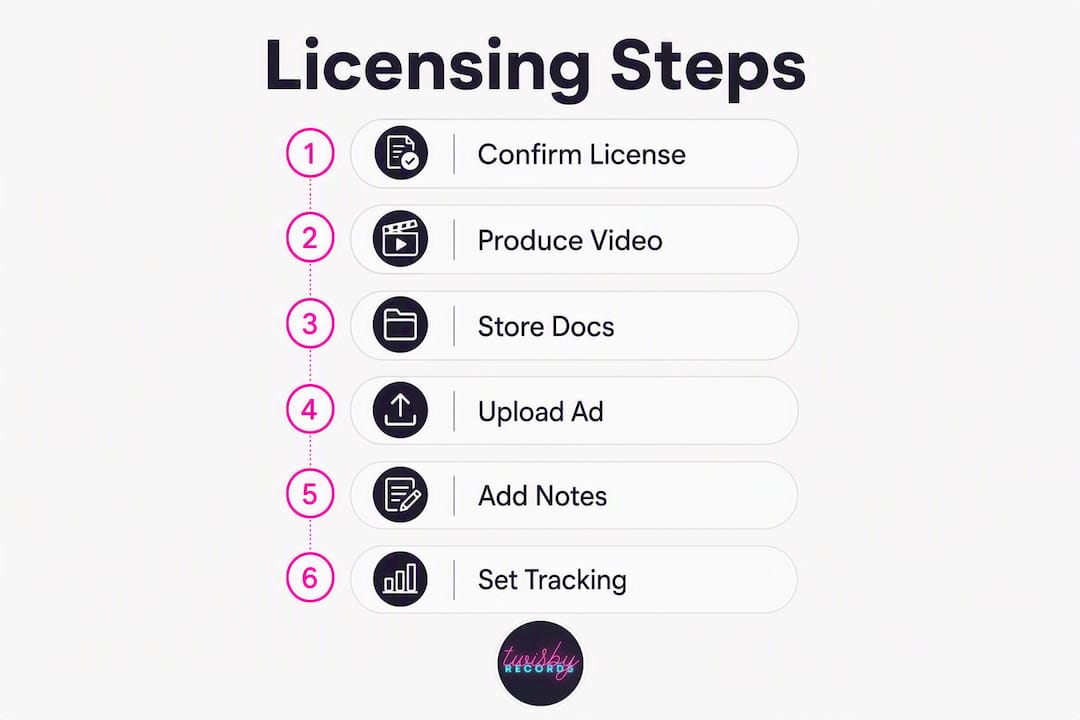
Step 2: Produce the final video with audio baked in. Export your final video file with the licensed audio embedded at the mix level. For Instagram Reels and Stories, export at H.264 or H.265, stereo audio at 44.1 kHz or 48 kHz, with a bitrate of at least 128 kbps for audio. Do not leave audio as a separate layer that Ads Manager might override.
Step 3: Store license documentation alongside the creative asset. Create a folder named for the campaign that contains the final video file, the license PDF (or license receipt), the license ID, the rights owner’s name, coverage dates, and allowed platforms. If you are managing multiple ad variants, each variant gets its own subfolder.
Step 4: Upload to Ads Manager. Use the video upload in the ad creative section. If you are using Creative Editor or Advantage+ creative, disable any automatic music suggestions to prevent the platform from overriding your baked audio.
Step 5: Add internal notes. In the ad’s notes field or your campaign management tool, log the license ID and the rights owner. If Meta’s manual review team contacts you, this is your first line of documentation.
Step 6: Set up conversion tracking. Install the Meta pixel on your landing page before the campaign goes live. A pixel-backed music landing page lets you optimize for streaming clicks or pre-saves rather than just impressions.
Pro Tip: Build a standardized folder template for every campaign: /CampaignName/Audio/[TrackName_LicenseID_RightsOwner_CoverageDate_Platforms.pdf]. Anyone on your team can pull the license proof in under a minute, and you are covered if Meta requests documentation during a manual review.
What kind of music actually improves ad performance?
The legal side gets you into the auction. The creative side determines whether you win it. Music that aligns with your hook and your audience’s energy improves Meta’s relevance signals, and that lowers your cost per result over time.
Starting with broad targeting and letting Meta’s delivery algorithm optimize toward engagement metrics like Saves, Profile Visits, and 3-second video views consistently outperforms over-narrow audiences, especially in the early days of a campaign. The algorithm needs data to find your best audience, and restricting it too tightly at launch starves the learning phase.
Audio selection checklist for ad creatives: See why music transitions matter to create smoother and more engaging ad edits.
- Hook in the first 0–3 seconds. The most impactful musical moment should land before the viewer can swipe. A drop, a vocal hook, or a tempo shift in the opening frame holds attention longer than a slow build.
- Match tempo to objective. High-energy tracks (120+ BPM) work well for awareness and engagement campaigns. Slower, more atmospheric tracks tend to perform better for retargeting and conversion-focused placements where the viewer already knows the artist.
- Vocal vs. instrumental trade-off. Vocals compete with on-screen text and captions. If your ad relies on copy or subtitles to tell the story, an instrumental or low-vocal mix keeps the message clear.
- A/B test audio variants. Run two versions of the same creative with different tracks or different mix levels. Watch 3-second view rates and Saves as early signals before optimizing toward downstream conversions.
Accumulating organic content around a release before you run paid ads is one of the most underused tactics in music advertising. Repurposing interviews, behind-the-scenes clips, and production snippets builds audience familiarity that makes paid ads convert at a higher rate. The audience has already heard the track; the ad closes the loop.
Pro Tip: Before you push a paid funnel, spend two to three weeks posting organic content that features the track: a snippet, a studio clip, a lyric moment. When the ad hits, the music already feels familiar. Familiarity lowers resistance and raises conversion.
What are the most common music licensing mistakes in Instagram ads?
Most ad rejections and muting events are preventable. They almost always trace back to one of these errors:
- Using Sound Collection tracks in paid ads without verifying commercial coverage. The in-app library is built for organic use. Assuming it covers paid placements is the single most common mistake.
- Relying on a creator’s upload without checking their license. If an influencer or co-creator supplies the audio, their personal license may not extend to your paid campaign. Get a copy of their license and confirm it covers commercial advertising before you use their asset.
- Clearing sync but not master (or vice versa). Both rights are required. A publisher approval without label approval is an incomplete clearance.
- Uploading audio as a separate track in Ads Manager. The platform can swap or mute a separately attached audio file. Bake it into the video before upload.
- No license documentation on file. If Meta flags your ad and you cannot produce proof of rights within hours, your campaign goes dark.
If your ad gets muted or rejected:
- Pause spend immediately to stop wasting budget.
- Pull your license documentation and confirm it explicitly covers paid social on Meta/Instagram.
- Contact Meta support through Ads Manager and submit your license proof via the appeal workflow.
- If clearance will take more than 24–48 hours to resolve, swap to a cleared production track from a library like Epidemic Sound or Foxi Music and relaunch. Speed matters more than the original track selection when a campaign is live.
How Twisbyrecords handles music licensing for ad campaigns
Getting music cleared, mastered, and packaged for a paid Instagram campaign involves more moving parts than most teams expect. Twisbyrecords handles the audio side end-to-end: mixing, mastering to Apple Digital Masters standards, baking cleared audio into final video files, and supplying written license documentation alongside every deliverable.
For independent artists and marketing teams running paid campaigns, the specific services include:
- Pre-clearance guidance on which license type your track requires
- Mastered audio packaged and embedded into final video files, ready for Ads Manager upload
- Written license riders and documentation organized for campaign folders
- Managed Ads Manager support, including campaign setup, creative coordination, and optimization reporting
With over 35 years of experience and Apple Digital Masters certification, Twisbyrecords brings both the technical precision and the advertising know-how to get your music into paid placements without the legal exposure. The advertising services page covers the full scope of what’s included, and you can request a quote directly from there.
Key Takeaways
Paid Instagram ads require both sync and master rights — or a production library license that explicitly covers commercial advertising use. Sound Collection alone does not clear a paid placement.
| Point | Details |
|---|---|
| Sync + master both required | Every paid Instagram ad needs both the composition right (sync) and the recording right (master) cleared in writing. |
| Sound Collection has limits | Instagram’s in-app library covers organic use; verify commercial ad rights separately before running paid delivery. |
| Bake audio before upload | Embed audio into your final video file before uploading to Ads Manager to prevent automated muting or swapping. |
| Document everything | Store license PDFs, license IDs, rights owner names, and coverage dates in the same folder as your campaign creative. |
| Twisbyrecords manages the workflow | Twisbyrecords packages mastered, cleared audio with written documentation for paid Instagram campaigns, reducing legal exposure and production time. |
The part most marketers skip until it’s too late
Music licensing for paid ads is one of those areas where the gap between “I think we’re covered” and “we are actually covered” costs real money. I’ve seen campaigns go dark mid-flight because the audio came from a creator’s personal library, or because the team assumed Sound Collection tracks were fair game for paid placements. They are not, and Meta’s systems are getting better at catching it.
The bigger issue is that most marketers treat music as a creative afterthought. They lock the visual, then grab whatever sounds good from an in-app library. That sequence is backwards. The audio decision should happen at the brief stage, alongside the visual concept, because the license type you need determines which tracks are even available to you.
Production libraries like Epidemic Sound and Foxi Music exist precisely to solve this problem, and for most campaigns, they are the right answer. Fast, affordable, and commercially cleared. Where I see teams go wrong is when they want a recognizable commercial track for the emotional lift it carries, then underestimate the clearance timeline and cost. A major-label master for a high-reach campaign is not a $200 transaction. Plan for it, or plan around it.
The one recommendation I’d give any team running music-driven paid social: treat your license documentation the same way you treat your ad spend receipts. You would not run a campaign without a budget record. Do not run one without a license record either.
Useful sources and vendor links
A short list of official and representative resources for verifying platform policy and sourcing licensed music for paid ads:
- Audiodrome: Music for Instagram Ads and How to Avoid Rejections — Practical breakdown of why paid ads require different rights than organic posts, with fix guidance.
- Twisbyrecords: Instagram Ads for Music — In-house workflow guide covering campaign structure and creative formats for independent artists.
- Twisbyrecords Advertising Services — Managed ad and audio services page for teams that want end-to-end support.
Save copies of every license file and vendor receipt. Store them outside your email client in a shared drive folder tied to the campaign. If a platform review or a rights holder dispute arises months after the campaign ends, you need those documents accessible in minutes, not hours.
| Resource | What It Covers |
|---|---|
| Instagram Help / Sound Collection | Official platform policy on music licensing for organic vs. paid use |
| Foxi Music licensing page | Per-track commercial ad license terms for Meta placements |
| Audiodrome music-for-ads guide | Practical rejection-avoidance guidance and baked-audio workflow |
| Twisbyrecords advertising page | Managed campaign and audio packaging services for paid social |
Twisbyrecords is the faster route to cleared, campaign-ready audio
Most independent artists and lean marketing teams spend more time chasing license paperwork than they do refining their creative. Twisbyrecords removes that bottleneck. Rather than navigating publisher contacts, label negotiations, and Ads Manager file specs on your own, you get a single point of contact that handles mixing, mastering, audio packaging, and documentation for paid Instagram campaigns.
The concrete difference: your final video file arrives with Apple Digital Masters-quality audio already baked in, a written license rider on file, and campaign notes ready for Ads Manager. No guessing whether the track is cleared. No scrambling for documentation if Meta flags the creative.
Twisbyrecords works with independent and DIY artists who are serious about growing their audience through paid social, not just hoping an organic post catches. If you are planning a release campaign and want the audio side handled correctly from the start, the advertising services page is the right place to begin. You can also review the full range of mixing, mastering, and campaign services to find the package that fits your release.
FAQ
What music can you legally use in Instagram ads?
You can use music in paid Instagram ads when you hold both a sync license (from the publisher) and a master license (from the label or recording owner), or when you use a production library that explicitly includes commercial advertising rights in its license terms.
Does Instagram Sound Collection cover paid ads?
Instagram’s Sound Collection is licensed for personal and organic use. It does not automatically cover paid ad placements, so using those tracks in a boosted or Ads Manager campaign can result in muting or rejection.
How do you find commercial music cleared for Instagram ads?
Production music libraries like Epidemic Sound and per-track services like Foxi Music offer licenses that explicitly cover paid social advertising. Always verify the license terms include “commercial advertising” or “paid social” before uploading to Ads Manager.
What is the most viral song on Instagram right now?
Trending audio on Instagram changes weekly and varies by niche. Check the Reels audio trending tab and the “Used in X Reels” count on any track to gauge current momentum, but confirm commercial rights before using any trending track in a paid placement.
Can Twisbyrecords help clear and package music for Instagram ads?
Yes. Twisbyrecords provides managed advertising services that include audio packaging, documentation support, and Ads Manager coordination for independent artists running paid Instagram campaigns.