


Mixing engineer collaboration means giving your engineer everything they need up front, in a format they can use, so the mix comes back close to right the first time. That includes stems, a rough mix, reference tracks, and a short written brief. A two-phase study of 22 mixing engineers found reference tracks and demo mixes are how artists and engineers reach a shared, unspoken agreement on the target sound. Do these five things before you hire anyone, whether that’s an engineer at Twisbyrecords or elsewhere:
- Export clean, labeled stems grouped by instrument family
- Include a rough mix so the engineer hears your intent, not just raw tracks
- Attach two or three reference tracks that match the vibe you want
- Write a one-paragraph brief covering genre, mood, and any must-fix issues
- Agree on the number of included revisions before the first file transfer
Key Takeaways
A prepared handoff, structured revision terms, and timestamped feedback are what actually shorten a mixing project, not luck or a bigger budget.
| Point | Details |
|---|---|
| Prepare a clean handoff | Send labeled stems, a rough mix, and reference tracks before the first session starts. |
| Agree on revisions upfront | Confirm included revision rounds and out-of-scope pricing before paying a deposit. |
| Use timestamped feedback | Structure notes with timestamp, element, change, and reason to cut back-and-forth. |
| Vet engineers on process, not just sound | Ask about revision policy, turnaround, and genre-specific sample mixes. |
| Twisbyrecords as a managed option | Offers Apple Digital Masters certification, defined revision terms, and combined mixing, mastering, and advertising support. |
Table of Contents
- What to Prepare Before You Hire a Mixing Engineer
- What Does a Typical Collaboration and Revision Workflow Look Like?
- How Do You Give Feedback That Speeds Up Revisions?
- What Should You Expect in Deliverables, Pricing, and Rights?
- How Do You Choose the Right Mixing Engineer?
- Why Twisbyrecords’ Experience and Certifications Matter
- What Common Problems Come Up in Mixing Collaboration, and How Do You Avoid Them?
- What Are the Best Tools for Communicating During a Mix Project?
- What Actually Speeds Up a Good Mix?
- Get a Managed Mix With Clear Revisions and Fast Turnaround
- Sources
- FAQ
What to Prepare Before You Hire a Mixing Engineer
Every hour your engineer spends untangling messy files is an hour they’re not spending on the mix itself. A clean handoff is, according to engineers who do this for a living, the single most useful thing an artist can provide, because it protects their time for creative decisions instead of cleanup.
Start with stems grouped by instrument family (drums, bass, guitars, keys, vocals), each one printed at a consistent sample rate with no clipping and no master bus processing baked in. Name files so anyone could understand them cold: “Lead_Vox_Verse1” beats “Track 14.”
| Item | What to send | Why it matters |
|---|---|---|
| File format | WAV or AIFF, project’s native sample rate | Avoids quality loss and format conversion delays |
| Stem grouping | By instrument family, aligned to the same start point | Lets the engineer navigate the session instantly |
| Rough mix | A rendered reference of your intended balance | Shows creative intent, not just raw audio |
| Reference tracks | 2–3 songs matching genre and energy | Anchors tone, loudness, and space |
Your brief should be short: target loudness feel, genre and mood in a sentence, and any known problem spots (a thin snare, a buried vocal). That’s it.
Pro Tip: Render your rough mix with all effects printed and clearly labeled, then turn off any master bus limiter or EQ before export. Engineers can’t undo processing they can’t see, and an unlabeled effect chain is one of the most common reasons a first mix misses the mark.
What Does a Typical Collaboration and Revision Workflow Look Like?
A predictable workflow keeps everyone honest about what’s included and what costs extra. Most working relationships with a mixing engineer follow the same basic shape:
- Initial consult: You share the brief, references, and rough mix; the engineer confirms scope and turnaround.
- File handoff: Stems and session notes go over, ideally through a shared drive with clear folder naming.
- First mix pass: The engineer delivers Mix v1, usually within a few business days for a single track.
- Feedback round: You return notes using timestamps and priorities (more on that below).
- Revision pass(es): The engineer delivers Mix v2, and sometimes v3, addressing your notes.
- Final approval and delivery: You sign off, and the engineer renders final files and stems.
Version naming should be simple and consistent: “SongTitle_Mix_v1,” “SongTitle_Mix_v2_Vocals,” and so on, so nobody’s ever guessing which file is current.
| Project type | Typical first-mix turnaround | Typical revision window |
|---|---|---|
| Single track | 3–5 business days | 1–3 business days per round |
| EP (4–6 tracks) | 1–2 weeks | 3–5 business days per round |
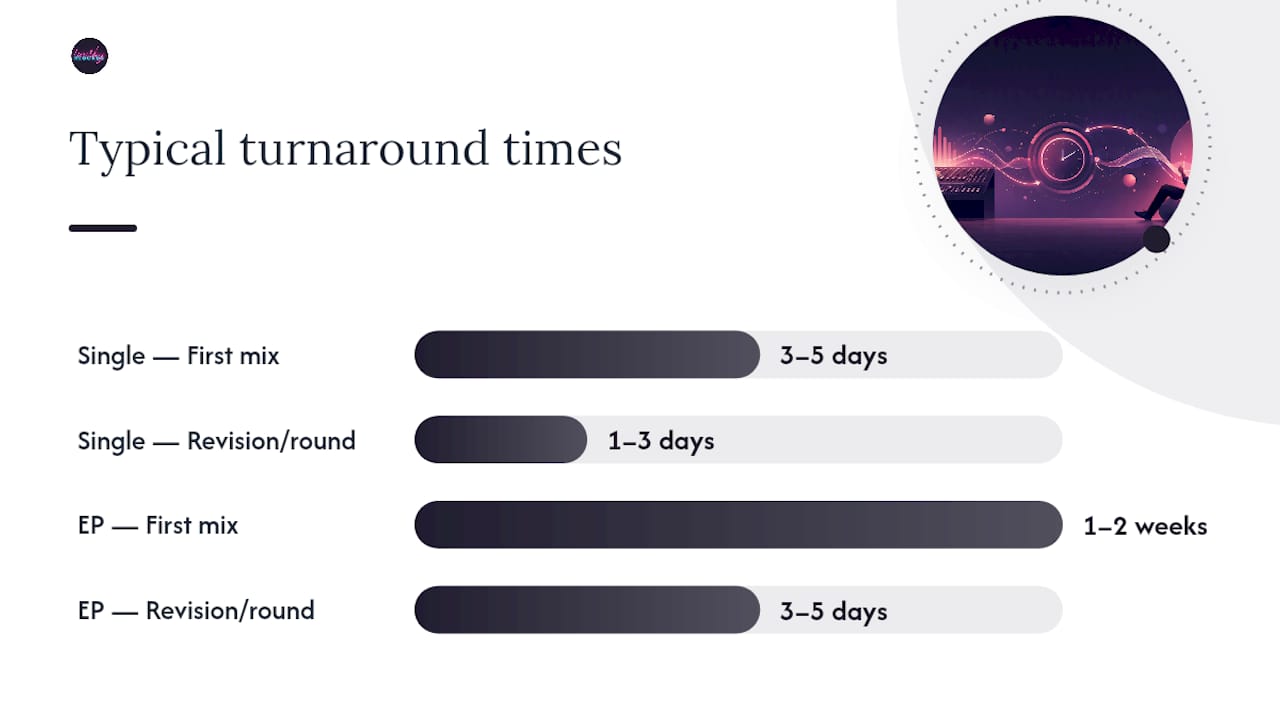
Most engineers, including the team at Twisbyrecords, build two to three rounds of revisions into a standard project rate. Changes beyond that scope, like re-recording a part or restructuring an arrangement, usually shift into hourly or add-on pricing. Get that number in writing before the first mix lands in your inbox.
How Do You Give Feedback That Speeds Up Revisions?
Vague notes are the number one reason revision cycles drag on. “Make it punchier” tells an engineer almost nothing. “At 1:42, the kick loses punch under the bass, can you carve some low-mid out of the bass there” tells them exactly what to fix.

A workable feedback template has four parts: timestamp, element, desired change, and reason. Something like: 1:42, kick and bass, want more kick punch, currently masked by bass low-mids. That structure, along with prioritizing the lead vocal first and centralizing notes through one point of contact, consistently cuts down on back-and-forth confusion.
When you sit down to write notes, work through them in this order:
- Show-stopping issues — distortion, missing parts, timing errors
- Balance — levels between vocals, drums, bass, and everything else
- Color and space — reverb depth, stereo width, tonal shaping
If more than one person in the band is weighing in, funnel every comment through a single point of contact before it reaches the engineer. Conflicting notes from three band members create more confusion than they resolve.
Pro Tip: Use a waveform-commenting tool or a shared doc with timecodes rather than a group text. Comments tied to an exact timestamp get fixed correctly on the first try far more often than a voice memo saying “the chorus feels off.”
What Should You Expect in Deliverables, Pricing, and Rights?
A finished mixing project should hand you more than a single stereo file. Standard deliverables include the final mix as a WAV or AIFF, high-resolution stems if you need them for future remixes or sync licensing, written mix notes, and a mix that’s ready for mastering (or already mastered, depending on the package).
Pricing generally follows one of three shapes:
- Flat per-track fee — most common for singles and EPs
- Hourly rate — typical for open-ended revision work or complex sessions
- Bundle pricing — mixing plus mastering, or mixing plus an advertising package, often at a lower combined rate
What moves the price up or down: track count, stem complexity, how many revisions you’ve agreed to, and turnaround speed. Rush jobs cost more almost everywhere.
Before you pay a deposit, get these in writing: number of included revisions, final file formats and sample rate, who owns the stems, whether you’re licensed to remix or resell the master, and any confidentiality terms if the release is embargoed.
Turnaround and revisions vary by engineer, but two to three included revision rounds per track is a common industry norm, with rush turnaround often carrying an added fee. Confirm these terms before the first file transfer, not after.
Once mixing wraps, most artists move straight into mastering, and understanding how mixing and mastering pricing works up front avoids surprise invoices later.
How Do You Choose the Right Mixing Engineer?
Genre fit matters more than most musicians expect. A phenomenal metal mixer might not know what to do with a folk vocal, and vice versa. Ask before you book:
- What genres make up most of your recent client work?
- How many revisions are included, and what happens beyond that?
- What’s your typical turnaround for a single versus an EP?
- Can I hear two or three sample mixes in my genre?
- Do you have client references or testimonials I can check?
Run any candidate through this checklist:
- Genre experience that matches your project, backed by actual sample mixes
- Communication style you can work with over weeks, not just one email
- Clear technical specs (sample rate, formats, delivery method) stated up front
- A written revision policy, not a vague “we’ll figure it out”
Watch for red flags: no defined revision policy, disorganized or unlabeled example sessions, or reluctance to share reference mixes. Trust signals worth weighing heavily include years in the field, certifications like Apple Digital Masters, a visible portfolio, and real client testimonials. A guide to choosing the right mixing engineer walks through more of these criteria in detail.
Why Twisbyrecords’ Experience and Certifications Matter
Over 35 years of engineering experience means fewer surprises in your mix, and Apple Digital Masters certification means your final files meet Apple Music’s technical standard for streaming quality. Twisbyrecords pairs that with sample mixes and portfolio work you can review before committing.
What that looks like in practice:
- Extensive combined engineering experience
- Apple Digital Masters certified delivery
- Documented revision policy and prompt turnaround
- Sample mixes and portfolio examples available for review
What Common Problems Come Up in Mixing Collaboration, and How Do You Avoid Them?
Most friction between artists and engineers comes down to unclear expectations, not talent. The fixes are almost always procedural.
Scope creep is the biggest one. A project quoted for two revisions turns into six because nobody defined “revision” clearly. Solve it before mixing starts: agree in writing whether swapping a vocal take counts as a revision or a new mix pass.
Conflicting feedback happens constantly on band projects, where the singer wants more reverb and the drummer wants less. This is exactly why professional courtesy and clear, prepared communication improve outcomes: assign one person to filter and submit notes, and don’t let the engineer referee internal band disagreements.
Mismatched expectations about “done.” Artists sometimes expect broadcast-level polish from a rough demo with timing issues the engineer can’t fully fix through mixing alone. Address performance and timing problems before the session, not during it, since mixing can’t rescue a take that was never in tune.
Slow feedback turnaround stalls projects as much as slow mixing does. If you sit on a mix for two weeks before responding, don’t be surprised when your revision slot gets pushed back too. Treat your feedback deadline with the same seriousness you’d want from the engineer’s delivery deadline.
Unclear file rights. Artists sometimes assume they own stems by default, or that a licensed sample clears automatically for remix use. Settle ownership and licensing questions in the same conversation where you agree on price, not after the invoice.
What Are the Best Tools for Communicating During a Mix Project?
The tool matters less than the discipline behind it, but some formats genuinely reduce friction. Mixing multiple methods, rather than relying on one channel for everything, tends to work best: email for formal, documented notes; a waveform-commenting platform for timestamped precision; and a quick voice memo when a reaction is hard to type out.
For file transfer, a shared cloud drive with a clear folder structure beats email attachments every time. Sessions with dozens of stems choke email servers and bury files in someone’s downloads folder within a week.
For feedback specifically, dedicated waveform-commenting tools that attach notes directly to a point on the timeline outperform group texts and scattered email threads, especially once more than one band member is weighing in. These platforms let every stakeholder see prior comments, which cuts down on duplicate or contradictory notes landing in the engineer’s inbox on the same day.
Video calls earn their place at exactly two points: the initial brief conversation, where tone and intent are hard to convey in text, and the final approval call, where hearing the mix together settles any last ambiguity. Everything in between works better as asynchronous, documented feedback. If you’re building general collaboration habits beyond mixing, resources on music coaching and creative partnership cover communication skills that carry over directly to studio relationships.
Whatever platform you land on, consistency matters more than sophistication. An engineer who knows exactly where to look for your notes every time will move faster than one juggling texts, emails, and voice memos for the same project.
What Actually Speeds Up a Good Mix?
The single habit that speeds up mixing more than anything else: a clear brief, honest reference tracks, and feedback you’ve prioritized before you send it. Everything else, the software, the studio, the gear, matters less than most musicians assume.
There’s a real tradeoff between speed and creative iteration, and it’s worth naming. If you want three rounds of exploratory changes on every track, budget for it, both in time and in cost. But once you’ve hired someone whose ear you trust, let their technical judgment carry weight on calls like stereo width or compression ratios. That’s what you’re paying for.
Get a Managed Mix With Clear Revisions and Fast Turnaround
If juggling file prep, feedback rounds, and revision math sounds like more overhead than you signed up for, that’s exactly the gap a managed engagement closes. Twisbyrecords handles mixing, revisions, and mastering under one roof, backed by Apple Digital Masters certification and a documented revision policy, so you’re not reverse-engineering scope from a vague quote.

You get a defined number of revisions up front, a realistic turnaround window before you commit, and a single point of contact instead of chasing separate vendors for mixing and mastering. If your release also needs an audience once it’s mixed, Twisbyrecords’ advertising services extend the same collaborative approach into Facebook and Instagram campaigns built around your release date. Start by reviewing the full services lineup and requesting a quote for your next track or EP.
Sources
These sources back the workflow and feedback practices covered above:
- The Role of Communication and Reference Songs in the Mixing Process: Insights from Professional Mix Engineers
- How to Give Effective Feedback on Music Mixes | Feedtracks Blog
- Team Effort: A Musician’s Guide To Getting The Most From Mix Engineers – ProSoundWeb
- How to Get the Most Out of Your Mix Engineer
FAQ
What files should I send a mixing engineer first?
Send labeled stems grouped by instrument, a rendered rough mix, and two or three reference tracks that match your intended sound.
How many revisions are normal for a mixed track?
Two to three included revision rounds per track is a common industry norm, with additional changes typically billed separately.
How do I write feedback an engineer can act on fast?
Use a timestamp, name the element, describe the change you want, and explain why, rather than general comments like “make it punchier.”
Does Twisbyrecords offer Apple Digital Masters certified mixes?
Yes, Twisbyrecords delivers Apple Digital Masters certified mixes alongside a documented revision policy and quick turnaround times.
What’s the difference between a rough mix and a final mix?
A rough mix is your working balance sent for reference and intent; the final mix is the engineer’s polished, release-ready version after revisions.