


An ISRC is a 12-character code that permanently identifies one specific recording, and it’s how streaming services, radio, and royalty collectors know a stream or sale belongs to you. For most one-off singles, the fastest route is letting your distributor assign one automatically. If you’re building a catalog, planning multiple versions of tracks, or working with a label, getting your own registrant prefix gives you far more control over the long run.
Before your next release, do two things:
- Check whether the track already has an ISRC from an earlier version or upload.
- Add an “ISRC” column to your release checklist right now, even if it’s blank for today’s session.
Pro Tip: Never assume your distributor’s ISRC is the only one that will ever exist for that track. If you re-record, remix, or re-release a “definitive” version later, that’s a new recording, and it needs a new code.
Key Takeaways
Accurate ISRC assignment and embedding directly determines whether your streams, sales, and royalties get correctly attributed to you.
| Point | Details |
|---|---|
| Match method to release plan | Use distributor-assigned codes for one-off singles; get a registrant prefix if you’re building a catalog. |
| Embed before delivery | Add the ISRC to the BWF chunk (WAV) or ID3 tag (MP3) before your mastering engineer finalizes the file. |
| Preserve codes during migration | Manually re-enter existing ISRCs when switching distributors to avoid splitting streaming history. |
| Never reuse a code for a new version | Remixes, edits, and remasters that meaningfully change the audio need a fresh ISRC. |
| Twisby Records verifies metadata during mastering | Twisby embeds and checks ISRCs as part of the mastering delivery, not as a separate step. |
Table of Contents
- What Is an ISRC Code and What Does It Look Like?
- Why ISRC Codes Matter for Independent Musicians
- How Is an ISRC Structured, and Where Do Systems Break?
- How to Get ISRC Codes: Distributor, Agency, or Manager
- What ISRC Codes Cost and How Long They Take
- How to Embed ISRCs in Your Files and Metadata
- Release-Day Checklist to Protect Your Royalties
- Common ISRC Mistakes and How to Fix Them
- How Twisby Records Supports Your Release Metadata
- Sources
- FAQ
What Is an ISRC Code and What Does It Look Like?
An ISRC (International Standard Recording Code) is the unique, permanent identifier assigned to a specific sound recording or music video. It doesn’t identify the song as a composition. It identifies the recording, the actual audio file that gets played, streamed, or sold. Write the same song in a studio version, a live version, and an acoustic version, and each one gets its own ISRC.
A typical code looks like this: US-S1Z-24-00001. The hyphens are just for readability. Systems store it without them: US S1Z 2400001.
Here’s how that string breaks down, according to the US ISRC Agency:
| Segment | Length | What it means |
|---|---|---|
| Prefix | 2 letters + 3 alphanumeric | Country code plus the registrant’s unique identifier |
| Year of reference | 2 digits | The year the code was assigned (not necessarily release year) |
| Designation code | 5 digits | A sequential number the registrant assigns, unique within that year |
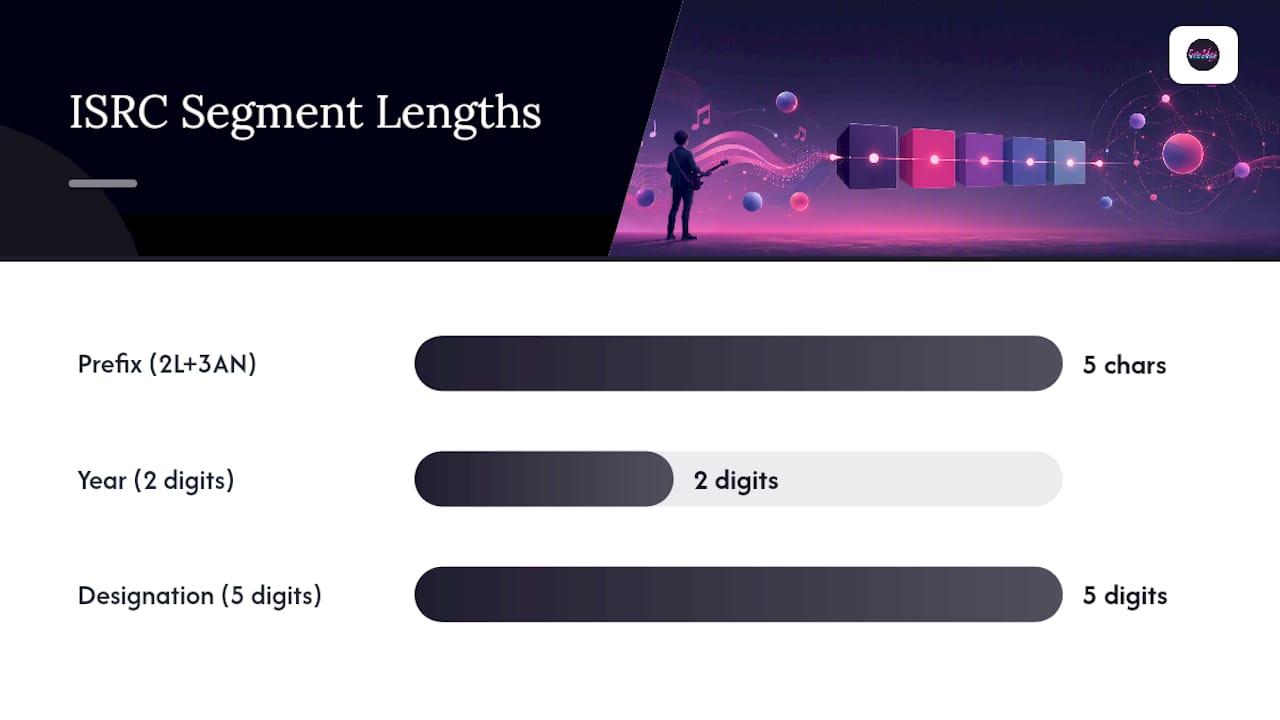
The registrant, whether that’s a distributor, an agency, or you, is responsible for making sure no two recordings share the same designation code in the same year.
Why ISRC Codes Matter for Independent Musicians
Every stream, download, and radio spin gets reported back through your ISRC. Get that code wrong, missing, or duplicated, and the money tied to those plays can vanish into someone else’s account or simply never get matched at all.
The practical benefits break down into four areas:
- Accurate royalty attribution. Performance rights organizations and neighboring-rights collectors match plays to you using the ISRC, not your artist name.
- Consolidated streaming history. One consistent code means your play counts don’t fragment across re-uploads or distributor switches.
- Easier licensing and sync reporting. Music supervisors and sync agencies reference the ISRC when clearing a track for film, TV, or ads.
- Chart and sales tracking. Services like Luminate and Billboard’s data partners rely on ISRC matching to count your sales and streams correctly.
The failure case shows up most often during a distributor migration. An artist moves from one distributor to another, the new upload generates a fresh ISRC instead of reusing the old one, and streaming history on the old code doesn’t merge with the new one. According to Hypebot’s guidance for independent musicians, registrant-prefix ownership gives you the control to prevent exactly that kind of split.
The fix is almost entirely within your control: assign the code before you deliver the track anywhere, write it down, and register it wherever a rights organization asks for it.
How Is an ISRC Structured, and Where Do Systems Break?
The three segments (prefix, year, designation) aren’t decorative. Each one does a specific job in how databases match your track to royalty reports, and each one is a place where a typo can quietly cost you money.
The prefix identifies who registered the code, either a country agency, a distributor, or your own registrant account if you hold a prefix. The year of reference marks when the code was assigned, which can differ from the actual release year if you assigned it early. The designation code is your sequential counter, and you (or your distributor) must never reuse one within the same calendar year.
Take an annotated example: US-ABC-24-00007. US is the country. ABC is the registrant’s unique three-character tag. 24 is the year of assignment. 00007 is the seventh recording that registrant logged that year.
Common breakage points include:
- Typing the ISRC into the UPC field (or vice versa) during distributor upload.
- Reusing a designation code from last year’s batch by copy-paste error.
- Letting a manager or label assign a code under their prefix when you actually own the master.
If you’re the rights owner, the ISRC should generally sit under your prefix, not your manager’s or your label’s, unless you’ve explicitly signed over that administrative role. Ownership of the code should track ownership of the recording.
How to Get ISRC Codes: Distributor, Agency, or Manager
You have three real paths to an ISRC, and each one trades off cost, control, and speed differently.
According to TuneCore’s guidance on ISRC codes, there are three primary routes to get a code, and many distributors assign one automatically the moment you upload. That’s the simplest path, and it costs nothing extra. But TuneCore also warns that the code itself should never require paying a third-party seller per ISRC. If a site is charging you $5 or $10 for “your own ISRC,” that’s not a legitimate registrant service.
If you’re going the distributor route, here’s what to check:
- Confirm the distributor’s upload form has a field for “existing ISRC” so you can supply your own if you already have one.
- Verify the assigned code appears in your distributor dashboard before the release goes live, not after.
- Save the code in your own records immediately. Don’t rely on the distributor’s dashboard as your only copy.
If you’re applying for a registrant prefix through IFPI’s prefix application or the US ISRC Agency, you’ll need to supply your business or artist name, confirm you’re the rights owner or an authorized representative, and commit to keeping an internal log so you never duplicate a designation code within a calendar year.
If you’re using an approved ISRC manager, IFPI’s own online assignment service lets you search the international database first to confirm a track doesn’t already have a code, then assign one using credits.
One migration rule matters more than any of the above: when you switch distributors, export your existing metadata and manually re-enter the same ISRCs into the new platform rather than letting it generate fresh ones. LANDR’s support documentation confirms most distributors let you input an existing code, and skipping that step is exactly how streaming history gets split in two.
What ISRC Codes Cost and How Long They Take
Distributor-assigned codes are typically free, bundled into whatever distribution plan you’re already paying for through services like DistroKid, TuneCore, or CD Baby. Assignment happens the moment you upload.
Getting your own registrant prefix involves a one-time application fee through your national agency, and approval usually takes a few business days rather than being instant.
Credit-based assignment tools sit in the middle. IFPI’s own online assignment service charges £15 plus UK VAT for a 30-credit bundle. Assigning a single ISRC costs 3 credits total (1 to look up whether a code already exists, 2 to complete the assignment). That works out to roughly 15 assignments per bundle.
Cost matters most if you’re releasing one single a year. Control matters most if you’re releasing five singles, three remixes, and an EP, and you don’t want to depend on any one distributor’s system to keep them straight.
How to Embed ISRCs in Your Files and Metadata
An ISRC only does its job if it travels with the actual audio file, not just sits in a spreadsheet. That means embedding it directly into the master before you deliver it anywhere.
For a WAV file, the code goes into the BWF (Broadcast Wave Format) chunk, a metadata container built into the file format specifically for this kind of identifier. For an MP3, it goes into the ID3 tag, alongside track title, artist, and album fields.
Here’s the practical sequence:
- Confirm your ISRC before final mastering, not after.
- Give your mastering engineer the code along with track title, version (radio edit, extended, acoustic), release year, and duration.
- Ask for a test export and check the metadata in a tag viewer or your DAW before you approve the final master.
- Re-enter the same code into your distributor’s upload form, matching exactly.
For physical releases, the ISRC belongs in the liner notes or on the disc itself. If you’re pressing CDs or vinyl through a service like Disc Makers, they’ll typically assign and embed the ISRC automatically as part of production, so ask early whether you want to supply your own instead of accepting theirs.
Release-Day Checklist to Protect Your Royalties
Run through this before you hit “publish,” not after streams start coming in.
- Confirm the ISRC is embedded in the final mastered file, not just listed in an email.
- Confirm the same ISRC appears in your distributor’s metadata fields.
- Confirm any rights registrations (PRO, neighboring-rights collector) list the identical code.
- Add the release to your master catalog spreadsheet.
For that spreadsheet, keep at minimum: track title, version, ISRC, distributor, release date, and rights owner. Six columns, one row per recording.
Once the release goes live, run these quick checks in your first reporting cycle:
- Log into your distributor dashboard and confirm the ISRC displayed matches your spreadsheet.
- Search the track title in any ISRC lookup tool to confirm it resolves to the code you expect.
- Flag any discrepancy immediately rather than waiting for a full quarter’s royalty statement.
Common ISRC Mistakes and How to Fix Them
The most expensive mistake independent artists make is treating a new version, remix, or master as if it can reuse the original recording’s ISRC. It can’t. A meaningfully different edit needs its own code.

Other recurring problems: accepting a distributor’s auto-generated code without checking if one already exists, typos that swap digits in the designation segment, and skipping a metadata audit after switching distributors. Guidance on catalog administration points to the same root cause behind most of these: ISRCs are easy to get, but keeping them consistent across every release, remaster, and platform migration is where artists lose track.
If you suspect a mismatch, export your full metadata from every distributor you’ve used, run each track through an ISRC search, and file corrections with your rights organization where records don’t match.
Pro Tip: Keep one master spreadsheet as your single source of truth. Every distributor dashboard is a copy; your spreadsheet is the original.
Why Twisby Records Treats ISRCs as Part of the Production Workflow
I’ve never understood why so many mixing and mastering shops treat metadata as an afterthought that gets bolted on after the creative work is done. At Twisby Records, ISRC embedding happens during mastering delivery, not after, because a track certified through Apple Digital Masters that leaves without its metadata intact is only half finished. Use the checklist above before your next delivery.
How Twisby Records Supports Your Release Metadata
Getting the ISRC itself is the easy part. Making sure it survives mastering, distribution, and every future re-release without a typo or a dropped field is where most independent artists lose track, literally.

Twisby Records builds ISRC verification into the mastering process itself, so the code you assign is the code that ships in your final WAV and MP3 files, not something added as an afterthought before upload. That’s the difference between a mastering house that treats metadata as your problem and one that treats it as part of the deliverable. Combined with Apple Digital Masters certification and advertising support that depends on clean streaming data to measure results, Twisby handles the technical side so your royalty tracking holds up from day one. If you’re preparing a release and want your metadata locked in before distribution, reach out to Twisby Records to start your project.
Sources
- Assign ISRC online — IFPI
- How it works — US ISRC Agency
- Get an ISRC prefix — IFPI
- How to Get ISRC Codes to Track Music Revenue — Hypebot
- All About ISRC Codes — TuneCore
FAQ
How Can I Get My Own ISRC Code?
Apply for a registrant prefix through your national ISRC agency if you want full ownership, or use a distributor like TuneCore or DistroKid, which assigns one automatically at upload for most releases.
Should I Get My Own ISRC Code?
If you release one single occasionally, a distributor-assigned code works fine. If you’re managing a growing catalog, multiple versions of tracks, or planning to switch distributors, a registrant prefix gives you far more control over your metadata long term.
Where Can I Get a Free ISRC Code?
Most distributors, including CD Baby, TuneCore, and DistroKid, assign ISRCs at no extra cost as part of their standard distribution service. Avoid third-party sites that charge a per-code fee for something distributors already include.
How Can I Promote My Music as an Independent Artist?
Accurate ISRC tracking is the foundation for measuring what’s working. Once your streaming and sales data is clean, tools like targeted Instagram and Facebook ad campaigns can use that data to find and grow your actual listener base.
Who Adds the ISRC to My Track?
Either your distributor assigns it automatically during upload, or your mastering engineer embeds a code you’ve already obtained into the final WAV or MP3 file before delivery.