

Yes, pre-saves are worth it when you treat them as the first step of a release plan and not as the plan itself. A pre-save gives you an early, countable signal of fan intent and puts your song in a fan’s library on release day. Spotify’s own figures show that a large share of pre-savers go on to stream in the first week. But a pre-save only works if the right people see the ask, and that is where targeted promotion and a clean landing page earn their keep.
Below, we cover what a pre-save does, what the numbers say, when it pays off, how to measure it, and how to make the next one count.
TL;DR
- A pre-save authorizes a platform to add your release to a fan’s library the moment it goes live. It is a promise to listen, not a stream.
- Spotify reports that on average nearly 60% of people who pre-save an album stream it in the first week.
- Completion is the weak point: many fans click but never finish the steps. Incentives, a short path and warm traffic fix most of that.
- Judge a campaign by cost per completed pre-save, conversion rate and how first-week saves compare with pre-saves, not by the raw count alone.
- Pre-saves are worth the most when they sit inside a release plan with a landing page, an audience and paid reach behind them.
Table of Contents
- What a pre-save actually does
- What the numbers say
- Why some campaigns flop
- When a pre-save is worth the effort
- How to tell whether yours worked
- A worked example
- Building the pre-save into a release plan
- Our view on pre-saves
- How Twisby Records can help
- FAQ
- Sources
What a pre-save actually does
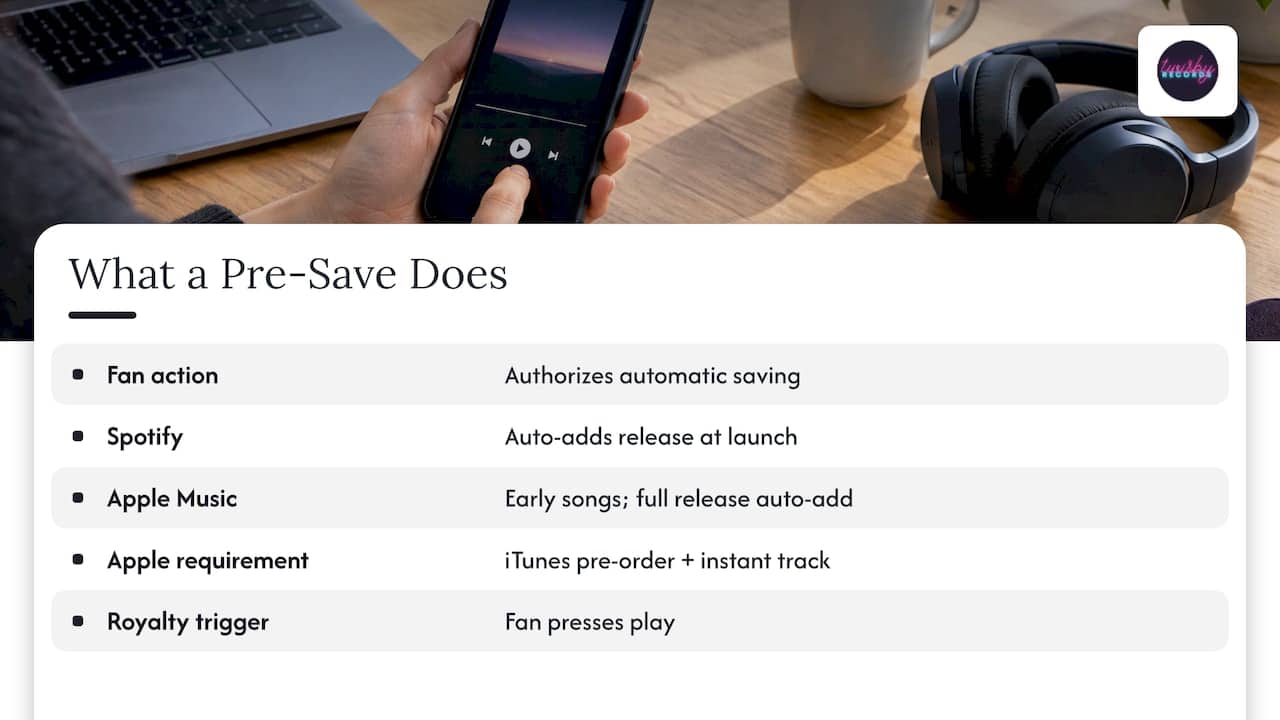
A pre-save is the streaming version of a pre-order. Fans click your link before release day and authorize the platform to save the music to their library automatically when it goes live. According to a distributor’s help center, pre-savers get the music added to their library or Liked Songs, a notification that it is out, and instant access without searching.
The tools differ by platform. CD Baby’s US help center explains that a Spotify pre-save auto-adds the release at launch, while an Apple Music pre-add can let listeners hear one or more songs early and then auto-adds the full release. Apple’s version requires an iTunes pre-order with one instant-gratification track.
What it does not do is create a listen. No royalty is generated until the fan presses play. That is why the smart question is not “how many pre-saves did I get?” but “how many of those people showed up on release day?”
What the numbers say
The best evidence comes from the platforms themselves.
- Week-one streaming. Spotify’s support page says nearly 60% of people who pre-save an album stream it in the first week. Spotify told Music Ally the figure was nearly 70% when it launched Countdown Pages. Either way, it is a strong conversion rate for any marketing action.
- Super listeners. Spotify for Artists says nearly 1 in 7 listeners who pre-save become super listeners by the end of release week. A super listener is a fan who streams your music far more often than average, and these are the people who drive long-term growth.
- Early publishing helps. The same page reports that artists who publish a Countdown Page at least 7 days before release see nearly twice as many pre-saves as those who publish later.
- Where the link lives matters. Secretly Group told Music Ally that Spotify’s native Countdown Pages produced 6 to 30 times more pre-saves than off-platform buy links.
For scale, Rolling Stone reported in 2022 that managers consider 100,000 or more pre-saves exceptional and 50,000 or more a smash. Most independent artists will never see those numbers, and they do not need to. Compare your pre-saves with your own reachable audience instead of with other artists.
Why some campaigns flop
Pre-saving takes effort. A fan has to click, land on a new page, grant permissions and commit to a song they have not heard. One industry guide cites a campaign manager who saw 75% of landing-page clicks produce only 20% completed pre-saves, and puts typical click-to-pre-save completion at 15% to 25%.
A recent trade report from August 2026 describes the same friction: third-party landing pages push completion down, and some artists are moving toward direct fan engagement. The lesson is not to skip pre-saves. It is to make the ask easy, give people a reason to finish and send it to people who already care.
Three fixes that work:
- Offer something in return. Think an exclusive acoustic version, a signed-vinyl drawing or early access to tour tickets. The guide above recommends exactly these kinds of incentives.
- Cut steps. One tap to the pre-save, no account creation, a page that loads fast on a phone.
- Ask warm people first. Your email list, your followers and fans who have already engaged with a snippet convert far better than cold traffic.
When a pre-save is worth the effort
A pre-save campaign pays off most when:
- You have a release date locked. Distribution needs lead time, so submit early. Our post on how long Spotify takes to approve a song shows how to plan the timeline.
- You have an audience to ask. Even a few hundred engaged followers and subscribers can produce a useful first-day number.
- You are releasing an album or EP and qualify for Countdown Pages. Spotify’s US support page says Countdown Pages need at least 3,000 monthly active listeners and cover only new original albums and EPs, not singles, reissues, deluxe editions, remasters or compilations.
- You plan to push the release anyway. Pre-saves give your ads, posts and emails one clear action to point to.
If you are releasing a single and are under the Countdown Pages threshold, a pre-save link from your distributor or a link tool still collects the same intent signal. For singles, you can also pair a short pre-save window with a strong release-day push. Our Spotify pre-save campaign guide walks through the setup.
How to tell whether yours worked
Set the benchmarks before the campaign starts, so the results mean something.
| Metric | What to look at | Reference point |
|---|---|---|
| Landing-page click-through | Visitors who click to a streaming service | 40% to 75% per AndR’s guide |
| Click-to-pre-save completion | Clicks that finish the authorization | 15% to 25% per the same guide |
| Conversion overall | Pre-saves divided by page visitors | Above 20% is strong, below 10% needs work, per Orphiq |
| Cost per completed pre-save (paid) | Ad spend divided by completed pre-saves | $1.00 to $2.00 is the target in the AndR guide |
| Release-week saves vs pre-saves | Spotify for Artists data after launch | If saves clearly exceed pre-saves, you reached new listeners (Orphiq) |
These benchmarks come from industry guides, so use them as starting points and build your own baseline from your previous releases. Track pre-saves against your last release, then watch your save rate. Our guides on the Spotify save rate and Spotify for Artists analytics show how to read those numbers.
One more check: divide your pre-saves by your reachable audience (followers plus email subscribers). A high ratio means a warm audience you can push harder. A low ratio usually means the ask was unclear, not that the song is weak.
A worked example
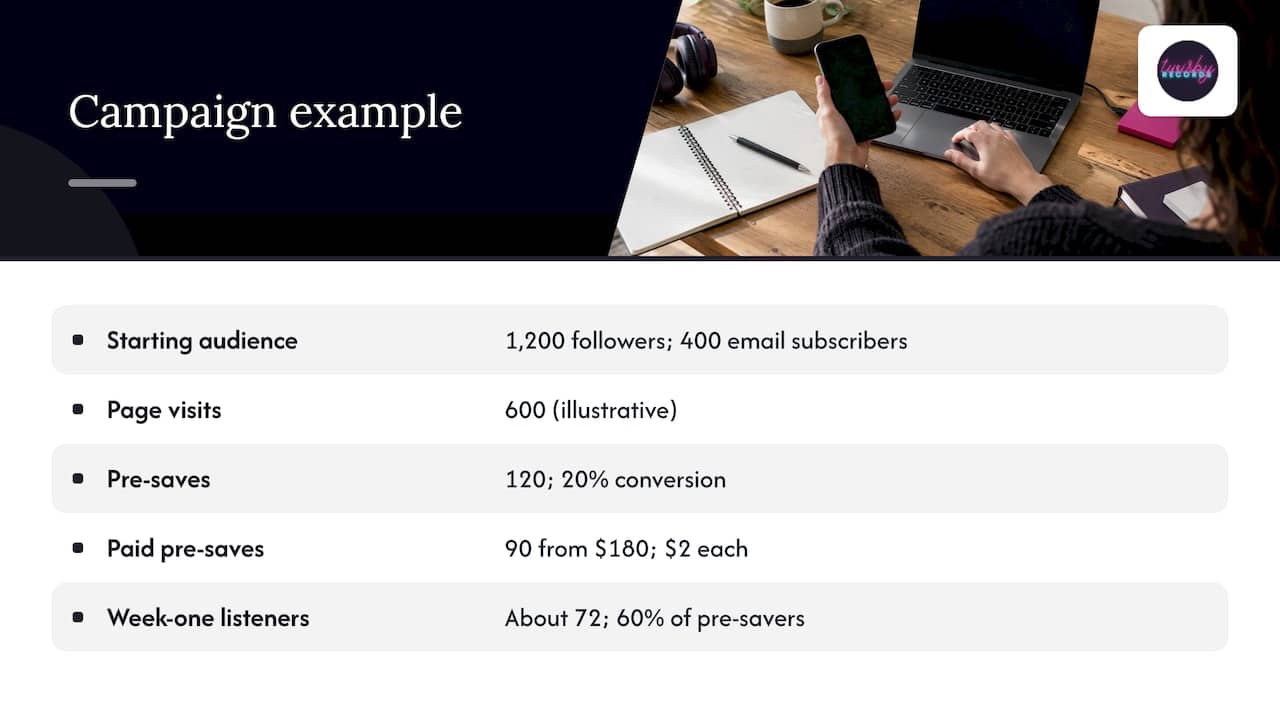
Say you have 1,200 followers and 400 email subscribers, and you plan an EP release. You publish your pre-save page about two weeks out, give subscribers an exclusive acoustic version for finishing the pre-save, and run a small paid campaign to people similar to your best listeners.
Suppose 600 people reach the page and 120 complete the pre-save, which is a 20% conversion. If the paid portion cost $180 and produced 90 of those pre-saves, that is $2.00 each, at the top of the target range. Based on Spotify’s figures, roughly 60% of those 120 pre-savers would be expected to stream in week one, which is about 72 people. Those listeners are the ones who give your release its first-week momentum, and in your Spotify for Artists data you can see how many came from that campaign. The figures are illustrative, not a promise of results.
Building the pre-save into a release plan
The pre-save is a single step in a sequence. A simple timeline looks like this:
- Six to eight weeks out: Finish the mix and master, lock the date and submit to your distributor.
- Four weeks out: Build a landing page with the pre-save link and an email sign-up.
- Three to two weeks out: Publish the pre-save page. Remember the 7-day mark for Countdown Pages if you qualify.
- Two weeks out to release: Post snippets, send emails and run targeted ads to the page.
- Release week: Notify your list, watch saves and streams daily and keep your ads running to new listeners.
Our music release strategy guide goes deeper on the whole timeline. For paid reach, the 1% lookalike audience approach helps you find people similar to your super listeners with small tests of $20 to $50.
The release also has to sound ready. Fans who finish a pre-save are trusting you with their library, and the first play is where the mix and master either hold them or lose them. That is why we treat mixing and mastering as part of the same plan as the campaign.
Our view on pre-saves
Most artists ask us whether pre-saves are worth it as if it were a yes or no question. We think the better question is what the pre-save is attached to.
A pre-save by itself is a link. A pre-save with a clear audience, a landing page that loads fast, a reason to finish and ads that find the right listeners is a release-day launch. At Twisby Records we have over 35 years of experience and Apple Digital Masters certification, and we handle mixing, mastering and advertising for independent artists. Putting those together is what we are built for.
Our advertising service covers audience research, custom landing pages, targeted Facebook and Instagram campaigns, reporting and optimization. That means the pre-save page, the ad and the audience are designed together, and the numbers come back to you in plain terms. Our approach is personal: experienced engineers, real analog gear, creative collaboration and fast turnaround, not an off-the-shelf template.
If you take one thing away, let it be this: start early, make the ask easy and make sure the song is ready for the people who show up.
Kreg
How Twisby Records can help
If you want the song and the campaign handled by one team, start with the song. Mastering is $50 one-off, and mixing is quoted per project. For the release itself, our advertising packages include a one-time onboarding fee of $99. The Standard package is $25 per month plus a 20% adspend fee.

If you are planning a release and want to see where a pre-save fits, you can start from the Twisby Records home page.
FAQ
Are pre-saves worth it for small artists?
Yes, if you already have people to ask. Even a few hundred engaged followers can produce a meaningful day-one signal, and Spotify reports that nearly 60% of album pre-savers stream within the first week. Start with your email list and most engaged followers, then add targeted ads.
Do pre-saves help the Spotify algorithm?
They help by concentrating listener activity around release day, which gives you a clear early window of saves and streams to work with. A distributor’s help center says releases with 500 or more day-one pre-saves are more likely to be considered for Discover Weekly, Release Radar and editorial playlists. No platform guarantees placement, so pair pre-saves with strong release-week listening.
How far ahead should I start a pre-save?
For an album or EP on Spotify, publish your Countdown Page at least 7 days before release, since Spotify reports nearly double the pre-saves for earlier pages. Many artists run two to three weeks to give emails, posts and ads time to work. Your distributor’s lead time sets the earliest date you can submit.
What is a good cost per pre-save?
One industry guide targets $1.00 to $2.00 per completed pre-save for paid campaigns. Your own number depends on your audience and offer, so track it against your previous release and improve from there.
Sources
- Spotify Support: Getting started with Countdown Pages
- Spotify for Artists: Countdown Pages
- Music Ally: Spotify rolls out Countdown Pages
- Rolling Stone: Is the Next Big Hit 15 Seconds Long?
- CD Baby: Understanding Pre-Saves, Pre-Adds, and Pre-Orders
- InterSpace Distribution: What Is a Pre-Save Campaign
- SoundStock: Pre-Save Campaigns Lose Momentum
- AndR: Pre-Save Campaigns That Convert
- Orphiq: How to Set Up a Spotify Pre-Save Campaign