

Most independent artists should target their active audience first: the listeners who intentionally streamed their music in the last 28 days. Once that’s dialed in, layer on one high-value segment based on your goal, whether that’s super listeners for merch revenue or local fans for a show.
Do these three things in the next 72 hours:
- Write a one-line positioning statement (who your music is for and how it makes them feel).
- Pull your numbers from Spotify for Artists and your social analytics.
- Build one test segment and one short-form video to see if it lands.
Pro Tip: Open Spotify for Artists before you do anything else. The “audience” tab tells you more about who already loves your music than any guess you could make about who should.
Your toolkit for the next 90 days: Spotify for Artists (and Spotify Ads), TikTok, Meta, YouTube, Bandcamp, and an email platform like Mailchimp or ConvertKit.
Key Takeaways
Prioritizing your active audience and one high-value segment, then validating with small paid tests, converts more listeners into fans than broad demographic targeting ever will.
| Point | Details |
|---|---|
| Start with active listeners | Target the 28-day active audience first; they drive the majority of streams and merch revenue. |
| Segment by real behavior | Use super/moderate/light tiers and purchase data instead of guessing demographics. |
| Sequence your channels | Validate on short-form video, boost proven posts, then retarget to email and streaming links. |
| Test small, scale fast | Seed creative at $5 to $15 per day, then scale winners 3 to 5 times once conversions prove out. |
| Get managed support | Twisbyrecords offers audience research, ad setup, and landing pages for artists who want expert help. |
Table of Contents
- What Is Music Audience Targeting, Exactly?
- Where Do You Find Music Listener Data?
- How Do You Segment Your Music Listeners?
- How Do You Build Listener Personas That Actually Help?
- Which Platforms Should You Use for Each Goal?
- How Much Should You Budget and Test?
- How Do You Turn Listeners Into Paying Fans?
- What Should Your First 90 Days Look Like?
- What Do Spotify’s Numbers Actually Tell You?
- How Collaborations and Playlists Multiply Your Reach
- Connecting Your Live Shows to Your Digital Targeting
- Get Managed Help Targeting Your Music Audience
- Sources
- FAQ
What Is Music Audience Targeting, Exactly?
Music audience targeting means using real listener data (not assumptions about your “target audience”) to decide who sees your ads, your posts, and your release campaigns. It’s the difference between hoping the algorithm figures it out and actually telling it who to prioritize.
Before you touch a single ad platform, get specific about your identity and your goal. Write a one-line positioning statement using this frame: “I make [genre/style] for [audience] who want to feel [emotion/experience].” A bedroom pop artist might write: “I make dreamy bedroom pop for late-night scrollers who want to feel understood.” That sentence becomes your filter for every creative decision downstream.
Next, match your campaign goal to an audience type. If you’re chasing audience growth, you want programmed and potential listeners, people who fit your sound but haven’t found you yet. If you’re building engagement, focus on your active audience. If you’re running reactivation, target people who used to listen but have gone quiet.
Before spending a dollar, validate your identity against real proof points:
- Top cities where your streams originate
- Your best-performing tracks by save rate, not just play count
- Typical listening contexts (workout playlists vs. late-night chill vs. study sessions)
- Anyone who’s already bought merch or a ticket
Pro Tip: If your positioning statement doesn’t match your top cities and listening contexts, trust the data over your assumptions. Fans tell you who they are through behavior, not through what genre tag you picked.
Where Do You Find Music Listener Data?
You don’t need expensive software to do this research. You need to know exactly where to look and what to export.
Start with these primary sources, in order of priority:
- Spotify for Artists: top cities, listener demographics, source-of-streams, playlist adds
- YouTube Studio: watch time, audience retention, traffic sources
- TikTok and Instagram analytics: follower demographics, video completion rate, profile visits
- Bandcamp or Shopify: who’s actually paying for your music or merchandise
- Email or CRM platform: open rates, click-through rates, list growth
Pull these specific metrics into one place: monthly listeners, 28-day active listeners, saves, completion rate, top cities, referral sources, merch buyers, and email open rates. A simple spreadsheet works fine at this stage. Column A is the metric, Column B is the platform, Column C is the current number.
| Metric | Where to Find It | Why It Matters |
|---|---|---|
| 28-day active listeners | Spotify for Artists | Shows who’s engaging right now |
| Completion rate | Spotify/YouTube | Signals content that holds attention |
| Merch buyer list | Bandcamp/Shopify | Highest-value conversion segment |
| Email open rate | Mailchimp/ConvertKit | Health of your owned channel |
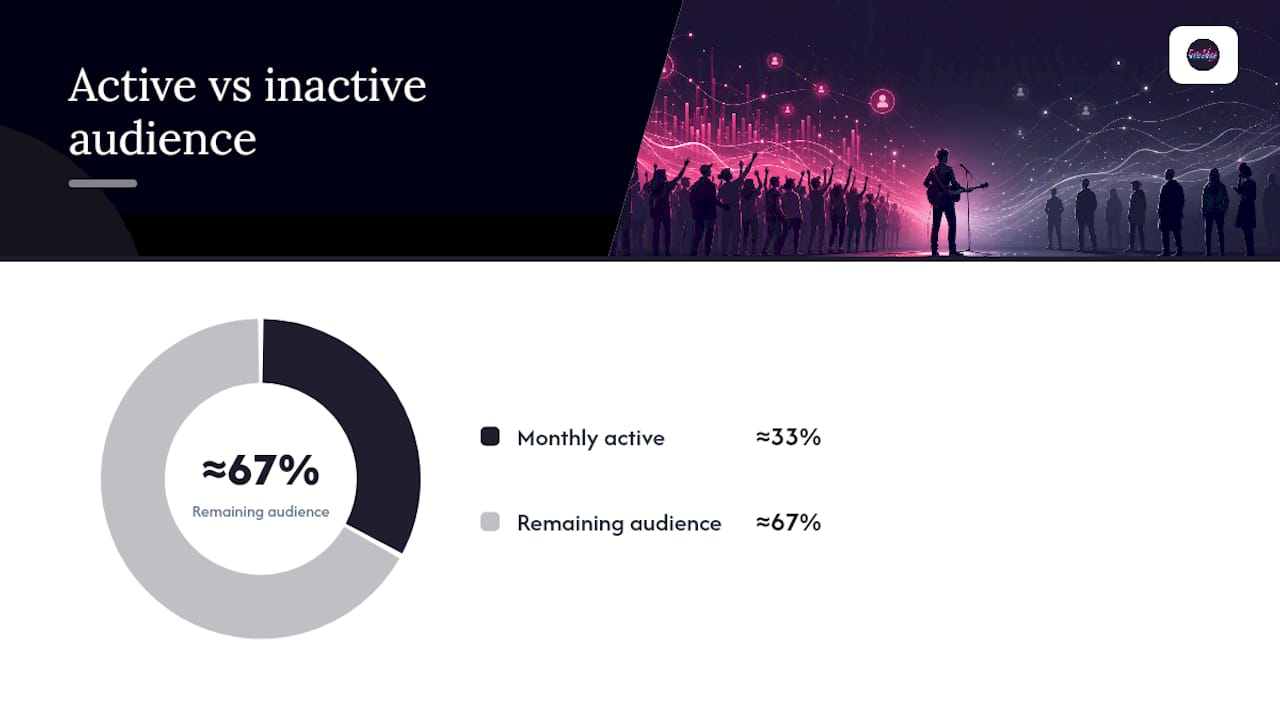
According to Spotify for Artists, monthly active listeners make up about a third of an artist’s total audience but drive the majority of streams and merchandise purchases. That one-third of your audience deserves a disproportionate share of your attention.
How Do You Segment Your Music Listeners?
Segmentation only works when you can act on it. Skip the academic labels and use definitions you can plug straight into an ad platform.
Spotify itself defines three tiers by recent activity: super listeners (15 or more streams in 28 days), moderate listeners (3 to 14 streams), and light listeners (1 to 2 streams), according to Spotify’s own campaign guidance. Layer that against Spotify’s broader categories: active audiences (recently and consistently engaged), programmed audiences (algorithmically served your music but haven’t fully converted), and potential audiences (fit your genre and behavior profile but haven’t heard you yet).
For monetization, a few cross-platform segments matter more than genre or age:
- Merch buyers and pre-savers who didn’t buy
- Email subscribers who haven’t streamed your latest release
- Local fans within driving distance of your next show
- High-save, high-completion listeners who haven’t followed you yet
Fan segmentation research from Sonikit confirms that combining purchase data, streaming behavior, location, and signup source produces audiences you can actually target, not just describe.
Turn each definition into a platform audience: upload super listeners as a Meta Custom Audience, build a Spotify Ads segment around active listeners, and create a TikTok lookalike group from your engaged followers.
Pro Tip: Purchases and pre-saves beat follows every time as a value signal. A fan who bought a shirt is worth ten who tapped “follow” and never came back.
How Do You Build Listener Personas That Actually Help?
A persona only earns its place if it changes your messaging. Keep the template tight: name, core behavior, highest-value action, favorite channels, tone, and one clear call to action.
Three personas cover most independent catalogs:
- Local Giggoer: buys tickets and merch, discovered you through a friend or local show, responds to “see you Friday” messaging.
- Super Streamer: streams your catalog repeatedly, adds tracks to personal playlists, responds to “new song is live, add it now.”
- Discovery Scroller: found you on TikTok, hasn’t streamed on Spotify yet, responds to a short clip with a direct “listen now” link.
Each persona needs a different ask. Don’t email your Local Giggoer about a playlist add. Don’t retarget your Super Streamer with a “discover new music” ad; they already know you. Match the CTA (presave, stream, email signup, merch purchase) to what that persona hasn’t done yet.
Pro Tip: Write each persona’s messaging in their voice, not yours. If your Discovery Scroller lives on TikTok, your copy should sound like a caption, not a press release.
Which Platforms Should You Use for Each Goal?
Every platform plays a different role in your funnel, and treating them interchangeably wastes budget.
- Spotify works best for retention and re-engagement, since you’re talking to people already inside the ecosystem.
- TikTok and Instagram Reels are your discovery engines, built for cold audiences who’ve never heard your name.
- Meta (Facebook and Instagram) converts warm attention into owned assets: email signups, presaves, landing page visits.
- YouTube builds deeper fandom through longer content: behind-the-scenes, live sessions, lyric videos.
- Bandcamp is your direct revenue channel, no platform cut standing between a fan and your bank account.
Specific targeting levers to use on each platform:
- Spotify Ads: demographic filters, behavioral targeting, and audience goals tied to active, programmed, or potential listeners
- TikTok: Spark Ads on top of organic posts that already prove traction, plus creator amplification deals
- Meta: lookalike audiences built from your Custom Audience uploads, layered with interest targeting
- YouTube: affinity and in-market audience targeting based on topics your fans already watch
- Bandcamp: fan-first offers like early access or limited vinyl runs promoted to your email list
Spotify’s own audience targeting documentation notes that editorial playlist slots are scarce, so independents get more traction triggering algorithmic playlists through strong save and completion rates in the first 24 to 48 hours after release.
The sequence that works best: validate a hook organically on short-form video, boost the post that already performs, retarget viewers to an email or presave landing page, then retarget converters back to your streaming links.
Pro Tip: Never boost a post that hasn’t proven itself organically first. Paid spend amplifies what’s already working; it rarely rescues something that isn’t.
How Much Should You Budget and Test?
Map your budget to your goal before you map it to a platform. Audience growth campaigns need programmed and potential audiences. Engagement campaigns need your active and super listener segments. Reactivation campaigns need lists of people who used to stream you but stopped.
A workable budget split for most independent artists:
- Seed creative tests at $5 to $15 per day, per creative, for 7 to 14 days.
- Scale any winner 3 to 5 times its original daily spend once it proves conversions.
- Allocate roughly 60% to organic amplification, 30% to paid spend, and 10% to ongoing test-and-learn budget.
Run a 7 to 14 day creative test first, then a 14 to 28 day audience test once you know which creative works. Scale only after you see proven conversions: email signups, presaves, or a save rate that beats your channel average.
Academic modeling of listening demand supports this cadence: listener affinity shifts across segments and platforms over time, so budgets perform best when reallocated on a regular schedule rather than set once and left alone.
Pro Tip: Check your test results weekly, not monthly. A dead creative burns budget fast at even $10 a day.
How Do You Turn Listeners Into Paying Fans?
The funnel runs discover, convert, re-engage, monetize. Discovery happens on TikTok or Reels. Conversion happens when someone joins your email list, presaves a release, or buys something. Re-engagement happens through email and retargeting ads. Monetization happens through tickets, merch, or a Patreon-style membership.
Specific tactics that move people down that funnel: a smart link landing page instead of a plain bio link, a lead magnet like an unreleased demo in exchange for an email address, presave campaigns tied to a release date, merch bundles offered only to early buyers, and exclusive content reserved for email subscribers.
For retargeting, build a simple email sequence: welcome message, behind-the-scenes story, then a direct ask. Use paid ads to retarget people who watched most of a video but never clicked through, since routing traffic through a tracking-enabled landing page gives you conversion data that makes every future ad smarter.
What Should Your First 90 Days Look Like?
Copy this into your calendar or project manager:
- Pre-release: finalize positioning, pull baseline data, build your first three custom audiences.
- Release week: publish daily short-form content, launch presave ads, send your email announcement.
- Post-release: retarget engaged non-converters, boost the top-performing post, send a follow-up email sequence.
Track a different KPI at each milestone. Week 4: check save rate and completion rate to decide what to amplify. Week 8: check email signups and presave conversions to decide what to scale. Week 12: check merch sales and repeat-listener counts to decide what earned a bigger budget next cycle.
A steady release cadence, roughly one track every 5 to 7 weeks, keeps you inside repeated Release Radar windows instead of relying on one big annual moment.
What Do Spotify’s Numbers Actually Tell You?
The clearest signal in the data: a small slice of your audience drives most of your revenue. Active listeners are about a third of total reach but account for the majority of both streams and merch purchases, according to Spotify for Artists. That means your ad budget and your email energy belong with that third first, not spread evenly across everyone who’s ever clicked play.
| Segment | Share of Audience | Behavior |
|---|---|---|
| Active/monthly listeners | 33% | Drive ~60% of streams |
| Same active segment | 33% | Drive a majority of merch revenue |
| Listener Tier | Definition | Best Use |
|---|---|---|
| Super | 15+ streams / 28 days | Merch offers, deep engagement |
| Moderate | 3 to 14 streams / 28 days | Playlist push, saves |
| Light | 1 to 2 streams / 28 days | Discovery retargeting |
Segmentation research treats listening demand as something that shifts over time and across platforms, which means your job isn’t a one-time setup. It’s a weekly check-in.
Pro Tip: Route every ad dollar through a landing page that captures an email or a presave, not straight to a streaming link. You lose the ability to measure and retarget the moment traffic bypasses a page you control.
How Collaborations and Playlists Multiply Your Reach
Every collaboration is really an audience trade. When you feature on another artist’s track or land a spot on a curated playlist, you’re borrowing trust that took someone else years to build, and that only works if the fit is genuine.
Start with artists who share your sound but not your exact audience. A folk artist teaming up with an indie-pop songwriter reaches two adjacent fan bases instead of splitting one. Before reaching out, check the other artist’s top cities and listening contexts on Spotify for Artists. If your fan bases overlap in taste but not in geography, that’s often the strongest collaboration.
Playlist strategy works the same way. Editorial slots are competitive and limited, but algorithmic playlists respond directly to save rate and completion rate in a release’s first 24 to 48 hours, which is why a strong opening week matters more than a polished pitch email. User-curated playlists, the ones run by independent curators rather than Spotify staff, are often more accessible and can seed the early engagement that triggers algorithmic placement.
Influencer partnerships on TikTok work best when you give up creative control. A creator whose audience already trusts their taste will outperform a scripted ad every time, because their followers can tell the difference. Send them the track early, tell them what feeling you’re going for, and let them build the hook. Track whether their post drives Shazams, saves, or profile visits, not just views, since views alone don’t tell you if the audience converted into listeners.
Connecting Your Live Shows to Your Digital Targeting
A show is a data collection event as much as a performance. Every ticket sale, every merch table transaction, and every person who scans a QR code for your email list becomes a segment you can retarget for months afterward, so don’t let that information disappear into a spreadsheet nobody opens again.

Before a show, upload your local city data from Spotify for Artists into a Meta Custom Audience and run a simple “we’re playing near you” ad in the two weeks leading up to the date. After the show, capture emails at the merch table with a tablet or a QR code tied directly to your email platform, not a paper sign-up sheet that sits in a drawer.
Once you’re home, treat that new local list as a distinct segment. These are people who spent money and showed up in person, which makes them your highest-intent audience for the next release. Send them a personal thank-you email within 48 hours, then fold them into your Local Giggoer persona for future tour announcements.
The reverse works too: use online engagement to plan offline moves. If your Spotify for Artists city data shows a cluster of active listeners in a city you’ve never played, that’s a data-backed case for booking a show there instead of guessing based on where your friends live.
What Usually Moves the Needle for Independent Artists
Own your email list, post short-form video consistently, and only put money behind content that already proves itself organically. Measurement and repetition beat chasing whatever tactic trends this month.
Get Managed Help Targeting Your Music Audience
Twisbyrecords gives you the audience research, ad setup, and reporting most independent artists don’t have the time to build alone, without locking you into a long-term contract or a one-size-fits-all package. Instead of guessing which Spotify segment or Meta audience to test, you get a custom landing page and a campaign built around the listeners already showing traction with your music.
Success looks like a campaign that turns cold scrollers into email subscribers and existing fans into repeat merch buyers, tracked with real reporting instead of vanity metrics. If you’d rather hand off the targeting and testing while you focus on writing and performing, check out Twisbyrecords’ advertising services and see what a managed campaign could look like for your next release.
Sources
- Introducing new audience segmentation on Spotify for Artists
- Audience goals for display campaigns — Spotify for Artists
- Segmentation & optimization models for listening demand (arXiv)
- How To Build An Effective Music Marketing Strategy In 2026: Step-By-Step Plan, Tools, And Mistakes To Avoid – Magnetic Magazine
- How To Segment Music Fans by Purchases and Streaming Behavior | Sonikit Blog
FAQ
How Do You Find Your Target Audience for Music?
Pull data from Spotify for Artists, social analytics, and sales platforms to see who’s already engaging, then build segments around active listeners, super streamers, and buyers rather than guessing based on genre or age.
What Are the 4 P’s of Music Marketing?
The traditional 4 P’s, product, price, place, and promotion, translate to your music itself, how you monetize it (streams, merch, tickets), where fans find you (Spotify, TikTok, live shows), and how you reach them (ads, email, social content).
What’s the Difference Between Active and Programmed Spotify Audiences?
Active audiences are listeners who’ve recently and consistently streamed your music, while programmed audiences have been algorithmically served your tracks but haven’t fully converted into regular listeners yet.
How Much Should an Independent Artist Budget for Ads?
Start with $5 to $15 per day per creative for a 7 to 14 day test, then scale proven winners 3 to 5 times that amount once you see real conversions like email signups or presaves.
Can Twisbyrecords Help With Audience Targeting?
Yes. Twisbyrecords’ advertising services include audience research, ad campaign setup, custom landing pages, and reporting for independent artists who want expert-managed targeting.