

TL;DR:
- For music campaigns in 2026, a 70% budget should go to YouTube and 30% to Meta for maximum impact.
- Most successful campaigns test multiple creatives and focus on measuring incremental lift rather than vanity metrics.
For most independent musicians running a release-driven campaign, the recommended allocation for 2026 is 70% YouTube and 30% Meta — backed by agency and consulting recommendations for advertisers targeting both intent and discovery. Here’s the short version:
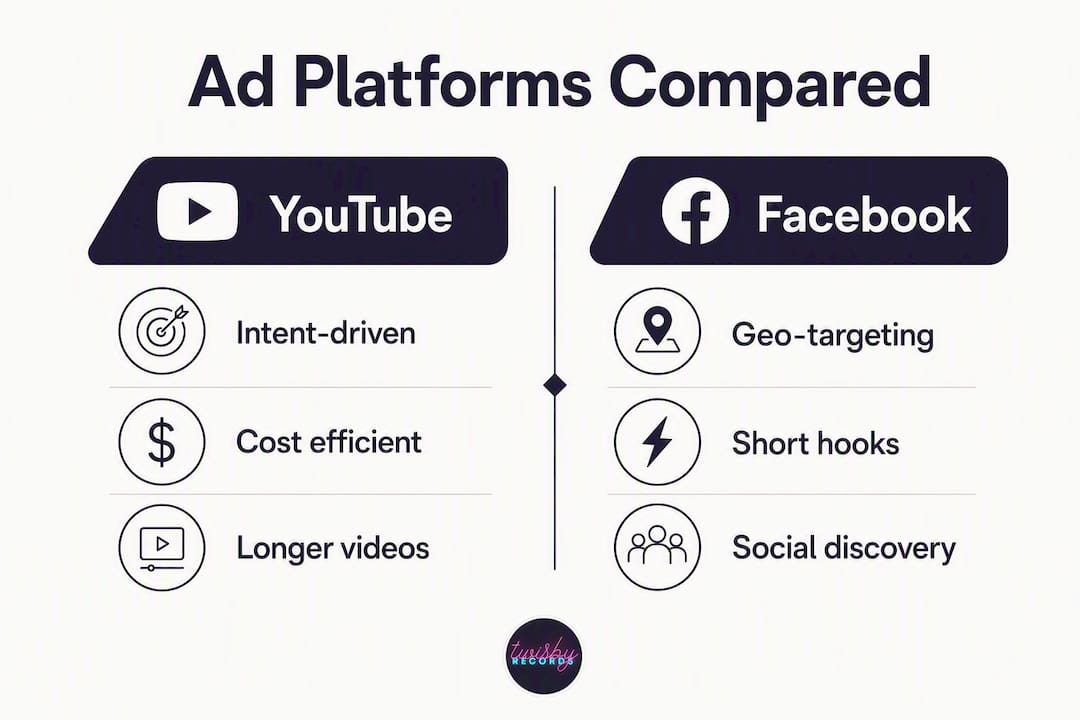
- YouTube Ads build trust through intent-driven placements. Listeners are actively researching music and production, so longer-form demos land harder there.
- Meta (Facebook & Instagram) Ads win on discovery, impulse engagement, and rapid retargeting via Reels and Stories.
- Twisby Records manages both sides for you, including creative production, landing-page builds, and Conversions API setup, so you’re not flying blind on measurement.
- Skip vanity metrics. The KPIs that matter are incremental lift and cost per booked customer (or fan acquisition), not raw click-through rates.
Table of Contents
- How do YouTube ads vs Facebook ads compare for music promotion?
- Which platform should you use for each campaign goal?
- How do you run a 60-day campaign test that actually proves results?
- Key Takeaways
- Why musicians almost always under-invest in measurement
- Twisby Records handles the campaign so you can focus on the music
- Useful sources
- FAQ
How do YouTube ads vs Facebook ads compare for music promotion?
| Twisby Records | YouTube Ads | Meta (Facebook & Instagram) Ads | |
|---|---|---|---|
| Best for | Artists who want professional creative + measurement without self-managing technical setup | Brand trust, demos, and capturing research-driven listeners | Top-of-funnel discovery, impulse engagement, retargeting |
| Audience intent | Managed for you across both platforms | High intent — users actively searching and researching | Passive scroll; discovery and social proof |
| Ad formats | Video, Reels, Stories, landing pages — all built for music releases | Skippable/non-skippable in-stream, bumpers, YouTube Shorts | Reels, Stories, Feed video, carousel, static image |
| Targeting strength | CAPI + Google signals + retargeting windows configured for artists | Google Search signals, placement targeting, competitor-channel targeting | Interest, lookalike, and cross-platform retargeting |
| Budgeting approach | Custom package; one-time onboarding fee | CPV-based; CPV typically $0.10–$0.30 | CPM/CPC-based; avg. CPM ~$11.54, avg. CPC ~$0.77 |
| Key KPIs | Incremental lift, cost per booked customer, mailing-list LTV | View-through rate, cost per view, brand lift | Cost per result, Reels engagement rate, retargeting conversion rate |
| Prioritize when | You want a managed, conversion-focused campaign from day one | Launching a single, EP, or mastering demo to a research-ready audience | Retargeting warm fans, building buzz before a release, local gig promotion |
Biggest practical implications for musicians:
- YouTube rewards longer creative (60–120 seconds) that demonstrates production quality. A well-mixed track excerpt or a behind-the-scenes studio clip outperforms a generic promotional graphic.
- Meta’s Reels and Stories placements favor hooks under 15 seconds. You need multiple short variants, not one polished video.
- YouTube’s integration with Google Search data lets you target viewers of specific channels or videos, including listeners researching artists similar to you.
- Retargeting windows on Meta can be as short as 3–7 days for a presave push. On YouTube, 30-day windows work better for building familiarity before asking for a conversion.
Which platform should you use for each campaign goal?
Presave / single launch buzz
Lead with Meta Reels for discovery. Run a 15-second hook with your track’s most arresting moment in the first 3 seconds. Use YouTube as a secondary placement for a 60-second demo targeting listeners of similar artists. KPI: presave conversion rate and cost per presave. A solid music release strategy ties this to your release calendar, not just your ad spend.
Paid mastering upsell (selling a service)
YouTube is the primary platform here. Intent-driven placements make it ideal for education-driven, high-consideration purchases. Run a 90-second demo comparing an unmastered vs. mastered track. Meta plays a retargeting role: serve a short testimonial clip to viewers who watched 50% of your YouTube ad.
Mailing-list growth
Split evenly. Meta’s lookalike audiences find new fans fast; YouTube’s placement targeting captures listeners already deep in research mode. KPI: cost per subscriber and 90-day email LTV.

Local gig / show ticket sales
Meta wins here, especially on a tight budget. Geo-targeting within a 25-mile radius with a Reels ad is faster and cheaper than YouTube for a time-sensitive local event. Skip YouTube unless you have budget to spare.
When to use only one platform: If your total test budget is under $300, run Meta only. The lower CPM and faster feedback loop let you learn more per dollar at that scale. YouTube’s learning phase needs more impressions to stabilize.
How do you run a 60-day campaign test that actually proves results?
-
Days 0–7: Tracking and landing pages. Set up Meta’s Conversions API (CAPI) to send server-side conversion events. Build a musician-focused landing page for presaves, mailing-list signups, or booking. Use UTM parameters on every link. A dedicated landing page converts significantly better than a Linktree or bio link for paid traffic.
-
Days 8–30: Creative testing. Launch at least six creative variations per platform. On YouTube, test two or three demo lengths (30s, 60s, 90s) and two different hooks. On Meta, test at least three Reels hooks and two static or carousel formats. Creative volume is the primary performance driver in 2026 — marginal audience refinement matters far less than finding the right creative outlier.
-
Days 31–60: Holdouts, optimization, and scaling. Run a geo-holdout or audience holdout to measure incremental lift — the actual new fans or bookings your ads generated, not the ones who would have found you anyway. Pause the bottom 50% of creatives. Scale the top two or three winners with incremental budget increases of 20% every 5–7 days. Tighten retargeting windows to 7 days on Meta for conversion-stage audiences.
-
Metrics to prioritize: Incremental lift, cost per booked customer, and mailing-list LTV. Not CTR, not reach, not impressions.
Pro Tip: Feed real conversion outcomes (presaves, bookings, paid purchases) back through CAPI rather than pixel-only tracking. Meta’s algorithm trains faster on server-side signals, which lowers your cost per result over the learning phase.
Key Takeaways
For independent musicians in 2026, agency and industry guidance recommends a hybrid YouTube/Meta campaign with conversion-driven measurement — and a 70% allocation to YouTube and 30% to Meta for the starting split.
| Match creative to platform | Use 60–120 second demos on YouTube; use sub-15-second hooks on Meta Reels and Stories. |
| Measure what matters | Track incremental lift and cost per booked customer — not clicks, reach, or impressions. |
| Run at least six creative variants | Test multiple hooks and formats per platform before scaling any single ad. |
| Twisbyrecords manages both sides | Twisby Records handles CAPI setup, landing pages, creative support, and reporting for release campaigns. |
Why musicians almost always under-invest in measurement
Most independent artists I work with arrive with the same problem: they’ve run ads before, seen some streams tick up, and have no idea whether the ads actually caused it. That gap between “I spent money” and “I know it worked” is where most music ad budgets quietly disappear.
The conventional wisdom says to pick a platform, set a budget, and watch the numbers. But platform-reported metrics are optimistic by design. Facebook will show you reach and link clicks. YouTube will show you views. Neither number tells you whether a new listener actually showed up because of your ad, or whether they would have found you anyway through a playlist or a share.
What actually works is treating your ad campaign like a controlled experiment. Geo-holdouts and audience holdouts are not complicated. You hold back a portion of your audience or a geographic region from seeing ads, then compare conversion rates. The difference is your real lift. That’s the number worth optimizing toward.
The other thing most musicians skip is creative volume. One well-produced video is not a campaign. It’s a single data point. You need at least six variants to find the one that actually resonates, and that means planning your asset production before you set a budget, not after.
After 35 years in music production and with Apple Digital Masters certification, the pattern I see most often is artists who invest heavily in the music itself and treat the campaign as an afterthought. The music deserves better than that.
Twisby Records handles the campaign so you can focus on the music
Running YouTube and Meta campaigns the right way takes more than a boosted post. It takes CAPI configuration, a purpose-built landing page, six-plus creative variants, holdout testing, and weekly optimization. Most independent musicians don’t have the time or the technical setup to do all of that before a release deadline.
Twisbyrecords builds and manages the entire campaign for you. That includes creative production support for mixing and mastering demos, custom landing pages for presaves and mailing-list signups, full CAPI and tracking setup, and weekly reporting tied to real outcomes. The result is a release campaign that’s built around your music, not a generic ad template.
If you’re ready to stop guessing and start running campaigns that prove their own results, request a quote or book an audit with Twisbyrecords today.
Useful sources
The recommendations in this article draw on the following research and industry analyses. Start with the first two for the core platform comparison, then move to the measurement and testing sources.
Must-read:
- YouTube Ads vs. Facebook Ads — AgencyAnalytics: Operator-level cost benchmarks and targeting comparison.
- Do Facebook Ads Work? — Camply: Measurement discipline, holdout testing, and CAPI guidance.
Useful:
- YouTube Ads vs Facebook Ads — Swydo: Intent differences and platform strengths for brand trust vs. discovery.
- Facebook Ads Benchmarks 2026 — ConversionStudio: CPM, CPC, and CPA ranges across verticals.
- Are Facebook Ads Worth It? — AdManage.ai: Creative testing framework and 2026 platform reach data.
Deeper methods:
- Instagram Reels vs YouTube Shorts — Authentica Digital: Budget allocation logic for hybrid campaigns.
- Do Facebook Ads Work for Musicians?: How Meta fits into a music-marketing funnel specifically.
FAQ
Which platform is better for independent musicians: YouTube or Facebook?
Neither alone. Agency recommendations for 2026 suggest a hybrid allocation with 70% on YouTube for intent-driven trust-building and 30% on Meta for discovery and retargeting, giving stronger outcomes than single-platform campaigns.
What does a typical YouTube ad cost for a music campaign?
YouTube CPV typically runs $0.10–$0.30, making it cost-efficient for longer-form demos where you need a listener to actually hear your production quality before converting.
How do I know if my ads are actually working?
Run a geo-holdout or audience holdout test and measure incremental lift, not platform-reported clicks. Holdout testing is the clearest way to separate ad-driven growth from organic discovery.
Should I hire someone or run ads myself?
If you’re within 30 days of a release and don’t have CAPI configured, a landing page built, and six creative variants ready, hiring a managed service like Twisbyrecords is faster and typically more cost-effective than learning the setup under deadline pressure.
What’s the minimum budget to test both platforms?
Below $300 total, stick to Meta only for faster feedback. Above $300, following agency recommendations, start with a 70/30 split between YouTube and Meta and run the 60-day test plan outlined above to measure real results.